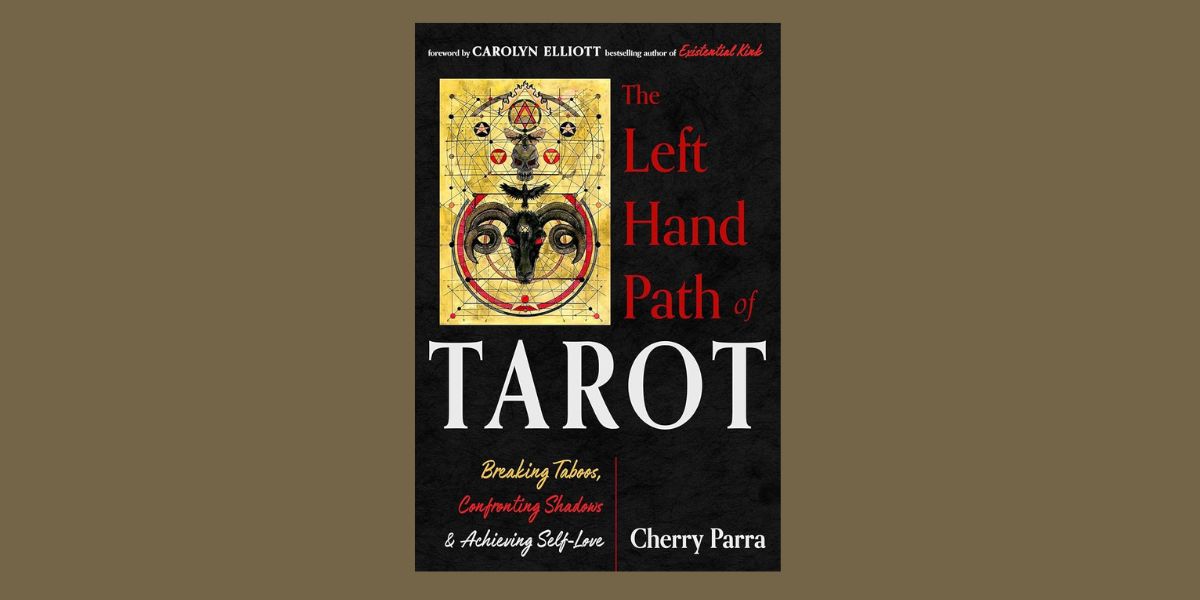
The Left-Hand Path of Tarot: Breaking Taboos, Confronting Shadows, and Achieving Self-Love, by Cherry Parra
Weiser Books, 157863878X, 248 pages, February 2025
The Left-Hand Path of Tarot: Breaking Taboos, Confronting Shadows, and Achieving Self-Love by Cherry Parra teaches that tarot is not meant to simply soothe the ego or wrap us in spiritual platitudes. She asserts that at its deepest level, tarot is a mirror that reflects what we might prefer not to see. When approached with honesty, the cards cut through wishful thinking and invite us into radical self-responsibility. They illuminate patterns we perpetuate, desires we hide, grief we avoid, and truths we sense but hesitate to claim.
This kind of practice asks for courage and the willingness to sit with discomfort rather than reaching for quick reassurance. Parra invites readers to work with the tarot in this way, demonstrating how tarot can be a tool for maturation, shadow integration, and self-catalyst. Having the agency to choose differently or act with clarity comes from the willingness to wade in the chaos, ask the tough questions, and pivot when necessary.
“First and foremost we deal in truth, and it is often uncomfortable and usually brutal. If we want the truth, we must ask true questions. Tarot is not a hiding place. There should be no room for shame, self-deception, or hide-and-seek dynamics.”1
Divided into three parts, Parra leads readers through viewing the tarot from the lens of the Left-Hand Path, interpreting the cards to offer a wider perspective (sometimes even challenging or subverting card meanings), and then how to put into practice the Left-Hand Path of tarot.
“Part 1: Welcome to the Left-Hand Path” provides an introduction to the overall topic of using tarot for confronting uncomfortable truths and reclaiming marginalized aspects of the self. Parra shows how tarot is a guide to outsiders, those who are outcast, marginalized, and nonconforming. When challenging social norms as a healer, visionary, artistic, or activist–all vital roles amid chaotic times–tarot can be used dually as a weapon and as a tool for self-alchemy. The chapters on shadow work and manifestation give insight into how readers can learn to embrace the “not positive” aspects of the cards for growth, revelation, and ultimately more personal agency.
“Part 2: Left-Hand Path Interpretations” is where Parra delves into the meaning of the cards. For each Major Arcana card, she shares about two pages of insight. While the general traditional meaning shines through, Parra definitely infuses the cards with meaning reflecting the philosophy of a Left-Hand Path journey. This is to say, she strips a lot of the BS away and gives a straight-forward message that acknowledges what’s really going on beneath the surface. What I appreciate about her approach is that there’s no doom and gloom, rather, it’s very grounded and “tell it like it is” for optimum clarity.
As for the Minor Arcana, Parra deconstructs the traditional idea of each suit corresponding to only one element. She writes, how “every Minor Arcana card, regardless of which suit it belongs to, carries wisdom from more than one element of nature.”2 This was the first time I’d ever come across this notion in my tarot studies, and the idea felt supremely liberating, a deviation with plenty of potential to explore on my own. In this chapter, Parra provides interpretations for each suit and then uses tables to provide short meanings (upright and reversed) for the Minor Arcana cards.
In the final section, “Part 3: Walking the Left-Hand Path with Tarot”, Parra takes the information shared thus far and casts it out into the wider world. She likens the Left-Hand Path to the “Path of Doubt”3, which “deals with uncertainty, contradictions, mysteries, and even riddles.”4. Here, Parra reminds readers to embrace their own flavor of reading, embracing their “out-of-the-box”5 interpretations when they arise. Infusing anarchy, challenging the trickster, and lingering in the unknown are all aspects of the Left-Hand Path that tarot can help cultivate. She offers ideas for shuffling, dialoging with the cards, and personalizing your decks.
Plus, Parra includes so many spreads! Spreads for money and business, self love, body image, mommy/daddy issues, psychic battles, transmutation and more. It’s like Parra has attuned to the multi-faceted shadow aspects and taboo topics that could use a reading for more insight and crafted meaningful spreads to mine the information with ease. Furthermore, she covers tarot rituals, such as opening/closing the reading and protection, offering readers a well-rounded approach to doing these readings.
All throughout, I really enjoyed how Parra shares her tarot wisdom. It’s very evident she’s gained a ton of experience as a reader, both for herself and others, and does a great job synthesizing what she’s learned into practical advice. From offering tips to both beginners and pros to framing the mindset of querents to better understand their position to how to handle readings honestly when cards reveal things aren’t peachy keen, Parra provides a lot of value for those interested in reading for others. The epilogue, “The Ethics of Tarot”6, also is great food-for-thought.
I also just gained a lot of perspective from Parra’s Left-Hand Path interpretations of the cards. In addition to enjoying her liberation of the Minor Arcana from the elemental suits previously discussed, her depictions of the Major Arcana were a breath of fresh air. It was SO nice to read novel interpretations of the cards, especially from Parra’s first-hand perspective. From linking the Hierophant with personal discipline to saying sometimes the Hermit can point towards needing a good old bed-rot, her lens was modern, relatable, and still deeply meaningful.
“Very few people actually discuss and practice the art of leaning into catastrophe, of riding the lows with as much attention and enthusiasm as they surf the highs, and of finding the potential within imbalance.”7
Overall, The Left-Hand Path of Tarot offers an approach to tarot that emphasizes the nitty gritty truth. Emphasizing the shattering of social taboos and upholding personal empowerment, readers will appreciate the originality of Parra’s interpretation of the cards. Within this framework, tarot becomes a method for choice, conformation, and cultivating personal agency (and responsibility!). Accessible for tarot readers of all levels, this book is best for those ready to question their spiritual conditioning, subvert traditional tarot meanings, and discover methods to bring more active questioning into their practice.

Alanna Kali is an astrologer, numerologist, and pioneer spirit that loves to explore life through the lens of depth psychology. She has a passion for studying the humanities and social trends. Her academic work is centered upon reuniting body, mind, and spirit through eco-psychology. She loves reading, spending time in nature, and travel.