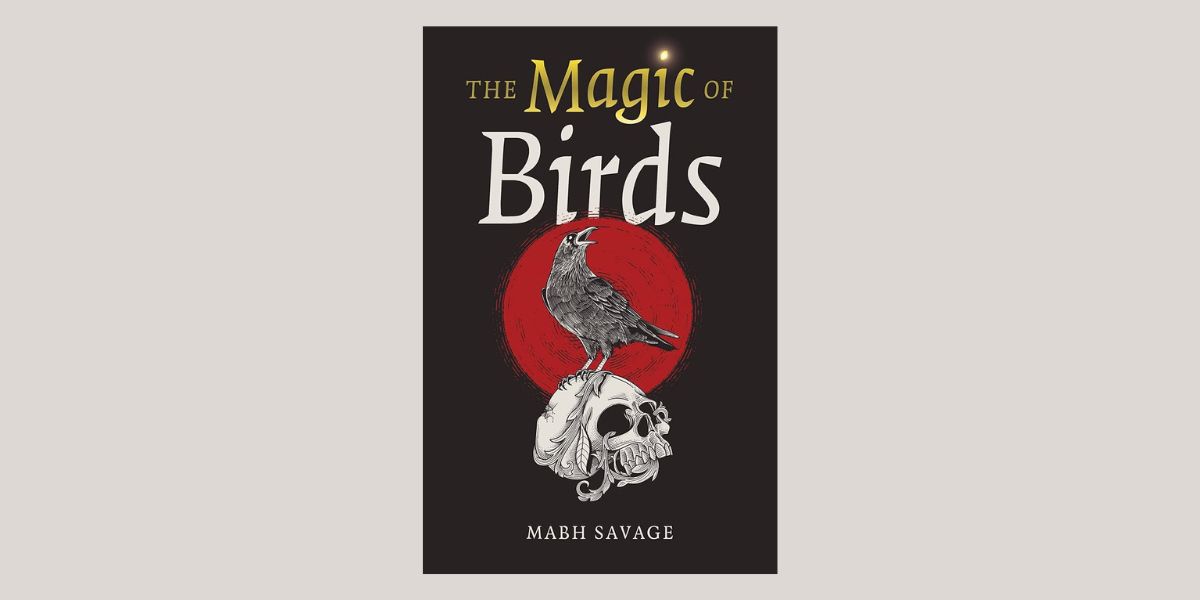
The Magic of Birds, by Mabh Savage
Moon Books, 1803410604, 120 pages, January 2026
Four decades of working with the symbolism and correspondences of the natural world through traditional astrology will do something to you — you start paying attention to things most people walk right past. Birds are one of them. Omens, augury, messages from the gods — these ideas run through nearly every spiritual tradition I’ve encountered. So when I came across The Magic of Birds by Mabh Savage, published by Moon Books, it felt overdue.
Savage is a pagan author and musician with a particular interest in the magic of animals and plants, and a lifelong fascination for Irish legends, Paganism, and spirituality. She’s previously written A Modern Celt and Pagan Portals: Celtic Witchcraft, so she comes to this material with both scholarly grounding and lived practice. My initial thought? This felt like it would be a quick, pleasant read. It turned out to be considerably more than that.
Savage’s writing style is warm, conversational, and personal in a way that doesn’t feel performed. She has a way of weaving together academic folklore references with moments from her own life that makes even the most obscure mythology feel immediate. You can tell she’s not just compiling information from books — she’s actually out there watching blackbirds at twilight and getting scolded by wrens in her garden. The book is organized thematically by type of bird: songbirds, carrion eaters, birds of prey, water birds, and then a chapter on famous mythological birds, followed by a practical chapter on seasonal and everyday magic. Each section builds naturally, and the structure makes it easy to either read straight through or use as a reference when a particular bird crosses your path.
What sets this book apart is the range of cultural traditions she draws from. Celtic and Irish mythology are clearly her home territory, and the depth there is impressive — the sections on Rhiannon’s mystical birds, the Mabinogi, and the Irish goddess Badb as the battle crow are rich with detail. But she doesn’t stop there. Norse mythology, Greek tales, First Nations traditions from North America, Australian Aboriginal dreamtime stories, and even Zulu folklore all make appearances.
What I appreciated was her explicit caution about Indigenous practices, which she places right in the Eagles section when discussing First Nations traditions: “Please don’t reproduce these unless you have genuine associations with a tribe or permission from those peoples”1. That showed real integrity, something you don’t always see in books that touch on cross-cultural spiritual material.
The personal anecdotes are what really elevate this book above a standard reference. Savage tells a story about a raven at an animal rescue centre that tricked her into stepping close, then deftly tipped her cup of duck food onto the floor and hopped down to enjoy her prize. “She knew, within seconds, that tipping the cup would give her the greatest prize. Remarkable animals”2. These moments bring the correspondences to life in a way that a simple list never could.
Similarly, her account of watching redwings arrive on a winter Solstice morning — “Beautiful redwings, probably just arrived from Scandinavia, resting after a long, cold night in the chilled winter air”3 — captures that feeling of witnessing something genuinely magical in the ordinary world.
For each bird, Savage provides correspondences and associations, folklore snippets, and practical magical applications. The corvid sections are perhaps the strongest — the magpies, ravens, jackdaws, and crows each get thorough treatment. Her retelling of the Lenape tale of the Rainbow Crow, who sacrificed his beautiful plumage to bring fire to the freezing animals, is genuinely moving. And her exploration of jackdaws as communicators who “use their eyes to communicate, and study the eyes of other animals in order to ascertain their intent”4 gave me a whole new appreciation for those noisy little birds.
The four seasonal rituals in the final chapter were an unexpected bonus. They’re well-written and adaptable — Savage explicitly encourages readers to change the birds to ones more familiar to them and to adapt the rituals to their own needs. The guided visualization for working with birds is thoughtfully designed, and she takes care to note that not everyone can visualize — something most magical authors never bother to mention. Her debunking of meditation myths, particularly that your mind must be blank, was refreshing. As someone who uses meditation in my own astrological practice, I found the woodland pathworking exercise genuinely useful and plan to incorporate elements of it into my own work.
Savage’s original poetry is scattered throughout the text, and while not all of it resonated equally with me, the pieces about blackbirds and curlews were evocative. The illustrations by Kay Savage add a lovely visual dimension to the book as well. If I had one minor observation, it’s that some birds get considerably more attention than others — the blackbird and wren sections are wonderfully deep, while some later entries feel more like sketches. But Savage is upfront about this being an introduction only, and she consistently points toward further reading, so that feels like an honest trade-off rather than a shortcoming.
Overall, The Magic of Birds is warm, thorough, and honest about what it is — an introduction, not an encyclopedia. There’s enough folklore depth to satisfy experienced practitioners, and enough plain language to not lose beginners. I’d recommend it to anyone on a pagan or nature-based spiritual path, any witch interested in expanding their practice with animal correspondences, or honestly, anyone who has ever felt that strange pull when a blackbird sings at dusk or a crow watches you from a rooftop.
This book has made me pay closer attention to the birds in my own neighborhood here in Southern California — different species than Savage’s birds, perhaps, but carrying their own magic nonetheless. As she writes in her preface, birds have been “chirping, squawking, tweeting, and flapping their way around my brain until there had to be an outlet”5. After reading this book, they’ve started doing the same in mine.

Ken is a professional Writer and Astrologer who was born in New York, went to school in the Berkshires, found his soul in Seattle, and now lives in Santa Ana, CA with his husband of 11 years and their two dogs, Pooh-Behr and Mr. FancyPants.
Ken’s passion for Astrology began in the mid-1970s and has only grown deeper throughout the decades. With a wealth of knowledge in Traditional techniques and methodologies, he offers insightful and accurate services through 4phases.com.