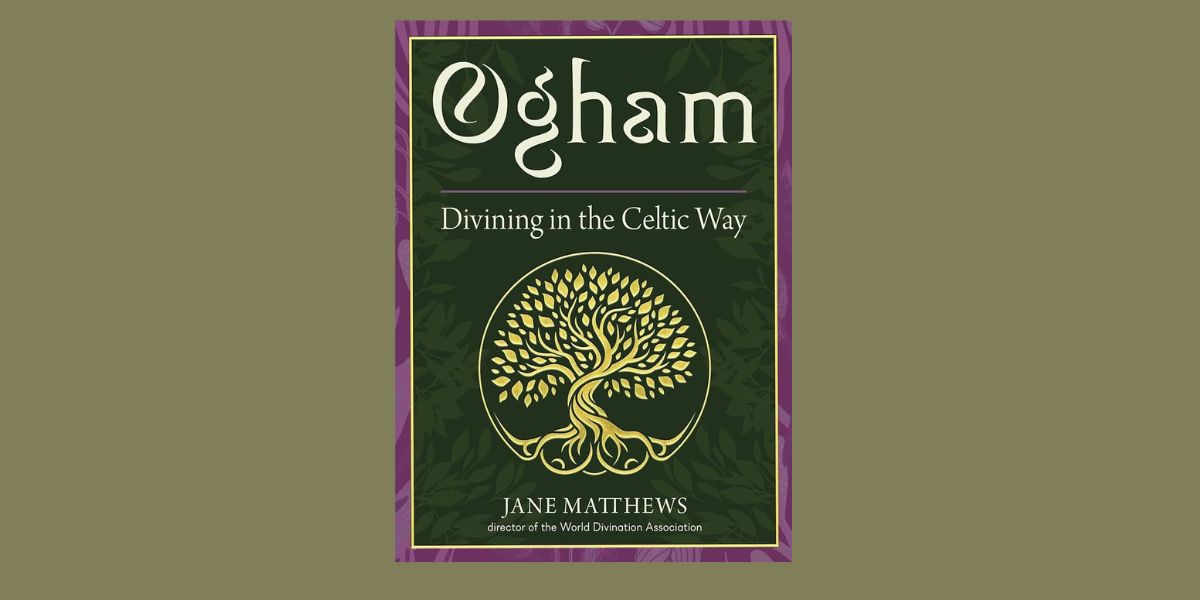
Ogham: Divining in the Celtic Way, by Jane Matthews
Weiser Books, 1578638909, 192 pages, 25 cards, March 2026
Ogham: Divining in the Celtic Way by Jane Matthews is a beautiful way to connect with powerful Celtic knowledge. Based on the earliest Irish written script, Ogham is rooted in the Celtic belief system. While most associate Ogham with corresponding trees–Matthews notes these correspondences were added later for Druids and Bards to remember the meanings of each letter–there’s plenty of wisdom within the letters themselves. She writes of the Ogham:
“The meanings all bring a duality with them. There is light and dark in each, and this makes them truly unique in how they present themselves.”1
This 25-card oracle deck is divided into four “families” called aicme, which are similar to the Futharks in the runes system for reference. Within each aicme is five fedha, or characters of the Ogham alphabet. At the start of each section, Matthews describes what each aicme deals with, illuminating the overall theme of the fedha in that section. The other five cards in the deck are the forfeda, which are the “additional letters”2.
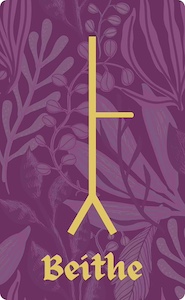
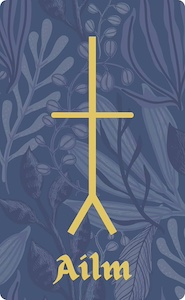
Each one is color-coded, so once a reader is familiar with the deck, they will be quickly able to discern which aicme the card is from. The fedha cards are dark blue, violet, indigo, and dark, while the forfeda cards are a contrasting bright white. All the cards have the same layered botanical pattern in the background, making the focus the golden Ogham glyph in the center and name at the bottom of the card.
Aside from the shift in color and Ogham glyph, there’s not much variation in the visuals of the cards, giving a clean and simple aesthetic. It’s a restrained design overall, but it works well for a system like Ogham where the power of the symbol is meant to stand on its own. It makes me imagine how these symbols would have appeared carved into wood or stone.
There are no corresponding numbers, so when first working with the deck, readers will most likely have to reference the table of contents in the guidebook to find the page of entry.
As for the guidebook entries, for each fedha card listed is the associated tree, keyword, letter, stroke bearing, and pronunciation. Matthews then gives insight about the Ogham’s particular message, providing further specific information within the context of a relationship, work, and health. I really enjoy all of Matthew’s insights, particularly into health, an area of life that I had never considered to engage with the Ogham’s energy. All of the advice she provides is very grounded, acknowledging the energies in play with clarity and directness.
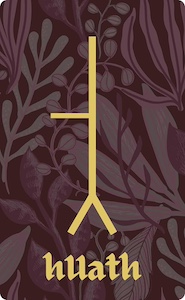
What surprised me the most was how the messages did not at all focus on the aspects of the trees associated with each Ogham. I actually really enjoyed this because all I’ve read about Ogham previously is specifically focused on the spiritual properties of the corresponding tree, rather than the symbols themselves. Getting to know the symbols on their own has been quite illuminating, particularly Matthew’s insight into the brush strokes that highlight the pathways to the Underworld, World, and Otherworld.
“When you’re looking at the fews in this way, it is easy to see how all paths come through our world, and that means that we have the answers to all that has been and all that will be–it is all at our fingertips, in this world for us to seek and understand. This world is a portal to all worlds and all the information that all worlds possess.”3
I also really enjoyed learning about the forfedha, which Matthews describes as “important on an esoteric point as they provide cosmological and directional signs.”4 They provide a map of the cosmos that can be then arranged as a casting mat or placement holder for reading with the deck. Matthews shares quite a bit about working with the forfedha, including using them in spreads (What Am I Spread, Spiral Spread, The Four Directions, and Celtic Cross) and in casting one’s own Ogham set.
Additional sections in the guidebook focus on using Ogham for magical purposes and a meditative framework for understanding Ogham, which provides a journey through The Underworld, This World, and The Otherworld. I definitely would recommend doing these meditations before working with the deck, as it really helps to center oneself within the belief system from which the Ogham emerged.
My only gripe with this deck is the guidebook is very tiny and hard to hold open and read. I kept trying to reference the spreads, but the book would close and then I’d have to flip it open again and try to keep the pages open. And whenever I use some force to do this, the binding then gets a bit messed up, creating a gap in those pages.
Overall though, Matthews has provided a wonderful resource for those who are seeking to connect with the Ogham, especially in a way that goes beyond the nature-based perspective that all too often focuses exclusively on the tree associations. The content in the guidebook offers both spiritual reflection and practical direction, providing a great balance for wisdom seekers. And, quite notably, the additional information about the forfedha is a real bonus for deepening one’s work with the Ogham.

Alanna Kali is an astrologer, numerologist, and pioneer spirit that loves to explore life through the lens of depth psychology. She has a passion for studying the humanities and social trends. Her academic work is centered upon reuniting body, mind, and spirit through eco-psychology. She loves reading, spending time in nature, and travel.