From Accountability to Absolute Peace:
How Justice Opens the Gateway to the High Priestess
Working with the Tarot is far more than an exercise in fortune-telling; it is a profound map for clearing subconscious blockages, unlocking spiritual growth, and aligning your energy to manifest both spiritual fulfillment and material desires.
To achieve this spiritual awakening, we can view the Major Arcana in two distinct phases. First, the cards from The Magician to The Hermit represent the conscious goals we strive to reach. Second, the cards from The Wheel of Fortune to The Moon represent the profound process of shadow work.
In this article, we map out a vital evolutionary step: how actively working with the objective energy of Justice bridges the internal gap, clearing the path to the absolute, intuitive peace of The High Priestess.
To achieve true fulfillment and manifest your desires, you must dive deep into your subconscious mind. Famed psychologist Carl Jung noted that it is precisely through the tension of opposites—polarities—that we connect with the subconscious.
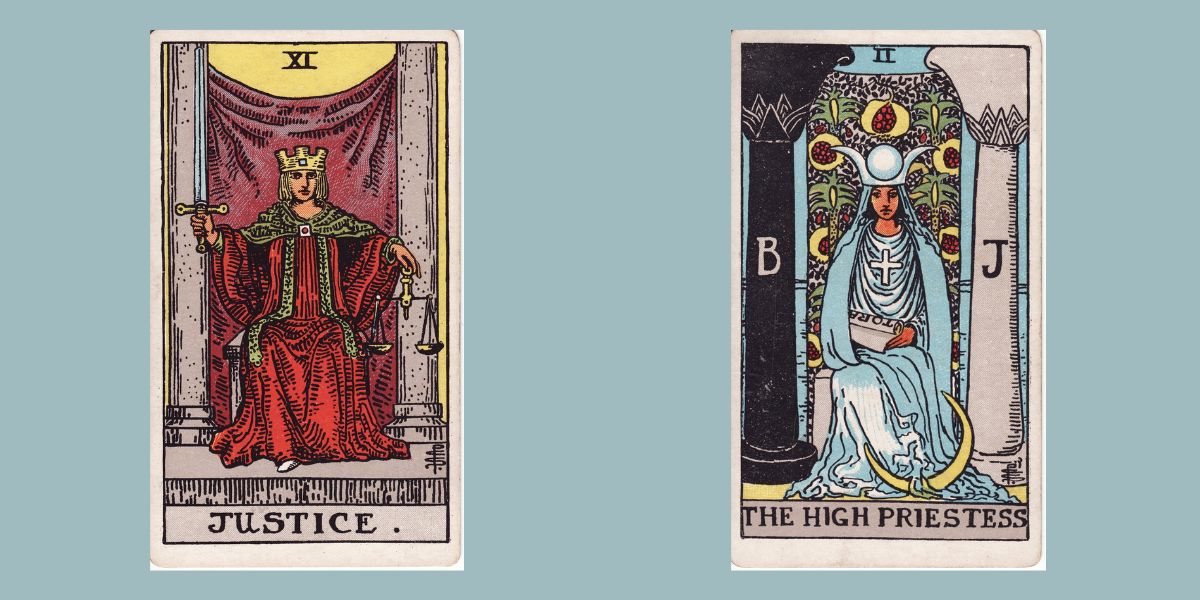
This duality is beautifully illustrated by the two pillars—one black, one white—standing beside The High Priestess. By actively working with these opposing forces, we bridge the gap between our conscious and subconscious minds, granting ourselves permission to step behind her veil and access the deep, flowing waters of divine intuition.
But how do we cross that threshold? We do it by executing the structural work of The Justice Card.
1. Analyze and Weigh Your Attitude
The figure on the Justice card looks directly at you. Her unyielding, piercing gaze signifies raw awareness and radical discernment. We cannot grow while lying to ourselves; healing begins only when we see the absolute truth of our lives and take total ownership of our reality. While you cannot always control external events, you have absolute control over your reactions.
Sit on your own metaphorical stone throne, hold up her scales, and objectively analyze your attitude toward your health, wealth, emotions, and self-esteem by answering three core questions:
• What happened? Look at the triggering event objectively, stripping away all drama, blame, or distortion.
• How did it affect you? Identify the exact thoughts, physical sensations, and emotions it triggered.
• What area of life is it impacting? Pinpoint the root. Are you fighting about a bill because of a subconscious fear of scarcity? Did someone embarrass you, piercing an unhealed wound in your self-esteem?
Answering these questions allows us to identify the exact opposites we need to work on. In any given situation, you might uncover one or more pairs of conflicting polarities. Once identified, we take these pairs and run them through the next step of the process.
2. Bridge the Opposites: The 7 Subconscious Laws
It is time to wield the Sword of Justice. Our ultimate goal is to balance the conscious and unconscious minds. True mastery over our knee-jerk emotional reactions happens when we apply the Seven Key Subconscious Principles. These principles are represented by the imagery on the High Priestess’s veil—the palms and pomegranates—and are implemented by the Sword of Justice.
1. The Law of Similarity – Using a past, successful parallel to solve a current conflict.
2. The Law of Contrast – Flipping the script when you hit a psychological wall.
3. The Law of Recency – Using your freshest emotional memory as a behavioral guide.
4. The Law of Repetition – Building the muscle memory of psychological balance.
5. The Law of Intensity – Using an emotional wake-up call to cement a permanent rule.
6. The Law of Multiplicity – Allowing a single point of friction to spark multiple creative solutions.
7. The Law of Structure – Organizing internal chaos into a usable, external system.
The Laws in Action: Balancing the Scales of Wealth
To see these laws in action, let’s examine a universal human friction point: Saving Money (Security) vs. Spending Money (Living in the Present). If you only save, you live in anxiety and deprivation. If you only spend, you face financial ruin.
Here is how the seven laws navigate that tension to bring you into perfect balance:
1. Similarity: You are torn between buying a plane ticket for a friend’s wedding or keeping that money in your emergency fund. To break the deadlock, you look for a similar tension you successfully resolved in the past. You remember being torn over buying a gym membership; you eventually realized health was an investment, bought it, and never regretted it.
2. Contrast: For six months, you have been on a hyper-strict budget, tracking every single cent. You now feel miserable, exhausted, and resentful. To flip the script, you consciously choose to treat yourself to a beautiful dinner out, recognizing that occasional indulgence is the necessary, healthy contrast required to sustain long-term financial discipline.
3. Recency: You are standing in a store staring at an expensive designer jacket, locked in a mental tug-of-war. Suddenly, you recall yesterday afternoon, when you logged into your bank account and felt a deep, profound sense of peace seeing your savings grow. That fresh memory anchors you, giving you the strength to walk away.
4. Repetition: The first time you say “no” to a luxury item, it feels painful. The first time you say “yes” to a vacation, you feel guilty. Yet, you keep practicing this balance month after month. Over time, repetition rewires your brain, transforming financial anxiety into an effortless, steady rhythm.
5. Intensity: Your car unexpectedly breaks down, leaving you with a $1,500 repair bill. Because you practiced the Justice Protocol and saved money, you pay the bill easily. The relief you feel is incredibly intense, cementing a lifelong rule to always maintain an emergency fund. Conversely, you vividly remember the raw panic of an emergency years ago when you had zero savings—an intense memory that keeps you accountable.
6. Multiplicity: You sit down, frustrated by the constant tug-of-war between wanting to eat out with friends and wanting to build your savings. Instead of treating it as a rigid “yes or no” choice, you let that tension stretch your creativity. You host a potluck, start a cooking club, or find a side hustle that funds your social life, creating multiple wins from a single friction point.
7. Structure: Struggling with daily anxiety over whether you are spending too much or saving enough is chaotic. To fix it, you apply physical structure. You download a budgeting app or create a spreadsheet utilizing a clear framework, like the 50/30/20 rule (50% Needs, 30% Wants, 20% Savings), transforming emotional overwhelm into organized clarity.
Step Behind the Veil
By implementing the Justice Protocol and mastering these seven laws, you successfully clear the mental debris and emotional static of your life. Only when the scales of Justice are balanced can you naturally step into the quiet, sacred domain of The High Priestess.
In her lap sits the scroll marked “TORA”—the divine law and memory containing the record of all human experience, accessible through symbols, myths, and dreams.
Because she is perfectly connected to the subconscious, she acts as your ultimate gateway to the collective unconscious. By doing the heavy lifting of Justice, you earn the right to step past the noise of the external world, pull back the veil, and bathe in the infinite wisdom of the universe.

Cariabella is a healer, spiritual teacher, and author with a special interest in using ancient wisdom to connect with the human soul. Guided by a deep passion for the Tarot, hermetic philosophy, and the hidden threads that connect us all, she crafts insightful articles and courses. Her writing serves as a bridge between the mystical and the everyday, guiding others toward spiritual development and awakening.