✨ A Gathering Place for Magical Readers and Writers ✨

Author Archives: Cariabella

About Cariabella

Cariabella is a healer, spiritual teacher, and author with a special interest in using ancient wisdom to connect with the human soul. Guided by a deep passion for the Tarot, hermetic philosophy, and the hidden threads that connect us all, she crafts insightful articles and courses. Her writing serves as a bridge between the mystical and the everyday, guiding others toward spiritual development and awakening.

From Alchemy to the Altar: How Temperance Paves the Path to the Hierophant, by Cariabella

The journey through the Major Arcana is far more than a sequence of archetypal images–it is a meticulous blueprint of human spiritual evolution. Each card serves as an initiation, building upon the psychological and esoteric foundation laid by the archetypes before it. Among these evolutionary leaps, few transitions are as vital, delicate, and misunderstood as the progression from Temperance to The Hierophant.

While modern spiritual discourse often treats these archetypes in isolation, viewing Temperance merely as balance and The Hierophant as traditional authority, their deep esoteric relationship reveals a profound spiritual mechanic. Temperance acts as the internal laboratory where the practitioner learns to harmonize their personal, physical, and spiritual existence. The Hierophant represents the ultimate manifestation of that harmony: the exact moment when individual practice evolves into a universal channel, granting divine authority, absolute clarity, and uncorrupted transmission.

1. The Practice: Temperance as the Laboratory of Integration

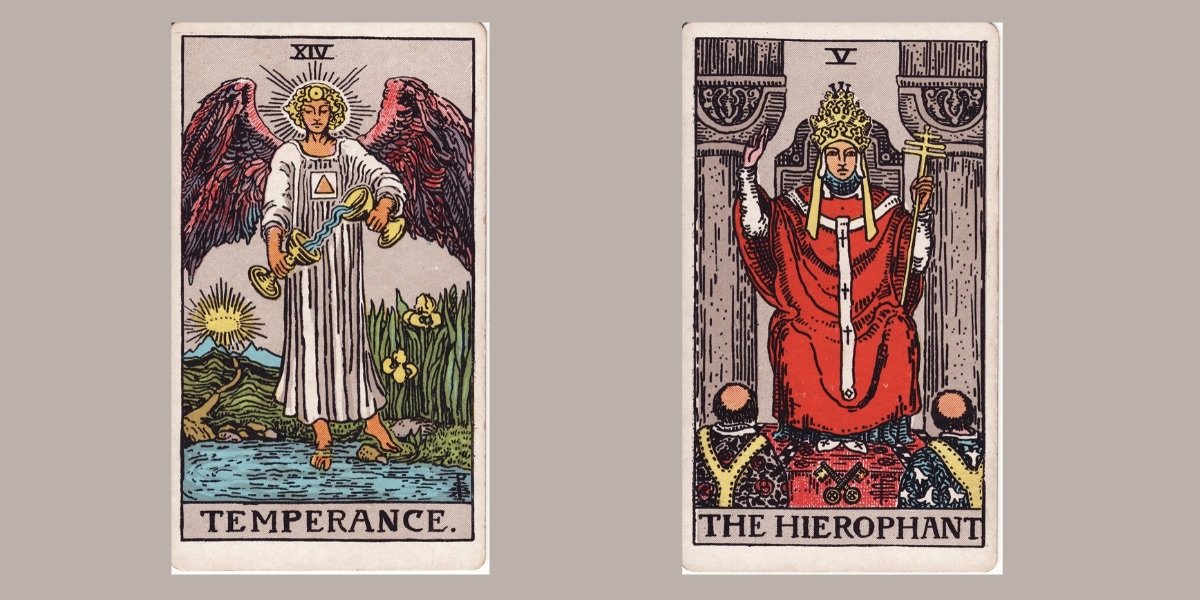
Temperance is the experimental phase of the soul’s journey. Dressed in a pristine white robe adorned with a triangle enclosed within a square (the symbol of the divine spirit operating within the physical container of the four elements), the winged angel stands at the critical edge of existence. With one foot grounded on the solid earth of the material realm and the other submerged in the deep waters of the subconscious and spiritual world, the angel demonstrates the supreme art of living as an active bridge between two realms.

Practical Alchemy and the End of Compartmentalization

The core tragedy of the uninitiated consciousness is fragmentation. Unintegrated individuals survive by partitioning their existence into distinct, uncommunicative boxes, creating one persona for business and another for private life, separating the “sacred” from the “secular,” or divorcing their instinctual desires from their romantic ideals. These separations stem directly from an inability to meet life as a continuous, unified stream.

Temperance demands the absolute destruction of these artificial walls through practical alchemy. It insists that we stop compartmentalizing our reality. On a day-to-day level, Temperance teaches us a fundamental cosmic rule: there are aspects of existence within our control AND aspects outside of it. The grounded foot on land represents taking radical responsibility for our material reality, managing our affairs, organizing our lives, and acting with pragmatic wisdom. The submerged foot in the water represents complete surrender to a higher power, trusting the vast spiritual currents that govern outcomes beyond our human reach.

By learning when to act and when to yield, Temperance unites the fragmented personality. The individual ceases to fight the rhythm of existence, allowing the inner self and outer reality to flow together with natural, effortless grace.

Refining the Psychic Senses

In the hands of the angel are two golden chalices. The figure carefully and continuously pours a luminous liquid back and forth between them. Look closely at the visual geometry: the lower cup is not directly beneath the upper cup, making physical motion impossible under standard terrestrial physics. This subtle impossibility signals that Temperance is operating under divine laws of energy transfer, not mechanical cause and effect.

This precise pouring represents the calibration of the spiritual and psychic senses. Intuition, clairvoyance, direct perception, and energetic sensitivity do not arrive fully formed; they are refined through a lifelong process of trial and error. In the laboratory of Temperance, we learn how our subtle bodies receive signals from the universe. We test small manifestations, practice hearing the quiet voice of spirit, and observe how spiritual energy translates into physical circumstance.

Through this constant practice of energetic titration, the soul cleanses its internal filters. Temperance sharpens the psychic senses so that when spiritual energy passes through us, it is no longer tainted by unexamined emotional wounds, fear, or subconscious noise.

2. The Culmination: The Hierophant as Universal Conduit

When the practitioner steps out of the alchemical laboratory of Temperance, they take their seat upon the stone throne of The Hierophant. Here, personal consciousness links irrevocably with universal consciousness. This is the realm of religious founders, channels, creators of enduring healing modalities, and true spiritual teachers.

However, this elevation is neither a miraculous fluke nor an arbitrary gift bestowed upon a chosen few. It is the direct mathematical result of the discipline, quieting of the mind, and energetic refinement cultivated during Temperance.

Absolute Precision and Zero Distortion

The fundamental difference between the intuitive perception of earlier archetypes (such as The High Priestess) and the mastery of The Hierophant is the degree of precision required. In intuitive readings or early psychic development, some margin for error exists; subjective interpretation can color the message without destroying its general utility.

At the level of The Hierophant, inaccuracy is unacceptable. When channeling a healing system, codifying spiritual law, or bringing through divine transmission intended to guide thousands, even the slightest distortion introduced by personal ego, fear, or unhealed desire corrupts the entire structure.

Because the practitioner in Temperance spent years purifying their personal vessel, The Hierophant can receive high-vibrational information from the highest divine realms rather than filtering lower astral noise.

The Alignment of Desire and Knowledge

At the feet of The Hierophant kneel two initiates, traditionally representing human desire and human knowledge. In the unrefined state, desire and knowledge are constantly at war: desire pushes us toward instinctual indulgence, while knowledge remains cold, analytical, and detached.

In The Hierophant, these two figures are disciplined and aligned. This alignment is the direct reward of Temperance. Because the alchemist learned to blend the physical and spiritual, desire is no longer a chaotic force, and knowledge is no longer an intellectual trap. Both are brought into subjection to universal law, symbolized by the black-and-white checkered floor upon which they kneel—the ordered rhythm of dualistic existence governed by supreme spiritual intelligence.

The Eternal Rhythm

The path from Temperance to The Hierophant reveals an essential spiritual truth: authority is earned through integration, not granted by title.

We cannot skip the trial of the chalices. We cannot bypass the patient, daily work of balancing our physical responsibilities with our spiritual surrender. It is within the quiet, often unglamorous laboratory of Temperance, where we learn to manage our daily lives with joy, refine our psychic instincts, and treat our human flaws with patient alchemy, that our container is strengthened.

Only when the vessel is tested and proven leak-proof under the pressure of daily life can it hold the intense, brilliant light of The Hierophant. By mastering the delicate, back-and-forth stream between the two golden chalices of Temperance, we earn the crossed golden keys required to unlock the mysteries of the universe, stepping forward not merely as seekers, but as true bridges between Heaven and Earth.

From Dissolution to Dominion: How the Mechanism of Death Builds the Emperor Within, by Cariabella

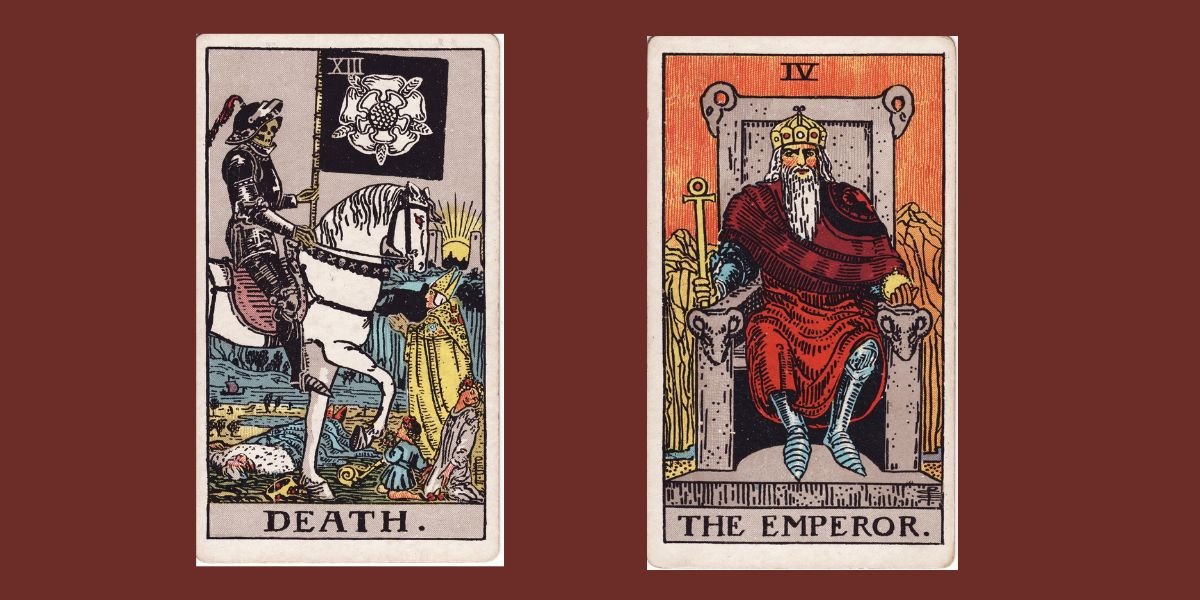
At first glance, the Death and The Emperor cards appear to stand in total opposition. One represents destruction, decay, and the terrifying unknown; the other embodies order, stability, and supreme authority. Yet, a deeper look into their psychological mechanics reveals a profound truth: the mechanism of Death is the engine that transforms human consciousness into the divine sovereignty of The Emperor.

1. The Alchemy of Change: Death as the Tool of Rebuilding

The core theme of the Death card is radical transformation. Tarot study invites us to willingly undergo this shift because change is the ultimate mechanism of growth.

What exactly must change? Everything that no longer serves you.

• Internal Dynamics: Habits, limiting beliefs, negative thought patterns, and outdated mindsets.

• External Environments: Unfulfilling careers, toxic relationships, and overbearing family dynamics.

• Sensory Inputs: Not just the food you put in your body, but the purity of the air you breathe, the ideas you consume, and the chatter you listen to.

If we keep repeating the same behaviors, we will inevitably harvest the same results. “Death” signifies the deliberate dismantling of the old self. Most people fear change and passively wait for their external environment to fix itself. True mastery belongs to those willing to navigate the emotional rollercoaster of inner expansion. When a situation no longer serves your evolution, you must move—mentally, emotionally, and physically.

Notably, the card’s most intimidating figure—the skeleton—serves as a stark reminder that all physical forms eventually decay. It reveals that beneath skin, wealth, and social status, every human shares the same underlying foundation. Beyond a symbol of mortality, the skeleton represents the core reality of any situation. Crucially, this skeleton wears armor, symbolizing the courage to remain vulnerable while enforcing firm boundaries.

Another important aspect of the Death card is The Four Figures, which represent the spectrum of human responses to radical change:

• The King (Rigid Ego): Lies fallen beneath the horse. When overwhelmed by change, an inflexible ego collapses into psychological breakdown.

• The Priest (Structured Belief): Faces Death directly. His robes and doctrine reflect how established frameworks of faith help us confront the terrifying unknown.

• The Maiden (Partial Resistance): Kneels while turning her head away. Her ego is softer than the king’s, yet she still hesitates to fully surrender.

• The Child (Pure Acceptance): Faces Death openly, offering flowers. Free from a rigid identity or fear, the child accepts change fluidly and naturally.

How you respond to life’s crucible is your choice—but navigating this process of dissolution is precisely how you forge the foundation of The Emperor.

2. Clearing the Ground for Authority

While Death breaks down outdated structures, The Emperor represents the ordering principles of the conscious mind that shape how we master the world.

Every experience is eventually imprinted upon the subconscious mind, dictating who we become. Through the Emperor’s power, you gain the ability to consciously direct how you perceive and respond to life.

The Emperor is the self-conscious mind using reason to correct misunderstandings derived from surface-level experiences. He acts as:

• The Definer

• The Law-maker

• The Regulator

Because the subconscious faithfully executes whatever blueprints it receives from conscious perception, you literally create your own reality.

The Security System Analogy:

Imagine owning a breathtaking, luxurious home, but having no doors or security system. Anyone can wander in, trespass, and cause damage. The Emperor is your psychic security system. The stronger his authority, the more protected your inner sanctuary remains against negative external influences.

3. The Path from Death to Dominion

The transformative work of the Death card echoes Brené Brown’s insight:

“I am never more courageous than when I’m embracing imperfection, embracing vulnerabilities, and setting boundaries with the people in my life.”

As we undergo this alchemy, we balance our reactions and uphold boundaries aligned with our ethics—rather than reacting out of a desperate need to feel seen or heard. We move deliberately through relational dynamics: knowing when to move against, toward, or away from external forces.

Etymologically and esoterically, The Emperor means “he who sets in order.” He embodies authority, executive power, and the source of law. He takes the raw, dissolved materials left in the wake of Death and builds a structured, harmonious kingdom upon them.

To achieve spiritual and psychological dominion, you must embrace the mechanism of Death:

• Surrender outdated cellular and mental patterns.

• Master the forces of change rather than resisting them.

• Allow your old identity to dissolve.

When you consciously let outdated prejudices and ego-driven ambitions die, your subconscious mind uses that clean slate to rebuild your very physical and mental makeup. As St. Paul noted, “I die daily.” Through the deliberate death of outdated self-conceptions, a higher version of the self is continuously resurrected.

Replenishing the Subconscious: The Psychological Magic of The Hanged Man and The Empress, by Cariabella

Working with the Tarot extends far beyond simple fortune-telling: it offers a profound psychological roadmap. By using its symbolism, we can clear deep-seated subconscious blockages, foster genuine spiritual growth, and align our inner energy to manifest both spiritual fulfillment and real-world abundance.

Within the structure of the Major Arcana, the early cards reflect the conscious goals of our initial awakening, while the later cards walk us through the raw, intense terrain of shadow work. Bridging these two realms is a crucial evolutionary step: learning how the surrender of The Hanged Man clears subconscious interference, making way for the radiant, unlimited creative power of The Empress.

The Gardener of Your Inner Sanctuary

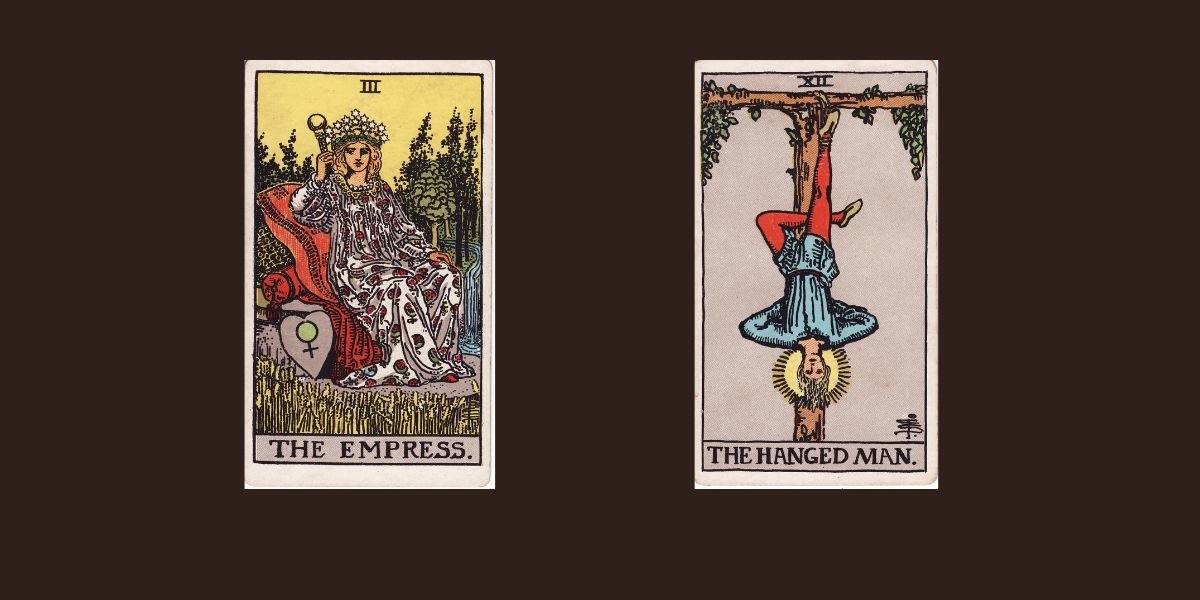
Imagine discovering that the master gardener responsible for cultivating your lush, fertile inner world—The Empress—is actually The Hanged Man.

At first glance, no two archetypes seem more opposed:

• The Hanged Man: Suspended upside down in solitary stillness, bound to a scaffold of living wood.

• The Empress: Seated regally on a plush throne, surrounded by flowing water, golden wheat, and boundless nature.

Far from being contradictory, these two cards form a potent esoteric formula. The Hanged Man represents the deliberate surrender of egoic force, while The Empress is the fertile subconscious mind that blossoms once that forcing stops.

The Mind as a Garden: Weeds and Seeds

In Tarot symbolism, The Empress embodies the subconscious mind in its pristine, unburdened state—the rich matrix from which all ideas take physical form.

The subconscious does not rationalize, critique, or evaluate. Like fertile soil, it blindly accepts whatever seeds are planted—whether rooted in scarcity or abundance—and automatically multiplies them into deeply ingrained habits, visceral beliefs, and outer life conditions.

Cultivating this mental landscape requires balancing two simultaneous actions:

1. Pulling Weeds: Clearing unresolved emotional blockages and toxic mental habits.

2. Planting Seeds: Consciously introducing vivid visual and emotional patterns of what you wish to create.

Why Force Fails

You cannot plant a delicate rose in a patch of untamed weeds and expect it to bloom. Similarly, trying to force a “prosperity mindset” through mechanical affirmations while holding hidden fears about survival will yield zero results. Clearing old blockages and incubating new outcomes must happen together.

Jung vs. Case: Two Approaches to the Inner Soil

During the early 20th century, two influential thinkers addressed the mechanics of the creative mind: Carl Jung, pioneer of analytical psychology, and Paul Foster Case, renowned occultist and Tarot authority.

While both agreed that creative imagination bridges the conscious and unconscious, their approaches highlight a compelling dialogue between psychological exploration and structured spiritual technique.

Carl Jung: Navigating the Primordial Unconscious

Jung viewed creative imagination as the living language of the psyche—a direct pathway into the collective unconscious.

• Active Imagination: Jung advocated for directly entering inner imagery rather than remaining a passive observer. By stepping into a relaxed, reflective state, one can engage in conscious dialogue with subconscious archetypes and figures.

• The Play Instinct: Jung asserted that genuine creation springs not from intellectual effort, but from the uninhibited play instinct driven by inner necessity.

• The Visionary Mode: Beyond personal experience, Jung identified a visionary mode of creativity that reaches deep archetypal layers, allowing the individual to channel universal human motifs.

• The Path to Wholeness: Ultimately, this process serves individuation—integrating repressed or hidden aspects of the self (the Shadow) into conscious awareness to achieve psychological synthesis.

Paul Foster Case: The Deductive Logic of Manifestation

Case approached creative imagination as a precise method for systematically reprogramming the subconscious mind.

• The Empress as Subconscious Matrix: In Case’s system, Key 3 (The Empress) symbolizes the subconscious capacity to generate new configurations from stored memories and impressions.

• The Process of Conception: Case mapped this through Tarot symbolism: The Magician (conscious focus) projects an intention into The High Priestess (subconscious memory pool), yielding The Empress (creative gestation), which brings the idea into form.

• Deductive Reasoning: Because the subconscious operates deductively, it draws specific, real-world manifestations from broader, underlying principles.

• Mental Architecture: By consistently holding clear, positive images in the conscious mind, one systematically restructures subconscious programming.

The Mechanics of The Hanged Man

True transformation is rarely a straightforward march forward; it often demands a radical, intentional pause. This is where The Hanged Man enters the work.

Suspended from a tree, looking out from an inverted perspective, The Hanged Man offers an antidote to the human habit of doing the same thing over and over while expecting a different result.

When stress or conflict hits, our default reaction is to double down—we replay arguments, nurse grievances, and try to muscle external circumstances into changing. This mental looping pollutes the mind, poisoning the fertile soil of The Empress. The emotionally sensitive subconscious latches onto that anger or panic, storing and multiplying it across our life experiences.

Putting the Method into Practice

1. How to Clear the Soil (Surrender)

When negative emotional loops surface, assume the posture of The Hanged Man. Refuse to engage with the drama. Consciously declare: “I am not playing this game.”

Hand the situation over to your higher self or universal intelligence, trusting that stepping back creates the space for resolution. With practice, this deliberate detachment starves the subconscious weeds of their energy.

2. How to Plant New Seeds (Incubation)

Once the noise has quieted, evoke the emotional state of what you wish to create. If you seek financial vitality, cultivate genuine gratitude and delight over even small amounts of money coming into your life. Celebrate that feeling and hold it. You are giving your subconscious explicit, emotion-backed instructions on what to multiply.

The Alchemy of Transformation

You cannot fertilize the subconscious mind while your ego is panicking, micromanaging, and running in circles. Trying to overhaul your life through raw willpower alone puts the cart before the horse, leading only to internal friction and burnout.

The Hanged Man provides the breakthrough. By stepping back, inverting your perspective, and surrendering false control, you stop polluting your inner soil. Only then can you step into the sunlit garden of The Empress—resting securely on her throne, planting clear intentions, and allowing her natural, effortless fertility to manifest a transformed reality.

From Accountability to Absolute Peace, by Cariabella

From Accountability to Absolute Peace:
How Justice Opens the Gateway to the High Priestess

Working with the Tarot is far more than an exercise in fortune-telling; it is a profound map for clearing subconscious blockages, unlocking spiritual growth, and aligning your energy to manifest both spiritual fulfillment and material desires.

To achieve this spiritual awakening, we can view the Major Arcana in two distinct phases. First, the cards from The Magician to The Hermit represent the conscious goals we strive to reach. Second, the cards from The Wheel of Fortune to The Moon represent the profound process of shadow work. 

In this article, we map out a vital evolutionary step: how actively working with the objective energy of Justice bridges the internal gap, clearing the path to the absolute, intuitive peace of The High Priestess.

To achieve true fulfillment and manifest your desires, you must dive deep into your subconscious mind. Famed psychologist Carl Jung noted that it is precisely through the tension of opposites—polarities—that we connect with the subconscious.

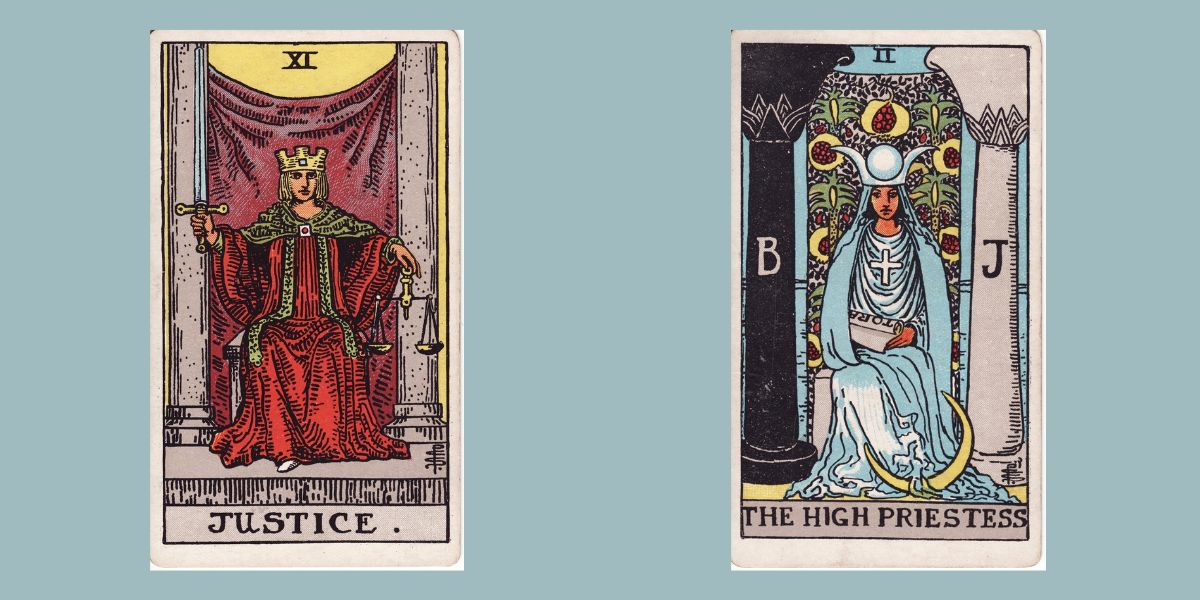
This duality is beautifully illustrated by the two pillars—one black, one white—standing beside The High Priestess. By actively working with these opposing forces, we bridge the gap between our conscious and subconscious minds, granting ourselves permission to step behind her veil and access the deep, flowing waters of divine intuition.

But how do we cross that threshold? We do it by executing the structural work of The Justice Card.

1. Analyze and Weigh Your Attitude

The figure on the Justice card looks directly at you. Her unyielding, piercing gaze signifies raw awareness and radical discernment. We cannot grow while lying to ourselves; healing begins only when we see the absolute truth of our lives and take total ownership of our reality. While you cannot always control external events, you have absolute control over your reactions.

Sit on your own metaphorical stone throne, hold up her scales, and objectively analyze your attitude toward your health, wealth, emotions, and self-esteem by answering three core questions:

• What happened? Look at the triggering event objectively, stripping away all drama, blame, or distortion.

• How did it affect you? Identify the exact thoughts, physical sensations, and emotions it triggered.

• What area of life is it impacting? Pinpoint the root. Are you fighting about a bill because of a subconscious fear of scarcity? Did someone embarrass you, piercing an unhealed wound in your self-esteem?

Answering these questions allows us to identify the exact opposites we need to work on. In any given situation, you might uncover one or more pairs of conflicting polarities. Once identified, we take these pairs and run them through the next step of the process.

2. Bridge the Opposites: The 7 Subconscious Laws

It is time to wield the Sword of Justice. Our ultimate goal is to balance the conscious and unconscious minds. True mastery over our knee-jerk emotional reactions happens when we apply the Seven Key Subconscious Principles. These principles are represented by the imagery on the High Priestess’s veil—the palms and pomegranates—and are implemented by the Sword of Justice.

1. The Law of Similarity – Using a past, successful parallel to solve a current conflict.

2. The Law of Contrast – Flipping the script when you hit a psychological wall.

3. The Law of Recency – Using your freshest emotional memory as a behavioral guide.

4. The Law of Repetition – Building the muscle memory of psychological balance.

5. The Law of Intensity – Using an emotional wake-up call to cement a permanent rule.

6. The Law of Multiplicity – Allowing a single point of friction to spark multiple creative solutions.

7. The Law of Structure – Organizing internal chaos into a usable, external system.

The Laws in Action: Balancing the Scales of Wealth

To see these laws in action, let’s examine a universal human friction point: Saving Money (Security) vs. Spending Money (Living in the Present). If you only save, you live in anxiety and deprivation. If you only spend, you face financial ruin.

Here is how the seven laws navigate that tension to bring you into perfect balance:

1. Similarity: You are torn between buying a plane ticket for a friend’s wedding or keeping that money in your emergency fund. To break the deadlock, you look for a similar tension you successfully resolved in the past. You remember being torn over buying a gym membership; you eventually realized health was an investment, bought it, and never regretted it. 

2. Contrast: For six months, you have been on a hyper-strict budget, tracking every single cent. You now feel miserable, exhausted, and resentful. To flip the script, you consciously choose to treat yourself to a beautiful dinner out, recognizing that occasional indulgence is the necessary, healthy contrast required to sustain long-term financial discipline.

3. Recency: You are standing in a store staring at an expensive designer jacket, locked in a mental tug-of-war. Suddenly, you recall yesterday afternoon, when you logged into your bank account and felt a deep, profound sense of peace seeing your savings grow. That fresh memory anchors you, giving you the strength to walk away.

4. Repetition: The first time you say “no” to a luxury item, it feels painful. The first time you say “yes” to a vacation, you feel guilty. Yet, you keep practicing this balance month after month. Over time, repetition rewires your brain, transforming financial anxiety into an effortless, steady rhythm.

5. Intensity: Your car unexpectedly breaks down, leaving you with a $1,500 repair bill. Because you practiced the Justice Protocol and saved money, you pay the bill easily. The relief you feel is incredibly intense, cementing a lifelong rule to always maintain an emergency fund. Conversely, you vividly remember the raw panic of an emergency years ago when you had zero savings—an intense memory that keeps you accountable.

6. Multiplicity: You sit down, frustrated by the constant tug-of-war between wanting to eat out with friends and wanting to build your savings. Instead of treating it as a rigid “yes or no” choice, you let that tension stretch your creativity. You host a potluck, start a cooking club, or find a side hustle that funds your social life, creating multiple wins from a single friction point.

7. Structure: Struggling with daily anxiety over whether you are spending too much or saving enough is chaotic. To fix it, you apply physical structure. You download a budgeting app or create a spreadsheet utilizing a clear framework, like the 50/30/20 rule (50% Needs, 30% Wants, 20% Savings), transforming emotional overwhelm into organized clarity.

Step Behind the Veil

By implementing the Justice Protocol and mastering these seven laws, you successfully clear the mental debris and emotional static of your life. Only when the scales of Justice are balanced can you naturally step into the quiet, sacred domain of The High Priestess.

In her lap sits the scroll marked “TORA”—the divine law and memory containing the record of all human experience, accessible through symbols, myths, and dreams.

Because she is perfectly connected to the subconscious, she acts as your ultimate gateway to the collective unconscious. By doing the heavy lifting of Justice, you earn the right to step past the noise of the external world, pull back the veil, and bathe in the infinite wisdom of the universe.

Riding the Cosmic Cycle, by Cariabella

Riding the Cosmic Cycle:
How Navigating the Wheel of Fortune Makes You the Magician

Working with the Tarot can clear subconscious blockages and catalyze deep spiritual growth, ultimately leading to personal fulfillment and the manifestation of your material desires.

To achieve this spiritual awakening, we can view the Major Arcana in two distinct phases. First, the cards from The Magician to The Hermit represent the conscious goals we strive to reach. Second, the cards from The Wheel of Fortune to The Moon represent the profound process of shadow work. 

In this article, we will explore how navigating the lessons of The Wheel ultimately leads us back to the mastery of The Magician—which is precisely where our journey begins.

We’ve all been there. You wake up on top of the world, ready to conquer the day. Then, an unpleasant interaction occurs—someone speaks to you rudely, or a sudden crisis disrupts your reality—and your mood plummets. You spend the rest of the day ruminating, replaying the scenario until you are mentally and emotionally exhausted. Just like that, a single external moment has hijacked your consciousness and drained your vital energy.

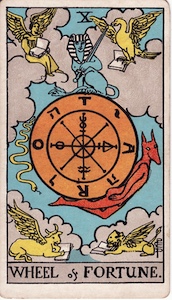
When this happens, you are being tossed around on the chaotic outer rim of The Wheel of Fortune.

Many people spend their entire lives reacting to the spin of this wheel, completely unaware that this chaotic rotation is actually the first step in necessary shadow work and inner transformation. The ultimate goal of the self-awakening paradigm is to move from the helpless spinning of the Wheel to the absolute mastery of The Magician.

But how do we bridge that gap? The secret lies in a precise, three-step psychological and spiritual process of assessing and balancing the four core elements of our psyche.

Step 1: Accept the Reality of the Spin

The first step is a shift in perspective. The Wheel of Fortune represents the eternal truth that change is the only constant. It illustrates a simultaneous descent and ascent: as the wheel rotates, what is on top moves downward, and what is below moves upward.

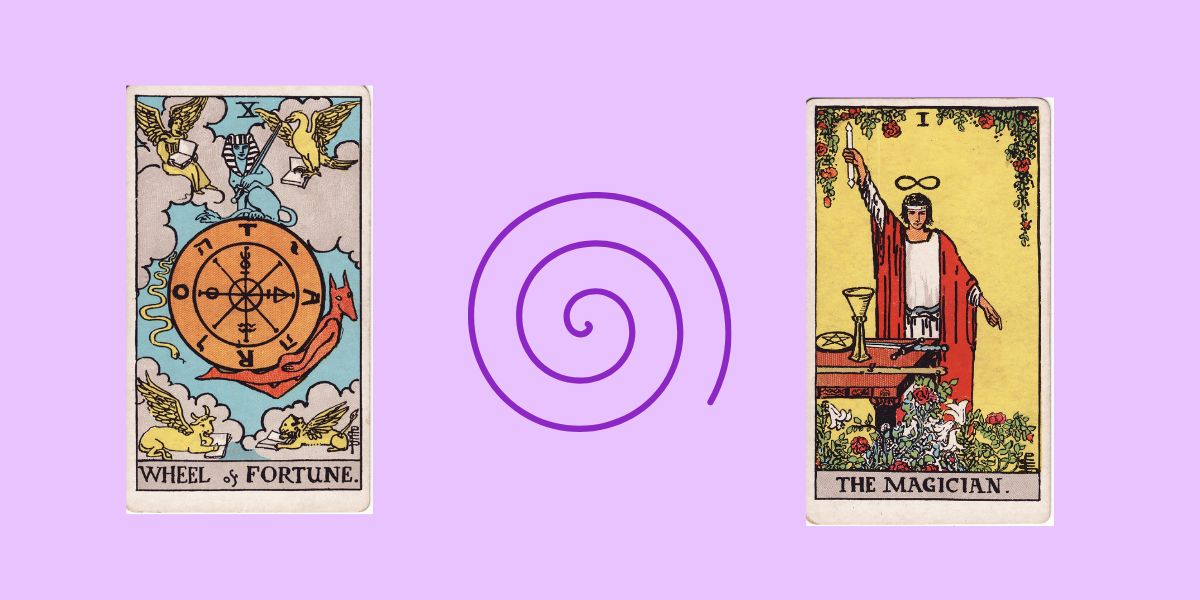
This continuous flow is governed by a hidden spiritual law woven into nature, famously spelled out by the letters on the wheel itself: ROTA TARO ORAT TORA ATOR (“The Wheel of Tarot speaks the Law of Hathor”).

Look closely at the card’s symbology:

  • On the right, a yellow serpent descends, expressing divine will in action. It reminds us that everything happening to you is happening for a reason—to make you grow spiritually.
  • On the left, Hermanubis ascends, symbolizing the evolution of human consciousness from lower to higher states.

Every time you stop fighting the external rotation and instead choose to overcome the event, your consciousness expands and you become stronger from within.

Step 2: The Four-Element Trigger Audit

When something happens that triggers you, the instinctual response is to react blindly. The spiritual path demands that you pause, recognize the trigger, and analyze how it is affecting the four classical elements within your psyche.

On the Wheel of Fortune card, these are represented by the Hebrew letters of the Tetragrammaton (Yod, Heh, Vav, Heh) on the outer circle, as well as the four mystical creatures in the corners. Carl Jung beautifully mapped these four elements onto the foundational cognitive functions of the human mind.

When a crisis hits, perform a sudden audit of these four areas:

  • • Earth (Sensation / Final Heh): How is your connection to the physical world? Are your five senses overwhelmed? Is your body physically tense or grounded?
  • • Water (Feeling / Heh): What does your emotional landscape look like? How is this event threatening your internal values or interpersonal relationships?
  • • Air (Thinking / Vav): Is your logic and intellect spinning out of control? Are you trapped in an obsessive, rationalizing mind-loop, or can you look at the problem with objective analysis?
  • • Fire (Intuition / Yod): Have you lost your connection to your higher vision and inspiration? What do your gut feelings and spontaneous understandings tell you about the future possibilities of this situation?

By stepping back to observe and categorize your reaction, you take the first step toward self-consciousness—the objective, directing part of the mind.

Step 3: Step Into the Center and Run the Alchemy

At the center of the wheel rests the symbols for Mercury, Sulphur, Water, and Salt—the universal mechanics of alchemical transformation. Water, in particular, represents dissolution: the necessary breaking down of our rigid ego structures.

To move from the spinning rim to the still center of the wheel, you must consciously undergo the four primary psychological phases of Carl Jung’s alchemical Magnum Opus (Great Work):

  1. Nigredo (The Blackening): You confront your Shadow. Instead of distracting yourself from the trigger, you face the painful breakdown, the darkness, and the repressed trauma head-on.
  2. Albedo (The Whitening): The stage of purification and catharsis. You bring objective detachment and balance, sorting through your inner polarities.
  3. Citrinitas (The Yellowing): The dawn of higher consciousness. You become illuminated by wisdom, insight, and true spiritual awakening.
  4. Rubedo (The Reddening): The final synthesis where conscious and unconscious aspects permanently unite, culminating in the realization of the True Self.

The Result: Becoming The Magician

When you balance the four elements by undergoing this rigorous alchemical process, you achieve the metaphorical “Fifth Element”—the unified, awakened Self. This state of integration is represented on the Wheel of Fortune card by the Sphinx seated majestically and immutably at the very apex of the wheel.

By mastering the elements, you step off the wheel of reaction and step into the card of The Magician.

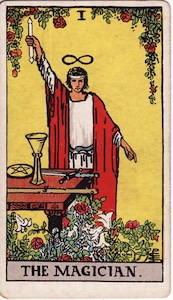
The Magician doesn’t get tossed around by external circumstances because he possesses absolute mastery over his mind. You unlock the iconic posture of the Magician: one hand raised aloft holding a wand toward the heavens, the other pointing down to the earth.

You embody the ancient Hermetic axiom: “As above, so below.” You realize you are a divine conduit—a messenger through whom higher spiritual energy flows down into material reality. You possess the active agency to direct cosmic energy to manifest your desires.

The Endless Cycle of Renewal

This spiritual alignment is never a static, “one-and-done” achievement. It is a lifelong, ongoing practice. This continuous evolution is vividly illustrated by the Ouroboros—the serpent biting its own tail clasped around the Magician’s waist.

It reminds us that creation, destruction, and renewal are eternal. To stay in your power, you must continually shed your old skins, letting the ego dissolve so your highest Self can be perpetually reborn.

Stop fighting the spin of the wheel. Embrace the rotation, audit your triggers, run your inner alchemy, and step into your true power as the conscious creator of your reality.