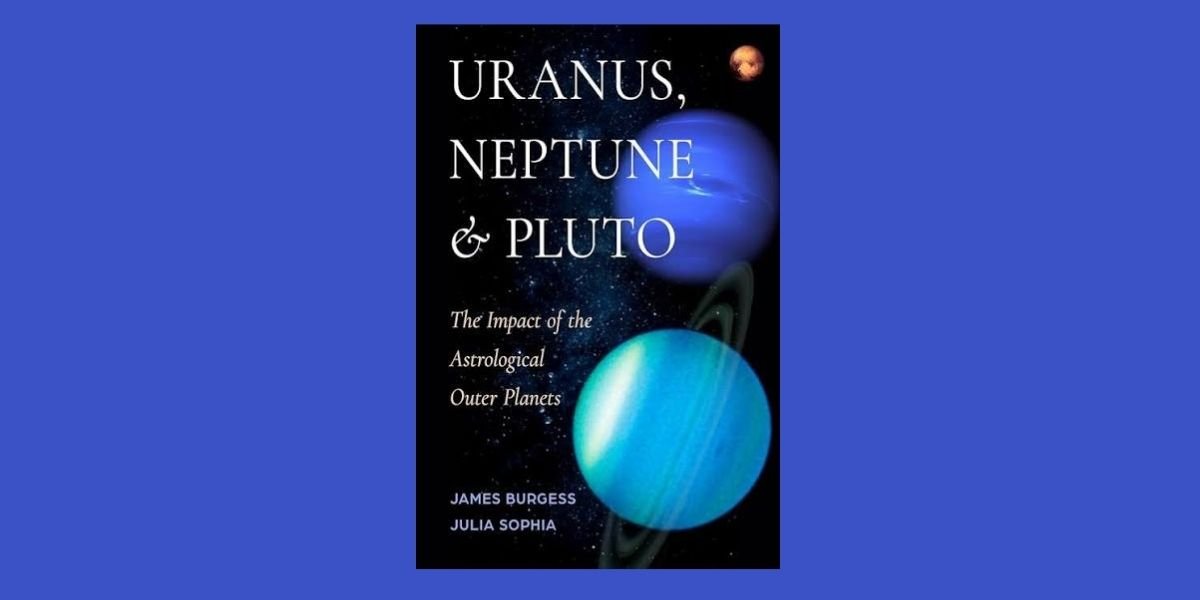
Uranus, Neptune, and Pluto: The Impact of the Astrological Outer Planets, by James Burgess and Julia Sophia
Weiser Books, 1578639182, 208 pages, July 2026
Uranus, Neptune, and Pluto by James Burgess and Julia Sophia is a thought-provoking exploration of these three outer planets, presenting them not simply as forces of disruption or transformation but as interconnected expressions of a unified spiritual consciousness. Going beyond familiar cookbook interpretations, the authors invite readers into a richer philosophical framework that “adds profound new layers to the ever-evolving field of the collective consciousness and reveals that even the universe itself is a work in progress.”1
I will admit that this book hooked me from the start. First of all, these transpersonal planets do not get enough attention. Many astrologers love to throw the baby with the bathwater out and focus exclusively on the traditional planets, while modern ones often resort to psychologizing the planets, thus focusing on personal attributes to describe their energy, which overlooks their transpersonal nature. By looking at these planets through the lens of wisdom teachings, these authors bring a better way to incorporate these planets into our astrological gnosis.
Following an introduction that lays the foundation of the book, “Part 1: The Planets” dedicates a chapter for each one. These were quite insightful, detailing the symbolism, discovery and historical events surrounding the planet’s detection, highlighting how the planet’s energy is a reflection of the times. From there, the authors weave together a meaningful explanation of how the planet relates to the word they equate with it (Uranus – freedom, Neptune – creativity, and Pluto – evolution).
“Part II: The Transits” then covers the conjunction, square, and opposition of Uranus, Neptune, and Pluto to the traditional seven planets, Chiron, and the angles (MC, IC, ASC, and DSC). In regard to these slow-moving transits, the authors write:
“Transits by the outers are “gifts from the gods”: they are portals in time that invite us into a vacuum of everything that was, is, and will ever be. We are granted access to an alternative space that offers new scripts and accelerated possibilities for shaping a different reality.”2
I enjoyed reading through the descriptions of the transits that I’ve experienced, such as Pluto transiting my natal Mars, Uranus, Neptune, Saturn, and Venus during its time in Capricorn from the start of 2008 to the end of 2024. I think consulting this book before meeting with an astrology client is a great way to expand your perception and generate inspiration for the reading; likewise, those who use astrology more personally would benefit from a wider understanding of the energy of these meaningful transits.
One thing I really enjoyed about this section is how the authors focus on the astrologer’s responsibility to not fall into doom and gloom when it comes to interpreting a planet in the chart. I have seen this happening SO MUCH recently, especially in astrocartography where some readers make claims such as “I would never send someone to a Pluto line” or “Going to a Mars line is bound to cause accidents.” The outlook provided by the authors is grounded yet filled with light, focusing on the meaningful experience that is possible rather than malefic superstitions.
“Part III: The Holy Trinity” presents the triad of Freedom (Uranus), Creativity (Neptune), and Evolution (Pluto) working together in the soul’s unfolding based on the unique energy of The Trinity Point, which can be calculated by finding the midpoint of the three outer planets in the chart, and its opposite degree, The Unity Point. This fascinating contribution to astrology intended to deepen spiritual self-understanding and provide another lens through which to interpret the natal chart.
The authors share how to get the calculations for this special 3-planet midpoint. I BELIEVE I did it correctly, but it was a little confusing with the degrees since there’s 60 minutes in a degree rather than the usual 100 base used to find an average. My Trinity Point came out to be 19’44 Sagitarrius. Though, the authors note the Trinity Point could also be one of the two trines to the average degree, noting “the other two can be seen as wings that offer support and wider context to the chosen Trinity Point itself.”3
The way you determine which point feels more resonant is by reading the Sabian Symbols for each degree. And it is through this Sabian Symbol that we come to know both our Trinity Point and Unity Point. I found it absolutely fascinating to meditate on how the Sabian Symbols reveal more about my spiritual path in life.
The Trinity Point symbol is “In an old-fashioned northern village men cut the ice of a frozen pond for use during the summer.”, while the Unity Point is “A modern cafeteria displays an abundance of food, products of various regions.” The Unity Point actually cracked me up because my whole life I’ve LOVED buffets and being in a cafeteria. Working with the Sabian Symbols ended up taking me on a whole side quest of looking at all the planets and angels in my chart, which made for a really interesting afternoon reflection. And since then, I’ve been calculating the Trinity and Unity Points for my family and friends telling them about this!
Overall, Uranus, Neptune, and Pluto is great for those seeking a deeper symbolic, esoteric, and philosophical dimensions of chart interpretation. Those interested in evolutionary astrology, archetypal astrology, or integrating spiritual practice into their astrological work will find much to contemplate. Meanwhile, practitioners looking for fresh perspectives on the outer planets, rather than repeating familiar interpretations, will enjoy how the fresh conceptual framework presented invites reflection and experimentation. This is absolutely a book that will be kept in my “often referred to” section of my astrology library!
Alanna Kali is an astrologer, numerologist, and pioneer spirit that loves to explore life through the lens of depth psychology. She has a passion for studying the humanities and social trends. Her academic work is centered upon reuniting body, mind, and spirit through eco-psychology. She loves reading, spending time in nature, and travel.