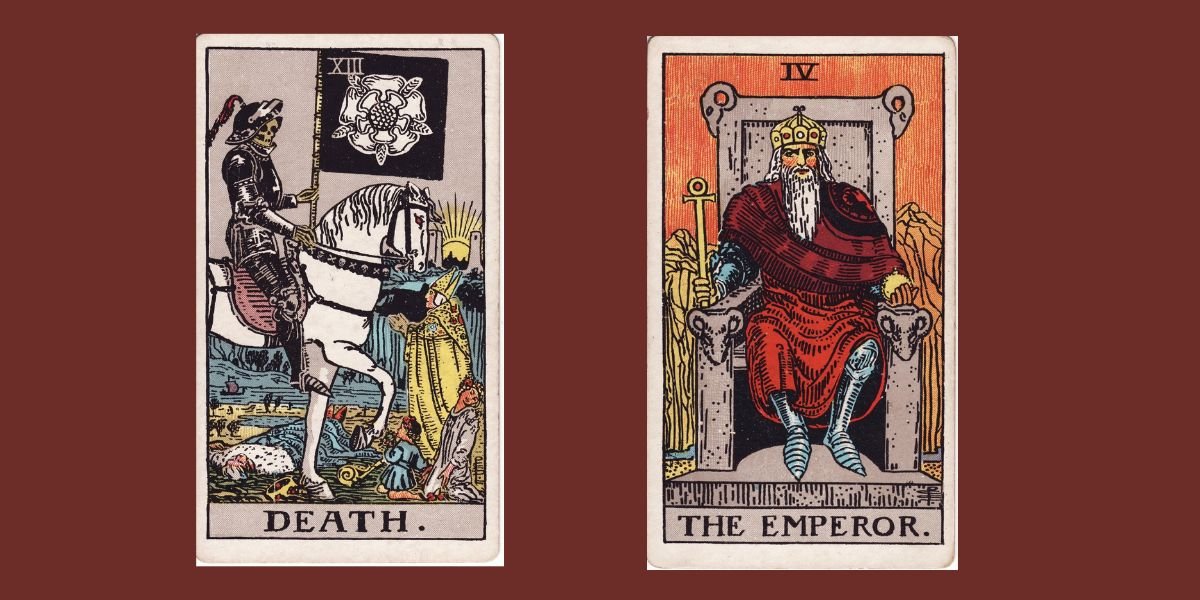
At first glance, the Death and The Emperor cards appear to stand in total opposition. One represents destruction, decay, and the terrifying unknown; the other embodies order, stability, and supreme authority. Yet, a deeper look into their psychological mechanics reveals a profound truth: the mechanism of Death is the engine that transforms human consciousness into the divine sovereignty of The Emperor.
1. The Alchemy of Change: Death as the Tool of Rebuilding
The core theme of the Death card is radical transformation. Tarot study invites us to willingly undergo this shift because change is the ultimate mechanism of growth.
What exactly must change? Everything that no longer serves you.
• Internal Dynamics: Habits, limiting beliefs, negative thought patterns, and outdated mindsets.
• External Environments: Unfulfilling careers, toxic relationships, and overbearing family dynamics.
• Sensory Inputs: Not just the food you put in your body, but the purity of the air you breathe, the ideas you consume, and the chatter you listen to.
If we keep repeating the same behaviors, we will inevitably harvest the same results. “Death” signifies the deliberate dismantling of the old self. Most people fear change and passively wait for their external environment to fix itself. True mastery belongs to those willing to navigate the emotional rollercoaster of inner expansion. When a situation no longer serves your evolution, you must move—mentally, emotionally, and physically.
Notably, the card’s most intimidating figure—the skeleton—serves as a stark reminder that all physical forms eventually decay. It reveals that beneath skin, wealth, and social status, every human shares the same underlying foundation. Beyond a symbol of mortality, the skeleton represents the core reality of any situation. Crucially, this skeleton wears armor, symbolizing the courage to remain vulnerable while enforcing firm boundaries.
Another important aspect of the Death card is The Four Figures, which represent the spectrum of human responses to radical change:
• The King (Rigid Ego): Lies fallen beneath the horse. When overwhelmed by change, an inflexible ego collapses into psychological breakdown.
• The Priest (Structured Belief): Faces Death directly. His robes and doctrine reflect how established frameworks of faith help us confront the terrifying unknown.
• The Maiden (Partial Resistance): Kneels while turning her head away. Her ego is softer than the king’s, yet she still hesitates to fully surrender.
• The Child (Pure Acceptance): Faces Death openly, offering flowers. Free from a rigid identity or fear, the child accepts change fluidly and naturally.
How you respond to life’s crucible is your choice—but navigating this process of dissolution is precisely how you forge the foundation of The Emperor.
2. Clearing the Ground for Authority
While Death breaks down outdated structures, The Emperor represents the ordering principles of the conscious mind that shape how we master the world.
Every experience is eventually imprinted upon the subconscious mind, dictating who we become. Through the Emperor’s power, you gain the ability to consciously direct how you perceive and respond to life.
The Emperor is the self-conscious mind using reason to correct misunderstandings derived from surface-level experiences. He acts as:
• The Definer
• The Law-maker
• The Regulator
Because the subconscious faithfully executes whatever blueprints it receives from conscious perception, you literally create your own reality.
The Security System Analogy:
Imagine owning a breathtaking, luxurious home, but having no doors or security system. Anyone can wander in, trespass, and cause damage. The Emperor is your psychic security system. The stronger his authority, the more protected your inner sanctuary remains against negative external influences.
3. The Path from Death to Dominion
The transformative work of the Death card echoes Brené Brown’s insight:
“I am never more courageous than when I’m embracing imperfection, embracing vulnerabilities, and setting boundaries with the people in my life.”
As we undergo this alchemy, we balance our reactions and uphold boundaries aligned with our ethics—rather than reacting out of a desperate need to feel seen or heard. We move deliberately through relational dynamics: knowing when to move against, toward, or away from external forces.
Etymologically and esoterically, The Emperor means “he who sets in order.” He embodies authority, executive power, and the source of law. He takes the raw, dissolved materials left in the wake of Death and builds a structured, harmonious kingdom upon them.
To achieve spiritual and psychological dominion, you must embrace the mechanism of Death:
• Surrender outdated cellular and mental patterns.
• Master the forces of change rather than resisting them.
• Allow your old identity to dissolve.
When you consciously let outdated prejudices and ego-driven ambitions die, your subconscious mind uses that clean slate to rebuild your very physical and mental makeup. As St. Paul noted, “I die daily.” Through the deliberate death of outdated self-conceptions, a higher version of the self is continuously resurrected.

Cariabella is a healer, spiritual teacher, and author with a special interest in using ancient wisdom to connect with the human soul. Guided by a deep passion for the Tarot, hermetic philosophy, and the hidden threads that connect us all, she crafts insightful articles and courses. Her writing serves as a bridge between the mystical and the everyday, guiding others toward spiritual development and awakening.