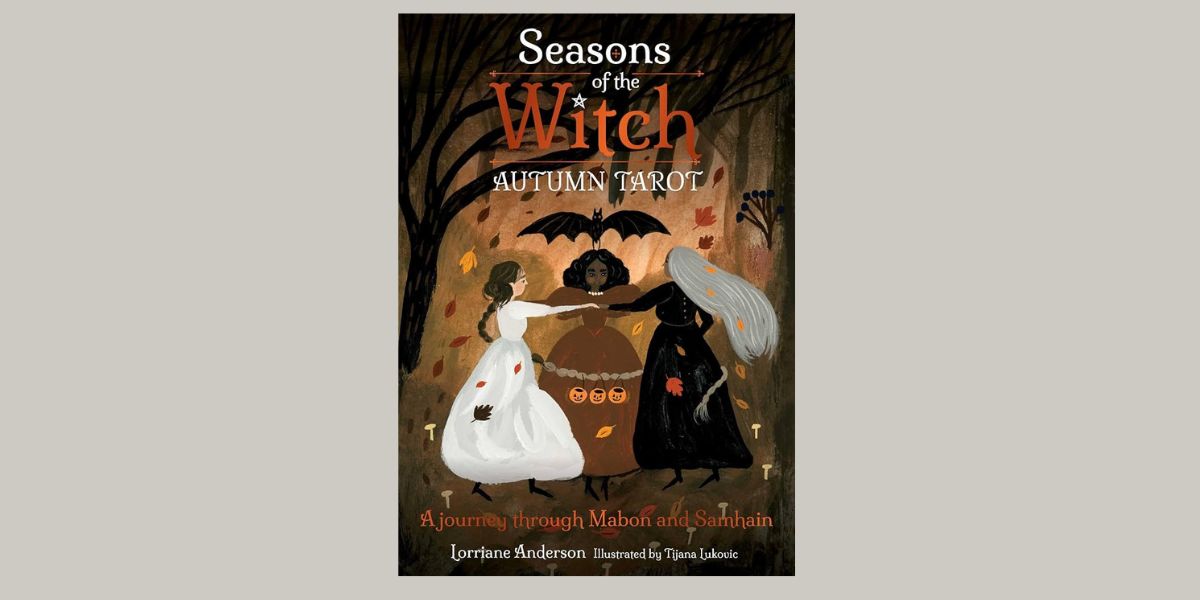
Seasons of the Witch Autumn Tarot: A journey through Mabon and Samhain, by Lorraine Anderson with illustrations by Tijana Lukovic
Rockpool Publishing, 1923208748, 128 pages, 78 cards, August 2026
There is something inherently magical about the transition into autumn: the world seems to slow down, the days grow shorter, and nature begins its beautiful process of letting go. It’s my favorite time of the year! Seasons of the Witch Autumn Tarot: A Journey Through Mabon and Sanhaim by Lorriane Anderson with illustrations by Tijana Lukovic captures the season’s liminal quality beautifully, inviting readers to experience the traditional tarot through the shifting energies of autumn.
This 78-card tarot deck is a continuation of the beloved Seasons of the Witch collection. Anderson reimagines the Rider-Waite-Smith (RWS) system through the themes of Mabon and Samhain when the Wheel of the Year turns to the darker times. Harvest, gratitude, balance, transition, release, shadow work, death, rebirth, and the wisdom that comes from turning inward all become part of the reading experience, fostering new insights within the structure of traditional tarot meanings.
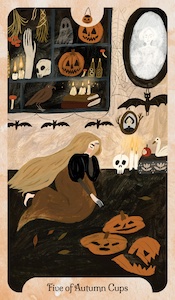
From the second I held this deck, I felt a magnetic pull towards it. The energy was just radiating the essence of fall. And while I am enjoying the end of summer, this deck has gotten me so excited for the shift of summer into autumn. For me, this is the magic of the Seasons of the Witch collection; the decks really foster an alignment with the season.
As soon as I opened the box, I was absolutely taken with the gilded orange edges filled with captivating images that are much more relatable for me than the traditional RWS imagery. The artwork by Tijana Lukovic highlights the warmth and coziness of Mabon with the mysterious, rustling atmosphere associated with Samhain. The palette of warm oranges, reds, browns, and autumnal golds makes the deck feel like stepping into a crisp October evening.
Shuffling through the deck, there are golden leaves, pumpkins, candles, woodland settings, witches, spirits, ghosts, and shadowy figures, which transport readers into the liminal space of autumn. There’s spookiness, enchantment, solace, and magic all within the artwork.
I see cards with a woman grieving, women together doing a spell, a woman gazing out the window reading a book, and one simply enjoying a steaming cup of something delicious I’m sure. Essentially, I see many versions of myself in the deck, which is why I feel like I resonate with it so readily.
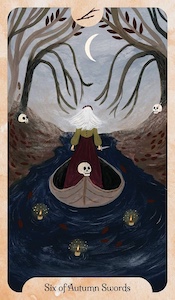
Yet at the same time, there’s an otherworldly, fairy-tale-like quality to the deck that invites a feeling of whimsy too. This dance between the mundane and the mystical, where daily ritual becomes a portal for wider connection is so apparent in this deck. Lukovic just has a truly remarkable ability to capture the soulfulness of each season. I can’t get enough of all her expressive images!
Further reflecting the autumn energy is the revisioning of the suits, which puts the tarot cards into a different archetypal perspective. Cups become jack-o’-lanterns, representing emotional warmth and light in the darkness; Wands become broomsticks, emphasizing cleansing and sweeping away what is no longer needed; Swords take the form of branches, connecting the suit with resilience and nature’s wisdom; and Pentacles become mirrors, turning attention toward self-worth, material relationships, and the reflection between our inner and outer worlds.
Anderson also makes some changes to the traditional tarot terminology to further immerse the reader in the seasonal world of autumn. For instance, the Sun becomes Sunset, the Moon becomes The Waning Moon, the World becomes Descending Into Winter. The last change to the traditional RWS design is reimaging the Court Cards. Anderson calls Initiates (Pages), Seekers (Knights), Shepherds (Queens), and Keepers (Kings). According to the guidebook, this terminology will continue for all of the Seasons of the Witch tarot decks. These changes give the familiar tarot symbolism an entirely new atmosphere while maintaining recognizable connections to the familiar system.
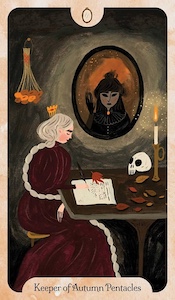
All of the deck descriptions I’ve mentioned can be found in the guidebook, which is quite informative. Following an introduction by Anderson, there’s a page with themes for autumn, along with a passage about the seasons as archetypes. Anderson offers guidance for working with the deck, including how to do cleansing and dedication, situations to use the deck beyond the time of Autumn, and combining tarot with oracle cards. I especially appreciated her method for reading reversals with the deck, which was an emphasis on the card rather than an inverted meaning. From here, Anderson shares spreads for readers. They range from one-card pulls to a full 10-card spread to get to know the deck.
As for the cards’ guidebook entries, all of them follow the same format. First, there’s an image of the card followed by a description of the artwork. This is very valuable because it highlights the imagery, giving readers’ perspective they might have otherwise not noticed. This is followed by a divinatory message, which I noticed aligns with the message from the traditional tarot card represented. The final section of the entry is a list of additional meanings for the cards; this is very helpful for expanding the message for readers to consider alternative possibilities.
As an example, I was doing a one-card pull and drew The Autumn High Priest. This is one of the cards that differs a bit from traditional tarot, making it much more resonant and approachable for me. The imagery shows women whispering counsel into the ear of a woman veiled in a white gown. The description reads, “The presence of each of these women emphasizes community, tradition, and the transfer of knowledge from teacher to student.”1 What a wonderful framing of the energy!
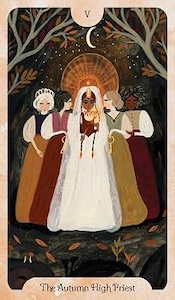
Anderson does go on to explain the energy, mentioning how it relates to the traditional Hierophant card, while also keeping a nature-based, spiritual connection present in the message. The additional meanings include things such as honoring seasonal practices that keep us rooted, working within a hierarchy, formal study or initiation into a new discipline, and family influence on one’s love life. The different ways this card can be read allow for plenty of flexibility, allowing for readers to apply the essence of the card to find meaningful insight into their personal situation.
All in all, for readers who already love the Seasons of the Witch oracle decks, Autumn Tarot feels like a natural expansion of the collection. Though, it also works beautifully as a standalone deck for anyone who loves seasonal spirituality, witchcraft, nature-based practices, or tarot with a strong archetypal atmosphere. For those who find spiritual meaning in the turning of the Wheel of the Year or simply love the introspective magic of autumn, this is a beautiful invitation to slow down, look inward, and listen to what the season has to teach us. I love it so much!!

Alanna Kali is an astrologer, numerologist, and pioneer spirit that loves to explore life through the lens of depth psychology. She has a passion for studying the humanities and social trends. Her academic work is centered upon reuniting body, mind, and spirit through eco-psychology. She loves reading, spending time in nature, and travel.