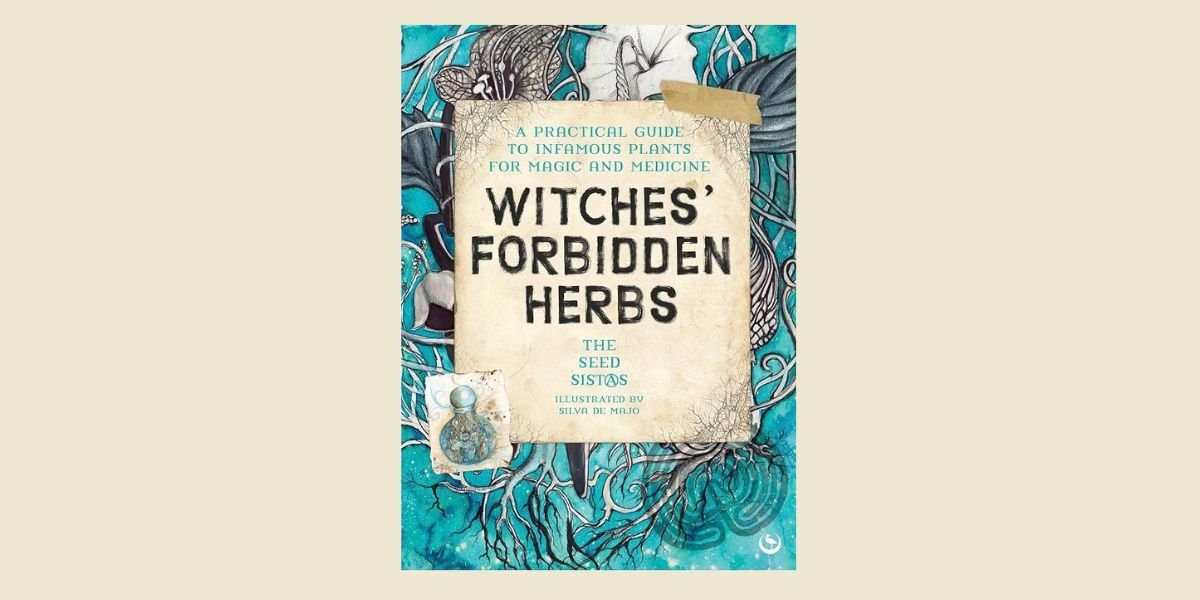
Witches’ Forbidden Herbs: A Practical Guide to Infamous Plants for Magic and Medicine, by The Seed Sistas (Fiona Heckles and Kaz Goodweather) with illustrations by Silva De Majo
Watkins Publishing, 978-1836810544, 304 pages, June 2026
I read a lot of books where cunning women use herbs for a variety of things: protection, healing, love, and more. I’ve picked up the basics such as Belladonna’s sweet flavor and that flying ointment has long been associated with witchcraft. But this is where my knowledge came to a heed. In the spirit of expanding my magical repertoire, I dove into Witches’ Forbidden Herbs: A Practical Guide to Infamous Plants for Magic and Medicine by The Seeds Sistas (Fiona Heckles and Kaz Goodweather) with illustrations by Silva De Majo, and I have been steeping (perfect herbal reference, right?!) in all that I’ve learned! My heart lit up when I read the words “re-wilding of the psyche”1, as the authors write in the introduction, and from here on I knew this book would be illuminating.
The first thing I want to say is that I love the format of this book. It’s chunky yet easy to hold in one’s hand. The flexible binding allows me to push down the pages to make note of things I want to remember quickly for reference. And, most of all, the illustrations keep me engaged! This isn’t the first time I’ve delved into herbalism, but too often books have an overload of text without any meaningful real-life imagery to connect with. How am I going to bond with a plant if I can’t even visualize it? And yes, I can Google, but that distracts from my reading immersion because then I’m on a rabbit hole for something else!
This book is more akin to a field guide, which is exactly what I would want when I’m studying nature. It’s even illustrated to look like pictures are taped in! It makes me feel like I’m reading someone’s beloved scrapbook filled with their plant magic and medicine. I then learned that The Seed Sistas have published another book, The Sensory Herbal Handbook, which shares techniques to understand plants without relying solely on memorized lists, and I was like “They get it!”. Especially given that so much plant wisdom has been passed down orally, it’s so refreshing to engage with the material beyond just charts, associated properties, and a list of uses.
But I digress! The book begins with an introduction from The Seed Sistas, sharing their magical intent and mission along with the ins and outs of what readers can expect. They write:
“This book is written for anyone who feels a calling to the feral and who is interested in the revival of forgotten knowledge. It is for those of us who want to restore the wild traditions – to be touched by the sacred power plants and fungi of our lands. It is for those who sense the existence of other realms and who wish to learn to trust their intuition and be guided by the plants. And it is for those of us who want practical tools for working with the forgotten gifts of the otherworld and who wish to explore a new paradigm around altered states of consciousness and health.”2
Check. Check. Check. Hi, It’s me. 😀 Needless to say, I dove right in. Divided into three parts, the pacing of the book is quite nice. First, The Seed Sistas give an overview of plant medicine, specifically poisons and altered states. There’s also coverage of witchcraft and how working with plants can become a practice of reclamation. I found The Seed Sisters’ backstory very interesting as well as their take on malevolent magic and hex removal. There’s also information about how astrological influences plant medicine as well, covering harvesting times to plant correspondences. I appreciate this bridge between Earth and the cosmos.
“Part II: Connecting to the Witching Herbs” begins with inspiration for connecting with plants, including smoking them, doing spellwork with them, drawing them, and simply yet profoundly tending to them. After this, the book turns to the heart of the topic: the Solanaceae plant family. More commonly known as nightshades, The Seed Sistas provide an overview of tropane alkaloids contained in the nightshade family, detail the alkaloids affect the central nervous system, discuss doses, and the potential of overdose, all while masterfully weaving together science, history, and mythology.
This all leads readers into chapters on “the magical three”3: henbane, datura, and belladonna. One by one, The Seed Sistas do a deep-dive on these three plants. There is just the right amount of information, and as mentioned previously, it’s all arranged in an engaging way thanks to illustrations and formatting that make the information easy to digest. From the removal of henbane as an herbal gruit used to flavor beer due to the Beer Purity Act to the way datura can be drawn on for sex magic, there was so much fascinating material into not only these plants but a wider collective experience that is possible or missing because of the exclusion or inclusion of these plants in our lives.
The Seed Sistas really offer a well-rounded approach to getting to know these plants. Yes, there’s the practical harvesting advice but there’s also insight into the plants’ divas. Readers learn the history, mythology, and magic of these plants. And while I initially avoided ever connecting with these plants because of their poisonous nature, I see now how misaligned this sentiment was, primarily based on fear and misinformation. It’s lovely how The Seed Sistas don’t shy away from the dangerous aspect–they give plenty of warnings and cautions about how these plants can be misused–but yet still make them so inviting and accessible for readers.
The final section, “Part III: The Flying Ointment”, really had me wishing I could somehow buy the compound The Seed Sisters so kindly with great detail share how to create yourself. However, it does require a 13-moon harvest cycle, along with herbalism skills that are way out of my reach right now. Made with 13 ingredients, The Seed Sistas have crafted this recipe over years of trial until it finally felt right. This section details the history of flying ointment followed by a nice overview of all 13 ingredients. There is guidance for preparing for flying along with different ways to use the ointment, such as meditation, divination, connecting with ancestors, and sacred sexuality to name a few.
While I am not in a position to physically tend to these plants right now with two very little children dominating my household and no outdoor area to grow plants, I have been inspired by this book to get to know these plants. I think my next step will be journeying to meet the plant divas and form my own relationship. I am so grateful for all the wisdom The Seed Sistas have included in these pages. I mean, a full-on tried and tested recipe for flying ointment, in addition to decades of wisdom of herbalism? It’s truly priceless! And something I am glad to have in times where ancient history is being replaced by AI-generated content. Ugh! Did I mention there’s a hex for rapid materialism in the book too? Once again, The Seed Sistas just get it!
I highly recommend checking out their website too. I felt super connected to their personalized attire and way of writing that is honest, open, and relatable. They also have prerecorded workshops on their site too for those who want to learn more!
Overall, I really connected with Witches’ Forbidden Herbs. The Seed Sistas brought to life these plants for me in a way that grounded their potential use in reality rather than just superstition, fear, and secrecy. One day I might have the privilege of tending to these plants, but for now, this book serves as a guide for expanding my relationship with them energetically, which in itself feels exciting! Herbalists, witches, and magic makers will all have something to gain from this wonderful content. This will definitely be a book I continue to recommend when the topic of the nightshade family arises!

Alanna Kali is an astrologer, numerologist, and pioneer spirit that loves to explore life through the lens of depth psychology. She has a passion for studying the humanities and social trends. Her academic work is centered upon reuniting body, mind, and spirit through eco-psychology. She loves reading, spending time in nature, and travel.