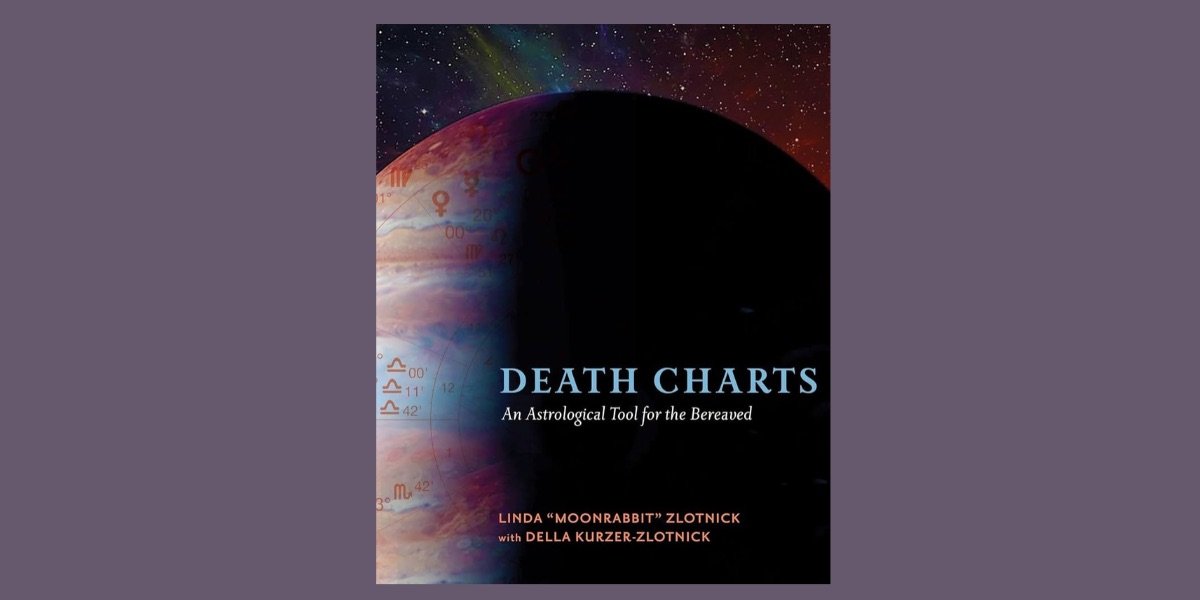
Death Charts: An Astrological Tool for the Bereaved, by Linda “Moonrabbit” Zlotnick and Della Kurzer-Zlotnick
Moonrabbit Press, 979-8234108197, 206 pages, July 2026
As an astrologer, I love exploring different reading methods, especially for taboo subjects, of which death is usually at the top of the list. Death Charts: An Astrological Tool for the Bereaved by Linda “Moonrabbit” Zlotnick and Della Kurzer-Zlotnick explores one of astrology’s most sensitive and rarely discussed applications: using the chart of a person’s death as a tool for understanding grief, transition, and meaning.
“What I’ve found in my research over the past decade is that death charts often reveal what I call “a path forward” for the client–a way to experience some healing and find meaning in what is so often a time of great tragedy and loss.”1
From the start, I was fascinated by the authors’ process. Rather than approaching death astrologically as something to predict, which has always scared me a bit to be honest, the authors invite readers to examine the moment of passing after it has occurred. By creating a chart for the exact date, time, and location of death, the authors show how to consider what that moment reveals. This approach is not rooted in forecasting. It is focused on reflection, healing, and bringing new insight to the client, offering astrology as a language through which the bereaved can contemplate an experience that often defies ordinary explanation.
The practice grew out of Zlotnick’s own experience of profound loss. After the death of her identical twin sister, Lou Ann, in 2005, she cast a chart for the moment of her sister’s passing. What began as part of her personal grieving process eventually developed into a method she has used in nearly two hundred sessions with bereaved clients. Her history gives the material an important emotional grounding. Death charts are not presented as yet another interesting astrological technique; they emerge from an intimate attempt to understand what happens psychologically and spiritually when someone we love is suddenly absent from our lives.
Throughout the book, readers are introduced to several layers of interpretation. And it’s worth noting this book is definitely geared more towards those with a solid astrological foundation. While everything is clearly explained by the authors, the methodology is a bit technical. Thankfully, there’s lot of full-page charts accompanying the writing, but there were still times when I was struggling to absorb all the details. This is definitely not a book to rush through!
Additionally, as a whole, the content is geared towards teaching those who already have a strong astrological background how to do a death chart reading, if they were interested in offering this as a service for their clients. Not only do Zlotnick and Kurzer-Zlotnick teach readers the astrological technique, they also share guidance on working with the bereaved, stages of grief, dealing with death as an astrology, and how to do a death reading session.
As for the primary technique, Zlotnick and Kurzer-Zlotnick explain how to construct and interpret the three key charts: the client’s birth chart, the beloved’s death chart, and the bi-wheel chart. The bi-wheel chart “examines the impact of the moment of death on the client.”2 Additionally, the authors examine eclipses that “sandwich” the death. As mentioned, the authors provide plenty of real chart examples to highlight this methodology, allowing readers to discover the nuance of it.
I was somewhat surprised by the methodology too. While I already knew that eclipses and Saturn often can be indicators of illness or death, the authors’ focus on the outer planets (Uranus, Neptune, and Pluto) along with asteroids Ceres and Chiron was quite interesting. Though, the outer planets are only significant when close in degree to a personal planet or angle; if two outer planets are close, the authors consider it more generational and less impactful.
For each of these planets or asteroids, the authors give some background about their astrological significance, a brief interpretation of their transits to other planets, and then a death chart reading (client’s natal, beloved death chart, and bi-wheel) that highlights the specific planet being discussed in the chapter. Their written readings are quite helpful for understanding how to read the charts for your own clients.
Beyond the specific methodology the authors generously share to pass on their wisdom, this book also highlights a significant way astrology can be used. Grief is often filled with questions: Why did this happen? Why at this particular moment? What remains unfinished? How does a relationship continue after someone dies? The death chart becomes a contemplative space in which those questions can be explored. In this sense, astrology functions almost as a meaning-making practice, a way to hold paradox, symbolism, memory, and emotion simultaneously.
This distinction is especially important because of the subject matter. Zlotnick has explicitly separated death-chart work from predicting death, describing astrology as a map of possibilities rather than a mechanism for determining exactly when someone will die. That ethical boundary allows the book to remain focused on bereavement and healing. Instead of encouraging fear about ominous transits or placements, the authors turn attention toward what astrology might illuminate once a loss has already occurred: cycles of transformation, the significance a death assumes within a larger life story, and the ways those left behind may begin integrating their experience.
There is something quietly radical about bringing astrology into a conversation that modern culture often struggles to have at all. Death is unavoidable, yet our language for discussing it can feel painfully inadequate. Death Charts proposes that astrology can become another language for that experience–not to explain death away, but to sit beside grief and help uncover meaning within it.
I highly recommend this book for astrologers interested in discovering how the moment of death can reveal fresh insights, providing a new beginning for contemplation and growth amid a heartbreaking ending. Additionally, for those navigating their own loss, this book may offer something equally valuable: another way to remain in relationship with the mystery of the person they loved, the moment they left, and the life that continues afterward. A great mixture of technique and theory, Death Charts is quite groundbreaking. I am certainly going to be discussing the topic with other astrologers and sharing my recommendation for this compelling read.

Alanna Kali is an astrologer, numerologist, and pioneer spirit that loves to explore life through the lens of depth psychology. She has a passion for studying the humanities and social trends. Her academic work is centered upon reuniting body, mind, and spirit through eco-psychology. She loves reading, spending time in nature, and travel.