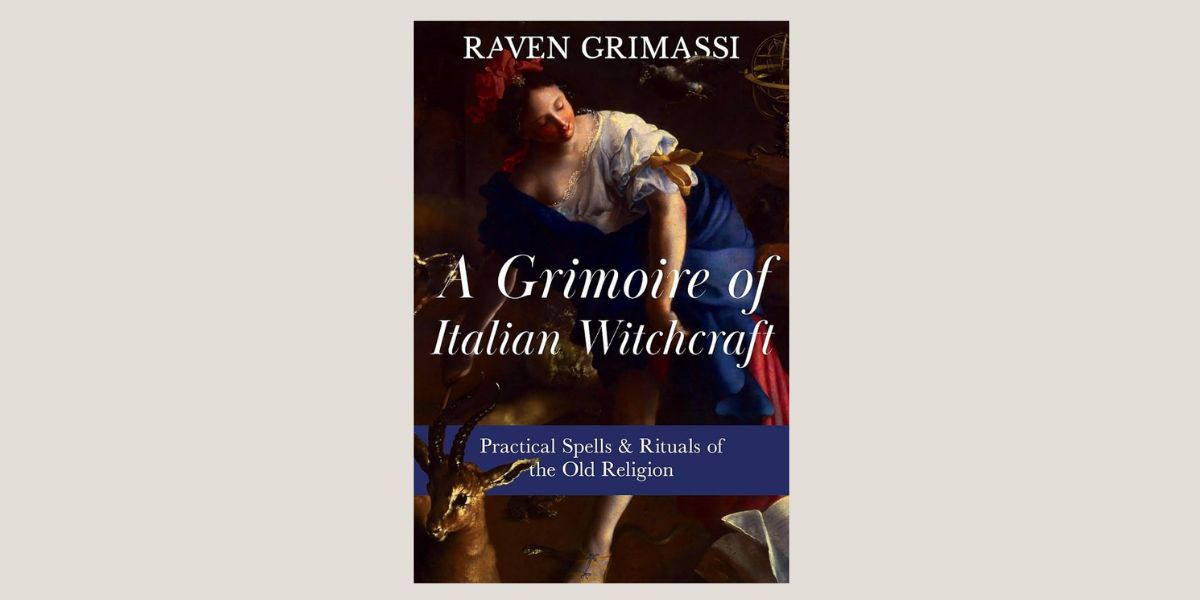
A Grimoire of Italian Witchcraft: Practical Spells & Rituals of the Old Religion, by Raven Grimassi
Crossed Crow Books, 1964537584, 276 pages, February 2026
My ancestors were from Italy. And while it appears I belong to a longtime staunchly Catholic family–while reading this book, my 89-year old Italian-American Grandmother picked it up and said, “What the hell is this?”–I can’t help but (wishfully) believe there is some lingering Italian folk magic within my veins. This has led me on a quest to learn more about neo-Pagan Italian witchcraft, or Stregheria. Having read other books by author Raven Grimassi, I was drawn to A Grimoire of Italian Witchcraft because it offers lore, spells, rituals, and teachings intended to bring this tradition into everyday magical practice.
As someone looking to build a foundation from the ground up, this book was a great starting point. Grimassi covers a variety of topics in this book, providing a structural overview of Italian spirituality, folklore, and ritual practices for those interested in the Old Religion. The book begins with a synopsis of Italian witchcraft and offers a ritual of dedication to begin one’s journey on this path. Grimassi also discusses Lasa and Lare, spirits who protect the Old Ways, encouraging readers to build a shrine as part of this work.
Chapters four through seven–”Making Contact”, “Sign and Symbol”, “Raising and Drawing Power”, and “The Art of Magick”–focus on core magical concepts but from the perspective of Italian witchcraft. For instance, there’s illustrations of physical poses to connect with the Grigori, “the entities that guard the ritual circle’s portals”1, as well as tables for symbols important in this tradition (Eight-Fold Path, Tanus (light), The Spirit of Aradia, and many more). Grimassi covers God and Goddess currents, explaining how energy flows through the body and teaching how to raise this power and move it accordingly. He also covers different types of magic and mechanisms of magic, noting the overlap between witchcraft and magical energy and components of ritual magic.
Chapter eight “Aradia, Woman of Power” and chapter nine “Moon Tree” delve more into the folklore of this path. The story of Aradia, popularized by Charles Leland, and her relevance to Italian witchcraft are explained. The symbol of the Moon tree and its ancient and esoteric meaning are also discussed, providing fascinating coverage of this lore.
The final four chapters– “Magickal and Ritual Gestures”, “Italian Folk Magic”, “The Ritual Tools”, and The Rituals”–are the practical “how-to” of the book. Readers learn the gestures and poses associated with Italian witchcraft, including “Calling Down the Goddess”2. Then there’s guidance about the saints and archangels to work with along with traditional spells and enchantments (silencing gossip, gambling, blessings). Additionally, all the tools needed are covered, including how to prepare them for use.
As for the rituals, they are varied but written out in full, so the reader can easily follow the script. Grimassi includes a ritual for a full moon and then all eight of the tregenda, or sabbats (Shadowfest, Winter Solstice, Lupercus, Spring Equinox, Diana’s Day, Summer Solstice, Cornucopia, and Autumn Equinox). To me, they were very traditional rituals, reminding me a lot of traditional Wicca, so I would probably adapt them, but they still serve as a good starting point.
The Appendices are also filled with a ton of additional information about Strega. Grimassi provides a history of the Old Religion, overview of the main deities, lists important plants and their uses, shares some Italian lore, an overview of palmistry, and more! It’s almost like all the neat other stuff that didn’t fit neatly into the structure of the book got put in the appendices, and I enjoyed it very much!
Compared to other books on this subject by Grimassi, A Grimoire of Italian Witchcraft functions much like a structured magical handbook (hence it’s name!). More than focusing solely on theory, the book is organized around practical application, presenting spells, rituals, and devotional practices that draw from the imagery and mythology associated with Italian witchcraft to make for a year-round meaningful practice. From workings related to seasonal observances to the ritual tools used, this book lays out an entire Stregheria practice that is accessible to modern practitioners.
What’s nice about the book as a whole though is that it also includes history that bridges past and present. Grimassi explains how this magic has evolved through time, dating back to the cult of Diana referenced as early as 30 BC, situating readers in the lineage and offering a connection to the origins of this magic. I really enjoyed the table of Old Gods of Tuscany and their Roman correspondences in “Chapter 3: Between Worlds”, as I previously hadn’t heard of any of these deities before. Tapping into the historical roots of Italian spirituality made me feel like a portal was opening to all those who walked this path before me, even if it wasn’t technically Strega. There’s still this deep connection I felt towards those who honored nature and the old gods and goddesses in this way.
Overall, A Grimoire of Italian Witchcraft continues the legacy of Raven Grimassi’s work by presenting Italian-inspired witchcraft as a living and accessible tradition. The book emphasizes practice over theory, offering readers a collection of rituals and magical exercises rooted in Italian history and Pagan spirituality. In this way, the grimoire attempts to serve both as a reference text and as a working manual for those interested in exploring the path of the Strega. I definitely plan to continue to refer to it as a I connect with my Italian ancestors.
About the Author
Raven Grimassi (1951–2019) was a prolific American writer on witchcraft, Wicca, and Neopagan spirituality, publishing more than twenty books throughout his career. He is particularly known for popularizing Stregheria, a form of Italian-inspired witchcraft that blends folklore, historical research, and modern Pagan ritual practice. Grimassi was also a practicing Wiccan priest and a teacher within Pagan communities for decades, shaping the way many modern practitioners encountered Italian magical traditions.

Alanna Kali is an astrologer, numerologist, and pioneer spirit that loves to explore life through the lens of depth psychology. She has a passion for studying the humanities and social trends. Her academic work is centered upon reuniting body, mind, and spirit through eco-psychology. She loves reading, spending time in nature, and travel.