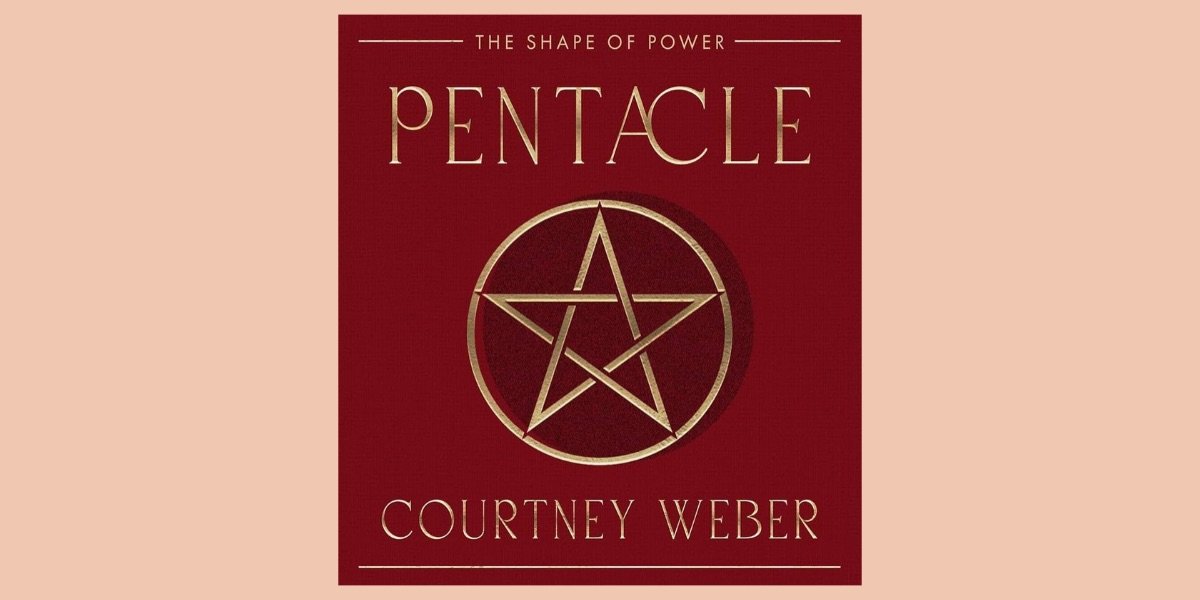
Pentacle: The Shape of Power, by Courtney Weber
Weiser Books, 1578639352, 112 pages, November 2026
What comes to mind when you hear the word “pentacle”? For me, my thoughts immediately turn to the tarot suit of Pentacles and its associations with the material world, resourcefulness, stability, and grounded energy. This was the perspective I brought with me when I began reading Pentacle: The Shape of Power by Courtney Weber.
However, it didn’t take long for my understanding of this familiar symbol to expand. Weber invites readers to look beyond the pentacle’s contemporary associations and explore its fascinating history, rich symbolism, and diverse magical applications. As I turned the pages, I gained a newfound appreciation for the depth and versatility of one of the occult world’s most enduring emblems.
At just 112 pages, the book provides an accessible introduction to a surprisingly expansive subject. Its concise format makes it an appealing choice for readers seeking to deepen their understanding of magical symbolism without becoming overwhelmed by extensive historical material. Those accustomed to working primarily with the pentacle through elemental correspondences or modern Pagan traditions will find its broader historical associations especially thought-provoking.
The first chapter focuses on the history of the pentacle. Weber highlights that while the symbol became known for its magical significance in the 12th century Renaissance, the shape of the pentagram (five-pointed star) dates back to 4000 BCE during the time of Mesopotamia. It’s wild to think the star I love to doodle on everything has such a lengthy origin, connecting me to millions of others who have gazed at this intriguing symbol.
From here, Weber explores the pentacle as a talisman and in ritual context. Cue The Key of Solomon and its role in shaping this magical practice. Weber also gives advice for creating, designing, and consecrating your own pentacle. It was interesting to me how Weber notes that many talismanic pentacles don’t even contain the five-pointed star! As for the ritual aspect, Weber covers The Lesser Banishing Ritual of the Pentagram and how the pentagram became a ritual tool for Wiccan circles too.
There’s also a final chapter on using pentagrams in personal ritual, and I feel like that one was more resonant for me, so don’t worry if you’re not into all the ceremonial stuff. Weber does a great job offering reflection questions, suggestions, and inspiration in a way that makes the material applicable to a wide-range of magical practitioners. There’s even a chapter on working with the pentacle as an oracle tool with a tarot spread.
Other chapters include the pentagram in architecture (I learned there was once a Summer of Love event to “levitate” the Pentagram – very cool, might need to collectively re-do it asap!) and counter-culture symbolism. These were interesting because they bridged the deep symbolism with material aspects of life: buildings, clothes, jewelry, art, etc.
My favorite chapter overall was on the numerology of the pentacle. Not only does Weber dive into the energy related to the number five, she also covers the significance of the number 9, explaining “The numerological significance of the number nine as it appears within the pentagram may have further influenced early occultists to embrace its power.”1 This was novel information for me, and it was the piece of information that got the wheels turning in my head in regard to the energy of the pentagram.
And since Weber approaches the pentacle from so many dimensions, I think each reader will find their personal take-away that brings to life a new understanding of this symbol. From the history to the practical applications of pentacles within magical traditions, there’s a lot of ways to connect. Protection, divination, spirit work, and ritual are all explored, further highlighting the versatility of this seemingly simple geometric form.
Overall, Pentacle: The Shape of Power will particularly appeal to those who are enthusiasts of tarot, magic, rituals, and occult history. It also offers an intriguing starting point for readers interested in sacred geometry or talismanic magic. While it’s a quick read, it’s very well-sourced and insightful.
Weber’s exploration reminds readers that even the most familiar magical symbols can hold layers of meaning waiting to be discovered. By tracing the pentacle’s journey across different traditions and historical contexts, this book encourages practitioners to approach this iconic emblem with renewed curiosity, appreciation, and intention.
AND for those who enjoy discovering more about meaningful symbolism, you’ll be pleased to know it’s part of The Sacred Talisman Series, featuring two other books: Ankh: The Shape of Life by The Editors of Weiser Books and Celtic Cross: The Shape of Faith by Derek Bryce.

Alanna Kali is an astrologer, numerologist, and pioneer spirit that loves to explore life through the lens of depth psychology. She has a passion for studying the humanities and social trends. Her academic work is centered upon reuniting body, mind, and spirit through eco-psychology. She loves reading, spending time in nature, and travel.