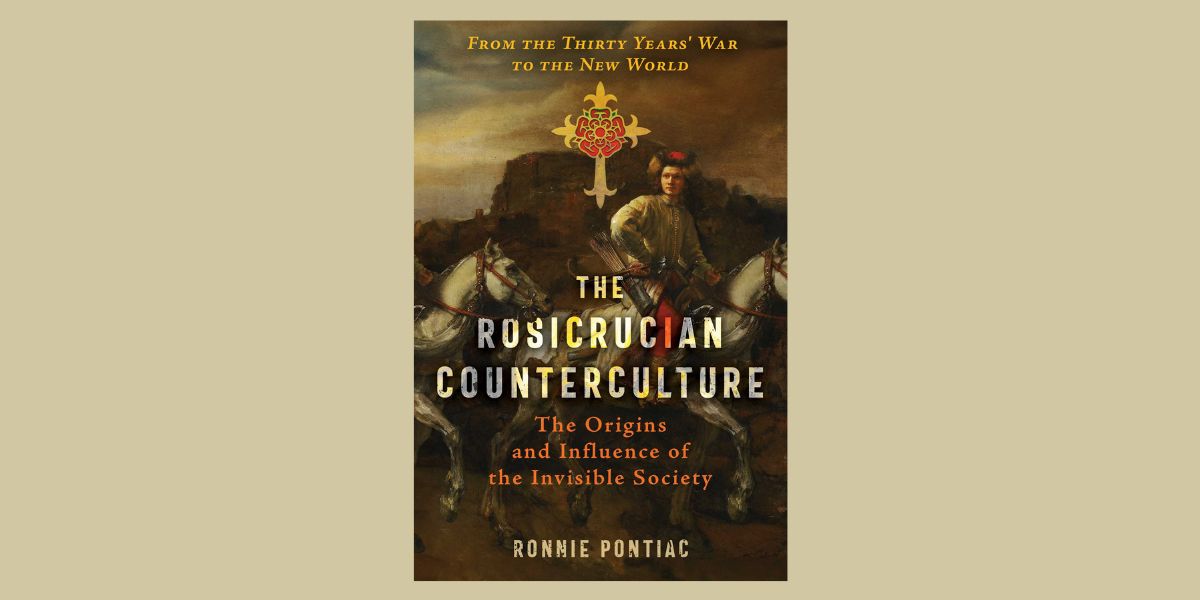
The Rosicrucian Counterculture: The Origins and Influence of the Invisible Society, by Ronnie Pontiac
Inner Tradition, 979-8888500354, 240 pages, December 2025
It’s tough to overstate the influence Rosicrucianism had on Western occultism, yet it’s hard to pinpoint the origins of the spiritual movement . Emerging in the early 17th-century, Rosicrucianism offered an integrative vision that fused Hermetic philosophy, alchemical symbolism, Christian mysticism, and natural science into a single spiritual worldview, reframing magic as a process of inner transformation rather than external power. At a time when alchemy was at its heights, the first Rosicrucian manuscripts emphasized spiritual alchemy, a transmutation of the soul rather than the production of gold.
Through its emphasis on moral refinement, symbolic initiation, and the myth of an invisible brotherhood working for humanity’s spiritual renewal, Rosicrucianism provided a conceptual template that later informed Freemasonry, the Golden Dawn, Theosophy, and modern psychological approaches to magic. Even where its historical structures remain elusive, its philosophical imprint endures, shaping Western occultism’s enduring focus on self-initiation, ethical responsibility, and the Great Work as an inward, regenerative path.
But just what was happening at the time when the first Rosicrucianism texts emerged? And who is responsible for writing them? Was there ever truly such an order? Ronnie Pontiac takes on these mystical mysteries in The Rosicrucian Counterculture: The Origins and Influence of the Invisible Society, sharing historical context in which these original Rosicucian manuscripts were published and tracing the influence of Rosicrucianism from the 17th century to modern era.
Approaching this topic as a storyteller, Pontiac delves right into the drama of the Early Modern Period. He looks at the esoteric culture around Holy Roman Emperor Rudolf II and his court, including Tycho Brahe and Johannese Kepler. Visitors, such as John Dee and Rabbi Loew, added to the discourse too, amid many other contributing figures to a significant period in history.
Next, Pontiac moves into the reign of Frederick V of Palatinate and Queen Elizabeth (Elizabeth Stuart of King James I of England), including the efforts to make Frederick the first Protestant Holy Roman Emperor, triggering the Thirty Years’ War. Though their story is one of Protestant resilience, it also highlights how mystical and reformist ideas intertwined with European politics. From their wedding, featuring alchemical symbols and celebrated Shakespeare plays to their incredible gardens and intellectual court, Pontiac goes into great detail surrounding the atmosphere of this time.
Other notable chapters include one about Robert Fludd, who wrote Tractatus apologeticus integritatem Societatis de Rosea Cruce (Treatist to defend the integrity of the Society of the Rosy Cross), and the aftermath of Frederick and Elizabeth’s rule, leading to the rise of their son Prince Rupert of Rhine.
There’s a lot of historical background here. Despite taking AP European history in high school, I will admit I was OFTEN having to look up family charts, paintings of the people, and maps. Until I read this book I hadn’t even known Bohemia existed (kind of embarrassing but it’s the truth), nor did I realize the level of the contention between the Protestant and Catholics during this time. As an American, it was quite eye-opening to explore the past of Europe in this depth. Another thing I learned? That Prince Rupert of the Rhine, son of King Frederick and Queen Elizabeth, had such a significant role in the slave trade as the founder, principal investor, and the first governor of the Royal African Company.
Though Pontiac doesn’t position himself as an academic historian, he nevertheless provides an impressively dense and illuminating historical framework that significantly deepened my understanding of the cultural, political, and religious conditions out of which Rosicrucianism emerged. For anyone interested in Western occultism, this context is genuinely valuable. Understanding how the esoteric movement developed alongside dynastic power struggles, religious persecution, and early scientific inquiry makes Rosicrucianism feel less like an abstract mystery and more like a living response to its moment in history.
That said, there were moments when the sheer weight of historical detail caused me to lose the plot. Sometimes the narrative veered so deeply into political history that I momentarily forgot I was reading a book about Rosicrucianism at all. Additionally, the structure can also feel somewhat nonlinear, with jumps across time periods and re-emergence of previously mentioned people (whom I definitely didn’t remember amidst the details), which occasionally made it difficult to maintain a clear perspective. While this factual density will likely delight readers with a strong appetite for early modern European history, it can challenge those approaching the text primarily from an occult or esoteric perspective, requiring patience to continually reorient and reconnect the historical material back to Rosicrucianism itself.
This said, I’m very glad to have learned about the origins of Rosicrucianism in this depth, even if there’s no definitive answer amid much speculation. The chapter “Three Little Books”, which focuses on Fama Fraternitatis, Confessio Fraternitatis, and The Chymical Wedding, gives a great overview of the zeitgeist of when these books were published. It’s one thing to look back on them from the perspective of hoping to receive the mystical insights of Rosicrucianism, it’s a whole other to contextualize their origins within the time period they emerged.
What struck me the most is how the true identity of the writer(s) of these books has remained secret for hundreds of years. There’s still debate about if the secret society even really existed. If anything, I now see that “Rosicrucianism became a popular hustle”1 with people claiming to be part of the mystical society to enhance their reputation, swindle others, or lend prestige to other evolving esoteric movements.
All in all, Pontiac is doing important work by bringing rigor, clarity, and historical grounding to occult subjects that are too easily romanticized or obscured by mystique. His willingness to explore uncertainty strengthens the study of Western occultism, reminding readers that esoteric traditions do not emerge in a vacuum. This book is part of a three-book series, including American Metaphysical Religion and The Magic of the Orphic Hymns, co-authored with Tamra Lucid, all of which reflect a consistent commitment to illuminating the philosophical, cultural, and historical roots of esoteric thought. Rather than offering tidy revelations, Pontiac invites readers into a more mature engagement with occult history, valuing context, discernment, and intellectual honesty as much as mystery itself. The Rosicrucian Counterculture is a wonderful resource for those seeking to better understand the historical underpinnings of this long-lasting esoteric movement.

Alanna Kali is an astrologer, numerologist, and pioneer spirit that loves to explore life through the lens of depth psychology. She has a passion for studying the humanities and social trends. Her academic work is centered upon reuniting body, mind, and spirit through eco-psychology. She loves reading, spending time in nature, and travel.