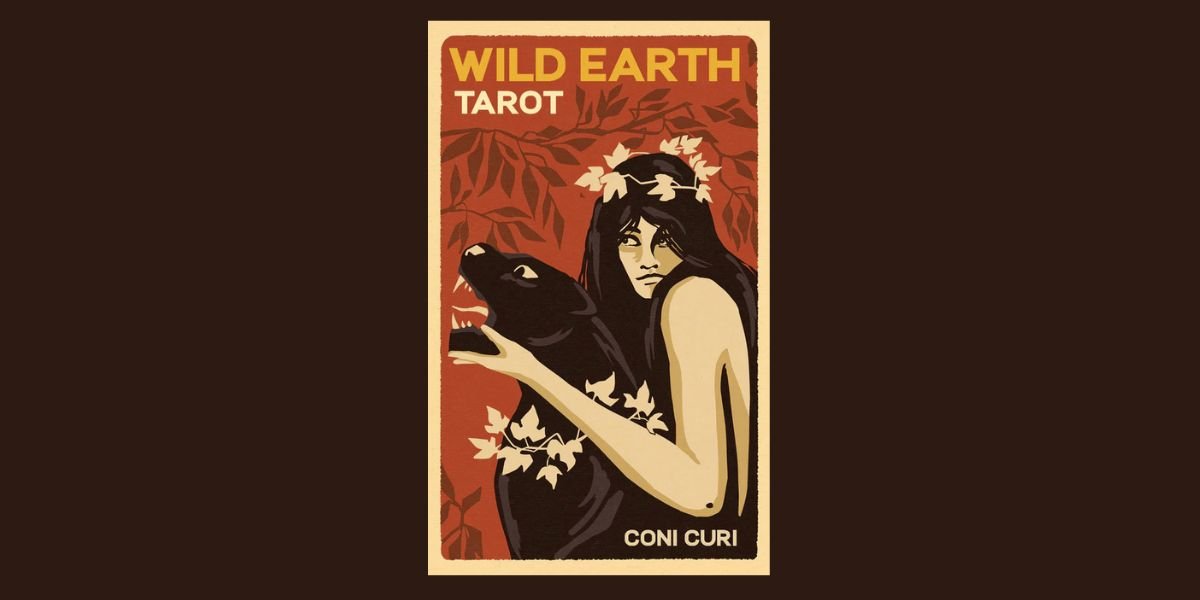
Wild Earth Tarot, by Coni Curi
Rockpool Publishing, 1922468185, 144 pages, 78 cards, September 2026
Wild Earth Tarot by Coni Curi is a refreshing reminder that nature doesn’t simply surround us but also speaks to us in its own language. In this deck, flowers, vines, insects, birds, and organic forms become the archetypes themselves. Nature becomes not just something to observe, but a living source of wisdom, reflection, and connection.
At first, I wasn’t quite sure how to interpret the energy of this deck. The Major Arcana immediately felt wild, earthy, and deeply feminine, almost as though the cards were speaking through an untamed, instinctual energy that I wasn’t yet accustomed to. But as I spent more time with the deck, I began to notice that there was a very specific methodology woven into the Minor Arcana. Beneath their blossoming imagery, the cards follow a thoughtful structure that gives the deck a sense of grounding and coherence.
It was this balance between the untamed quality of the Major Arcana and the intentional framework of the Minor Arcana that gradually helped me understand how the deck wanted to be read. In the guidebook, Curi writes:
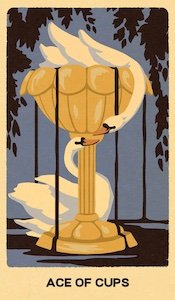
“Unlike other tarot cards, here the minor arcana have their own voice. Its structure is based on the Marseille deck but the content is replete with cycles, elements, and narratives that speak to each other.”1
As for the aesthetics, Curi embraces a minimalist aesthetic that encourages contemplation and intuitive discovery. Her signature vintage-inspired style is soft, earthy, and deeply inviting. The muted color palette gives the deck an heirloom quality, as though it could have been discovered tucked away in an old botanical journal. Fruits, flowers, insects, birds, and other elements of the natural world weave seamlessly into the archetypes, creating cards that feel elegant in their simplicity.
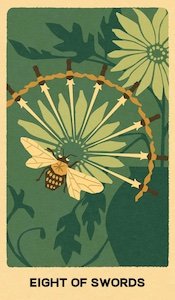
However, there’s actually plenty of symbolism throughout the deck that adds layers of meaning to the readings. For instance, the elemental suits are color-coded, making it visually intuitive to read the cards. Then each suit also has a corresponding symbol: Bees for Swords, flowers for Wands, fruit for Coins, and swans for Cups. The meaning of these symbols is explained in the guidebook. Additionally, Curi has also drawn in hidden symbols, which are repeated or transformed throughout the deck, leaving it up to the readers to spot these.
At the beginning of the guidebook, Curi provides an introduction to the cards along with some spreads that can be used for the deck. Then for every card there’s three keywords at the top followed by a one sentence overall meaning and an image of the card. Curi’s message for each card draws upon the symbolism of the card but is also direct and meaningful. She highlights the significance of the imagery on the card, providing insight that is grounded and tangible.
I appreciate how Curi makes connections between cards too in the guidebook entries. She describes the imagery for the Nine of Wands, writing “a yellow flower opens up facing forwards, similar to that of the Three of Wands but more mature and mindful and bearing the stars of The Hermit (card IX).”2 This allows readers to see the interdependence of the cards, a true nod to the beauty of nature and its infinite connectivity.
And this aspect is something I really like about the Wild Earth Tarot. There’s an invitation to slow down and attune ourselves to a different rhythm, see new patterns, and uncover a perspective that is built on mutuality. Tarot has been interpreted through so many lenses, so this one being so fluid and organic makes for a certain type of reading. I’ve found this deck is best for working with when I want to cultivate long-term visions or goals, rather than rapid fire readings where I’m quickly trying to figure out an answer and move on. This deck likes to be pampered a bit, sat and chatted with, and even offered a snack. Lol! It sounds silly but it’s true from my experience so far.
As a result, I’ve been more indulgent in my time when doing readings with it. And taking the time to carefully observe the relationships between the cards has enhanced how my readings turn out as a result: a gentle knowingness providing undoubted clarity I’ve particularly liked using a method that Curi suggests in the beginning for discerning more information, which is adding the numbers of the cards together until they are below 21 and referencing the Major Arcana card associated with it. This further helps to illuminate the message coming through.
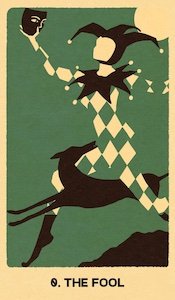
One of my favorite cards in the deck is The Fool. I absolutely love the message Curi shares:
“The traveller is formed in tandem with the path.”3
This quote is so inspiring, and something that gave me the courage to move in a new direction with my business.
Ultimately, Wild Earth Tarot feels like an invitation to see the tarot through the lens of the natural world. The traditional tarot transforms into a living, breathing body of knowledge where voices of the natural world get an opportunity to share their wisdom. Curi’s cyclic approach syncs the tarot with the on-going processes of growth and renewal, from the ripening of fruit to the roots of resilience, allowing readers to ascertain when it’s time to grow, remain steady, or release. Plus, there’s so much beauty in the botanical symbolism.
I highly recommend this deck for those who are seeking a deck that has fresh and lively energy. The focus on the Marseille deck is a unique feature, which those familiar with the traditional Rider-Waite-Smith deck might find novelly refreshing, offering new insights.

Alanna Kali is an astrologer, numerologist, and pioneer spirit that loves to explore life through the lens of depth psychology. She has a passion for studying the humanities and social trends. Her academic work is centered upon reuniting body, mind, and spirit through eco-psychology. She loves reading, spending time in nature, and travel.