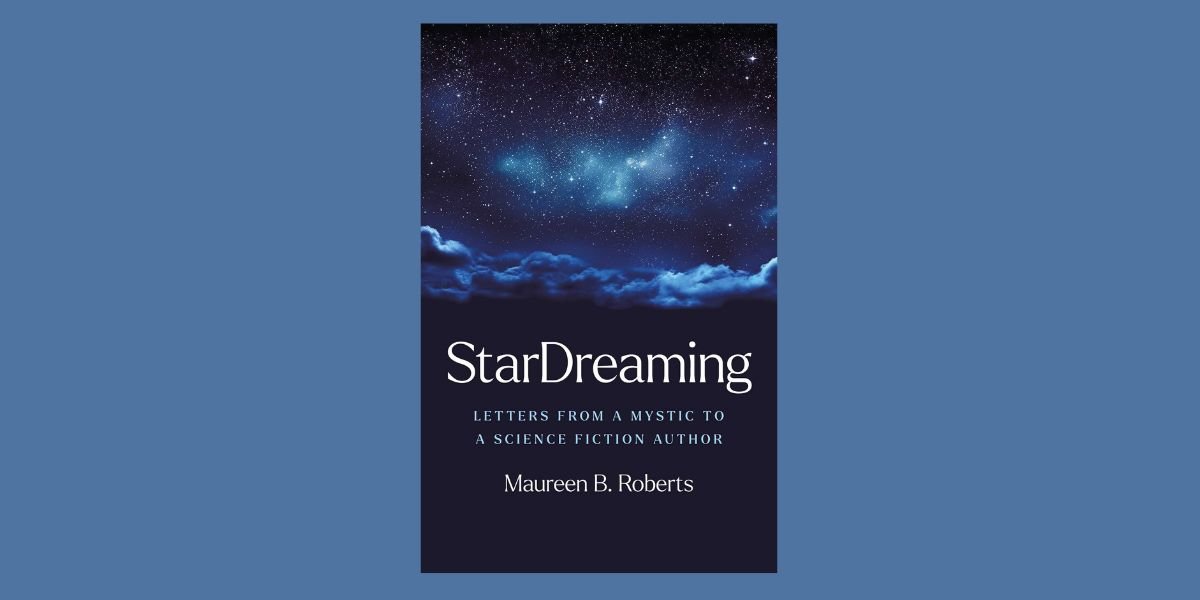
StarDreaming: Letters From a Mystic to a Science Fiction Author, by Maureen B. Roberts
6th Books, 1917704623, 200 pages, August 2026
What happens when two people meet at the intersection of intellect and intuition, skepticism and mysticism, outer space and inner worlds? In StarDreaming: Letters from a Mystic to a Science Fiction Author, Maureen B. Roberts offers an intimate record of a relationship that seems to exist within all of these tensions at once.
StarDreaming centers on Roberts’s correspondence with Australian science fiction author Damien Broderick during the mid-1990s. Roberts, whose background encompasses depth psychology, Jungian thought, shamanic psychotherapy, mythology, and spirituality, approached their connection through an intensely symbolic lens. Though we don’t read Broderick’s side of the correspondence, these letters become the story of two people attempting to understand one another, meeting between two different ways of interpreting reality.
Between 1994 to 1997, Roberts experienced a series of powerful dreams, including one with Broderick himself that piqued her interest in him; she came to understand the dream as foreshadowing the emotional pattern and eventual trajectory of their relationship. Even knowing things probably wouldn’t end great, Roberts dove into the relationship with an open mind and open heart.
What followed was years of thoughtful correspondences that range from day to day things going on in Roberts’ life at the time to metaphysical discussions to romantic conversation. Here’s an example of the range:
“At the heart of myth is the archetypal essence of human nature, the transcendental centre and circumferential whole of the Jungian “self”, which is coextensive with the cosmic and experientially indistinguishable from God. If myth is inclusive by virtue of its holism, so then is its unifying core self, which transcends the polarities of matter and psyche, inner and outer, Nature and technology.”1
To vulnerable confessions like this:
“All the men I was involved with before you were conventionally good-looking as well, personality-wise, idealised versions of my idolised father, and as I’ve mentioned before, part of my breaking free from this complex has come through finally learning to love aman who’s not in the least like my dad, so perhaps I’ve made some progress.”2
It’s so fascinating to see things from Roberts’ perspective, navigating her inner world during the evolution of her relationship with Broderick.
Readers familiar with Jung will recognize many of the ideas woven throughout the letters: projection, archetypes, synchronicity, individuation, the unconscious, and the meaningful symbolic life. Yet the book moves beyond Jungian psychology into questions of precognition, spirituality, reincarnation, shamanism, paranormal experience, literature, and philosophy.
Science fiction becomes another realm where these mysteries are explored, as Broderick was a science fiction writer, while Roberts was an enthusiastic reader. Robert introduces readers to the idea that rather than being completely separate from mystical experience, speculative fiction becomes a place where humanity has long experimented with ideas about consciousness, identity, alternate realities, transcendence, and the unknown. While I rarely knew the science fiction book she was discussing, I loved how she interwove themes, for instance:
“All of this is of course the essence of synchronistic phenomena as eruptions of archetypes into the phenomenal realm. Predictably, then, Strieber’s aliens reflect the evolution of consciousness, that is, Jung’s proposal that ruling dominant age, thereby bringing about what he called a ‘metamorphosis of the gods’, such that (in Strieber’s words) ‘we know that their appearance depends more on the understanding of reality through which a given culture perceives them than on any objective insight into their true nature.”3
I mean, we got aliens, consciousness, and Jungian psychology. How cool, right?!
It’s fascinating to read her letters because Roberts can move from intellectual discussion into emotional vulnerability, from literary analysis to spiritual speculation, from psychological interpretation to the complicated realities of loving another person. She has a wide range of interests but her thoughts are absolutely fascinating.
The book’s range is broad, occasionally moving quickly between personal experience, psychology, philosophy, literature, science fiction, and mystical speculation. Those comfortable following connections between seemingly different territories are likely to find this quality part of its charm in reading Roberts’ letters.
I really enjoy epistolary structure of the book, which makes the experience of reading it particularly intimate. Since these were Robert’s personal letters during the time, decades later they still retain something of that immediacy that comes from passion–the amorous and vexing feelings all in one shimmering within the subtext. You get this glimpse into Roberts’ heart and soul, which feels a bit voyeuristic at times but completely enthralling.
And while readers never get to read Broderick’s responses, I do not feel this diminishes the book in the slightest. Ultimately, the style reinforces what StarDreaming truly is: one person’s attempt to understand what that relationship awakened within her. As someone who has long kept diaries of lovers and saved especially meaningful conversations, I just think there’s such beauty in this publication. The thought that a meaningful catalyzing relationship could yield such insight is inspiring, and it’s very entertaining to witness this small glimpse into a formative time in Roberts’ life.
While most readers will never experience Roberts’s precise circumstances, many will recognize the experience of meeting someone whose presence rearranges the internal landscape. Some relationships arrive not because they are destined to remain forever, but because they expose something previously hidden. They reveal projections. They activate wounds. They challenge assumptions. They introduce new ideas. They force an encounter with parts of the psyche that might otherwise remain comfortably unconscious. Within these letters, we see how Roberts moved through these activations, finding meaning in the process.
Love, in StarDreaming, does not guarantee compatibility. Spiritual significance does not guarantee permanence. A relationship can matter profoundly and still become conflicted. Meaning does not necessarily require a conventional happy ending. I think this is a beautiful lesson that is imparted, amid the many intellectual, emotional, and spiritual conversations taking place.
Those who are interested in exploring the idea of destiny, soul connections, synchronicity, and signs will enjoy reflecting on what might have brought Broderick and Roberts together, as StarDreaming presents a romance that is psychologically complex. This is a meaningful example of how connection may feel fated while still demanding discernment and how a dream may reveal significance without providing simple instructions. Sometimes, the goal is not a unified relationship; transformation itself may be the purpose.
Ultimately, Roberts invites us into the liminal territory where dreams intersect with waking life, intellectual understanding meets intuitive knowing, and another person can become both companion and catalyst. Some relationships change the course of our lives because they last. Others change us because they awaken something. StarDreaming is an exploration of the latter and of the mysterious inner universe that opens when we are willing to take our dreams seriously.
I highly recommend this book for those interested in Jungian psychology, dreamwork, synchronicity, paranormal experience, science fiction, shamanic perspectives, and spiritually transformative relationships. Roberts has given those with mystical inclinations a real gift by sharing her letters. There are so many avenues one can explore within the content–discovering new sci-fi books, understanding Jung better, contemplating the role of dreams in our lives–that I am sure each reader will take away something special from this book.

Alanna Kali is an astrologer, numerologist, and pioneer spirit that loves to explore life through the lens of depth psychology. She has a passion for studying the humanities and social trends. Her academic work is centered upon reuniting body, mind, and spirit through eco-psychology. She loves reading, spending time in nature, and travel.