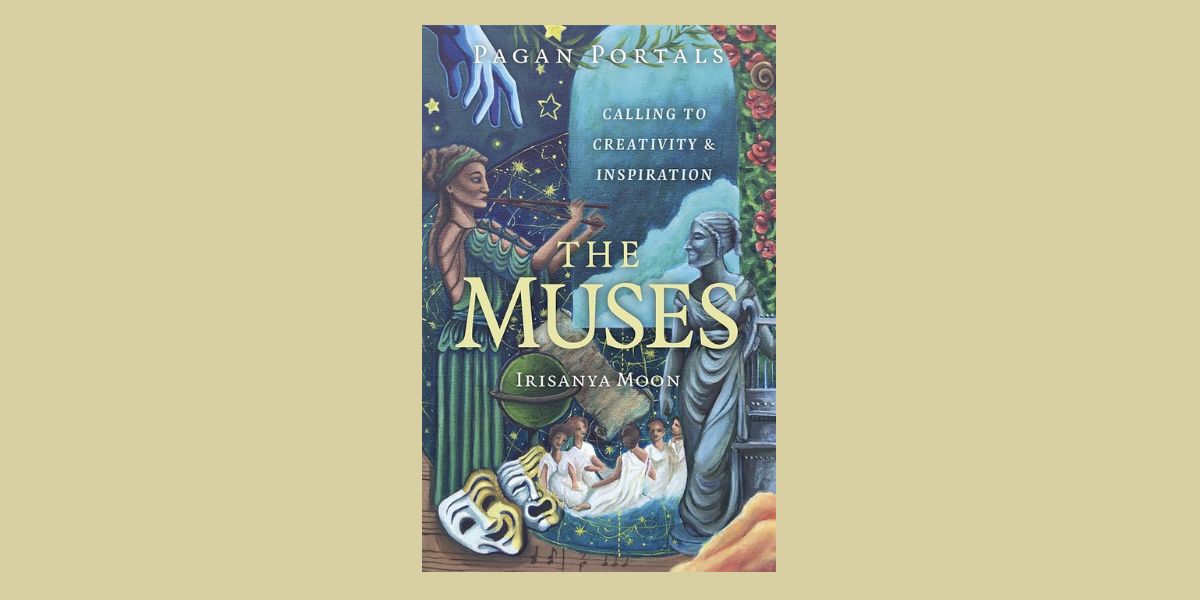
Pagan Portals – The Muses: Calling to Creativity & Inspiration, by Irisanya Moon
Moon Books, 1803417463, 120 pages, March 2026
Sing me, O Muses, of the hallowed acts of creation–all descendants of Memory and delivered through divine inspiration! That is the task Irisanya Moon sets for herself in Pagan Portals: The Muses Calling to Creativity and Inspiration, a beautiful introduction to the energies and personalities of the nine Muses depicted in Greek myth and religion. Naturally, the domains of these goddesses are not fixed to the ancient past–inspiration for all manner of creative pursuits strikes us just as frequently and inexplicably today as it did for our ancestors throughout the ages.
One of the most interesting features of the Muses, both as a group and individually, is that very few stories or sources directly discuss these figures. While the Muses are invoked in almost every ancient Greek text, these deities primarily participate in the creative process itself rather than serving as the subject of the creation. Moon advises the reader that although each of the traditional nine Muses (which doesn’t mean there couldn’t be more!) is associated with certain kinds of creative activity, “it’s not necessarily about doing as they do. It’s more about being inspired by their gifts to unfold your unique kind of creativity.”1 Thus, although the reader will learn about the Muses, Moon’s focus is connecting the reader with the Muses in their own life and art.
Moon is adamant that, even if you know nothing about the Muses as deities, their inspiration will nevertheless be granted if you show up to the creative process. Whatever you are trying to create, openness to inspiration from unexpected directions and the curiosity to follow where it leads is just as important as any ritual or practice designed to call upon and connect with these mysterious figures. And further, since this openness and curiosity do not depend on any particular artistic medium or domain of life, everyone has access to the Muses’ gifts and possesses a unique creative capacity that can be shared with the world.
While Moon says it is perfectly fine for readers to skip to the final chapter(s) of her book, which are explicitly devoted to cultivating a relationship with the Muses, she also suggests that learning the “facts” and stories about these deities can create a strong foundation before embarking on a relational journey with them. Half of the book’s eight chapters are dedicated to these foundations, covering the origins of the Muses and other myths in which they appear, their relationships with other deities and humans, the creative domains traditionally ascribed to each of the nine goddesses, as well as the historical cults devoted to the Muses and their gifts.
Although the descriptive section for each Muse is quite short, each contains a passage from a historical source, which helps set the deities in their original/mythic context. As a lover of etymology, I very much appreciated how Moon breaks down the Muses’ Greek names! E.g. Clio presides over history: her name is derived from kleos, the “imperishable glory” sought by heroes so their lives and deeds would not be forgotten. This was incredibly helpful in connecting the energy/essence of each Muse to their associated artistic expressions, physical appearance, myths, and suggestions for how to cultivate a relationship with the deity. And in the chapter elucidating more, “Stories and Myths of the Muses”, I was intrigued to learn the Muses often act as judges in contests of creative expression, and are even provoked to terrible wrath by hubristic mortals.
The very first exercise that Moon shares with us contains her preferred technique for contacting any godd (god or goddess): the use of a trance state. Unlike some guided meditations or visualizations, Moon employs neutral, trauma-informed language that affords each practitioner an experience unique to their needs. Trying this out for myself, the beautiful and evocative script helped settle me deeply into a liminal state, while the built-in pauses created the space for inspiration to alight.
Another insightful exercise centers around a question one has about a creative pursuit. By making an effort to remember this question throughout the day (not just during rituals), especially during embodied creative pursuits, one will become more open and attentive to inspiration regardless of how it happens to show up. This allows the Muse(s) to speak to us on their own terms, in their own “language,” which may be as subtle as how the light dances across the water or the feeling we have when someone speaks our name.
Moon also takes the opportunity to address how the Muses’ gift of inspiration has become maligned, especially in light of the capitalistic, product-focused creativity we can observe in the world today. This is due in part to “Western culture’s commitment to being ‘self-made.’ One can’t claim to be inspired as it means they aren’t enough alone. Or if they aren’t making money from their inspiration or inspiring others, it’s not ‘real’… Or if someone just ‘gets’ an idea, then they aren’t really doing things on their own.”2
Although short, this critique feels extremely potent for our ego-driven world, where individuals attempt to claim sole credit for an artistic achievement or use their inspiration only in service to profit. Such denial of the Muses’ inspiring presence or putting their gifts in service to another godd (e.g. Money, Mammon) certainly tempts the wrath of the Muses, as Moon discusses earlier.
As a final note, Moon is wonderfully playful with her approaches to cultivating relationships with the Muses. She constantly invites the reader to try new modalities for opening up to the influence of these deities. Acting exercises such as Theatre of the Oppressed can broaden one’s perspective by playing different parts in the drama, or an improvised scene can be like opening a direct channel to the Muses’ creative gifts. Such methods help one come to know the Muses by playing their role as an inspiration for others: being an inspiration not just receiving it. Being an inspiration for the creative work of another may not be intentional (or even desired), but in simply following one’s own inspiration, the gifts of the Muses radiate into an ever-widening field of beauty and creation!

Zak has two master’s degrees in philosophy, from Brandeis University and University of California Santa Barbara. He is currently the lead editor for Dungeons in a Box, and he spends much of his time in the realm of fantasy crafting new plots and ensuring the adventure is in mechanical balance. When he’s not DMing, he also enjoys hiking, studying eastern philosophy, and playing board games.