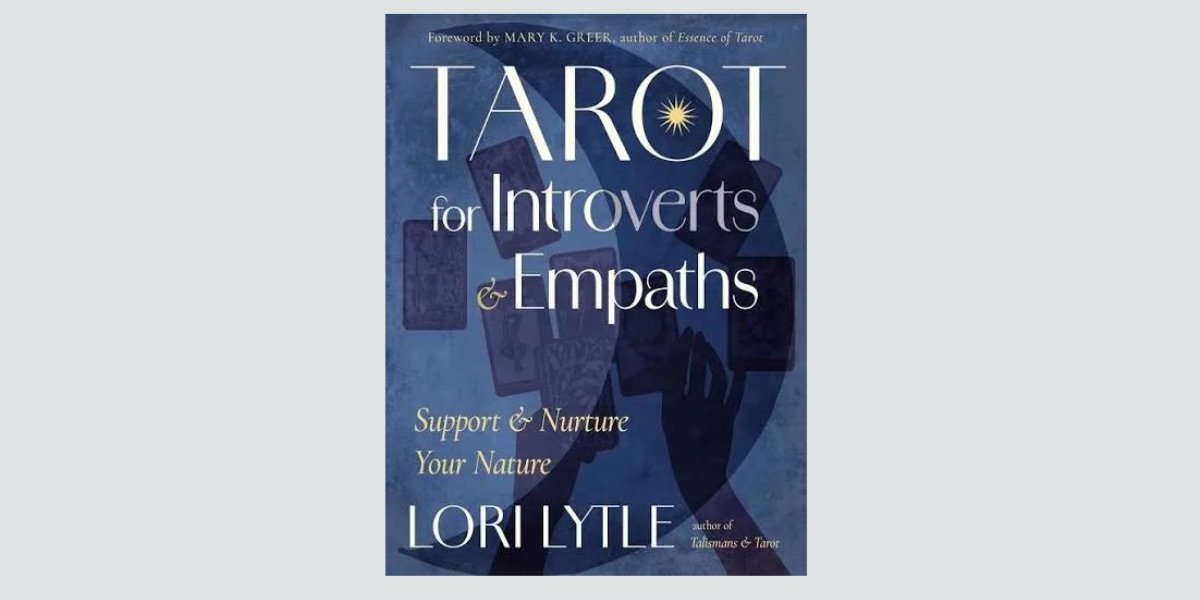
Tarot for Introverts and Empaths: Support and Nurture Your Nature, by Lori Lytle
Weiser Books, 1578638941, 288 pages, November 2026
Introverted, empathic, or both? Lori Lytle revisits this prompt again and again throughout her exploration of the tarot and the role it can play in one’s life. In Tarot for Introverts and Empaths, Lytle takes the reader on a grand tour of every card in the traditional tarot deck, sharing insights she has gained from each card throughout her own journey as both an introvert and empath. With each card, she invites readers to reflect on their own experience as an introvert and/or empath and how different facets of this experience are reflected in the image and energy of the card. Ultimately, Lytle hopes to inspire other practitioners to discover the sacred and healing space tarot can provide to those, like herself, who face the challenges unique to an introverted and empathic life.
Tarot for Introverts and Empaths is divided into three main sections. “Part 1. The Players”, provides a general introduction to the tarot itself, as well as an overview of the primary attributes that characterize an introvert and an empath. “Part 2. The Cards” then delves into the cards one-by-one, starting with the Major Arcana and then journeying through the four suits of the Minor Arcana, and ending with a short interlude covering Soul, Personality, and Year Cards. This section is the heart of the book, where Lytle provides not only a discussion of each card, but journal prompts, spreads, spells, meditations, and other exercises to guide the reader to their own insights about the cards. “Part 3. The Practice”offers a short conclusion and a final spread integrating the author’s insights into a final message of advice and inspiration.
As my own experience with the tarot is still limited, I appreciated the first part’s overview of the deck and its structure. The suite of characteristics Lytle ascribes to each suit were helpful to bear in mind throughout the rest of the book, as she relates aspects of each suit/element to the introvert/empath experience. For example, Wands don’t simply indicate passion, but “passions that inspire us to become temporary extroverts”1; Cups relate to feeling the emotions of others and ourselves; Pentacles involve creating energetic shields; and Swords can relate to overthinking or perfectionism. Notably, these two characteristics of Swords are the only ones among the four suits to have inherent negative connotations, reflecting the particular challenge introverts have with getting lost or stuck in their own thinking and planning.
In Lytle’s own journey, tarot has served as a sacred container to unfold the inner weavings of her introverted mind, as well as to distinguish and separate the currents of feeling and emotion that originate from herself and those stemming from others. As she goes on to describe key attributes of introverts and empaths, she uses a series of cards and corresponding journal prompts to elucidate themes of the introvert/empath experience.
For instance, she uses the 9 of Pentacles, Hermit, Star, 4 and 7 of Swords, and 4 of Wands to expand upon how introverts must balance the need for solitude with the energetic demands of social, extroverted activity. And for the empath’s capacity for emotional connection to others and the environment, Lytle showcases the 2, 5, 7, 10, Knight and Queen of Cups, the 4 of Pentacles, and The World. She conveniently provides black and white images of the classic Rider-Waite-Smith (RWS) Tarot cards, so the reader can easily follow the discussion of each card’s symbolic meanings.
Moving into the heart of the book, Lytle takes us on the “Fool’s Journey”: an exploration of archetypal patterns within the Major Arcana, starting with The Fool (card 0) and ending with The World (card 21). Each entry starts with the card image and a description, which moves from a more general interpretation to specific meanings the card can carry for introverts and empaths. Lytle then prompts the reader with three potential journal topics, allowing the reader to conduct their own exploration of the card’s symbols and meaning. Every card entry concludes with an affirmation/mantra, as well as a unique spread or activity meant to engage with the themes and energy of that card.
I was drawn to Lytle’s multidimensional approach to The Lovers card, and was intrigued that she takes self-love as the foundational theme of the card. As self-love is a challenge for me–likewise for many introverts who live with a persistent inner critic, an exacting superego–I was somewhat taken aback by the card answering the question: “How can I offer greater love and kindness to myself?”
It was the fierce, scything Knight of Swords charging directly at the Page of Pentacles, who answered “What do I love about myself?” Am I supposed to intellectually slash myself to ribbons with even greater intensity? Yikes! Yet, considering Lytle’s interpretation: this Knight exudes certainty and is laser-focused on his goal–no room for self-doubt or changes of direction–it dawned on me that I might outflank my inner critic with fully committed action. As an introvert who’s often stuck in analysis paralysis, this truly felt like an invigorating blast of cold wind! A greater capacity to love myself arises from focused action towards my goal, rather than solving the problem of what is the best, most worthwhile, goal to pursue.
In the final section of the book, Lytle offers some advice about reading for oneself and others which I found especially insightful. By using spreads with specific placements and prompts for each card, this helps to navigate between one’s own biases and blind spots. Without a structured spread, a solo reader can easily slip into seeing only what they want, or fall into endless second-guessing (especially as an introvert). But Lytle’s greatest advice pertains to reading for others:
“You don’t have to amaze others with your accuracy; you don’t have to heal their deepest wounds,” even when the empath in you wishes to. “[F]ind your own unique style and stick to it.”2
When you treat tarot as a sacred container and allow your readings to flow from the unique relationship you have with the cards, insight and guidance can emerge free of people-pleasing or providing answers you think they want to hear. You can never be certain which aspects of a reading will have a significant or lasting impact on the seeker–including yourself!
Overall, I would one hundred percent recommend Tarot for Introverts and Empaths to other introverts and empaths wishing to deepen their relationship to the tarot, and illuminate aspects of their own souls in the process. Even for extroverted or less empathic readers, the book can serve as a glimpse of “the other side:” the ever-expanding, interior landscape of those quiet, unassuming folks, who might outwardly seem boring or disengaged. For true tarot veterans, Lytle’s discussion of the cards might be a little basic, but the plethora of spreads, journal prompts, and other activities associated with each card opens plenty of space for rich exploration.

Zak has two master’s degrees in philosophy, from Brandeis University and University of California Santa Barbara. He is currently the lead editor for Dungeons in a Box, and he spends much of his time in the realm of fantasy crafting new plots and ensuring the adventure is in mechanical balance. When he’s not DMing, he also enjoys hiking, studying eastern philosophy, and playing board games.