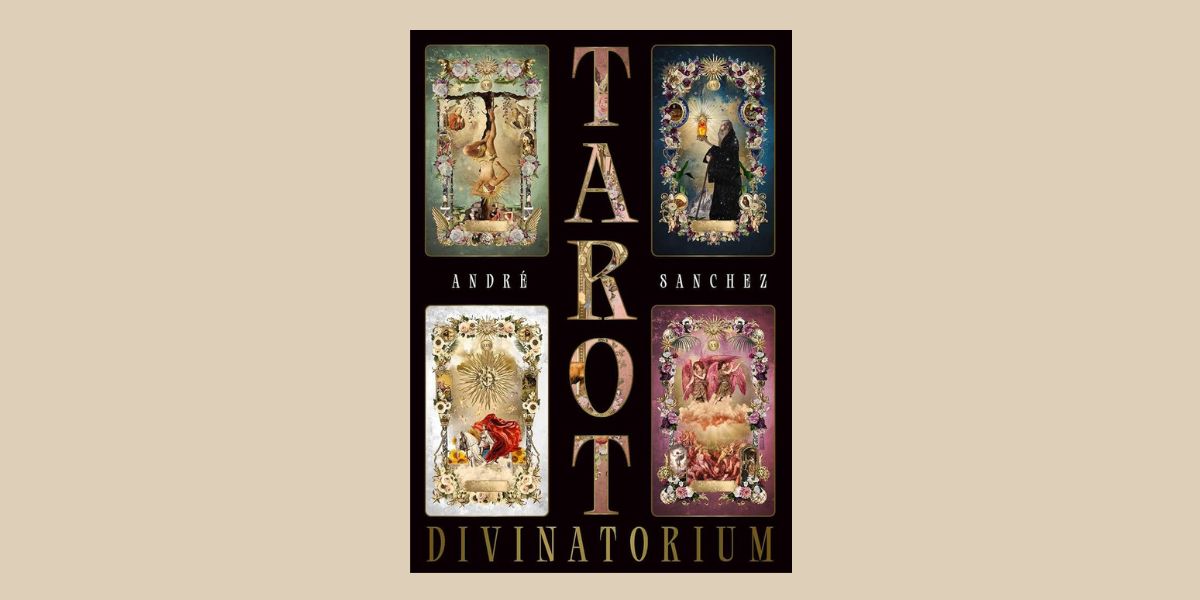
Tarot Divinatorium, by André Sanchez
Rockpool Publishing, 1923208470, 176 pages, 76 cards, April 2026
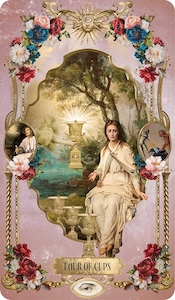
Art lovers rejoice in the stunning Tarot Divinatorium by André Sanchez! This elegant deck, designed to honor the history of tarot, transforms the traditional Rider-Waite-Smith (RWS) structure into a lavish visual language of art, symbolism, and beauty. Through intricate digital collage and classical art aesthetics, Sanchez invites readers into a time “where gentle noblemen and women await your queries with open hearts and reassuring insights.”1
At first glance, the deck is breathtaking. Rich gilded borders frame each card like museum masterpieces, while layers of Renaissance and Baroque imagery create an atmosphere that feels both timeless and surreal. Rather than simply reproducing Pamela Colman Smith’s iconic scenes, Sanchez reconstructs them using fragments of historical paintings, religious iconography, botanical motifs, and celestial symbolism. The result is a deck that feels luxurious and elegant.
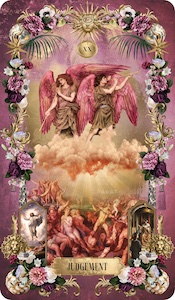
What’s even cooler is that Sanchez had depicted classical paintings into every card. On the border, there are two paintings, representing the positive aspects (left side) and negative aspects (right side). These painting vignettes give readers a whole other layer of symbolism to work with, as you can go learn about the painting/artist, research it, and look at that too for further intuitive insights. For those who love art or art history, this is an amazing element of this deck; it’s something I’ve never seen done before.
I find it very fascinating to think about the time and dedication Sanchez put into creating this deck, meditating on the different meanings of the tarot cards and finding not just one but two paintings to represent the polarities of the cards’ meanings. It’s so neat to see these little paintings within Sanchez’s own original artwork, bringing such fascinating layers of meaning to the deck. This is definitely one of the most creative interpretations of tarot that I’ve seen.
Looking at this deck gives me the same feelings I felt walking around Philadelphia Museum of Art just the other day: awe and inspiration. The energy of this deck is regal, majestic, romantic, opulent, contemplative, and sacred all at once. There’s a luminous, timeless feeling that comes from gazing at the tarot archetypes depicted with Sanchez’s artistry, with each card hinting at hidden wisdom and every frame inviting closer inspection. I like how Sanchez didn’t do all borders the same way, so placement of the painting vignettes varies, giving the eyes an adventure of finding the little details. I could gaze at these cards all day long!
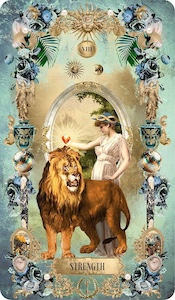
As for the guidebook, it’s well illustrated, colored, and easy to hold in one’s hand. For each entry, Sanchez provides insight into the meaning while also explaining the card’s imagery for further clarity. He also shares information about the left and right vignette, so readers know the paintings depicted and gain knowledge about how it represents the message of the card.
There’s a headlined subtext for each card too, which is useful for those who want quick guidance. For example, it reads “New Spiritual Power”2 under the Magician, and “Exciting Invitations”3 under the Knight of Cups. I appreciate these quick descriptions because they make it easy to piece messages from spreads that have multiple cards.
This goes to show that while there’s a lot of artistic complexity and symbolism within the deck, the guidebook distills it quite nicely, making it accessible for all readers to find meaning. The familiar RWS framework ensures that experienced tarot readers will immediately recognize the narrative and symbolism of each card, while newcomers could still comfortably learn the traditional system without feeling overwhelmed. The imagery expands upon the original card meanings rather than obscuring them, making the deck equally suitable for intuitive readings and deeper symbolic exploration.
One of my favorite cards in the deck is The Devil. In the card, a semi-transparent veiled naked woman looms standing on a crescent moon with a black goat at her heels and snake wrapping around her leg. She has black wings and a crown of black and red flowers. Looking at it carefully, one notices black candles burning on each side too. Sanchez highlights all these symbolic elements in the guidebook entry, writing:
“There is an energy of obsession and jealousy surrounding this situation: the need for others to be obedient and bow to your will and the need to control. An element of weakness when faced with temptation is indicated.”4
Very potent! And the paintings associated with it are Portrait de Bacchus by Peter Paul Rubens (positive aspect) and Temptation of Saint Anthony by Joos van Craesbeeck (negative aspect). I really enjoyed going and spending time looking at these images as well.
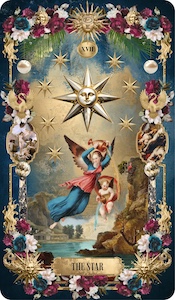
Overall, this riveting deck is filled with avenues to explore. Sanchez preserves the symbolic integrity of the RWS system while presenting it through a contemporary artistic lens rooted in classical mastery and beauty. The result is a tarot deck that feels both familiar and refreshingly original. This is a collector’s deck that is equally capable of serving as a practical reading tool.
Whether displayed as an art piece or used for daily divination, Tarot Divinatorium offers an immersive experience that reminds us tarot is not only a system of symbols but also a visual language capable of transcending time through artistic legacy. Readers who appreciate fine art, layered symbolism, and intricate design will enjoy this deck. There’s so much to explore, and it’s a very compelling deck to work with time and time again for inspiration, creative appreciation, and discerning wisdom.

Alanna Kali is an astrologer, numerologist, and pioneer spirit that loves to explore life through the lens of depth psychology. She has a passion for studying the humanities and social trends. Her academic work is centered upon reuniting body, mind, and spirit through eco-psychology. She loves reading, spending time in nature, and travel.