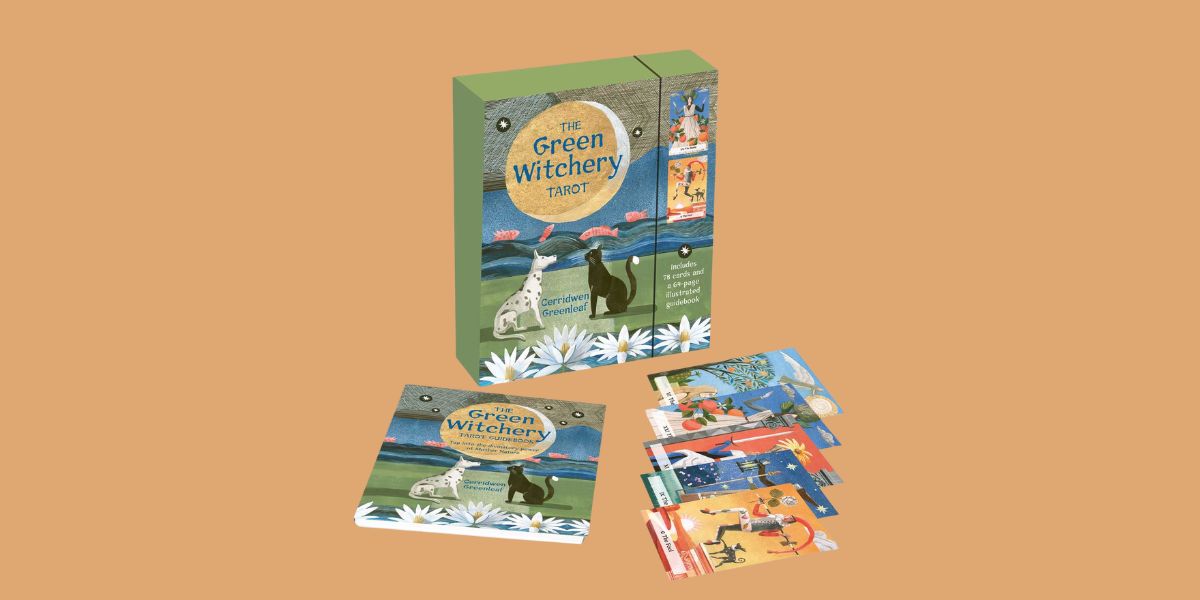
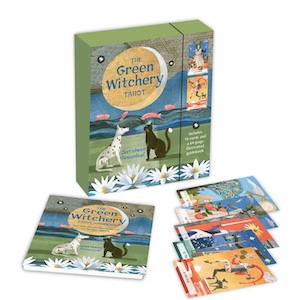
The Green Witchery Tarot, by Cerridwen Greenleaf
CICO Books, 1800655916, 78 cards, 64 pages, March 2026
Where tarot offers a mirror for the soul, green witchcraft grounds this insight into the living world through flowers blooming in their season, herbs gathered with intention, moonlit rituals, and the steady guidance of the Earth itself. Together, they create a practice that is both mystical and deeply embodied: one that invites us not only to seek answers, but to reconnect with the rhythms of our intuition, our environment, and our own inner magic. The Green Witchery Tarot by Cerridwen Greenleaf weaves these paths together, creating a deck where the whispers of the natural world nurture the wisdom already growing within you.
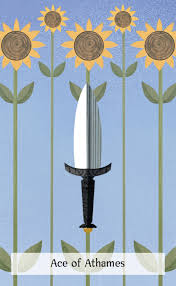
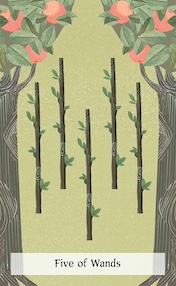
Perfect for Pagan readers, The Green Witchery Tarot carries the energy of nature reverence, offering gentle guidance and botanical ritual inspiration. The design of the deck and format of the guidebook make it quite accessible for readers of all levels. There’s a simplicity to the deck, as only the Major Arcana and Court Cards have illustrations of people or animals on them. The Minor Arcana cards have a different color and plant background for each suit and feature just the number of the suit symbol (crystal (pentacles), athamae (swords), goblet (cups), and wands). I appreciated this design choice because it decenters humans and invites the energies of nature to come front and center.
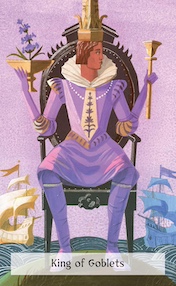
As for the aesthetic, the Court Cards and Major Arcana look a bit like a storybook version of medieval tapestries. The illustrations are flat, stylized, and a little stiff in their posture, which remind me of iconography. There’s whimsy, but it’s structured. I was a little surprised by the images at first, as many nature-inspired decks tend to have softer illustrations, but there’s something about the images that works well for the energy of the deck. It gives the cards a timeless, old-world magical feeling, bringing forth unique symbols to draw from as you read the cards.
The illustrations stick pretty close to the traditional Rider-Waite-Smith (RWS) deck though, so people already familiar with those images will easily be able to read with this deck. Similarly, this deck is a suitable one for beginners learning the traditional card imagery that isn’t the standard RWS deck, great for those who want to infuse their practice with some earth-based magic. It’s pretty neat how the Major Arcana cards are “accompanied by trees, herbs, and flowers, as well as tools of green witchery” to further bring dimensions to the meaning of each card.
Referencing the guidebook is a great way to get acquainted with the subtleties of this deck. The full-color book is nice and big, easy to hold in one’s hand and read. There’s a table of contents, so readers can quickly find the card they’re looking for. Greenleaf provides a bit of direction for working with the deck and offers spreads to get started with.
As for the card entries, for the Major Arcana cards entries Greenleaf offers insight into the symbolism, the meaning, one-sentence guidance, and a practice that can be done. This is a really nice combination because it offers practical advice, symbolism to contemplate, and an action that can be done to integrate the energy. The practices are varied too, ranging from gazing at a white flower and thinking about the good things ahead (The Fool) to creating a magical ink to boost your self-esteem (The Lovers) to removing negative energy by placing a bowl of salt and a bowl of water on your altar (The Tower).
The Minor Arcana card entries are a bit shorter, only sharing the card’s meaning and practice. However, this was more than enough to continue to work with the cards in a magical way. The Eight of Athames suggests lighting sandalwood incense, while the Ace of Goblets encourages carving a heart into a lavender-scented candle. For the magically-minded that like to do hands on crafting or spellwork, the guidebook has 78 ideas of how to incorporate the tarot into meaningful practices! This is definitely what makes the deck so valuable to me.
Here’s an example of how I utilized one of the practices recently: I had a blessing for my new daughter, which included a community maypole dance. My family and my husband’s family are both entirely Catholic, nevertheless we decided to have the ceremony in alignment with our own spirituality (opening a circle, blessing my daughter with all the elements, Pagan prayers, and of course, the maypole).
I was a bit nervous about how it would go, so I pulled a card for guidance. The card I got was Seven of Athames. Greenleaf’s guidebook entry reads:
“Customarily, this card warns of opposition and urges you to protect your beliefs with resilience. Find courage under pressure and swap doubt for determination.”1

While the message alone was enough to give me the encouragement I needed to be true to my own beliefs, it was the practice that really helped me get out of my head and back into my magical sense of trust. The practice Greenleaf suggests for this card is holding an obsidian stone and visualizing a shield around you to bolster your resolve and defend intellectual territory. Doing this practice before the blessing ritual definitely gave me the energy I needed to tune out the judgement of others (specifically my staunchly “religious” father-in-law) and be in my own high priestess energy.
Overall, The Green Witchery Tarot is a multifaceted tool that one can use for both divination and magical practices. This combination of oracle wisdom and Earth-based magic, which is reflective of the tarot energies, make for a very well-rounded deck. Readers gain insight into plant symbolism while also seeing the traditional tarot energies from a new perspective.
I would definitely recommend this deck for those interested in plant magic. It’s a deck that quickly becomes a ritual companion, as it’s easy to integrate into one’s daily life. Working with this deck attunes readers to the magic of the natural world and reminds us of the special energies we can tap into to ground our tarot readings.

Alanna Kali is an astrologer, numerologist, and pioneer spirit that loves to explore life through the lens of depth psychology. She has a passion for studying the humanities and social trends. Her academic work is centered upon reuniting body, mind, and spirit through eco-psychology. She loves reading, spending time in nature, and travel.