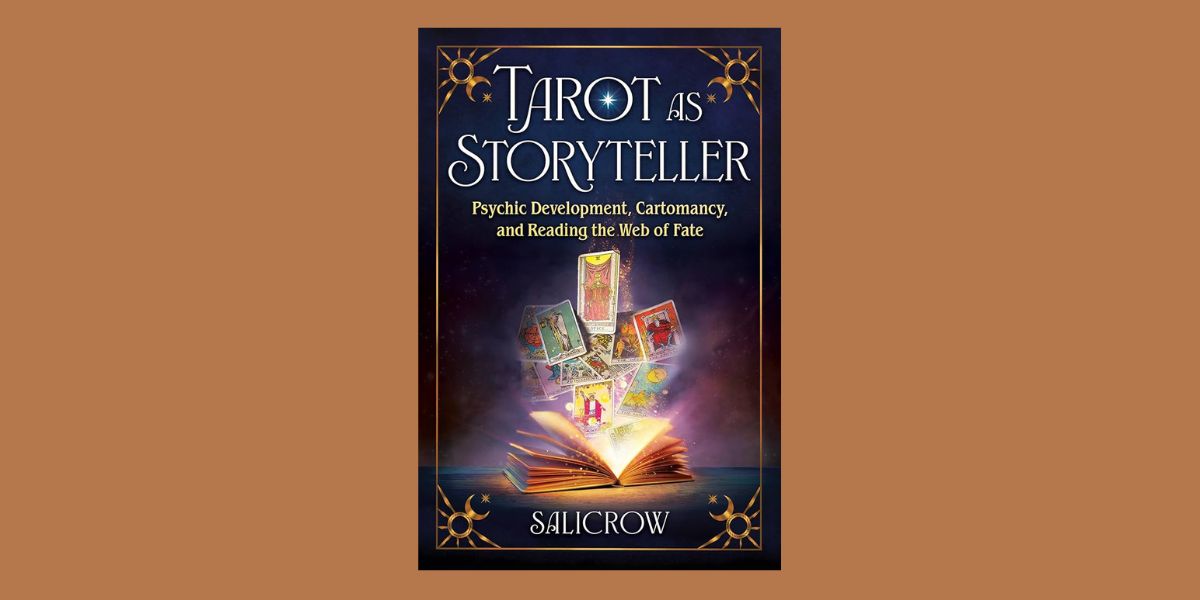
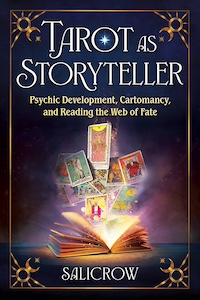
Tarot as Storyteller: Psychic Development, Cartomancy, and Reading the Web of Fate, by Salicrow
Destiny Books, 979-8888502068, 320 pages, June 2025
It’s one thing to memorize the meanings of tarot cards, but it’s another level entirely to weave them together into a story. Tarot as Storyteller: Psychic Development, Cartomancy, and Reading the Web of Fate by Salicrow is an engaging guide that invites readers to view their cartomancy practice not just as rote card-reading but also intuitive storytelling. Sharing her decades of wisdom, Salicrow teaches cartomancy as a psychic and intuitive art through which readers can become skillful narrators of the cards that are dealt.
Divided into three sections, the book begins with “Psychic Storytelling”, the foundational topics of the psychic arts and divination. Salicrow provides an overview of what it means to be a seer, delving into topics like the different ways to receive intuitive information, empathic abilities, cartomancy, and lunar and solar cycles. Filled with techniques ranging from opening the third eye to entering a light trance state, this section lays a great foundation for anyone performing readings. She also emphasizes the importance of self-care and personal healing work too, as this can fuel one’s psychic activities and shape one’s interpretation of the cards:
“Having walked through our wounding and out the other side we are often far more compassionate and understanding of other people’s situations, and sometimes our personal experience is what holds the best path for others as well.”1
From here, Salicrow moves into the art of storytelling through the cards. Salicrow offers methods for readers to tap into the living thread that connects the cards and querent, specifically tapping into the web of fate, seeing karma within the cards, and asking the right questions. All of this is done with integrity and ethical consideration, another topic Salicrow covers.
One of my favorite pieces of advice from this section was to create space in a spread or reading to hone in helpers. Salicrow writes, “we should docs on things like how the querent knows them, what they look like, what position do they hold, and the best way to contact them.”2 Reading this was like a huge dong on the head for me. I get so caught up in my own inner world during readings, leaning towards a spiritual interpretation, that I often forget the cards can also provide practical, direct guidance too.
I also extremely enjoyed Salicrow’s take on telling time in tarot. She offers some suggestions for telling time, but overall explains how timelines are always changing. I love her metaphysical explanation for why readers don’t always get the timing correct:
“People often change their own timing by rushing ahead or putting the brakes on after a reading.”3
Mind blown! I had never thought about how the reading in turn impacts the timeline of unfolding events.
Similarly, I enjoyed Salicrow’s approach to readings as open-ended rather than pre-determined. She encourages readers to keep going until a pathway that feels good is seen rather than accepting things as-is if it doesn’t feel right. Her techniques shared in the next section “Spreads and Layouts”, such as activated prayer, healing boards, and spellwork, give agency to the readers, allowing them to weave the web of fate through their focused intentions.
Within this second section, Salicrow also offers a variety of card spreads. There’s one for each turn of the Wheel of the Year, along with “soul-level card spreads”4 that assist with identifying soul purpose, querent’s magic, communication gifts, and more. She suggests exploring spiritual journeying, specifically through the story in the cards of one’s reading.
The final section, “The Tarot”, assists readers with creating their own personal connection to each card to draw upon when doing their readings. Salicrow writes:
“The images on the cards are interpreted through the psychic’s personal experiences and the knowledge they have obtained through study, which in turn translates into the information relative to the situation. The more personal experiences we have with a card, the broader our viewpoint.”5
To facilitate this relationship development with each card, Salicrow takes the readers through the Major Arcana, Suits/Minor Arcana, and Court Cards, offering a general description, what it means if you notice certain aspects of the card, and a guided meditation to journey with the card. I enjoyed reading this section, especially the way she groups the Minor Arcana cards. For each number, Salicrow covers all four suits at once, offering insights into commonality and contrasts within the cards. There’s also Rider-Waite-Smith pictures for each card, so readers can really get a good look at what’s being described even if they don’t have a deck on hand. At the end of this section, Salicrow covers numerology, offering yet another way to find the story within the reading.
There’s countless books on reading tarot, but Tarot as Storyteller really stood out as exceptional to me. I love all of the personal insight Salicrow incorporates into the book, as well as her overall approach to spirituality and tarot reading; I feel readers of all levels would benefit from her techniques, especially those of a beginner to intermediate level.
Approaching tarot through storytelling adds so many nuance layers, opening pathways for interpreting one’s readings and going deeper into the meaning of what the cards are revealing. This is where intuition, symbolism, and psychic awareness come alive, turning the assortment of cards within a reading into a cohesive narrative that speaks directly to the soul.
This book is perfect for those who want to hone their reading skills, especially if they have a goal of professionally doing readings. Reading tarot as a story moves the reading beyond card interpretation and into the realm of artistry, where intuition guides them to see the deeper message unfolding between the lines. True mastery of tarot comes not from reciting keywords, but from sensing the living thread that connects each card in a spread, and this is exactly what Salicrow teaches readers to do.

Alanna Kali is an astrologer, numerologist, and pioneer spirit that loves to explore life through the lens of depth psychology. She has a passion for studying the humanities and social trends. Her academic work is centered upon reuniting body, mind, and spirit through eco-psychology. She loves reading, spending time in nature, and travel.