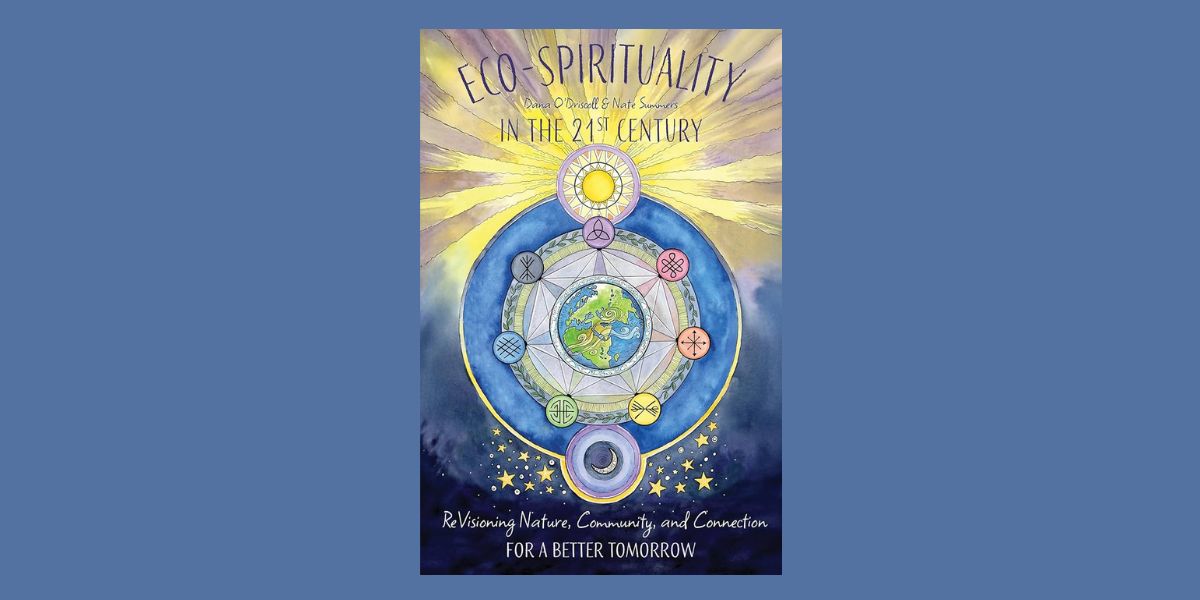
Eco-Spirituality in the 21st Century: ReVisioning Nature, Community, and Connection for a Better Tomorrow, by Dana O’Driscoll and Nate Summers
REDFeather, 0764370162, 208 pages, October 2025
Ecological spirituality is not simply a revival of ancient, indigenous traditions—it is an essential response to a world at a turning point. As climate instability, ecological degradation, mass extinction, and disconnection from the natural world deepen, humanity is being called to remember that we are not separate from the Earth but woven into its living community. Rather than viewing Nature as something to control or consume–”natural resources” to be harvested for human purposes, eco-spiritual paths invite reverence, reciprocity, and stewardship. They encourage us to open our senses, hearts, and minds to reestablish our relationships with the rhythms of the seasons and the wisdom of the land and its diverse inhabitants. This perspective is not rooted in nostalgia; it is profoundly future-oriented, establishing the sensual, social, and spiritual foundation needed to cultivate resilience, regeneration, and collective care.
Dana O’Driscoll and Nate Summers explore this timely shift in Eco-Spirituality in the 21st Century, presenting a vision of spirituality that blends ancestral awareness with modern ecological responsibility and calls readers toward a more conscious, participatory relationship with the planet–especially with one’s local ecology. In recognizing the spiritual sovereignty and sacredness of rivers, forests, soil, sky, and all living beings therein, we begin to understand that healing the Earth and healing ourselves are inseparable.
“[T]o fight anthropocentrism and all of its resulting problems and work to move us toward a biocentric, animistic philosophy that interweaves connections to nature (ovate practices), the world of spirit (druid practices), and the human community (bardic practices).”1
Remembering our place within the web of life may be one of the most important steps toward creating a balanced and compassionate future.
The authors use three perspectives–Ovate, Bardic, and Druidic–to explore the seven core principles of the new vision of eco-spirituality they present. Each chapter focuses on and unpacks one of the 7 R’s–Reconnection, Respect, Rewilding, Regeneration, Resilience, Reenchantment, and ReVisioning–interweaving the three perspectives to help readers establish new ways of relating to the natural world.
Going beyond mere discussion of each R theme, each chapter presents nature-inspired artwork and a trio of stories (the bardic perspective in action!) that provide a vision of how each theme manifests in past, present, and future. Accompanying each story, the authors offer plenty of example practices, journalling prompts, and other tools to help the reader cultivate deeper relationships to the natural world, other living beings, and the spiritual reality that grounds these relations.
While bardic practices help us to form human connections and grow communities based on shared values, the ovate perspective focuses on the renewal of our direct sense-experience and relationships to the panoply of living beings–plant, animal, insect, water, and mineral–in our local environment. The emphasis O’Driscoll and Summers place on engagement with one’s local ecology cannot be overstated, and is even one of the book’s greatest strengths. Far too often, books on similar topics tend to focus on large-scale (even global) social change aimed at destroying “the patriarchy” and (simply) replacing such structures with a new system of values.
The authors certainly support the decomposition of perspectives and values which have led to the vast imbalances in our relationships to Nature, other living beings, and the animistic spirits abiding therein. However, they also emphasize that action must start locally. It is only through real (Re)connection (chapter 1!) with the patterns of life in one’s immediate environment that we can move toward collective change.
Rather than engage exclusively in “green” political action, which often manifests as just a different form of human-centered control/manipulation that created these imbalances, Summers and O’Driscoll urge us to cultivate our awareness of and relationships with our immediate natural and social environment. Not only does this increase personal connectedness with Nature, neighbors, and kin, it also decreases our dependence on goods and services extracted and imported from their own locality (and the necessity of money to purchase such things).
In the final chapters, “Reenchantment” and “ReVisioning”, the authors state that this book is in fact an explicit work of magic meant to help birth their vision of a more connected, caring world. Although every chapter incorporates the druidic perspective, including examples and guides for cultivating ritual practices which deepen our relationships with the spiritual beings of the natural world, the latter chapters share a vision of a world that is overflowing with Spirit.
This Reenchanted reality is one where mutual respect and cooperation between the human, natural, and spirit worlds can bring about lasting, global change, despite being carried out at the personal and local scales. Within the druidic perspective, O’Driscoll and Summers rely on the familiar notion of microcosm/macrocosm–as above, so below, as within, so without–to characterize our place and role in the world. I found their response to our perceived sense of powerlessness in the world to be especially insightful:
“Modern Western culture teaches us we are insignificant, we cannot make a difference, and we cannot levy broader change… The principle of the microcosm/macrocosm suggests that you can make a major difference even by focusing your efforts in small ways.”2
One of my favorite aspects of Eco-Spirituality in the 21st Century is the perfect container the authors create for developing practices, rituals, and relationships with one’s local ecology. They are very careful to present practices/rituals as general guidelines, rather than as prescriptive rites that must be performed in a certain way. In fact, the reader is often advised to refrain from overly-formal or strict practices. Instead, the importance is to focus on one’s intention while adapting the practice to the needs of the particular environment and beings involved. This is precisely why the book begins with ovate-inspired Reconnection: attentive listening/witnessing to the needs of the land/spirits, asking their permission to perform rituals or harvest, and unceasing gratitude for their presence and support. These attitudes and behaviors are the living heart of the process that will ultimately culminate in our new-old ways of perceiving, relating, and co-creating a more balanced and harmonized life for humanity and all of Nature.
Overall, nearly any reader will find something of value in this magical tome, whether you’re taking the first steps to reevaluate your relationship with the natural world, or you’re a practicing druid or permaculture expert. O’Driscoll and Summers weave a beautiful story that both informs and inspires us toward a renewed vision of the World, starting with nothing more than dirtying our hands and feet in the living soil of Mother Earth.

Zak has two master’s degrees in philosophy, from Brandeis University and University of California Santa Barbara. He is currently the lead editor for Dungeons in a Box, and he spends much of his time in the realm of fantasy crafting new plots and ensuring the adventure is in mechanical balance. When he’s not DMing, he also enjoys hiking, studying eastern philosophy, and playing board games.