
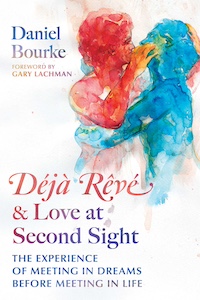
Déjà Rêvé and Love at Second Sight: The Experience of Meeting in Dreams before Meeting in Life, by Daniel Bourke
Destiny Books, 979-8888502716, 320 pages, January 2026
For those who are dream lovers, Déjà Rêvé and Love at Second Sight by Daniel Bourke is a fascinating compendium of unique dream experiences. This book explores the phenomenon of déjà rêvé (“already dreamed”), the experience of encountering something in waking life that you feel you’ve specifically dreamed before, not just vaguely recognized. The vast amount of documentation surrounding this experience makes it a worthwhile topic of exploration, especially for those intrigued by the idea of precognition.
“Is it possible to dream or otherwise mysteriously envision a future spouse, acquaintance, helper, healer, or even a shaman or saint before meeting them in life? To literally see the face, hear the voice, or sense the presence of another whom you are yet to meet and are nevertheless destined to do so? If our only witnesses were the voluminous records of legend, lyric, and lore on all corners of the globe then answer would be a resounding yes.”1
Jam-packed with hundreds of instances of déjà rêvé, Bourke has organized the chapters of this book by general themes. One of the first types of déjà rêvé covered focuses on healers, saints, sufis, and sheiks. The general focus of these stories is when people had spiritually significant dreams and then soon met the person in the dreams for healing or spiritual growth. Another chapter focuses on how dream visions aid people in making real life decisions. For instance, according to The Schism in England, translated by Pedro Calderon de la Barca, Henry VIII had a dream of Anne Boleyn before he ever met her.
Speaking of fated romances, there’s plenty of stories of dreaming of lovers before meeting them in real life. One of my favorite stories was from the biography of a 107-year-old man from Arkansas who dreamed about heading to a terminal and seeing a beautiful woman standing there who said to him, “You come to carry me home, James? I’m your wife.”2 and then he met the same woman in real life at a New Year’s Eve party later on.
Other chapters do focus on folklore surrounding divination and magic in regard to this dream phenomena, as well as the religious impact déjà rêvé had on some people after their experience. Bourke shares tidbits such as how among the Ilocano (a Filipino ethnolinguistic group), “a man sleeps with a dipper of water near his bed in order to see the reflection of his future spouse, needing to wake at exactly twelve o’clock.”3
Then there’s also a story about a man whose youth pastor encouraged him to pray to God for the person he would marry in the future. He then received a vision of the cross pendant his future wife would be wearing. Lo and behold, he met her when he went to visit a new church and the secretary was wearing the pendant. Wouldn’t you know it, the cross pendant had been a gift from her grandmother, who had told her it had special meaning related to her future husband, who would be drawn to it. Now, it might be easy to brush off these tales as romantic, exaggerated love stories that signify a relationship has a divine blessing, but the sheer number of tales Bourke shares really does expand the reader’s perception of just how common déjà rêvé has been throughout time.
One of my favorite chapters in the book is “Picture Perfect”, which had a sections like “Media and Murder in Motion” and “Death, Ghosts, and Near Death”. Can’t help it—I love thrillers! But beyond the typical dreaming of a partner or spiritual aid, these stories had practical applications, such as solving a crime or reconnecting loved ones with someone who had departed.
What makes the book stand out is its scope: it gathers hundreds of accounts from folklore, historical texts, memoirs, and modern reports, aiming to create one of the first comprehensive collections of this phenomenon. While modern society might have an unhealthy dose of skepticism, many cultures historically have accepted dreams as predictive or spiritual messages. Bourke pulls from an unusually wide range of sources (saints, shamans, historical anecdotes, and contemporary experiences) showing that dream-foretelling appears across cultures and eras. This gives the book a mythic, almost archetypal feeling, as though you’re reading a global folklore archive rather than a single-author thesis.
This said, I found reading it to be overwhelming at times. It took me a few months to make my way though, and it was mostly because I kept getting mentally overloaded. While I was drawn to Déjà Rêvé and Love at Second Sight because I wanted to be immersed in the liminal space of dreams and discover something about their ethereal nature, the content is more along the lines of reporting on this dream experience rather than providing discussion on its significance or the meaning of reality understood through the exploration of this paranormal phenomena.
I would often get a bit of whiplash with how it jumped from one story to the next, quickly spanning time periods and cultures. There’s cohesion, but it’s definitely a book that keeps you in your mind, bombarded with recorded accounts rather than tapping into the spiritual dimension. I actually found this amusing, as dream books usually make me feel a bit spacey or ungrounded, while this one made it feel too stuck in reality with names, dates, and recorded experiences spanning centuries and the whole world.
Plus, the unfamiliarity with many of the cultures or historical time periods had me grappling just to wrap my head around the context of the story, ultimately preventing me from fully engaging with the content. I am all for cross-cultural examination, but one paragraph being about a Burmese writer in the early 1990s quickly followed by another featuring a tale of an Welsh American explorer in central Africa in the 1800s, which within the same paragraph talks about another American explorer living with the Ojibwa Indians of the Great Lakes between 1763 and 1764, you can see how my head could get spinning pretty quickly. Like where am I located in time and space?! I guess in some ways, I did get that untethered dream experience, but not how I was hoping!
Overall, for readers interested in dreamwork, synchronicity, psychic or intuitive phenomena, this comprehensive text will feel quite validating, highlighting just how common this phenomena of déjà rêvé is worldwide. I would definitely recommend Déjà Rêvé and Love at Second Sight for those who enjoy gathering stories, as Bourke collects and presents rather than rigorously interrogates. The documentation of the mystical experience of already dreamed gives backing to further discussion about the nature of reality, purpose of dreams, and the way people are connected. This book is a great launching pad for further study of a very intriguing topic!

Alanna Kali is an astrologer, numerologist, and pioneer spirit that loves to explore life through the lens of depth psychology. She has a passion for studying the humanities and social trends. Her academic work is centered upon reuniting body, mind, and spirit through eco-psychology. She loves reading, spending time in nature, and travel.