✨ A Gathering Place for Magical Readers and Writers ✨

Tag Archives: rewildling

Feral Magick, by Denny Sargent

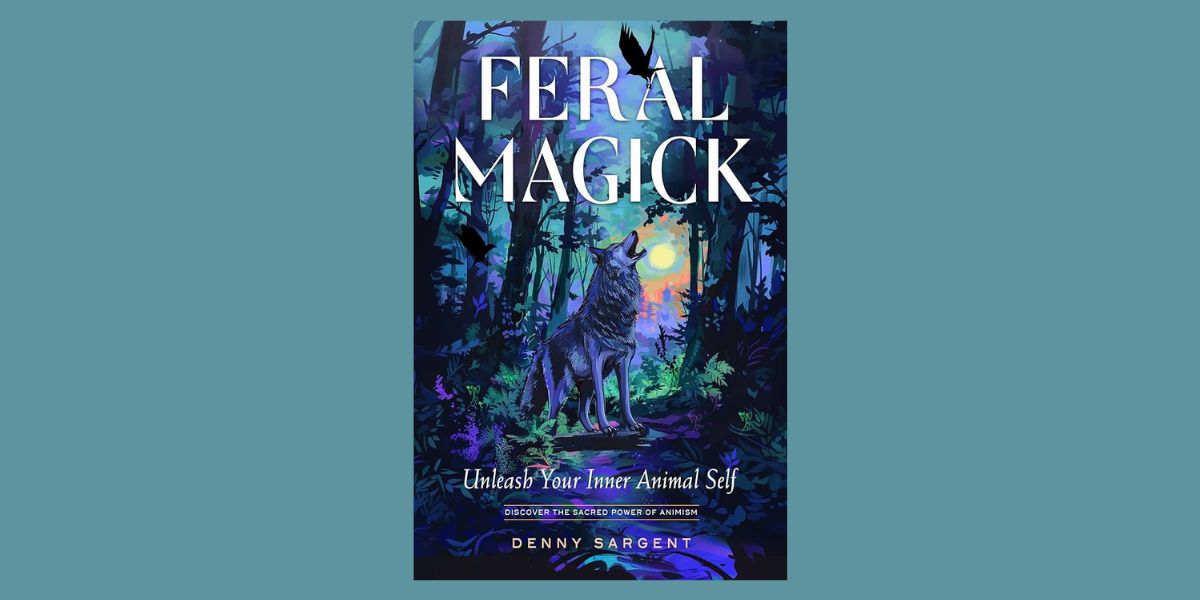
Feral Magick: Unleash Your Inner Animal Self, by Denny Sargent
Weiser Books, 1578638518, 208 pages, July 2025

Feral Magick: Unleash Your Inner Animal Self by Denny Sargent is an insightful read on the world of animism. The book’s title initially is what caught my attention. I have no experience with animism or with feral magic, but this book is a perfect stepping stone for those who want to have a deeper connection with the animal spirit inside of them.

“When you “wake up” to the wild world of Neo-Animism, you find yourself in a world that is filled with many amazing spirits and awesome powers.”1 

The book is divided into two parts: “Discovering Wild Nature” and “Feral Magick Practices”. “Discovering Wild Nature”, which goes through chapter six, is described as a sort of spiritual training manual, while “Feral Magick Practices” is preparing us for more complex work.

In the beginning of part one, we learn how to connect with that animalistic side by reconnecting with nature and the spirits of nature. Sargent teaches how to become more open to the wild and work alongside your spirit animal. With all of this being a very new topic for me, Sargent explained the process of getting connected and in tune with these animal spirits quite well in chapter two, “Return to Deep Nature”, and in chapter three, “Sensing Nature”. She guides you into reconnecting with nature spirits by listening and paying attention to the sounds around you, taking in the scent of the forest around you, and just simply relying on your senses to connect you on a deeper level with the animal spirit.

Then after connection comes working on intuition, instinct, and insight. Some other things covered are working with the primal spirits, how to differentiate from helpful and harmful spirits, and how to approach each one. Chapter six, “Communing with Nature Spirits” goes over learning about the spirit-kin and how to work with it. I was very excited to see Eikthyrnir being mentioned when learning about divine associations! Great example!

Then we move into part two, which gets into the nitty gritty of it all, the more complicated work. Chapter Seven covers what tools are used and what is needed for a proper altar. Then the rest of the chapters into this go into the more intermediate topics. Chapters Eight through Chapter Sixteen cover topics ranging from unleashing your animal self and discovering the Genius Loci to classifying the sacred animals, bonding and trance states, and shapeshifting.

I found it cool to learn about the Ulchi people. I’ve never heard of them before so I ended up doing my own learning adventure on the tribe. This gave me more insight on how other tribes practice animism, such as the Hopi that were also mentioned. Sargent was very helpful in providing a history lesson on animism. It’s extraordinary to think that this practice goes all the way back to 100,000 years ago!

Another thing this book taught me was how to slip into a liminal state. The method taught by Sargent really seemed to help me more than the other methods I’ve been trying. Right now, I don’t feel ready to try more advanced exercises or practices, but some of the practices I do daily are meditation and journaling. Down the line, I think trying the dream magick practice in this book down the line would be fun. I also might try out the “Recapturing Spirits of Childhood” practice too.

I would say once you are on the part of your journey where you’ve acquired the knowledge and the confidence to try a new path, this would be the time to get Feral Magick; it’s best for an intermediate witch. Additionally, if you are looking into nature-based paths, I would recommend adding this to your reading list. As Sargent writes, “Everything about feral magick and Neo-Animism is about nature. Everything.”2 The topics in this book are very interesting and worth the knowledge!

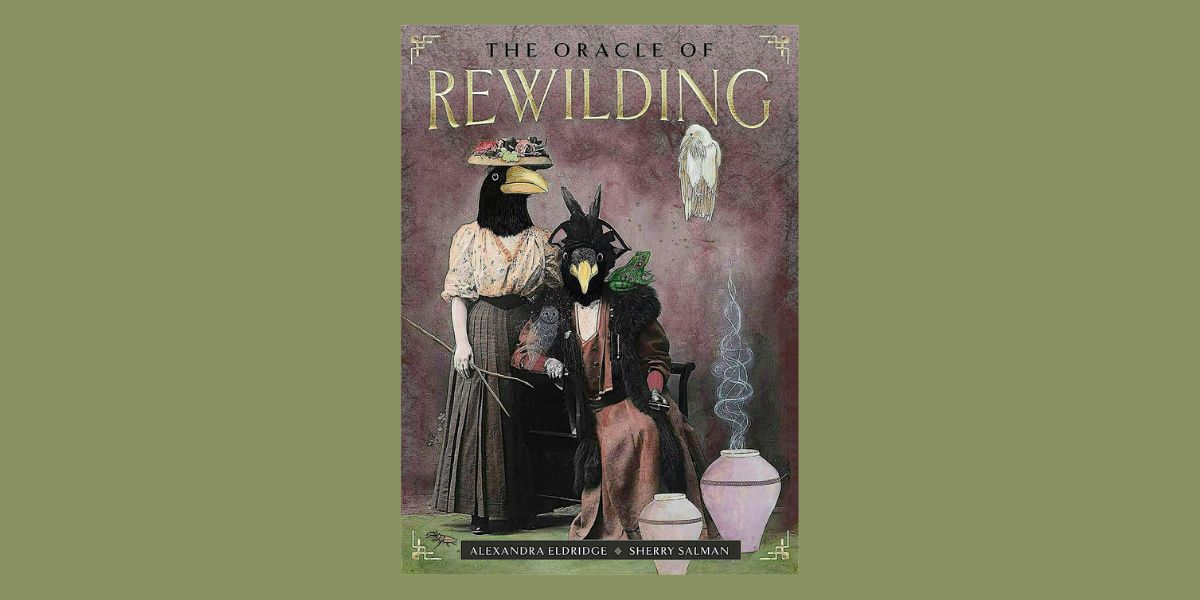
The Oracle of Rewildling, by Sherry Salman and Alexandra Eldridge

The Oracle of Rewilding: Pathways to Renewing Our Kinship with All Things, by Sherry Salman and illustrated by Alexandra Eldridge
Red Wheel Weiser, 9781578638239, 176 pages, 44 cards, June 2025

In Sherry Salman’s new deck, The Oracle of Rewilding: Pathways to Renewing Our Kinship with All Things, she pays homage to the transformative power of rewilding—both as a practice and as a mindset. The author intertwines fairy tales, ecological insights, and spiritual messages to craft a narrative that is insightful and inspiring. Rewilding, as presented in this deck, is not solely about returning to untamed landscapes but also about rediscovering the instinctive, untamed animal essence within each of us.

Sherry Salman, PhD, LP, is a Jungian psychoanalyst, who teaches and writes for the Jungian Psychoanalytic Association. She also consults for the Archive for Research in Archetypal Symbolism in NYC. Known internationally as a speaker on “the creative imagination in postmodern culture and psychological life”3, Salman’s work has been published in numerous books and journals.  Her book, Dreams of Totality, discusses symbolism and imagination and our struggle with modern living.  You can learn more about Salman on her website.

Eldridge says this about her work:

“My paintings emerge from a place where contradictions are allowed, paradox reigns and reason is abandoned. My search is for the inherent radiance in all things… the extraordinary in the ordinary.”4

The Oracle of Rewilding is a collection of 44 cards and a guidebook that shares a rare glimpse into the kinship between man and the animal kingdom:

“Although we will never really know what it’s like to be a stag or a rabbit, a wolf or a bird, we can still imagine it. In fact, as humans, we have always done so-in art, in story, and in myth.”5

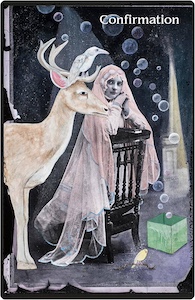
Eldridge uses a combination of the glass plate negatives and the addition of artistic elements to create these windows into the heart and soul of this kinship. The glass plate negatives hail from 1880-1920 and the author explains that this time frame was selected purposefully:

“It was an era when there was excitement about Charles Darwin’s findings that emotions exist in both humans and animals; it was the beginning of land conservation and wildlife preservation, the emergence of modernism in the arts, the invention of photography and the X-ray. Simultaneous with these developments, there was an enthusiasm for peering into the ethereal beyond.”6

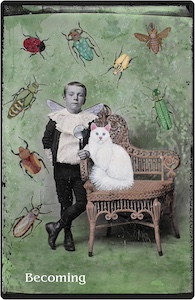
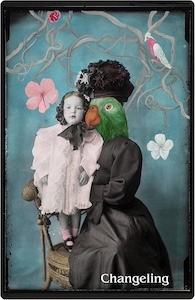
Although the glass plate negatives are used as a base for Eldridge’s art, these are only a starting point. For example, Eldridge paints bird, lioness or wolf heads on ladies and fox, stag and goat heads on gentlemen.  She adds angel wings to children and lots of birds and flying insects throughout the deck. Fish, octopus, and other water creatures also come to play.

Although the glass plate negatives would create black and white images, Eldridge has skillfully colorized the images.  Sometimes, she highlights the eyes, sometimes the clothing and other times the background. The colors are soft pastels, reminiscent of colorized versions of these photos from another time. 

To fully explore this deck, I pulled a daily card for seven days.  The cards never failed to mesmerize and bolster me with the guidance and symbolism shared. One of my favorite cards is called Forgiveness. It features a woman in a blue dress with a crisp, white collar and the head of a dove. She is shown handing a rose to a cat on a table. The guidance recommends “it may be time to come home to the tranquility and peace that forgiveness offers.”7

Salman presents a unique way to welcome and honor forgiveness:

“Start with just cultivating the feeling and tangible scent of forgiveness itself. Then let that feeling radiate outward. This takes a lot of practice and includes the soothing of vengeful impulses that persist.”8

I love and appreciate the softness of this type of forgiveness, as well as Salman’s narrative of the myth of the dove in literature and history. Including this information provides a backstory that grounds the reader in preparation for the wisdom that is shared at the end of each section.

One of the best aspects of The Oracle of Rewilding is its lyrical yet accessible prose. The author’s voice is filled with passion and clarity, a rare combination that makes complex ecological and spiritual concepts understandable for a wide audience. The deliberate pacing and vivid descriptions evoke a sense of wonder, pulling readers into a world where each animal, insect, and natural habitat holds a story.

The guidebook is designed for easy navigation with the cards arranged in alphabetical order along with a Table of Contents. Salman explains that she has done so only for the reader’s convenience, and she invites us to use them in a “nonprescribed order.”9 Salman includes a lengthy introduction to the concept behind the cards, including some history, notes about Jung and a discussion of shapeshifting. She also includes two ideas for card spreads.

The guidebook includes a four-color copy of each card, a brief description of the card images, keywords, and the background of the card.  The final entry is guidance or wisdom. At the back of the book, Salman includes a list of books for further reading. 

The cards are standard card size and are printed on good quality card stock. The edges are dipped in silver and the back of the cards features a soft mauve background and a white bird. The cards also feature a matte finish, which blends well with the feel of the artwork.  The kit is housed in a beautiful two-part box with an indentation for the cards. The box color is also mauve.

The inside of the box features a frog; the box lid highlights a jackrabbit and the back showcases four of the cards.  On the cover, Eldridge has chosen to feature two women wearing the heads of crows, paying homage to the card entitled Divination. While the box cover is printed with a matte finish, Eldridge has added stamped, silver type for the title, corner accents and other bits of type around the edges of the box lid. The effect is quite striking.

Whether you are an environmentalist, a mystic, or simply a seeker yearning for a deeper connection to the natural world, The Oracle of Rewildling holds profound messages and guidance.  The images will awaken new insights and whisper magical words of hope and inspiration. I recommend this deck for any level of oracle or tarot reader.  For those who might get lost in some of Salman’s Jungian prose and mythology, you can go directly to the section called “When this card appears” and enjoy the wisdom she shares.

Every card I pulled left me with significant guidance to ponder or a new view of my world.  The interplay of poetry, prose, and evocative imagery ensures that every page delivers a beautiful experience and allows individuals to seek wisdom tailored to their unique journey.