✨ A Gathering Place for Magical Readers and Writers ✨

Tag Archives: shadow work

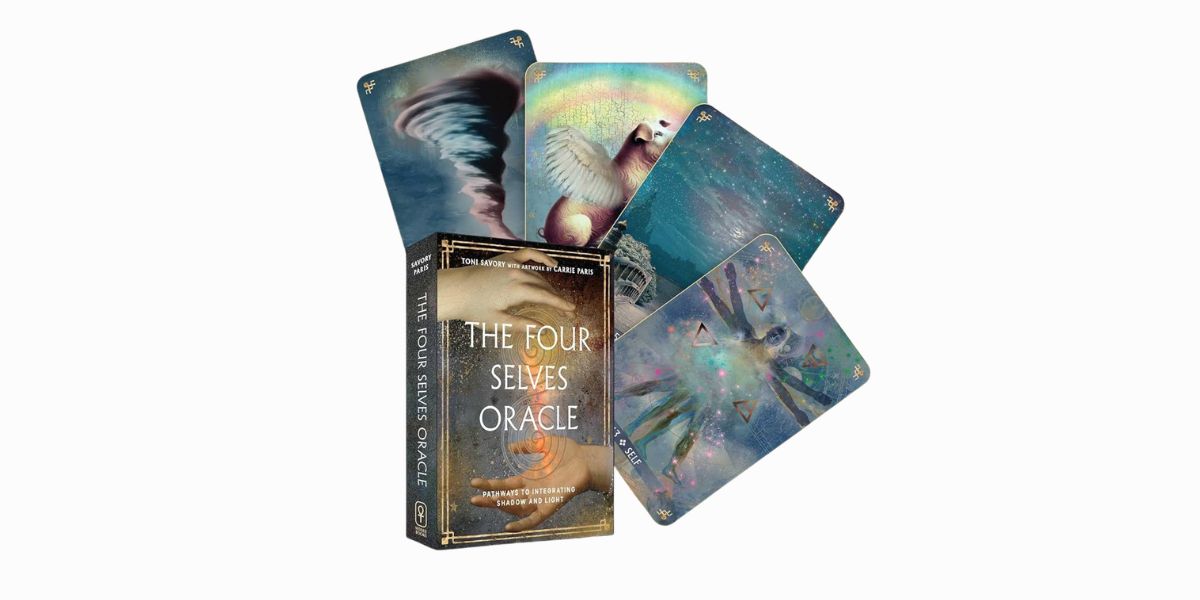
The Four Selves Oracle, by Toni Savory and Carrie Paris

The Four Selves Oracle: Pathways to Integrating Shadow and Light, by Toni Savory with illustrations by Carrie Paris
Weiser Books, 1578638933, 160 pages, 36 cards, June 2026

The Four Selves Oracle: Pathways to Integrating Shadow and Light is one of the more psychologically nuanced oracle decks to recently be published. Created by Toni Savory and illustrated by Carrie Paris, the deck is built around the idea that each person contains four interconnected aspects: the Physical Self, Conscious Self, Subconscious Self, and Superconscious Self. Rather than focusing solely on affirmation or spiritual uplift, the deck explores the dynamic relationship between shadow and light, helping readers identify emotional triggers, unconscious patterns, and pathways toward integration and wholeness.

“Quite simply The Four Selves Oracle is a gateway for you to understand yourself in ways that allow you to take action and do the work to become and embrace the true divine source within you and around you.”1

The structure of this deck is unique; it definitely took me a little time to get used to working with it. First, there’s two significator cards: Self (13) and Shadow Self (15). Of the 36 cards in this deck, 16 of them are light cards (belonging with the Self significator), 16 are shadow cards (belonging with the Shadow Self significator). The light and shadow cards are all paired, so each light one will have a corresponding shadow card and vice versa. Then the other four cards are neutral ones, intended to balance the reading.
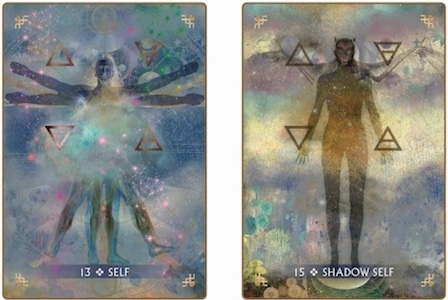
Now, before the Savory even gets into the layouts, readers learn the poisonings in the deck. Depending on the layout, the card could be in a light or shadow column and conscious, physical, and subconscious position layer. There’s a nice big color-coded visual of this in the guidebook, which helps with understanding the placements.

It seems like there’s a lot of moving parts, but once you begin working with the deck regularly, things become more intuitive. The intention behind it all is for the cards to support one another, bringing a holistic approach to the deck, as each card is reflected within ourselves. I find this approach so novel since even if there’s a common theme to the deck, most oracle readings focus on the individuality of each card. The layer in this deck makes for a much richer reading than any deck I’ve worked with before.
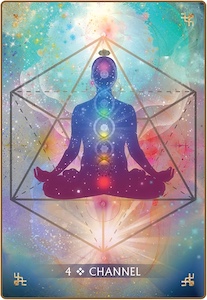
The guidebook description of each card provides the card type, keywords, mantra, core meaning, imagery, and guidance for it in the position of conscious, subconscious, and physical. Also listed is the card’s counterpart and insight on how the cards reflect each other. To become more familiar with the deck, I found it very helpful to go through the guidebook and read the corresponding pairs, reflecting on the wisdom and letting the information coalesce a bit prior to even doing readings. This approach made me feel more comfortable with the cards once I did start doing spreads.

Interestingly enough, the layouts are not even presented in the guidebook until the second part, following all the oracle meanings. The first suggestion in this section is to do a pull of either one, two, or three cards and simply work with the mantras. I found this VERY useful for familiarizing myself with the deck and every time got uncanny guidance that was reflective of what was going on for me internally at the time.

The other spreads continue to build on the different facets of personal exploration the deck can be used for, from releasing triggers to checking in with the four selves, and culminates with a 36-card grand tableau. I have yet to do this full deck spread because I am saving it for when I really want some big guidance, but I love having it available to me with this deck.
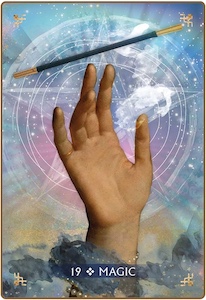
Visually, the deck is colorful with plenty of symbolic richness.. The imagery is dreamlike, archetypal, and slightly surreal, featuring portals, mirrors, moons, gardens, vortexes, and liminal landscapes. Rather than depicting literal scenes, the artwork functions as a symbolic language that invites contemplation and intuitive interpretation. The aesthetic feels mystical without becoming overly ornate, giving the reader plenty of imagery to gaze at while not getting too overwhelmed with small details. The imagery does a good job of providing visual structure for the complexity of the deck rather than be a source for predictive insights.

And this brings me to my final thoughts on the deck. Many of us go to oracle decks for predictive guidance or affirmation-focused messages, so this focus on introspective reflection and shadow work might not initially be a comfortable realm for our readings. The deck certainly requires more time learning than the majority of oracle decks.
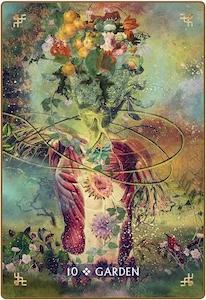
But this is what makes The Four Selves Oracle so exceptional. Instead of asking for universal guidance from the oracle deck, this card brings to light the parts of ourselves that hold wisdom. Bridging both spirituality and psychology, the guidance is both meaningful and practical. It’s a comprehensive tool for those looking to better understand the multi-faceted self and delve into the patterns, triggers, and deeper emotions that are best explored through tools such as this deck. Savory acknowledges that growth requires confronting difficult emotions and unconscious habits and the structure she’s created with this deck is excellent.

I highly recommend this deck to those who enjoy shadow work, depth psychology, journaling, or therapeutic spiritual practices. While the deck does take some time to get used to working with, which makes me want to recommend it more towards advanced readers, I do think there’s more than enough information to begin working with it at any level. Allow time for your connection with the deck to grow is my advice. I was a bit overwhelmed at first, but slowly, as I took the time to learn the structure of the deck, the readings became more clear and potent. This has now become one of my favorite decks to turn to for when I’m doing inner work.

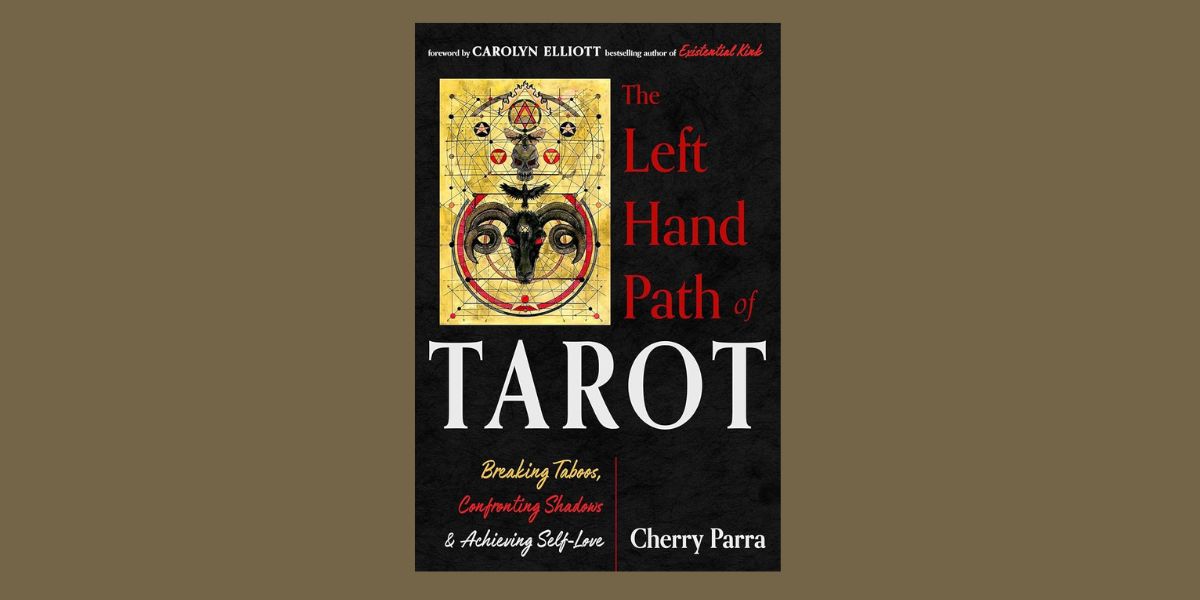
The Left-Hand Path of Tarot, by Cherry Parra

The Left-Hand Path of Tarot: Breaking Taboos, Confronting Shadows, and Achieving Self-Love, by Cherry Parra
Weiser Books, 157863878X, 248 pages, February 2025

The Left-Hand Path of Tarot: Breaking Taboos, Confronting Shadows, and Achieving Self-Love by Cherry Parra teaches that tarot is not meant to simply soothe the ego or wrap us in spiritual platitudes. She asserts that at its deepest level, tarot is a mirror that reflects what we might prefer not to see. When approached with honesty, the cards cut through wishful thinking and invite us into radical self-responsibility. They illuminate patterns we perpetuate, desires we hide, grief we avoid, and truths we sense but hesitate to claim.

This kind of practice asks for courage and the willingness to sit with discomfort rather than reaching for quick reassurance. Parra invites readers to work with the tarot in this way, demonstrating how tarot can be a tool for maturation, shadow integration, and self-catalyst. Having the agency to choose differently or act with clarity comes from the willingness to wade in the chaos, ask the tough questions, and pivot when necessary.

“First and foremost we deal in truth, and it is often uncomfortable and usually brutal. If we want the truth, we must ask true questions. Tarot is not a hiding place. There should be no room for shame, self-deception, or hide-and-seek dynamics.”2

Divided into three parts, Parra leads readers through viewing the tarot from the lens of the Left-Hand Path, interpreting the cards to offer a wider perspective (sometimes even challenging or subverting card meanings), and then how to put into practice the Left-Hand Path of tarot.

“Part 1: Welcome to the Left-Hand Path” provides an introduction to the overall topic of using tarot for confronting uncomfortable truths and reclaiming marginalized aspects of the self. Parra shows how tarot is a guide to outsiders, those who are outcast, marginalized, and nonconforming. When challenging social norms as a healer, visionary, artistic, or activist–all vital roles amid chaotic times–tarot can be used dually as a weapon and as a tool for self-alchemy. The chapters on shadow work and manifestation give insight into how readers can learn to embrace the “not positive” aspects of the cards for growth, revelation, and ultimately more personal agency.

“Part 2: Left-Hand Path Interpretations” is where Parra delves into the meaning of the cards. For each Major Arcana card, she shares about two pages of insight. While the general traditional meaning shines through, Parra definitely infuses the cards with meaning reflecting the philosophy of a Left-Hand Path journey. This is to say, she strips a lot of the BS away and gives a straight-forward message that acknowledges what’s really going on beneath the surface. What I appreciate about her approach is that there’s no doom and gloom, rather, it’s very grounded and “tell it like it is” for optimum clarity.

As for the Minor Arcana, Parra deconstructs the traditional idea of each suit corresponding to only one element. She writes, how “every Minor Arcana card, regardless of which suit it belongs to, carries wisdom from more than one element of nature.”3 This was the first time I’d ever come across this notion in my tarot studies, and the idea felt supremely liberating, a deviation with plenty of potential to explore on my own. In this chapter, Parra provides interpretations for each suit and then uses tables to provide short meanings (upright and reversed) for the Minor Arcana cards. 

In the final section, “Part 3: Walking the Left-Hand Path with Tarot”, Parra takes the information shared thus far and casts it out into the wider world. She likens the Left-Hand Path to the “Path of Doubt”4, which “deals with uncertainty, contradictions, mysteries, and even riddles.”5. Here, Parra reminds readers to embrace their own flavor of reading, embracing their “out-of-the-box”6 interpretations when they arise. Infusing anarchy, challenging the trickster, and lingering in the unknown are all aspects of the Left-Hand Path that tarot can help cultivate. She offers ideas for shuffling, dialoging with the cards, and personalizing your decks.

Plus, Parra includes so many spreads! Spreads for money and business, self love, body image, mommy/daddy issues, psychic battles, transmutation and more. It’s like Parra has attuned to the multi-faceted shadow aspects and taboo topics that could use a reading for more insight and crafted meaningful spreads to mine the information with ease. Furthermore, she covers tarot rituals, such as opening/closing the reading and protection, offering readers a well-rounded approach to doing these readings.

All throughout, I really enjoyed how Parra shares her tarot wisdom. It’s very evident she’s gained a ton of experience as a reader, both for herself and others, and does a great job synthesizing what she’s learned into practical advice. From offering tips to both beginners and pros to framing the mindset of querents to better understand their position to how to handle readings honestly when cards reveal things aren’t peachy keen, Parra provides a lot of value for those interested in reading for others. The epilogue, “The Ethics of Tarot”7, also is great food-for-thought.

I also just gained a lot of perspective from Parra’s Left-Hand Path interpretations of the cards. In addition to enjoying her liberation of the Minor Arcana from the elemental suits previously discussed, her depictions of the Major Arcana were a breath of fresh air. It was SO nice to read novel interpretations of the cards, especially from Parra’s first-hand perspective. From linking the Hierophant with personal discipline to saying sometimes the Hermit can point towards needing a good old bed-rot, her lens was modern, relatable, and still deeply meaningful.

“Very few people actually discuss and practice the art of leaning into catastrophe, of riding the lows with as much attention and enthusiasm as they surf the highs, and of finding the potential within imbalance.”8

Overall, The Left-Hand Path of Tarot offers an approach to tarot that emphasizes the nitty gritty truth. Emphasizing the shattering of social taboos and upholding personal empowerment, readers will appreciate the originality of Parra’s interpretation of the cards. Within this framework, tarot becomes a method for choice, conformation, and cultivating personal agency (and responsibility!). Accessible for tarot readers of all levels, this book is best for those ready to question their spiritual conditioning, subvert traditional tarot meanings, and discover methods to bring more active questioning into their practice.