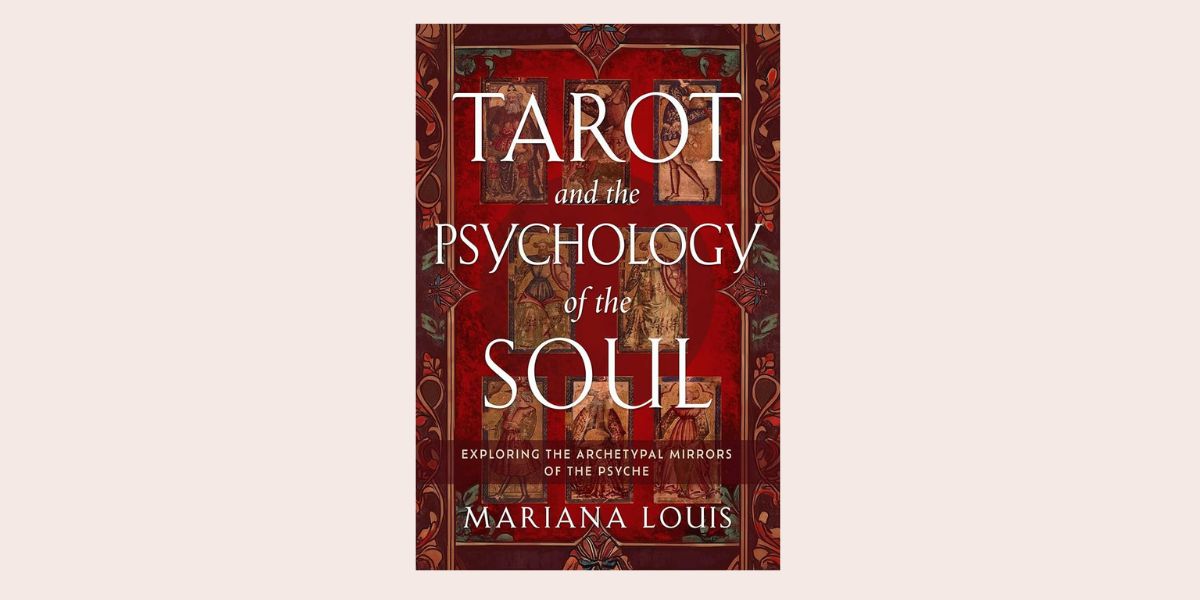
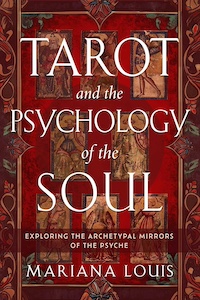
Tarot and the Psychology of the Soul: Exploring the Archetypal Mirrors of the Psyche, by Mariana Louis
Weiser Books, 1578638984, 320 pages, March 2026
People are drawn to tarot cards for all kinds of reasons. Some come to tarot out of curiosity or a desire for guidance during uncertain moments, while others are pulled in by the imagery, symbolism, or a deeper spiritual calling. That range of motivations is exactly what makes tarot such a versatile tool, and Tarot and the Psychology of the Soul by Mariana Louis takes this a step further by redefining what the cards can offer.
In Tarot and the Psychology of the Soul, Louis does not position tarot as an oracular tool, but rather as a mirror of the inner world. Coming from the lens of depth psychology, she frames the cards as archetypal symbols that reflect both conscious patterns and unconscious material, inviting readers into ongoing inner work rather than one-off readings.
“In this approach, which you will be guided through in this book, we do not read the cards for predictive divination or even encouraging self-care, but as a tool to support our individuation, the psych-spiritual process of self-becoming.”1
Following an engaging introduction that establishes the foundation of the book, the content is divided into four parts. “Part 1: Depth Psychology and the Analytical Approach” covers the basics of depth psychology: individuation, the strata of psyche, and archetypes, synchronicity. Louis also presents the framework for working with the cards archetypally, teaching readers how to build a relationship with the cards, strengthen their intuition, and form questions that draw the best response. Techniques shared, such as active imagination and shadow work, are portals for deeper self-excavation. Louis has a knack for making these complex topics approachable, ensuring concepts are well defined and clear to readers before building on the information she’s presenting.
“Part 2: The Minor Arcana” begins to get deeper into the cards themselves. Louis explains, “the Minor Arcana show us the dynamics of our psyches, revealing its inner conflicts, strengths, processes, and neuroses.”2 She draws a parallel between the four suits and Carl Jung’s theory of personality which focuses on the four functions we all possess (thinking, feeling, sensation, and intuition). She then proceeds to delve into archetypal numerology and applies Joseph Campbell’s hero’s journey to the Pips, which was totally fascinating in my opinion and one of my favorite sections!
From here, Louis moves through both the Minor Arcana and Court Cards, providing insights of the traditional meanings from the perspective of depth psychology. She moves suit by suit, she covers both the upright and reversed guidance the cards have to offer. As mentioned prior, Louis’ insights are not predictive, so the focus is on the inner workings of the reader. For instance, part of the Five of Wands entry reads:
“We often find ourselves involved in a battle between our contrary drives, perspectives, and complexes. One part of us fights to focus on career, while another demands we face our self-doubt, while yet another begs for relaxation. Rather than be riled to the point of explosive frustration, we must make room for each of the voices within us to speak and release its energy.”3
Before covering the Court Cards, the chapter “The Many Faces of the Tarot Court” covers additional depth psychological concepts, such as projection, persona, typological maturity, and complexes. Whereas the interpretations for the Minor Arcana cards are written in the first-person “we” form, the Court Card descriptions are in third person, presenting each one as an individual to be identified as a part of our whole self. Louis uses mythology and fairy tales to highlight the nature of the Court Cards, further providing a way for readers to connect with each card’s archetypal energy.
In “Part 3: The Major Arcana”, Louis shows readers how the Major Arcana reflects the entire journey of individuation. Beginning with the Magician and ending with the Fool (such an illuminating layout), she guides readers through the archetypal tarot framework. For each card, she gives an overview of the symbolism, often relating it to alchemy, mythology, and even pop culture (Yoda and Gandalf energy comes through!) as well as including insights from well known depth psychologists (James Hillman, Marion Woodman).
The whole archetypal journey moves from the primordial powers to the birth of the Self through the emergence of the shadow to finally arrive at wholeness. Simply reading this section is very inspiring, introducing a deeply meaningful philosophy of life as mirrored in the Major Arcana. The interpretations Louis provides for the card appearing in a reading–both upright and reverse–shed light on the parts of yourself and life journey that are calling for acknowledgement, pointing the way towards integration of the energy.
Louis’ presentation of each card from a psychological lens really hits home. She perfectly captures the balance between esoteric and mundane, honoring the liminal spaces where the psyche speaks. I could feel the messages in the heart as I read them, and some even brought me to tears. Here’s a few lines from one of my favorite cards, the Star, when it appears in a reading:
“The Star comes to remind us of our potential and higher purpose. Now is the moment to claim–without a word of rebuttal–I am special and I have meaning in this world. With the Star risen before us, we are invited to develop the security that only comes when we are at peace with ourselves.”4
The final part, “Reading with a Psycho-Spiritual Lens”, guides readers through the ritual of reading tarot and offers archetypal spreads. Louis lists steps for preparing for a reading and then interpreting the cards. The spreads offered focus on synthesizing this content in the book thus far, offering card placements that reflect depth psychology themes: tension of opposites, inner work, and unconscious/conscious/higher calling. While there’s many directions one could build from with this book, this section is a great starting point for the journey.
Overall, Tarot and the Psychology of the Soul is just a true gem for cultivating a relationship with the psyche. Rather than teaching how to memorize rigid meanings or predict the future, Louis teaches readers how to use tarot as an access point into the on-going, life-long work of becoming whole. She gives structure to inner work practices that can often be abstract, helping readers engage with their psyche in a tangible way.
As someone who spent many years studying both depth psychology and tarot, I was genuinely impressed by the scope and content of this book. Louis’ insightful intelligence shines through every page. The time she’s dedicated to cultivating this approach, bridging these two potent systems for self-reflection, is evident.
Those with an interest in psychology, particularly archetypal studies, will find a wonderful introduction to the tarot cards, while people with a tarot background are in for a real treat with the comprehensive approach Louis offers, sure to enhance anyone’s reading style. By grounding tarot in archetypal and depth psychology concepts, Louis offers a language that will resonate with modern spiritual seekers who want to explore their inner workings more fully. This style of working with the tarot is perfect for self-guided healing and introspection.
About the Author
Mariana Louis is a contemporary tarot teacher and scholar known for her psychologically oriented approach to the cards. She transitioned from a background in musical theater into the world of tarot, eventually becoming a recognized voice in the space, with a strong online following and teaching presence. Her work is deeply influenced by depth psychology and archetypal studies. Beyond this book, Louis shares offerings through her platform Persephone’s Sister and spreads her wisdom on her podcast Soror Mystica, co-hosted with Cristina Farella. I definitely recommend checking it out if you’re interested in this topic. I did a deep dive into the podcast and loved it!

Alanna Kali is an astrologer, numerologist, and pioneer spirit that loves to explore life through the lens of depth psychology. She has a passion for studying the humanities and social trends. Her academic work is centered upon reuniting body, mind, and spirit through eco-psychology. She loves reading, spending time in nature, and travel.