✨ A Gathering Place for Magical Readers and Writers ✨

Tag Archives: Fiona horne

Coven Oracle, by Fiona Horne and Miriam Ocaña Pérez-Cerdá

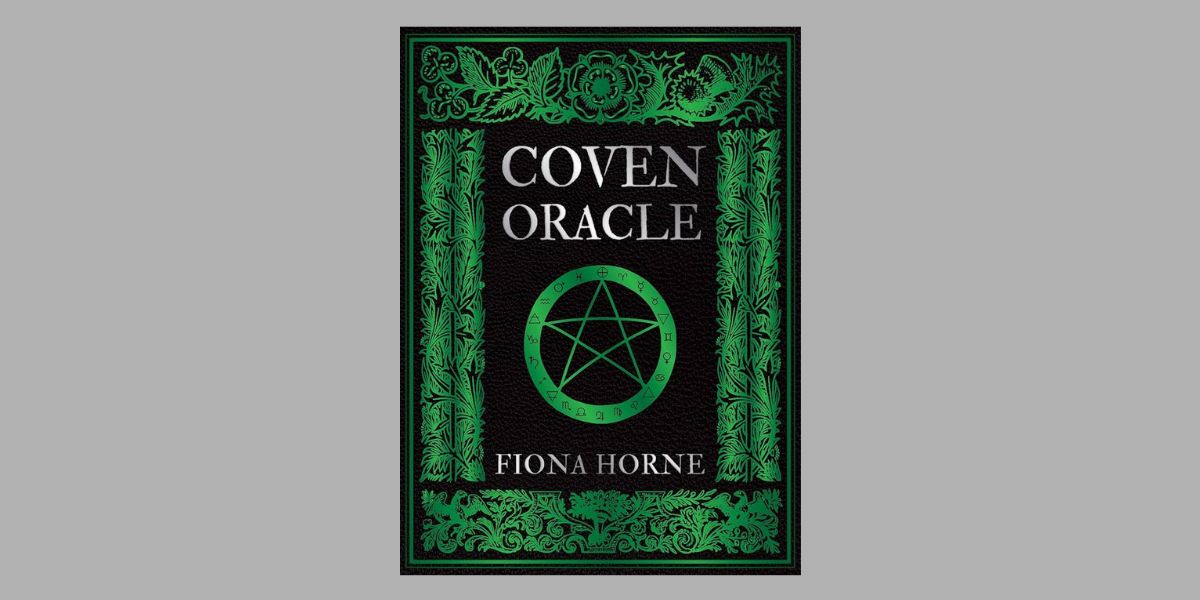
Coven Oracle, by Fiona Horne with illustrations by Miriam Ocaña Pérez-Cerdá
Rockpool Publishing, 1922468010, 160 pages, 36 cards, March 2026

Group dynamics are tricky–both finding your own place within one and the overall holistic functioning of the group as a whole. It gets even more energetically complex when you add a magical dimension in too, such as the case with a coven. Coven Oracle by Fiona Horne with illustrations by Miriam Ocaña Pérez-Cerdá is the first group-centered oracle deck that I’ve ever seen. Emphasizing collective magic and relational spirituality, this deck reveals valuable insights for group dynamics and the individual practitioner.

Horne’s 36-card deck aims to support harmony, respect, and shared power, reflecting “what it takes to truly create and tend a coven – not as a rigid hierarchy, but as a living, evolving magickal ecosystem.”1 However, the deck doesn’t lose sight of the individual reader too, also providing guidance for the group dynamics showing up for them and serving as an energetic bridge to connect with others in the astral or spiritual realm.

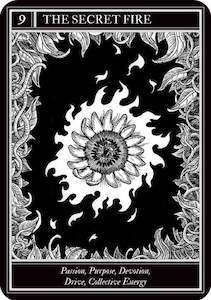
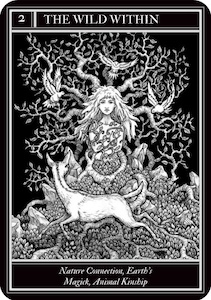
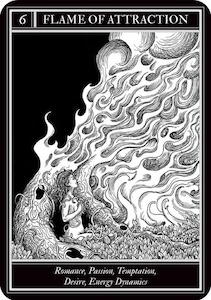
Ocaña Pérez-Cerdá’s card design brings a mystical energy to this deck, making it feel less like a casual divination and more like stepping into a sacred current. While gilded with green edges, the black and white illustrations give the deck a timeless occult quality. The contrast of light and dark adds an intensity, reminding readers that we contain all parts of the spectrum within ourselves.
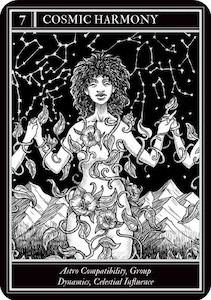
The card images often feature plants, animals, and women in their full spiritual glory. The cosmic symbolism, elemental forces, and archetypal feminine power activates magical consciousness. There’s a feeling of movement and fluidity in the images, a twisting eternal connection that binds us all together. And this strong thread of interconnectedness running through the imagery (celestial constellations, roots, flames, bodies merging with the landscape) reinforces themes of relationship, cohesion, and energetic exchange. The theme of nature as a weaver and foundation for connection comes through in all the illustrations.

As for the guide book, Horne shares how to use the cards, information for consecrating and cleansing the deck (including blessings that can be said), and spread suggestions. For each card entry, there’s the image and name of the card along with key words, an oracle message for the coven, and an oracle message for the individual reader. This style gives the deck a lot of versatility, allowing for the messages to be received on both a personal and collective level.

For this reason, I feel like it’s an incredible tool for working in a group. While a coven could use any deck to attune to the energies, Coven Oracle is so specific and relevant, speaking directly to those in the circle, that it unifies the intent and energy to deliver a clear message. Oftentimes, Horne infuses the divinationtory message with questions too, offering a place for meaningful conversation to emerge within the group. Here’s an example from the card Art of Balance:
“This card invites your coven to check in and take a closer look at the unspoken energy dynamics in your group. Is someone always leading while others fall back? Is everyone being heard? Had someone gone quiet while others take up space? Has someone been quietly picking up the slack while others drift? Sometimes imbalance isn’t obvious – it builds over time in small silences, quiet assumptions, and unequal giving.”2

Horne demonstrates a clear understanding of the different dynamics that arise in group situations, and the different cards offer acknowledgment of the energies, giving them space to be acknowledged and handled in order to keep the magical essence of the group thriving. In the course of my practice, I cannot tell you how many covens I’ve seen split up or become infused with resentment, disagreement, and jealousies. Using this deck regularly in a circle has enormous potential to open up necessary dialogue, find inspiration about what’s best for the collective, and unify intentions to keep the group in a good space.

Similarly, the deck offers a wonderful way for individuals to see their own role or place within a group, which is also challenging to do on one’s own sometimes. While I am not currently in a coven, I have been using this deck to discern more information about my energy in relation to my family–a coven of sorts that you’re born into for better or worse!
After a period of feeling a bit disconnected from my family where I was feeling outcasted, I decided to pull a card to inquire about the situation. The card I received was Return to the Coven. I was extremely moved to read Horne’s wisdom in the guidebook:

“Whether you’re in a formal coven or simply rejoining a group, community, or circle you once stepped away from (or were cast out of), this card reminds you that returning is not weakness – it is strength. To walk back in with an open heart, or to hold the door open for another, is an act of power, humility, humanity, and powerful love.”3

This card gave me the courage to mend the relationships and be more participatory in a family event that I was originally thinking of bailing on. I ended up having a great time, feeling seen and appreciated by the group now that I had opened myself up to being included once again.

Overall, Coven Oracle is a tool not only for individual readings but also for group dynamics and spiritual communities, making it somewhat unusual among oracle decks. The deck’s core framework centers on working magic together, offering the oracle guidance to strengthening relationships, building aligned spiritual groups, maintaining energetic containers, and revealing where shifts might need to take place. By encouraging reflection not just on the self but on the collective, Coven Oracle supports the kind of intentional, reciprocal relationships where deeper and more resilient magic can take root.
This deck is ideal for covens or magical study groups, magical practitioners seeking spiritual communities or wondering if certain groups are a good fit for them, and witches interested in collaborative rituals that might not be a full-time coven situation but still require group effort. As mentioned, readers might also enjoy it for furthering understanding dynamics in their family too.

I’ve really been enjoying working with this deck and very much appreciate how it can be used for both group and individual readings. Horne has done a wonderful job capturing the multi-faceted energies of coven dynamics and created a deck that reflects these energies for reflection, growth, discernment, and harmony. Meanwhile, Ocaña Pérez-Cerdá’s illustrations deeply honor the wild feminine divine, visually reconnecting readers to the natural world and the many sacred relationships that make all ecosystems thrive.

A real bonus is an optional companion book, Coven: Where Witches Gather, by Horne is also available as a grimoire for covens. If you are interested in creating a coven or already leading one, interested in witchcraft, and hoping to deepen your practice, this book is the perfect companion to Coven Oracle.

Coven, by Fiona Horne

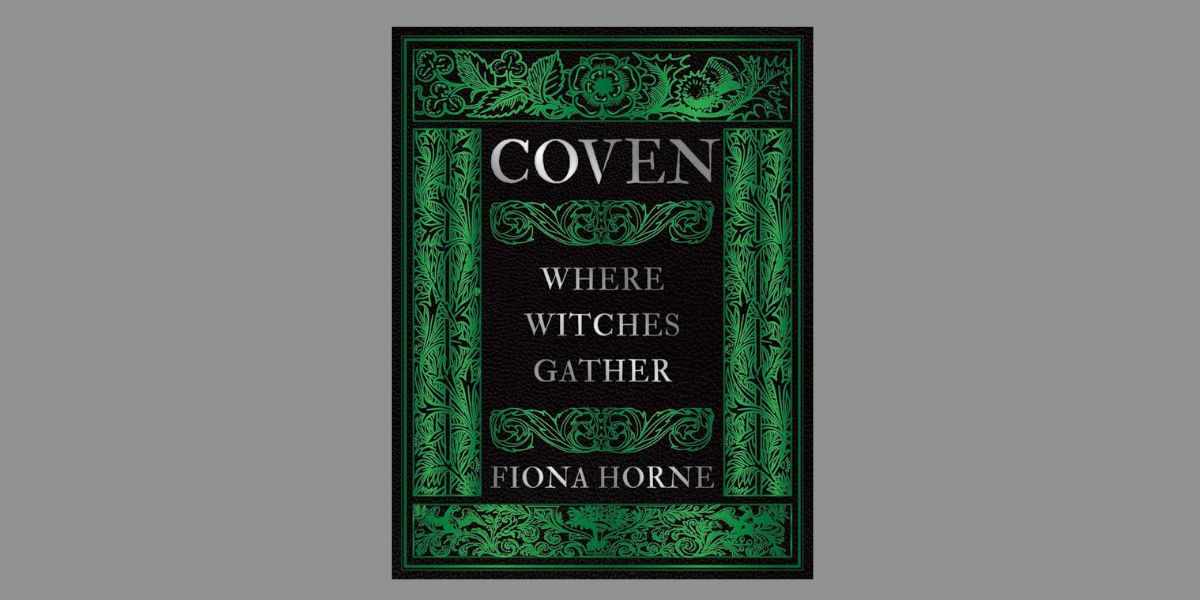
Coven: Where Witches Gather, by Fiona Horne
Rockpool Publishing, 1923208462, 272 pages, March 2026

For many witches, the path begins in solitude – a quiet unfolding of intuition, ritual, and personal power. Yet there is a different kind of magic that awakens when practice becomes shared. Being part of a coven offers more than companionship; it creates a living current of collective energy where wisdom is exchanged, strengths are amplified, and individual blind spots are gently illuminated. Within a trusted circle, ritual deepens, accountability strengthens intention, and transformation becomes both witnessed and supported. Coven: Where Witches Gather by Fiona Horne explores how magic can be enhanced through group relationship, becoming shared sacred work, and offers guidance for creating or finding your own magical community.

Author Fiona Horne is an Australian witch, author, musician and teacher who emerged publicly in the 1990s as one of the first modern practitioners to openly identify as a witch in mainstream media. Raised with an early interest in mysticism and the occult, she later helped popularize contemporary witchcraft through bestselling books that reframed it as a nature-honoring, self-empowered spiritual path rather than something secretive or sensationalized. Over the decades, her work has focused on making witchcraft accessible, community-oriented, and aligned with modern life, encouraging practitioners to claim their identity openly and practice with confidence. This book is a revised and updated version of her previous publication The Coven: Making Magick Together (2003).

I was immediately impressed with the smooth texture of this book and gilded green edges. Though light in weight, there is a feeling of spiritual significance that comes through the book’s design. There’s a sensory elegance to it; the surface feels deliberately textured with care, as if it was made to be handled slowly. Instantly, I recognized this as a potent grimoire.

Peeking inside, I noticed the enchanting design continues within too. The interior pages all have an intricate border design, adding a feeling of elegance. The text is well structured and neatly organized with plenty of headings, bullet points, and different size and style of fonts. There’s also a nice ribbon for bookmarking your place. All throughout illuminating black and white images that contribute to the magical resonance, infusing the text with visual prompts too.

As for the content, Horne begins with a chapter introducing witchcraft, including what witches believe and laws of witchcraft (many from traditional Wicca), followed by a chapter on witchcraft in the past, present, and future. The information in these sections sufficiently grounds readers in the wider context of witchcraft, a base from which they can then go and explore covencraft.

“A coven is a sacred space – but it’s also a shared space, and that means it comes with all the beauty and complexity of human interaction.”4

There’s so many elements to a coven, and Horne covers the different aspects and layers of this joint interaction in the following chapters. From the get-go she distinguishes the type of coven this book is aimed for is different from traditional Gardnerian and Alexandrian witchcraft ones. Some of the differences in modern covens that Horne values are things such as shared leadership, inclusivity, environmental focuses, and rapid adaptation and flexibility. Meanwhile, she also shares different types of covens, ranging from eclectic ones with members who have a mixture of magical backgrounds to “working” covens that are more focused on learning and discussion, and noting how some covens meet in-person while others are virtual. The main emphasis is on the variety of ways a coven can exist, giving readers plenty of room to feel into what would be best suited for them.

As for actually forming or finding a coven, Horne provides plenty of advice for where one might connect with other like-minded souls, even providing an attraction spell. She also shares how to know if someone is a good fit for a coven. Once the group is established, Horne guides readers through the process of establishing responsibilities, picking deities, naming the coven and choosing a magical name for one’s self, and deciding where to gather. She also covers topics such as choosing which tools to use within the coven as well as wardrobe when gathering, noting the financial element of these decisions too. All of these small decisions laid out clearly provide a good roadmap for beginning a coven’s journey.

Horne has a whole chapter dedicated to how to run a coven meeting, including preparation, casting a circle, element invocation, inviting the deities,raising energy, and closing the circle. This chapter is a great resource for those familiarizing themselves with group magic. Subsequent chapters then cover topics such as sabbats, spellwork, group meditation, magickal gathering (open to those outside the coven too), sacred play, sex within the craft, and healthy living.

One chapter that I think is very valuable is “The Art of Coven Keeping” because I’ve seen SO many covens fall apart from disagreements, gossip, jealousies, misunderstandings, and simple lack of energy or interest in maintaining them. There’s usually a potent energy at the formation of a coven, but sustaining this energy takes work. In addition to this information in this chapter, Horne also has created an oracle deck, Coven Oracle, to provide insight into group dynamics that I think is a great tool for any group work.

I really resonated with her approach to covens, making it feel much more accessible than the traditional, “hidden” covens that require much more rigid adherence to a belief system and thorough initiation. In fact, Horne’s approach to the coven dispelled many long-standing beliefs I had about covens. For the first time, I believed it was possible I could create my own or find an aligned magical community. Not only does Horne provide an overview of how to do this, but she leaves so much room for personalization, especially considering every coven will have unique energies. I enjoy how she honors the art of covencrafting, rather than trying to make it fit in specific and outdated boxes.

At the same time, Horne takes a very practical approach to covens. The chapter dedicated to legally incorporating a coven as a spiritual organization was all novel for me. I had never really thought about this approach, but it makes sense in that the organization becomes tax exempt and is eligible for grants. I appreciate how Horne offers this, in addition to all her magical advice, because it grounds the potential of each coven in our structured reality.

“Because beneath the hashtags and highlight reels there is still a living, breathing mystery – a sacred, subversive truth that belongs to witches; a truth about power, connection, and the unseen forces that shape our world. This book isn’t just a how-to. It’s a lived testament to community, courage, and the magick we create when we gather in trust and intention.”5

Overall, Coven stands out as a thoughtful and practical resource for witches drawn to group magical working. Horne offers meaningful insight into not only how to form a coven, but how to nurture, protect, and sustain its energetic integrity over time. By weaving foundational witchcraft principles with guidance on leadership, harmony, and shared intention, she creates a framework that feels both accessible and purposeful. For those seeking to move beyond solitary practice and into the alchemy of collective magic, this book serves as a steady and encouraging guide. There’s so much to explore within a group witchcraft practice, and Horne has truly provided the community with a valuable tool for navigating this special type of magic.