✨ A Gathering Place for Magical Readers and Writers ✨

Tag Archives: Nicholaj de Mattos Frisvold

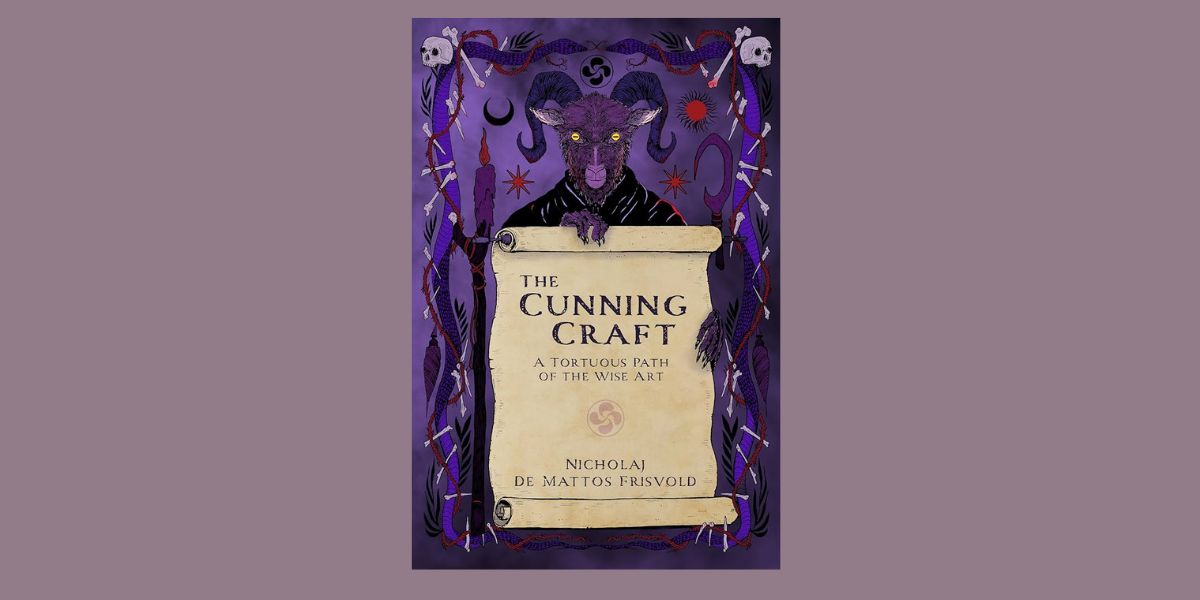
The Cunning Craft, by Nicholaj de Mattos Frisvold

The Cunning Craft: A Tortuous Path of the Wise Art, by Nicholaj de Mattos Frisvold
Crossed Crow Books, 1959883933, 222 pages, February 2025

Sometimes, a book comes along that just, well, it makes you pause. The Cunning Craft: A Tortuous Path of the Wise Art by Nicholaj de Mattos Frisvold is one of those. The title itself suggests something intricate, a journey perhaps not for the faint of heart, and the content certainly lives up to that. As someone with a long-standing interest in astrology and spiritual paths, the very concept of “cunning” as “to know,” especially “special knowledge of spiritual mysteries”1, immediately captured attention. It seemed to promise a deep dive into the practical and philosophical aspects of a craft that has often been, shall we say, misunderstood.

The author, Nicholaj de Mattos Frisvold, approaches this complex subject with a clear scholarly background—degrees in psychology, anthropology, and cinema studies are noted. This is evident in the precise language and the historical breadth of the text. Frisvold unpacks what “Traditional Craft” truly means, distinguishing it from more modern, popularized versions. He’s pretty direct about it, too, explaining that early historical forms of witchcraft were, perhaps surprisingly to some, “intricately and intimately involved with and bound up within”2 Christian and other faiths of their time. 

The book is structured thematically, with chapters delving into concepts like the crossroads, serpents, the “Mountain of Lady Venus,” and the sorcerous dimensions of the craft. Each section builds upon the previous, creating, I think, a comprehensive, if at times challenging, picture.

One aspect that truly stands out is the exploration of working “with both hands”3—that is, engaging with both what might be called the Left Hand Path (Maleficia) and the Right Hand Path (Beneficia). The author doesn’t shy away from the darker, more ambiguous aspects that have historically been linked to the cunning ones. This pragmatic approach, where the “Devil” figure is presented as a powerful initiator of knowledge, someone who “transcends this and His origin is far beyond just this planet, in the realms of the stars and beyond”4, offers a perspective not often found in popular texts. The text even quotes directly from a description of this entity, emphasizing its liminal, trickster nature:

“He is the firstborn from the Darkness of Night, but contains within Himself Night’s opposite—the bright and blinding Light. He is therefore a complete duality in Himself, both Dark and Bright, which exemplifies the liminal nature so prominent in the Witch themselves.”5

It’s a compelling, if somewhat unsettling, portrayal, one that asks the reader to really, I mean really, grapple with the idea of paradoxical truths.

The book also delves into the concept of Witchblood or Elven blood, suggesting a unique, sometimes otherworldly, ancestry for practitioners. This idea of a secret pedigree, stemming from ancient unions, gives the craft a profound sense of otherness that I found fascinating. It’s not just about inherited traits, apparently, but also about a particular kind of perception. Frisvold states:

“The presence of this unique essence manifests in a natural and arcane perception of the world that comes easily to ‘the other,’ who sees the world as enchanted, filled with possibilities and secrets.”6

This is quite different from some more modern, human-centric magical systems, offering, in a way, a deeper, more inherent connection to the “enchanted worldview”7.

The historical context is, in my opinion, meticulously researched. Frisvold traces the evolution of witchcraft accusations and beliefs, demonstrating how ecclesiastical interpretations and societal fears shaped concepts such as the Witches’ Sabbath and familiar spirits. The discussion on how the Church, in its own struggles, needed the “existence of witches and devils to sustain their hold on people and to validate their theology8 provides a crucial historical lens. This isn’t a light read, certainly not for beginners in the field of magic or occult studies, but it is gratifying for those willing to engage with its depth. 

The detailed ritual instructions, including The Masquerade of the True Cross, offer a practical dimension, allowing the reader a glimpse into the workings of cunning folk. The inclusion of these previously unpublished rites really gives the book a unique edge.

In conclusion, The Cunning Craft is a profound and thought-provoking exploration of traditional witchcraft and sorcery. It challenges popular notions and delves into the historical, philosophical, and practical intricacies of the wise arts. It makes you think about how we define truth, power, and the “other.” 

This book is best suited for intermediate to advanced students and practitioners of esoteric traditions, as well as historians interested in the nuanced evolution of magical practices. It will likely encourage readers to look beyond superficial interpretations, to, in the author’s words, “look beyond the surface of things and look deeper, to challenge, to consider different realities”9.

The book is a testament to the idea that “Humanity’s modern psyche is a product of their belief in their greatness and loss of spiritual connection”10, offering, through its pages, a powerful antidote to that very modern predicament.

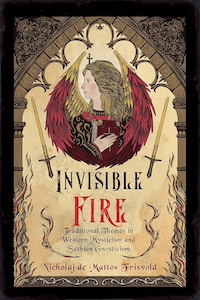
Invisible Fire, by Nicholaj de Mattos Frisvold

Invisible Fire: Traditional Themes in Western Mysticism and Sethian Gnosticism, by Nicholaj de Mattos Frisvold
Crossed Crow Books, 220 pages, 1959883607, August 2024

Nicholaj de Mattos Frisvold’s Invisible Fire: Traditional Themes in Western Mysticism and Sethian Gnosticism offers a profound exploration of the starlit river of ancient wisdom that connects the diverse tributaries of Western spirituality. Drawing from a wellspring of Gnostic and Apocryphal texts, Frisvold illuminates the Primordial Tradition, turning our gaze to the heavenly realms of pure Platonic ideas where all mystical paths converge into a slipstream of cosmic consciousness.

Frisvold, a behavioral psychologist, anthropologist, and consecrated Bishop of Gnostic, Catholic, and Orthodox lineages, has spent decades studying a wide range of spiritual practices, from African-based traditions to European witchcraft. His scholarly analysis of ancient texts, combined with his poetic prose and engaging writing style, make these complex concepts more accessible to readers. Frisvold’s meticulous citations also provide a valuable resource for those seeking to dive deeper into the obscure texts discussed, providing a springboard for further exploration and independent research.

Divided into two parts, titled “Gnosis” and “Praxis,” this book offers both theoretical insights and practical guidance. The first section consists of essays on the Primordial Tradition, while the second provides a collection of rituals for personal spiritual growth. At the heart of Invisible Fire lies the Biblical figure of Seth, the third son of Adam and Eve, who replaced the slain Abel. From the Gnostic perspective, he is the embodiment of the Primordial Tradition and takes on a Christ-like role. “Due to his perfected state, Seth enters the world as a perfected one, the upright one, and, as such, becomes the symbol of redemption, prophecy, and tradition,”5 Frisvold says.

“Invisible Fire is about this legacy left by Seth and is explored through examining the Primordial Tradition and the Sethian themes found in Western Mysticism.”6 

Frisvold introduces the core principle of the Primordial Tradition as a non-dual cosmology centered on the interconnectedness of all things and the divine. This perspective rejects the dualistic worldview that separates the spiritual from the material, emphasizing the underlying unity of existence. In addition to this non-dual cosmology, the Primordial Tradition places great importance on divine revelation, the direct experience or understanding of spiritual truths. According to Frisvold, “these are paths of prophetic activity that focus on how we can connect to the Empyrean realm in such a way that we become subject to this revelatory fire that gives luminescence to stars and angels.”7

In the Primordial Tradition, God is considered the incandescent source and center of everything, both seen and unseen. Therefore, in our fallen, imperfect state, everything we experience is fragmented like a shattered mirror, the scattered shards reflecting distortions of the Divine Light. To truly understand the divine, we must transcend our material limitations and recognize that the physical world is a reflection of a higher, perfect order. This higher order can be understood through the stars, which represent a tangible manifestation of the divine.

Frisvold’s analysis of the Cain and Abel narrative offers a compelling interpretation that transcends dualistic notions of good and evil. Departing from the canonical portrayal of Cain as a villainous murderer driven by envy and wrath, the Primordial Tradition offers a more nuanced perspective, presenting him and his brother Abel as archetypal figures representing opposing forces within the human soul.

The story of Cain and Abel is not merely a tale of fratricide but a profound allegory of the dual nature of humanity, the clash of the divine and the profane. Cain, the hylic man, embodies the material and sensual aspects of existence, while Abel, the psychic man, represents the spiritual and intuitive nature. Their sibling rivalry represents the internal battle between the material and spiritual, waged within the heart of every human being.

Cain’s murder of Abel is not merely a senseless crime of passion but a symbolic sacrifice, a dark ritual that unwittingly sets the stage for a greater redemption. It is a catalyst for the emergence of Seth, the divine mediator, who bridges the chasm between the earthly and the celestial.

“When Cain murdered Abel, he sacrificed the flesh and released the spirit,” Frisvold says. “He did what needed to be done in order to become perfected.”9

Seth, the pneumatic man, embodies the divine spark that unites the material and spiritual realms. Through this act, Cain inadvertently paved the way for Seth’s revelation, demonstrating that even the darkest aspects of human nature can serve a higher purpose.

Frisvold explains that Cain’s murder of Abel was redemptive, much in the same way that Judas’s betrayal of Jesus paved the way for salvation. “It is the redemption of the soul from its material state that is enabled through the betrayer and the betrayed, the murderer and the murdered, dissolving the dyadic illusion and becoming one,”11 he says.

According to Frisvold, the white and black pillars standing sentinel at the entrance to the Temple of Solomon, Jachin and Boaz, symbolize the dual nature of humanity, manifested in the right and left-hand paths of Seth and Cain. Jachin, the pillar of understanding, reveals the mystery of Seth and the divine spark within us. Boaz, the pillar of confusion, represents the material world and the illusions that obscure our spiritual vision.

As Frisvold explains, “Ultimately, the pillar of confusion carries the secrets of Cain’s legacy as the pillar of Jachin reveals the mystery of Seth, which Cain made possible.”12 As the pillars of Jachin and Boaz stand before the Temple of Solomon, so too do Cain and Seth represent the twin forces of darkness and light. The profane and the sacred, the abyss and the empyrean, are not opposites but complementary aspects of the Great Work.

Frisvold’s insightful interpretation of the pillars aligns with the following passage from the Gnostic Gospel of Phillip: “Light and Darkness, life and death, right and left, are brothers of one another. They are inseparable. Because of this neither are the good good, nor evil evil, nor is life life, nor death death. For this reason each one will dissolve into its original nature. But those who are exalted above the world are indissoluble, eternal.”13

Frisvold’s analysis of the Cain and Abel narrative exemplifies the non-dualistic cosmology central to the Primordial Tradition, illuminating the interconnectedness of all things, even the seemingly contradictory forces within the human psyche. Cain is not merely a villain but a necessary catalyst for spiritual evolution. His actions, though seemingly dark and destructive, ultimately serve to illuminate the path to divine consciousness.

Seth, the third brother, emerges as a symbol of hope and renewal. He embodies the divine spark within humanity, the potential for spiritual enlightenment. Seth’s legacy is a testament to the enduring power of the human spirit, capable of overcoming even the darkest of sins. Thus, the tale of Cain and Abel is a timeless parable that teaches us the importance of balancing the material and spiritual aspects of our nature. By recognizing the divine spark within us and striving to overcome the limitations of our material existence, we can achieve spiritual enlightenment and liberation.

Frisvold also presents a non-dualistic perspective on the fraternal rivalry between Archangel Michael and Satan. “Bogomil doctrine teaches that Satanael, Michael’s brother, was forgiven for his mistake, and, as such, redemption already happened by the intervention of God, which made it unnecessary for Jesus Christ to die for a sin already forgiven,” Frisvold says. “Rather, Jesus came as an example and to light the fire of gnosis and wisdom. Saint Michael took care of the spiritual domain as the ‘Golden Tzar,’ and Satanael was given the material realm and to rule over as its ‘Silver Tzar,’ clearly referencing the two main luminaries of the heavens.”14

One of the most intriguing aspects of Invisible Fire is its emphasis on astral magic, the celestial wisdom Adam received from the angel Raziel and passed down to Seth.

“One who knows their star will know themselves, and from this, an ability of discernment that recognises the divine mirror upon the Earth will be born,”15 Frisvold says.

This passage really jumped out at me, because, a few years ago, one of my spirit guides told me in my sleep that my star is Aldebaran. The next day, I plugged fixed stars into my natal chart and was startled to discover that Aldebaran is exactly conjunct with my Sun at 9 degrees Gemini. I’ve been hooked on studying fixed stars in astrology ever since. 

In an essay titled “The Regent of the Milky Way,” Frisvold paints a vivid picture of the Milky Way as a celestial river of liquid silver flowing through the heavens. This astral stream of immortalizing milk is the Pleroma, a transcendent realm beyond the traditional seven planets, ruled by Seth. This evocative imagery reminded me of an enigmatic message on one of the Orphic gold tablets: “A god you have become from a man. A kid you fell into milk.”16 Perhaps the Milky Way represented the transformative journey from human to divine for Orphic mystics as well.

As a Gemini, I was especially intrigued by Frisvold’s association of the Milky Way with my zodiac sign. He explains that the celestial river leads to Gemini, the sign of duality, which nourishes the twins Castor and Pollux, and “challenges our choices by strength and mercy.”17 This house of Mercury holds the caduceus, the symbol of balance and healing, where the snakes of Mercury and Sulphur coexist in perfect harmony, supporting the sacred path. 

One of my favorite essays is titled “Raziel’s Secret.” In this magical work, the Tzohar is described as a literal jewel, a sapphire forged in primordial light. Revealed by the angel Raziel, this sapphire enabled Adam to read the Book of Raziel by holding it to his eye. I was delighted by this enchanting touch of Jewish fairy tale mysticism. 

Raziel, a being of extraordinary power, is both a Seraphim and an Ophanim, and as such, “belongs to the potencies of divine fire guarding and watching the divine throne itself.”18 Frisvold explains that Seraphim are the guardians of “the primordial fire of transcendence, the glowing coals of perfect fire flowing forth in the rivers of wisdom from the divine throne.”19 Being a Seraphim “means that Raziel is not only an angel formed in the likeness of the mystery itself; Raziel is the voice of the Tzohar.”20

The Praxis section of Invisible Fire includes several rituals that utilize the power of the fixed stars, and have that old school feel of the Greek Magical Papyri. One such ritual involves creating a protective talisman using a scorpion. The practitioner is instructed to feed the scorpion wine and herbs while reciting a hymn to Antares, the Royal Star and heart of the Scorpio constellation. While acquiring a scorpion, dead or alive (the ritual doesn’t specify which), might be challenging, I personally own a taxidermy scorpion necklace that I wear to honor my natal Mars and Saturn in Scorpio, which I’m considering incorporating into a modified version of this ritual to imbue it with protective energy.

While the grand scope of this luminous work may be a bit overwhelming for the casual reader, Invisible Fire will serve as a valuable resource for those seeking a deeper understanding of the mysteries of the universe and the human soul. Its esoteric insights, like the stars themselves, illuminate the ancient traceless paths of Gnosis, awakening the divine spark, the invisible fire that flickers within us all.