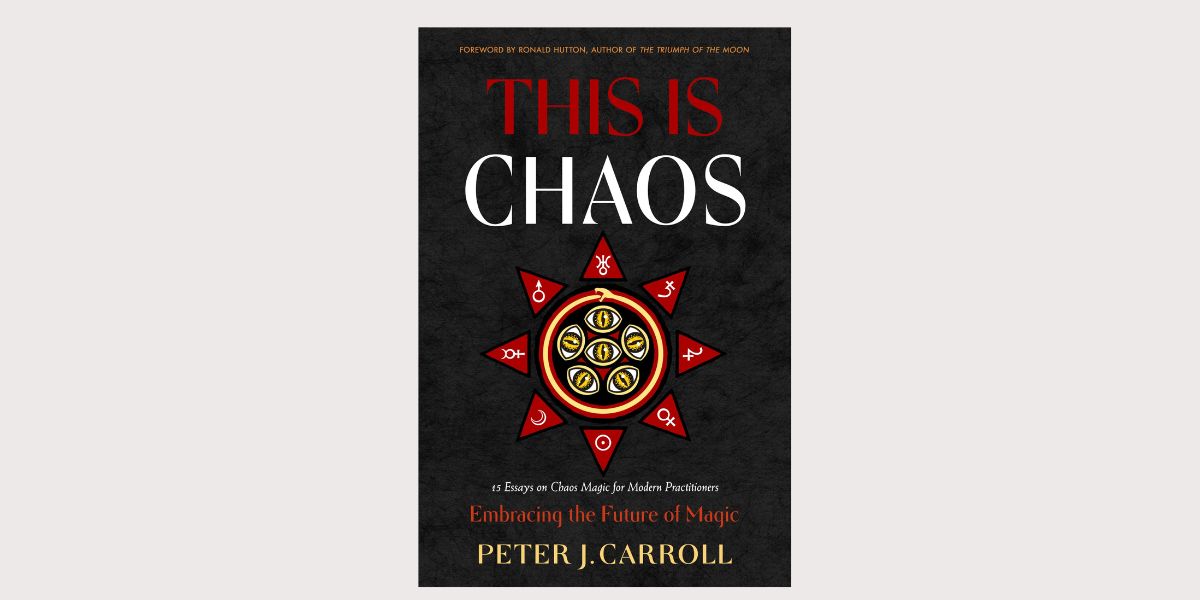
This Is Chaos: Embracing the Future of Magic, edited by Peter J. Carroll
Weiser Books, 1578638739, 288 pages, June 2025
This is Chaos: Embracing the Future of Magic is a captivating anthology that delves into the enigmatic world of Chaos Magic. It is edited by Peter J. Carroll, whose influence has been foundational in Chaos magic through both shaping its core principles but in popularizing and legitimizing it as a serious magical paradigm, yet it brings forth the voices of a diverse array of practitioners. This collection of essays, theories, and practical applications from various contributors offers readers a comprehensive overview of Chaos Magic’s philosophy, practical application, and future potential. As Carroll notes in the introduction:
“The essays in this anthology come from a variety of orthodox Chaoists, heterodox Chaotist, and Chaos heretics. Energy and information, and hence creation and destruction, suffuse their inspirations. Taste the Chaos!”1
This is Chaos: Embracing the Future of Magic is a captivating anthology that delves into the enigmatic world of Chaos Magic. It is edited by Peter J. Carroll, whose influence has been foundational in Chaos magic through both shaping its core principles but in popularizing and legitimizing it as a serious magical paradigm, yet it brings forth the voices of a diverse array of practitioners. This collection of essays, theories, and practical applications from various contributors offers readers a comprehensive overview of Chaos Magic’s philosophy, practical application, and future potential.
I’ve been happily making my way through this book for well over a month now, taking the time to reflect on and digest each chapter; it’s that thought-provoking! From the exploration of the nature of Chaos itself to belief as a tool for personal transformation and spiritual growth, there’s plenty of Chaos concepts to play around and experiment with while reading. Some essays focus on practical application, while others are more theoretical. Plus, certain essays’ segways into the scientific and postmodern influences of quantum physics, chaos math, and psychology/cognitive science open up even more doorways for readers to explore.
It’d be hard for me to pick a favorite essay, but I can share some of the revelations I had while reading:
- • “On Naive Interventionism in Magic, How Not to Do Magic, and How to Do it Well” by Jozef Karika was great overall magic insight for practitioners. It makes you remember that magic doesn’t need to be your first intervention for every life problem while also highlighting how naive other magical systems can be. I loved the advice to change up my magical practice frequently: do it often then intermittently, shift the times of days and types of magic, and once comfortable, change the sequence of the work.
- • “On the Casual Relationships Between Spirits and Archetypes” by Jacob Sipes led to crazy synchronistic discussions between my husband and I when he asked me if I felt archetypes had a spiritual essence that collectively we could shape and evolve. I had just read this chapter, which focuses on the existence of spirits and archetype and how these two models differ yet also have room to coexist with Sipes offering “a model that proposes a causal interaction”2 between them. This was an extremely interesting topic overall.
- • “A Path into Animist Sorcery” by Aidan Wachter super opened my awareness to all spirits around me, from the intelligence of nature to the guidance of ancestors. The writing was very meditative, reminding readers we are part of a larger web of energy we can intentionally interact with, whether we consciously acknowledge this or not. I really resonated with Wachter’s observation that “Magical practice builds stronger connections, allowing greater and clearer passage of information. This information has a guiding effect on both the system and your experience within it.”3
- • “Octomantic Neuro-Hacking: A Map and a Compass for ChaoSurfing” by Mariana Pinzón provides a Chaos Magic perspective on Dr. Timothy Leary’s Eight-Circuit Brain model presented in his books Neurologic and Exo-Psychology. In this essay, she combines the model with Carroll’s eight magicks in Liber Kaos, “to describe the different-colored flavors of “gnosis” a Chaos Magician might work with.”4 I highly enjoyed this mapping model overall and found it extremely useful for becoming more aware of certain thought patterns holding me back. It is definitely something I am going to continue to utilize in my magical practice.
What stood out most for me clearly gives some insight into my personal practice, and that’s the beauty of how all these essays offer personalized experiences for the reader. This book is appealing to an eclectic audience, doing a little dive into a wide-range of subjects that can be followed up on for further exploration. Other essay topics include Chaos Magic and tarot, chemogenesis, egregore entities, cybermagick, correspondences between Chaos Magic and Japanese Gods, Chaos witchcraft, and more!
“Thus, in Chaos Magic we observe an attempt to liberate magical practice from a single setting and set, defined by the truth claims of competing metaphysical viewpoints, and open up a multiplicity of possibilities.”5
Overall, This is Chaos is an enlightening anthology that successfully captures the versatility of Chaos Magic. Carroll’s skillful editing brings coherence to the diverse contributions, creating a well-rounded reading experience (although, you definitely don’t have to go in order!). Plus, the illustrations by Hagen von Tulien throughout the text are fun to look at, even perhaps meditate with, as you readers move through the book.
The book’s approach to Chaos Magic is suitable for practitioners of all levels. Instead of offering a single definition of Chaos Magic, it opens a multi-faceted prism that reflects the full spectrum of the paradigm.The result is a well-rounded, richly textured map of where the magical current has been, where it is now, and where it’s going. It doesn’t just teach—it invites readers to connect with the living, evolving practice of Chaos Magic. This is certainly a read I’ll be coming back to for inspiration again and again!

Alanna Kali is an astrologer, numerologist, and pioneer spirit that loves to explore life through the lens of depth psychology. She has a passion for studying the humanities and social trends. Her academic work is centered upon reuniting body, mind, and spirit through eco-psychology. She loves reading, spending time in nature, and travel.