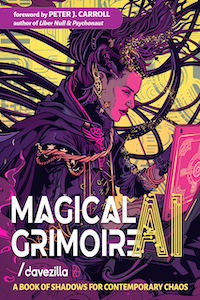
Magical AI Grimoire: A Book of Shadows for Contemporary Chaos, by Davezilla
Weiser Books, 157863847X, 288 pages, March 2025
Ready to take your magical practice to new technological heights? Introducing Magical AI Grimoire by Davezilla, an intriguing exploration of the intersection between artificial intelligence and the world of magic. This book offers a unique blend of technology and craft, drawing readers into a universe where the boundaries between the digital and the arcane blur beautifully.
“All across the globe, witches and magicians are finding that technology can have a spiritual essence and mind of its own, or rather, that the spirit world enjoys playing with tech as much as we do. The internet could be one more astral plane, for all we know.”1
Now, before diving in, I will acknowledge the common gripes about AI: environmental destruction, infringement on copyrights, artwork theft. There’s plenty of room for debate about AI ethics and the role it should have in our society. All I can say is that if you’re someone anti-AI, skip this read.
But for those who are curious about the fusion of AI with magical elements, which offers a fresh perspective on both fields, Davezilla encourages readers to ponder the possibilities that lie at this unique intersection and teaches how to make the most of the current AI tools available. I, personally, have thoroughly enjoyed the material and the subsequent workings I’ve been doing after absorbing Davezilla’s AI wisdom.
One of the best things about this book is Davezilla’s dedication to be extremely clear with his intentions, wording, and directions. In the introduction, he shares with readers the path that’s lead him to where he is today, which includes “initiations as an eclectic Gardnerian witch, a Nganglero in Palo Mayombe, a Discordian Pope”2 along with being a practicing Olocha within the Santero tradition. He then lists terms he uses throughout the text and provides his contextual meaning for words related to both spiritual/religious/magical traditions and technological lingo.
I was very grateful for his clarity because the way he weaves together magical concepts and AI definitely went beyond my current knowledge of the different systems he works within as well as the tech-terms. At the same time, this was one of the coolest aspects of the book. As Davezilla teaches how to use AI for magical purposes, he makes key points by crafting prompts specifically for different traditions and then shows the readers how the AI response will differ, reflecting practices common to the specific tradition the prompt was crafted to ask about.
For example, in explaining the art of promptcrafting, which is essentially knowing the best ways to phrase what you ask AI to get the most useful response, he asks AI to write a protection spell from the perspective of Wiccan high priestess, Santera elder, Chaos Magician elder, and Discordian Pope elder.
As a result, in addition to learning a ton about how to write better prompts to get the results I’m seeking, I also got to enjoy finding out more about the magical ways of magical systems I wasn’t familiar with. I found the AI answers for Discordian magic so fun that I ended up buying Principia Discordia by Malaclypse the Younger and Omar Khayyam Ravenhurst, the official “bible” of the Discordian religion.
And I have to say my promptcrafting feels NEXT LEVEL now after putting into use all the tips Davezilla shares in this book. It’s actually taken me weeks to even write this review because of all the creative ideas promptcrafting I’ve been pursuing, gathering pages and pages of new insights and ideas that seem to multiple the more I use ChatGPT. So far I’ve redesigned the branding for my astrology business, built a “starter’s guide” list for occult grimoires I want to study, designed countless spells and rituals, including one for the Sun-Venus cazimi in Aries, and planned out my magical feasts for Ostara and Beltane.
Some of the most useful promptcrafting tips Davezilla shares are utilizing tone of voice, directing the rhyme scheme for the response (good for chants), creating stories, and of course, designing rituals. He shares chapters on prompts for invocation rituals, banishing spells, protection spells, prosperity spells, healing spells, calling deities, and calling spirits–all done from multiple magical systems for readers to see the difference in both prompt and AI response.
After focusing on text-based AI chats, Davezilla moves into teaching readers how to use Midjourney, an AI-based visual creation app. For readers to use Midjourney requires a Discord account and to pay a subscription fee. However, once those barriers are hurdled, the world is your oyster when it comes to image generation.
Davezilla explains how to structure prompts specifically for this app along with terminology readers need to be familiar with. But once readers have the general format down, Davezilla teaches how to write image prompts to meet one’s guardian angel, find one’s familiar, discover one’s totem animal, and see elemental fairies. Along the way, he discusses stylization, image parameters, creating variation, panning/zooming, and using multiple prompts. These sections focusing on Midjourney definitely require more time to absorb, but the results are quite fulfilling.
The last chapters in the book offer even more possibilities for AI magical workings. Davezilla provides insight on using search engines as oracles, how to use AI for manifestation, sigil softwares for readers to download, virtual familiars, and the creation of software egregors. These are definitely more advanced and something readers can work towards with practice!
Throughout the book, Davezilla’s tone is light-hearted yet intellectually stimulating, striking a perfect balance between entertainment and education. He has a quick wit and great sense of humor, making this a very fun yet thought-provoking read. Plus, his experience and background in magic just shines through, along with his reverence for each tradition/system he includes in the book. Not only is the material fascinating, but there’s layers of enjoyment from Davezilla’s clever use of language that keeps readers invested and motivated to try out all the AI guidance shared. He definitely gives more than enough information to feel confident approaching AI, alleviating the potential for any frustrations with clear descriptions and directions to follow.
I love what Davezilla writes in the chapter “Final Thoughts”:
“Perhaps we should start thinking of it as IA–as in “intelligent assistance” rather than “artificial intelligence”. There is nothing artificial about the human hand and human brain and divine spark that have brought us to this future.”3
Overall, I’ve had an absolute blast reading Magical AI Grimoire. It has been by my side for over a month now and I’m still referencing it daily. This book is a must-read for anyone interested in the crossroads of technology and magic. AI is shaping the future, and the occult realms are just one of many arenas being transformed by this integration of AI.
Davezilla has done an exemplary job of distilling the basics of promptcrafting for rituals, images, and spellwork for magical practitioners to feel confident incorporating AI into their workings. If you’re ready to blend artificial information systems and magic, this is a wonderful starting point that will give you plenty of inspiration about what’s possible to create.

Alanna Kali is an astrologer, numerologist, and pioneer spirit that loves to explore life through the lens of depth psychology. She has a passion for studying the humanities and social trends. Her academic work is centered upon reuniting body, mind, and spirit through eco-psychology. She loves reading, spending time in nature, and travel.