✨ A Gathering Place for Magical Readers and Writers ✨

Tag Archives: goddess

Pagan Portals – Iris, by Irisanya Moon

Pagan Portals – Iris, Goddess of the Rainbow and Messenger of the Godds, by Irisanya Moon
Moon Books, 1789047110, 96 pages, July 2021

When was the last time you saw a rainbow? Seeing one is always such a miraculous gift to me. It feels so spiritual, like a harbinger of blessings. Moments after seeing a rainbow about a month ago, I discovered the book Pagan Portals – Iris, Goddess of the Rainbow and Messenger of the Godds by Irisanya Moon. As Moon describes, “She [Iris] offers magick in the way rainbows form, seemingly from nothing, but truly from the perfect alignment of conditions.”1 With this synchronicity, it was as though the rainbow was calling me to delve into this book.

Moon introduces herself to the reader and gives a bit of background on her experience with Iris, who she connected with to include as part of her magical name. I especially enjoyed reading about her experience with Reclaiming on her path, as all the Reclaiming workshops I’ve attended have been some of the greatest portals to magic!

To start with, Moon provides quite a few stories of Iris to assist the reader with getting acquainted with her mythology. Reading stories of Iris delivering messages for Hera and Zues was interesting, along with realizing she was the messenger sent to Demeter to coax her out of grief at the loss of her daughter Perspehone. I also learned Iris is the consort of Zephyrus, god of the west winds — so cool!

After reading the stories of Iris in mythology and hearing Moon’s thoughts, I really resonated with her view that Iris can teach us about being of service without being in servitude. For any person who feels calls to share their gifts, Iris’s story is a wonderful reminder of the need for personal self-care as well. Moon encourages the practice of self-service alongside serving deities and one’s communities, and relates the story of Iris to the need for this. As she writes, “A tired and burnt out priestess is not a very effective servant, after all.”2

The main bulk of the book is Moon’s magical practice called Traveling the Rainbow. She guides the reader through all the colors of the rainbow, offering exercises to connect with each energy. For instance, doing mirror work with the color orange and water gazing for the color blue. Working the way through the rainbow proved to be quite insightful. I really enjoyed making a collage for yellow and a meditative journey for indigo.

Towards the end, Moon offers ideas on how to do a ritual to honor or petition Iris. There’s an absolutely beautiful devotional poem that Moon has written to Iris that made my heart melt. It is so well written, while also emotionally evoking. She also offers quite a few ways one can create a relationship with Iris through options such as altar building, artwork, journaling, and meditation.

Moon calls readers to be intentional in their work with Iris, and to be honest, gives more background than any book I’ve ever read about the process of choosing to work with a deity and focusing attention on that relationship. She is very honest in her approach to deity work, acknowledging there’s different reasons people choose to work with a particular deity, from being called to building a long-term relationship, while some might just want to create a connection for a specific purpose. It was helpful to read her thoughts, tips, and techniques, and regardless if one plans on connecting with Iris, one would surely benefit from her insight about relationships with deities.

While I have not formally created a relationship with Iris, this book was immensely helpful in learning more about her, her role in mythology, and her special energy. I really enjoyed being immersed in the feeling of rainbows while reading, and within I felt a multitude of colors illuminating my creativity through artwork and time spent in nature. I also did a lot of reflection on the similarities and differences between Iris and Hermes, my patron deity, as they are both messengers that have the ability to move freely through all realms.

I recommend Iris to those hoping to learn more about her mythology, wishing to connect with the goddess of the rainbow, or even establish a relationship with her as a deity. Moon has done a great job of piecing together her story and sharing her method of connection with Iris. As already mentioned, the wisdom of Moon’s work with deity is very insightful and sure to be beneficial to any reading looking to petition or dedicating themselves to a godd. Next time I see a rainbow, I certainly will be wondering what messages Iris is delivering and pause for a moment to give her my praise.

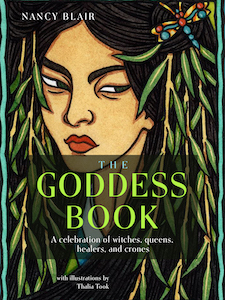
The Goddess Book, by Nancy Blair

The Goddess Book: A celebration of witches, queens, healers, and crones, by Nancy Blair and illustrated by Thalia Took
Hampton Roads Publishing, 1642970203, 234 pages, April 2021

It’s not every day that I have the opportunity to invite 52 friends into my home, but that’s what happened when Nancy Blair’s book, The Goddess Book arrived at my doorstep. As I happily opened the door to retrieve the book, so too did I gladly open myself up to welcoming these goddesses into my life to share their wisdom with me. As Nancy writes in the Preface, “our Goddess heritage and her story, the greatest story never told, brought me home.”3 She continues:

“Goddess spirituality brought me home: to my Self, to the innate wisdom of my body, to our living Earth body, and the body of women’s wisdom long repressed. The return of the Goddess is a rising tide that cannot be held back.”4

I was attracted to the book as I wanted to participate in the celebration of witches, queens, healers, and crones — pretty great company if you ask me. I liked that Nancy worked with the Goddesses in a seasonal way, 13 Goddesses for each season. I read the book in its entirety, but then I focused on the Goddesses of Spring as that is the current season where I live.

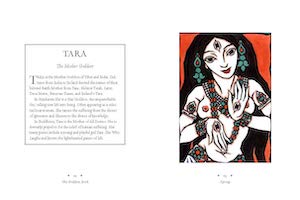
I’ll keep this book out the entire year, and I plan on working with one Goddess a week based on the season to allow for a deeper relationship with each. I am really enjoying being introduced to Goddesses with whom I wasn’t aware of such as Vila (Spring), Oshun (Summer), Ungnyeo (Fall), and Aida Wedo (Winter). I also welcomed reconnecting with some of my favorites such as Tara (Spring), Selena (Summer), Baba Yago (Fall), and Brigit (Winter). 

The book has a very brief introduction for each season before profiling the 13 Goddesses. There is a short description of the Goddess followed by an exercise to work with the Goddess and a related affirmation.

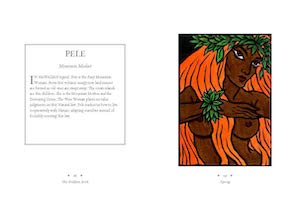
Thalia Took’s illustrations remind me of beautifully colored woodcuts that greatly enhance the writings. As the author is also an artist, I thought it a great testimony to Took’s talent that Nancy chose her to illustrate the book rather than doing so herself. I absolutely loved the illustrations, some favorites were the multi-breasted Diana of Ephesus, Inanna bejeweled in stars and the moon, and Willendorf, the first time I’ve seen her portrayed in a two-dimensional with a face rather than the tiny sculpture of which I’m most familiar. 

Nancy is an artist and published author (Amulets of the Goddess: Oracle of Ancient Wisdom) who imparts a Mother Earth-based familiarity with these Goddesses in an approachable way. With Demeter, for example, we meet the Goddess whose Roman name, Cere, is where the word cereal is derived. One is encouraged to “invite Demeter to feast with you as Autumn’s light grows thin.”5 The three-line accompanying affirmation focuses on healthy food and nourishment. The illustration of Demeter shows a woman with long blonde hair resembling corn, cloaked in green.

We meet Sophia in the Winter season. As Holy Wisdom, she will “lead you to your true destiny.”6 In the Affirmation we hold “inner wisdom as my road map.”7 She is illustrated as with the almond-shaped eyes reminiscent of a Byzantine image. The yoke of her cloak is covered in similarly almond-shaped stones that mirror her eyes. 

Danu, the Great Goddess, appears in Spring. We see her in profile, rooted leaves forming her hair. All in green, her upper body and face are covered in the spirals that are most identified with Celtic art as she is the “Great Mother Goddess, from whom all Irish gods descend.”8 The affirmation calls us to embrace our power.

Summer introduces us to Yemaya, Goddess of the Sea. A dark-skinned woman, she is cloaked in a patterned batik fabric. Shells adorn her upper arm, neck, and ears. She is a “mother spirit: matron spirit of women, especially pregnant women.”9 Call on Yemaya to “release you from old beliefs, thoughts, or feelings that seem to enslave you and keep you estranged from your sacred Self.”10

As I said, this book will be a reference for all the seasons to connect with the many different Goddesses who support us on our path. The Goddess Book packs a lot of information and offers empowering affirmations. I recommend using this as a guidebook, inviting these Goddesses to become your companions as you move through your life and the wheel of the year. Meditate on them, embrace them, and accept the guidance they are providing. Blair and Took have done a wonderful job of depicting the many facets of the great Goddess and bringing them all to life.

The Magical Nordic Tarot, by Jayne Wallace

The Magical Nordic Tarot: Be Inspired by Nordic Legends and Explore Your Past, Present, and Future, by Jayne Wallace and illustrated by Hannah Davies and Tracey Emin
CICO Books, 1782498865, 64 page, 2020

The Magical Nordic Tarot by Jayne Wallace is a serenely magical deck. In recent years I’ve found myself attracted to all things Nordic such as hygge, the Northern Lights (which is on my list of things to see), and a society that promote a healthy work/life balance. However, I am not at all familiar with Nordic myths and legends. I have been looking forward to using this deck because I was curious to see how this deck would incorporate Nordic myths, gods, and goddess with the card interpretations. I am happy to say it wonderfully connects the reader with the exceptional energy of Nordic mythology, infusing the reading with the wisdom of Scandinavian culture.

The deck has a nice card stock and the card size is manageable (about 4” x 6”). The illustration on the outside of the cards reminds me of a love child between Vincent Van Gogh’s Starry Night and the Northern Lights. A bright yellow star is and smaller illuminated stars are placed on a background of colors of muted purples, pinks, and greens.

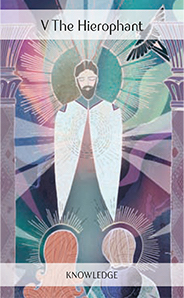
Hannah Davies’s illustrations of the Major Arcana cards are pure beauty. The depiction of light, landscape, and images reminds me of the dancing Northern Lights. Most of the images on the Major Arcana cards are set in a Nordic landscape and each card has a unique keyword at the bottom. In the accompanying book Jayne provides a description of the scene, key words, a message, and a meaning. Also included is a description of the card’s connection to Nordic myths, folklore, gods, goddesses, or legends that provides a deeper explanation of the card’s imagery. 

I pulled a few Major Arcana cards as I familiarized myself with the deck.

The Lovers shows a man and woman each standing on what appears to be a mini iceberg. Two white swans swim towards them. Pastel colors of purple, pink, and turquoise are used in the illustration. “Passion” appears at the card’s bottom, supporting the message “I am entwined with passion.” 11 As the Nordic connection to the card, Jayne writes that “The goddess of spring and eternal youth, Idun, was thought to have magical apples that would help the gods and goddesses stay young and beautiful forever.” 12

The Magician is cloaked in a fur-trimmed jacket with the beams of the Northern Lights behind him. In the foreground is a compass, representing the directional points in which one can move. Mastery is the keyword of the card, representing that ultimately, we are all masters of our own fate.

In the Empress card, a woman sits on the ground, surrounded by blooming flowers and three rabbits (fertility). She lovingly caresses her belly that is pregnant with new life. In the background, mountains are set against the Northern Lights. Jayne describes that “in Nordic folklore it was said that seeing the Northern Lights could ease the pain of childbirth.” 13 Nurture is the keyword for this card, a reminder that we need to nurture the new. 

The Hermit depicts a young man sitting in contemplation against the background of a waterfall. In the far distance, the Northern Lights shine like beacons. A rabbit and deer stand near but do not disturb the man. Jayne details that “the Nordic tree of life was thought to have three wells under it, all of which would water its roots and keep it alive.” 14  Wisdom is the keyword, the wisdom that comes from inner knowing that bubbles up when we are silent.

Interestingly, Jayne included an extra card titled Clarity to the Major Arcana. Clarity is depicted as a blue cat, “one of the most sacred animals in Nordic mythology.” 15 Unlike the other cards in the deck, this card was illustrated by Tracey Emin and so has a different style, more of a loose Japanese water color with no Nordic references.  It is described as a card of compassion and self-care. The blue cat is “synonymous with the goddess of love and beauty, Freya, who’s thought to have traveled in a chariot pulled by cats, felines were highly prized by ancient Nordic people, who believed the cats had been given to Freya as a gift from Thor.” 16 I did not pull this card in any of my readings, though, but remain intrigued by its placement in the deck. I’m curious to see in which reading it will emerge.

The Minor Arcana cards contain depictions of each of the four suits. In the book, Jayne explains each of the four suits, their respective elements, and associations (for example, finances for Pentacles). The accompanying book also provides a description of the meaning of each card and a keyword. There are no Nordic legends or myths written about for the Minor Arcana cards. 

The numbered cards of the Minor Arcana show the respective number and suit image with a different colored background for each suit. For example, One of Swords has one sword on the card against a purplish background. While the numbered cards lack illustrations that might help one in determining a message, each card has keyword at the bottom. Going back to the One of Swords, the clarifying word is Clarity. However, the court cards of the Minor Arcana are illustrated in the same Nordic style of the Major Arcana card. Most are set against a background of mountains and Northern Lights. They also include a keyword. I feel that a beginner can easily become familiar with the meanings of the Minor Arcana with a keyword which compensates for the lack of an illustration. The austere background of the numbered cards in no way diminishes one’s ability to read the cards. 

The accompanying guide book is divided into four sections: Introduction, the Spreads, Major Arcana, and Minor Arcana. 

The Introduction offered advice to both novice and experienced readers. I liked that Jayne Wallace walks new readers through various ways to connecting with the deck. Before diving into different spreads and the card meanings, Jayne suggests ways to get the most of a reading, advice that I have found is often skipped in tarot books. I think it’s really important to build a relationship with one’s cards and liked that this information was included. Jayne recommended various ways to connect with your deck including touching every card and also sleeping with the deck under your pillow. She also offers ways to care for your cards, which I think is another aspect of working with a deck that is also often neglected. 

The Introduction also suggested various ways to begin the reading, set the mood, and participate in a closing ritual. I feel that these different components covered in this section reinforce the idea of respecting the cards, opening a “dialogue” with them, honoring the process of a reading, and concluding the reading with a ritual. I admit that I haven’t done a closing ritual in all my years of working with my cards but now plan on including last step in my ritual, which is generally centering one’s self and thanking the cards. Beautiful!

The second section of the book was on various Spreads. The Spreads range from one and three cards spreads to a spread that used 36 cards. The smaller Spreads are geared to both the Beginner and also a more experienced reader who wants a quick bit of guidance or clarification. I was not familiar with some of the spreads that Jayne included such as the four card Nordic Compass, the six card Horseshoe, the seven card Light Within, and that large 36 card spread, Clock. 

I did a few quick reads which were amazingly spot on. But of course, I had to try the Clock spread which intrigued me. In this spread you pull 12 cards and set them out like the numbers on a clock and continue the process of laying out the cards until you have three cards for each of the 12 number spots, each of which corresponds to a topic such as Money, New Beginnings, Obstacles, and Past. As Jayne writes, the spread is meant to give insight into life at the present, offering help and guidance to any obstacles or challenges. As I sat with each of the 12 piles I came to see that the three cards in each spot began to reveal a story and I was able to get a deeper understanding of the message coming forth in each of the 12 positions; much more clarification came through by pulling the three cards rather than just one as many spreads often suggest.

All in all, The Magical Nordic Tarot is a beautiful deck. I enjoyed embracing the Nordic myths and legends while engaging with the deck. The deck seemed “quiet” to me, quite like the world seems after a snowfall. The messages come through, but in a muted way that gently seeps into one’s being versus a loud pronouncement. This feeling invited me to sit with the cards, enabling them to open themselves to me. I highly recommend this deck for those who seek an unassuming read filled with the beauty of Nordic landscapes, myths, and spirituality.