✨ A Gathering Place for Magical Readers and Writers ✨

Tag Archives: toni savory

The Four Selves Oracle, by Toni Savory and Carrie Paris

The Four Selves Oracle: Pathways to Integrating Shadow and Light, by Toni Savory with illustrations by Carrie Paris
Weiser Books, 1578638933, 160 pages, 36 cards, June 2026

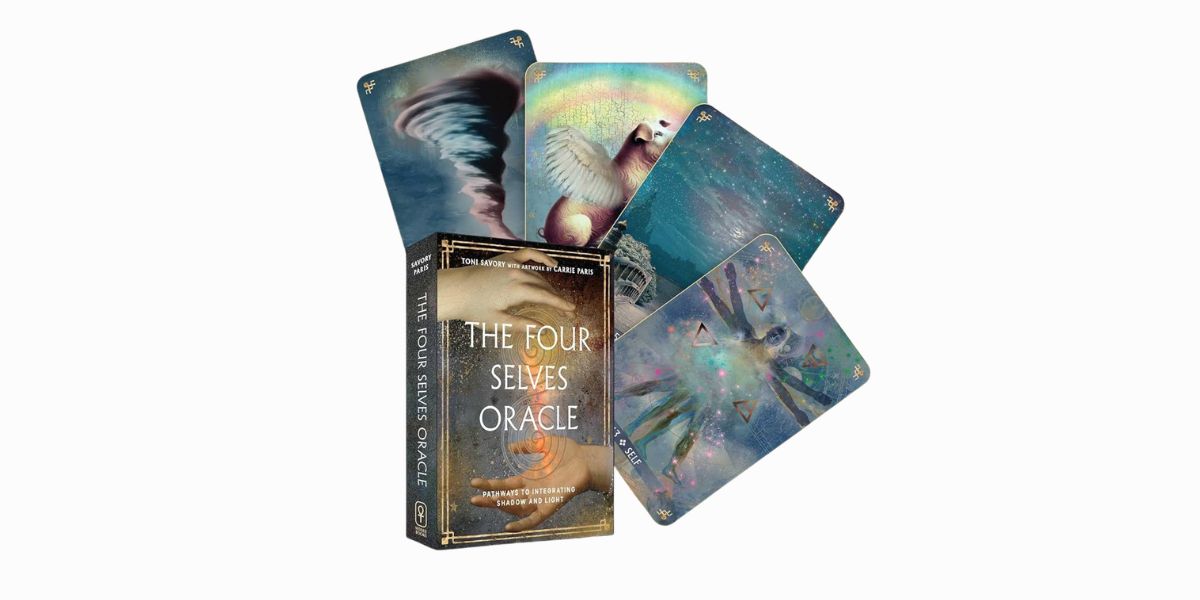
The Four Selves Oracle: Pathways to Integrating Shadow and Light is one of the more psychologically nuanced oracle decks to recently be published. Created by Toni Savory and illustrated by Carrie Paris, the deck is built around the idea that each person contains four interconnected aspects: the Physical Self, Conscious Self, Subconscious Self, and Superconscious Self. Rather than focusing solely on affirmation or spiritual uplift, the deck explores the dynamic relationship between shadow and light, helping readers identify emotional triggers, unconscious patterns, and pathways toward integration and wholeness.

“Quite simply The Four Selves Oracle is a gateway for you to understand yourself in ways that allow you to take action and do the work to become and embrace the true divine source within you and around you.”1

The structure of this deck is unique; it definitely took me a little time to get used to working with it. First, there’s two significator cards: Self (13) and Shadow Self (15). Of the 36 cards in this deck, 16 of them are light cards (belonging with the Self significator), 16 are shadow cards (belonging with the Shadow Self significator). The light and shadow cards are all paired, so each light one will have a corresponding shadow card and vice versa. Then the other four cards are neutral ones, intended to balance the reading.
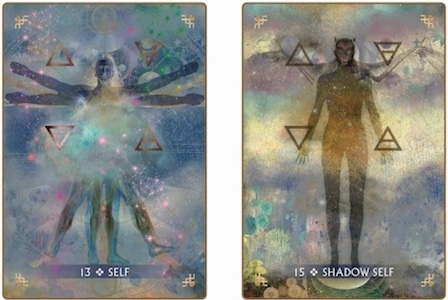
Now, before the Savory even gets into the layouts, readers learn the poisonings in the deck. Depending on the layout, the card could be in a light or shadow column and conscious, physical, and subconscious position layer. There’s a nice big color-coded visual of this in the guidebook, which helps with understanding the placements.

It seems like there’s a lot of moving parts, but once you begin working with the deck regularly, things become more intuitive. The intention behind it all is for the cards to support one another, bringing a holistic approach to the deck, as each card is reflected within ourselves. I find this approach so novel since even if there’s a common theme to the deck, most oracle readings focus on the individuality of each card. The layer in this deck makes for a much richer reading than any deck I’ve worked with before.

The guidebook description of each card provides the card type, keywords, mantra, core meaning, imagery, and guidance for it in the position of conscious, subconscious, and physical. Also listed is the card’s counterpart and insight on how the cards reflect each other. To become more familiar with the deck, I found it very helpful to go through the guidebook and read the corresponding pairs, reflecting on the wisdom and letting the information coalesce a bit prior to even doing readings. This approach made me feel more comfortable with the cards once I did start doing spreads.

Interestingly enough, the layouts are not even presented in the guidebook until the second part, following all the oracle meanings. The first suggestion in this section is to do a pull of either one, two, or three cards and simply work with the mantras. I found this VERY useful for familiarizing myself with the deck and every time got uncanny guidance that was reflective of what was going on for me internally at the time.

The other spreads continue to build on the different facets of personal exploration the deck can be used for, from releasing triggers to checking in with the four selves, and culminates with a 36-card grand tableau. I have yet to do this full deck spread because I am saving it for when I really want some big guidance, but I love having it available to me with this deck.

Visually, the deck is colorful with plenty of symbolic richness.. The imagery is dreamlike, archetypal, and slightly surreal, featuring portals, mirrors, moons, gardens, vortexes, and liminal landscapes. Rather than depicting literal scenes, the artwork functions as a symbolic language that invites contemplation and intuitive interpretation. The aesthetic feels mystical without becoming overly ornate, giving the reader plenty of imagery to gaze at while not getting too overwhelmed with small details. The imagery does a good job of providing visual structure for the complexity of the deck rather than be a source for predictive insights.

And this brings me to my final thoughts on the deck. Many of us go to oracle decks for predictive guidance or affirmation-focused messages, so this focus on introspective reflection and shadow work might not initially be a comfortable realm for our readings. The deck certainly requires more time learning than the majority of oracle decks.

But this is what makes The Four Selves Oracle so exceptional. Instead of asking for universal guidance from the oracle deck, this card brings to light the parts of ourselves that hold wisdom. Bridging both spirituality and psychology, the guidance is both meaningful and practical. It’s a comprehensive tool for those looking to better understand the multi-faceted self and delve into the patterns, triggers, and deeper emotions that are best explored through tools such as this deck. Savory acknowledges that growth requires confronting difficult emotions and unconscious habits and the structure she’s created with this deck is excellent.

I highly recommend this deck to those who enjoy shadow work, depth psychology, journaling, or therapeutic spiritual practices. While the deck does take some time to get used to working with, which makes me want to recommend it more towards advanced readers, I do think there’s more than enough information to begin working with it at any level. Allow time for your connection with the deck to grow is my advice. I was a bit overwhelmed at first, but slowly, as I took the time to learn the structure of the deck, the readings became more clear and potent. This has now become one of my favorite decks to turn to for when I’m doing inner work.

Mastering the Tarot Tableau, by Toni Savory

Mastering the Tarot Tableau: Revisiting Predictive Accuracy with Tarot, by Toni Savory
REDFeather,  978-0764368912, 144 pages, April 2025

Mastering the Tarot Tableau: Revisiting Predictive Accuracy with Tarot by Toni Savory introduces the reader to a style of tarot reading that is more commonly used in European countries. In setting up the tableau, Savory provides the reader with a complete narrative, connecting and moving through the cards chosen as a whole, rather than independent outcomes. The spread for a reading is laid out in a sequenced grid, also known as a “tableau”, which offers deeper insights and greater clarity and accuracy of the reading.

“Each Tarot deck contains the story of life, and every possible situation is available for insight. By using a tableau spread, we can determine interpersonal relationships and auspicious versus inauspicious fortunes and tell the tale of daily life for our querents.”2.

This book is organized into four major sections, each containing subsections aligned with the cards of the tarot, basics, and technique. The sections and their components build upon one another, forming a solid foundation of information and study for the novice as well as enhancements and new perspectives for the more advanced tarot devotee.

The introduction provides the reader with the history and diverse ways in which this style of reading has been used, particularly at the moments when divination and the predictive arts were banned or came under fire. This method of adaptability makes a bold statement about the tenacity of the tarot readers and the fact that there are many ways to accomplish the desired outcome– all very much aligned with the art of tarot itself.

“The tableau provides the backdrop for a pure predictive reading, quite like the fortune-tellers of the nineteenth century would employ, leaving spiritual matters to the side and focusing on what would happen within the daily life of the client. All flowery language attached to the Tarot meanings are removed for a short, sharp and direct narrative….. The reader finds that their readings become a novel-like affair, and the story of the querent’s life is explained from start to finish with flair.”3

Throughout the section entitled “The Game of Tarot” the reader is taken through the fundamentals of tarot as a predictive and intuitive tool. With the section “The Meanings”,  a third of the book is assigned to the task of providing brief, yet concise meanings of each of the seventy-eight keys complete with keywords, auspicious and inauspicious application, and highlights or movement that is indicative of the specific card.

Having completed a “crash course” or “refresher” of the tools employed, focus is directed towards using that information in the creation of tarot tableaus.

“Thinking of your Tarot tableau as a game to be played is the perfect mindset for imaginative and intuitive readings.  Consider a board game; we throw the dice and move along the rows of the board until we finally either win or lose. Each position on the board has a rule (e.g. receive five gold pieces), and we have to overcome a few obstacles along the way. The game of Tarot is no different-we follow the flow of the board to interpret a narrative using each card as a further step in the story of life.”4

The following section introduces the reader to six types of tableaus, the basics of understanding how the cards interact with one another in this style of reading, selection of the significator (representing the querent) card, and how the flow of the narrative begins in its story telling. The author makes use of a step-by-step example of a sample reading to give clarity and a visual component for comprehension.

I especially enjoyed the subsequent section entitled “Advanced Tableau Techniques” and the offerings of ten highly usable approaches for tarot readings. Of these, The Fool’s Journey Tableau, stirred the most interest. Perhaps because this “journey” has been given so much attention and means of interpretation throughout the ages and in particular in the more modern style of tarot reading and the spreads used.

“The Fool’s Journey provides the backdrop to the Major Arcana TABLEAU and is read in conjunction with the cards presented. Each Major Arcana card becomes a house (or placement) within the spread, enabling the reader to follow the client’s future storyline.”5

Mastering the Tarot Tableau aptly concludes with additional supportive meanings for the cards relevant to the selected tableau and the inquiry being made. The final pages are devoted to client readings and, more importantly, making the reader feel assured and confident in this style of reading.

“When first looking at a tableau, it is easy to feel intimidated and almost fearful of the sheer number of cards and their meanings to digest and communicate. Before reading for others, begin by having fun with a Tableau. Use them to tell stories about work, love, and random tales of kindness, sorrow and life. Allow yourself to be immersed in the story, to build not only a narrative but also a relationship with the tableaus themselves.”6

Savory then goes on to share her experience of reading tableaus and further supports the idea that this is a viable, highly usable, and accurate way of serving your client, despite the complexity and practice required. 

Would I Recommend?

Mastering the Tarot Tableau is a unique book that offers an intriguing approach to tarot reading. It is a comfortably sized companion to bring along for reading practice or study while having coffee. Additionally, there are more than fifty  illustrations of both cards and grids for tableau placement providing a visual kinesthetic experience of learning and doing.

I am especially appreciative, as I am sure other readers will be, of the thorough and concise manner in which Savory has organized the information regarding this style of reading. Although the complexity and possible overwhelm of necessary preparation and knowledge may seem daunting, the way in which it is presented speaks to the passionate interest of the author in sharing and broadening the styles of the traditional tarot community. 

All in all, whether an experienced reader or novice to tarot, this book  is definitely worth a read, encouraging tarot readers to remain open to the new narrative that may unfold for yourself as both reader and querent.

About the Author: Toni Savory 

Toni Savory, founder of the World Divination Association and author of The Card Geek’s Guide to Kipper and the Rainbow Kipper, has studied cartomancy and divination in England, France, and Germany.

The Sirens’ Song, by Carrie Paris and Toni Savory

The Sirens’ Song: Divining the Depths with Lenormand & Kipper Cards, by Carrie Paris and Toni Savory
Weiser Books, 9781578638062, 144 pages, 78 cards, August 2023

Being somewhat of a newbie with Lenormand cards, I jumped at the chance to work with The Sirens’ Song: Diving the Depths with Lenomand & Kipper Cards by Carrie Paris and Toni Savory with contribution from Tina Hardt. The Sirens’ Song is a combination divination kit that contains 40 Lenormand cards and 38 Kipper cards. (What I know about Kipper cards would fit in an earbud!)

Paris is one of my favorite diviners and deck creators and I had an opportunity to meet with her for coffee at a tarot event several years ago. She is a generous, incredibly creative and gifted teacher and mentor. I’ve also “met” Savory on Zoom via her World Divination events, and her knowledge and enthusiasm for various types of card divination is contagious! When I heard that the two of them collaborated on this kit, I was very excited to learn more.

Paris has created four other tarot and Lenormand decks, as well as numerous charm casting kits. Her The Relative Tarot and The Beloved Dead kits are two of my favorites for communicating with the ancestors for messages and guidance to live my life. Paris is a very talented artist, who blends art and graphic elements from across many eras to create her decks and frequent Facebook posts. She has a master’s degree in the Cultural Study of Cosmology and Divination from the University of Kent, UK. Learn more about Paris at her website.

Savory (aka The Card Geek) founded the World Divination Association and hosts virtual teaching events several times a year with a collection of teachers and mentors. She is also well-known for hosting free events with classes on tarot, Lenormand, Kipper and other types of cards. She has created five other decks and written five books on card divination. Savory has researched Kipper decks for more than ten years, including spending time with the families of readers going back several generations. See more at her website.

Contributor Hardt is an author, who has worked with Paris to create the guidebooks for The Relative Tarot, The Beloved Dead, and The Sirens’ Song. She considers herself a diviner and enjoys sitting in circles and communicating with departed souls.

Paris and Savory have beautifully created this kit with a compact box in hushed tones of gray-blue and aqua. The teal lettering and haunting image of the siren and some of her underwater friends grace the cover of the box. Printed inside the kit, this lovely invocation greets you:

“May the Sirens’ Song guide you away from rocky shores and lure you into the dazzling depths of your own truth and mystery.”7

Next, you notice the guidebook, which provides a brief history of both Lenormand and Kipper cards, as well as how this deck came to be. Paris created the original Sirens’ Song Lenormand deck in 2017. Savory asked her to create a Kipper Deck and then the two of them combined both decks “into a single treasure chest because, at their core, these two card decks are kindred divinatory tools.”8

“Both the Kipper and Lenormand cards long to tell the reader a detailed, no-barnacle- unturned story, in which the Querent is always the main character. The potential for discovery is enormous. . . . The Petite Lenormand can serve as a gateway to the Kipper.”9

The guidebook was expertly structured to introduce you to the Lenormand style of reading and descriptions of the card meanings before flowing into the Kipper cards and their unique card descriptions. The creators made it clear that the cards can be used alone or in tandem, and they showed how each deck has its own “ability to tell a story, to sing you the song that you need to hear.”10

Unlike tarot and oracle decks, which are read intuitively, Lenormand cards are read symbolically, and Kipper cards are read quite literally. Lenormand deals with the outer world while Kipper deals with the interpersonal. Read together, the story the Sirens tell reveals the hidden meaning to be found in both people’s everyday lives and in societal issues they face.

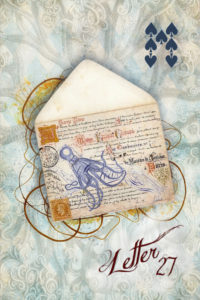
This kit is so much fun! I enjoy the graphics, with the beautiful artwork and symbolism. Each of the images has an underwater creature theme, from an octopus to fish and so on. The cards are marked on the back with either a K for Kipper or an L for Lenormand, so you can keep the decks straight.

The spreads in the back of the guidebook were so helpful! I especially loved how they showed a three-card Lenormand reading and featured the three cards in each of the three positions. Paris and Savory also share how to do the Grand Tableau style of reading, which involves using all the cards in either deck. The deck creators also shared how to combine the cards and read a Grand Tableau of 36 cards created out of both decks. However, I think I will master the four, five or nine-card spreads before I venture into the deep waters of the Grand Tableau!

Yet the coloring on the front is the same, so it is not easy to distinguish between the decks for someone like me who was relatively new to the two styles of cards. Yes, the Lenormand deck features the miniature card symbols from playing cards in the top right-hand corner. Yes, the Kipper deck has different card images. But it may take me lots of practice to be able to distinguish between the two decks.

The cardstock was a nice weight, and the cards had a matte finish. I loved the small size, which made the cards easy for my small hands to shuffle. The guidebook was also a great size to tuck into a bag or purse and was printed in four-color with thumbnails of all cards. The paper was glossy, and the font was whimsical, to complement the underwater theme.

Armed with this background information, I decided to give the Lenormand cards a spin. I created a question regarding the launch of a new program I wanted to present to my community. I decided to use Paris’s spread called “The Tell it Like it is Spread.”

  • What it’s all about. The situation. The issue.
  • What it isn’t.
  • What it is.
  • How it turns out.

And here are the cards I drew:

  • Book – Unknown, Secrets, Reveals
  • Mountain- Challenge, Struggle, Resistance
  • Stork –Change, Alteration, Shift, Movement, Progress
  • Heart – Well-being, Love, Goodness

Creating my own sentence from the key words and the placement of the cards as shown, I saw the following:

Sharing my knowledge is NOT going to be challenging, so I may move ahead to schedule the event and know that all will be well.

Great first reading!

For the Kipper Cards, I decided to do a simple three-card spread. I placed the Siren significator card to the right as I asked my question: How may I support my daughter at this phase of her life, after her recent break-up? I drew three cards and placed them alongside the Siren card. The cards lined up as:

  • Long Road
  • Hope
  • High Honors
  • Siren

From this, I saw that recognition, maybe a promotion was forthcoming, especially since it was next to the Siren card. Hope was the next card, meaning manifestation of love, fame and/or fortune. Finally, I saw Long Road, which could be indicative of a great distance or maybe a time of two years. The fact that the Hope card was next to it said that the time may pass quickly and the road may not be rocky. From these cards, I saw that my daughter’s job will be very rewarding, and there is hope for her future in both love and fortune, although it may take some time. Wonderful reading!

The Sirens’ Song would be great for anyone who wants to learn or practice Lenormand or Kipper. I was a relative newbie to both styles of reading, and I enjoyed learning them very much. I could see myself keeping this deck by my desk to refer to when I had a quick question. For now, I’ll be off to check out one of Savory’s videos on Kipper cards on YouTube!