✨ A Gathering Place for Magical Readers and Writers ✨

Tag Archives: divine feminine

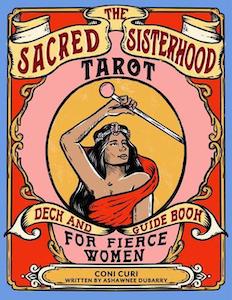
The Sacred Sisterhood Tarot, by Ashawnee DuBarry and Coni Curi

The Sacred Sisterhood Tarot: Deck and Guidebook for Fierce Women, by Ashawnee DuBarry with illustrations by Coni Curi
Red Wheel, 1590035259, 80 pages, 78 cards, October 2021

Despite tarot reading becoming a booming trend in recent years, few readers seem to be discussing the esoteric foundation of the common Rider-Waite-Smith (RWS) deck. Essentially, the RWS deck is steeped in tradition of the Hermetic Order of the Golden Dawn, which drew from the Qabalah, astrology, numerology, Christian mysticism, Hermeticism, the religion of Ancient Egypt, Freemasonry, Alchemy, Theosophy, Enochian magic, and Renaissance grimoires. Talk about overload!

As a seasoned tarot reader and energy worker, I’ve been on a mission to find tarot decks with a different energy for my readings. The Sacred Sisterhood Tarot: Deck and Guidebook for Fierce Women by Ashawnee DuBarry has been so immensely rewarding to discover. A deck that isn’t steeped in occult traditions that I don’t practice NOR a patriarchal framework? Yes yes yes! This is what The Scared Sister Tarot offers.The energy feels so deeply resonant with my spirit, and the good vibes of this deck have been shining through in all my readings so far.

The box for this deck is hefty, and I love it. Looking at the image on the box makes me feel ready to take on the world. I love that there’s some weight to the deck. Yet, the cards themselves are the perfect fit for one’s hands. Measurements aren’t really my thing, but I would say they’re a little taller than normal play cards yet a bit more narrow in width. Basically, they fit in my hands perfectly and make it really easy to shuffle.
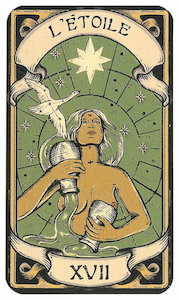
Opening the box is a color-pop of oranges, yellow, red, and light brown tones that make the cards feel infused with solar energy but also grounded. The back of the cards have lovely, luscious pomegranates on them, which is the perfect representation of Divine Feminine energy, as they are known for being a symbol of fertility and abundance.

Illustrator Coni Curi has done a marvelous job featuring a multitude of women in this deck. As you go through the cards, it becomes evident there’s one “no size fits all” model for women. This concept is bolstered by the intent of the deck to tap into the different facets of Divine Feminine wisdom, through both the major arcana and different suits of the minor arcana.

“The Sacred Sisterhood deck was created with inclusivity in mind, from trans folk to cis-gender- all are welcome, unlike the original tarot, which centered its images and descriptions around hte old gender roles. True sisterhood is all about coming together in a sacred space to support one another, no matter how  you identify.”1

The representation in the deck is remarkable. From multiracial relationships between women to women with disabilities, vast identities and body types are portrayed. And this diversity  imbues the deck with a feeling of empowering solidarity, as though I want to see “I see you! I know we’re all out here doing our best, learning what it means to embody this Divine Feminine feeling in our life.”  It’s beautiful because it feels so REAL. This is what womanhood looks like, and it comes in so many shapes, sizes, shades, and orientations, which is something worth celebrating.

While there is plenty of symbolism for each card, Curi didn’t stick to the traditional tarot imagery. I enjoy the modern take on the cards’ meaning and alternative representation to the traditional RWS tarot. One of my favorites is the Judgment card that has a winged angel playing a saxophone as two women dance beneath her. 

There’s a simplicity to the cards too. Each card has a solid-color background that emphasizes the main image on the card. This makes it so the reader isn’t lost in detail and can easily connect with the image that is popping out to represent the card.
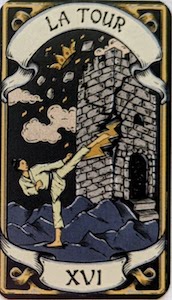
Additionally, the emotion of the women featured on the cards is also something that makes this deck unique. Curi has clearly conveyed sadness, discontentment, happiness, and sovereignty. The women of the deck help to connect with the many emotions of life, tapping the reader into their own feelings. Beginner, intermediate, and expert readers all will be able to find meaning and resonance with the imagery of the deck.

Though, I will mention the one thing that threw me off a little at first: the card names are written in French! For instance, The World is called Le Monde and the Ace of Pentacles is called As De Deniers. Luckily, from the imagery and general knowledge of romance languages, I’ve been able to figure out what each card is, but it definitely was a stumbling block that  made initial reading not feel as intuitive as it might with a deck in English. Now that I’ve been reading with this deck though, I feel pretty cool for knowing the French name for these cards though!

Plus, the guidebook is a huge help for understanding the card’s meaning. I love it so much!! I think it’s one of the best guidebooks I’ve ever seen. It’s large, easy to read, and very colorful. DuBarry offers a complete guide to working with the deck, including tips for getting to know the deck, shuffling, and doing readings. What I liked most though is the suggestions for how to use the deck aside from just doing readings, which included things such as candle magic and shadow work. There’s also plenty of spreads to use with each card position thoroughly detailed.

The cards’ messages are all very meaningful. DeBarry clearly conveys each card’s essence through their interpretation. For every card there are keywords and meanings for the card upright and reversed, plus the best thing about this guidebook, which is the answer for yes/no questions.

HALLELUJAH! This yes or no meaning guide has been so incredibly useful. You often hear the advice to shy away from yes/no tarot questions, but so often I just want some quick insight about if I should do something or not, and this guidebook is perfect for those questions!! I so very much appreciate this being shared.
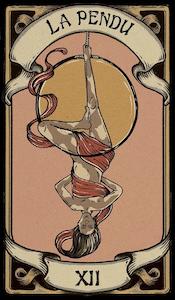
Moving through each definition, DeBarry strips away traditional meanings of each card, so that readers can see the card’s energy through the lens of the Divine Feminine. I especially loved the card and message for The Hanged Woman, traditionally The Hanged Man, which reads:

“Take some time out, as this will give you the space you need to pause for a moment and analyze what may need to be released for the sake of growth. The Hanged Women can also represent a person who looks at life in her own way, not allowing herself to be influenced by the actions or opinions of other people.”2

I’ve been reading tarot for over a deck, but this was the first time I identified personally with the card. Why had I never thought to view it as The Hanged Women? It’s like this simple shift of making it so I felt seen within the card completely changed the way I identified with it.

The Sacred Sisterhood Tarot has become my go-to for both quick questions and more reflective readings. Reaching out for the deck has started to feel like calling up my bestie to talk about life. There’s a gentleness to the deck, though it has consistently given me the honest advice I needed to hear in the moment. I trust it because I feel it has my best intentions at heart.

Plus, reading or meditating with this deck taps me into an empowered sisterhood solidarity, and I love envisioning other women also using it, pooling our collective Divine Feminine wisdom for healing, divination, and spiritual growth.  I highly recommend this deck for beginners, as it is perfect for getting to know the cards (with maybe the exception of the French! Lol), as well as intermediate to expert readers that are looking for a new way to explore the energy of tarot.

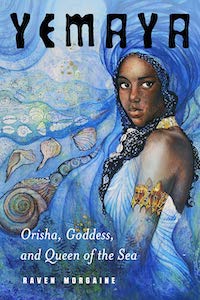
Yemaya, by Raven Morgaine

Yemaya: Orisha, Goddess, and Queen of the Sea, by Raven Morgaine
Weiser Books, 1578637430, 208 pages, September 2021

Back in May, sitting atop a small mountain in Joshua Tree National Park and meditating as the sun rose at dawn, the word “Yemaya” came through the silence. Instantly, I felt a sense of peace rush through me. I knew Yemaya was a great ocean goddess, but that was my extent of knowledge about her. When I returned home after this experience, I followed an intuitive nudge to bring some cowry shells down to the ocean and honor Yemaya, thanking her for the beauty of the ocean that I enjoy and the calmness that it brings me.

While I felt a call to continue developing this relationship and explore this quiet prompting from either my intuition or the Universe (not sure!), my summer travels took me away from my home on the California coast and into the canyons of Utah, woods of the Sequoia trees, and cities of the east coast from Philadelphia, PA to Providence, RI. Within my heart though, I kept remembering Yemaya and doing my best to connect with her energy wherever I went.

Now that I’m settled into my daily routine again, back to combing the beaches for seashells and spending my weekends reading on the beach, I felt ready to explore this budding relationship a bit more. However, I will admit I didn’t know exactly where to get started. The Orishas have always felt unreachable for me, a white American woman with European ancestry, due to their African heritage. I am well aware of the training and dedication that goes into becoming a devotee of the Orishas, and I also know how inaccessible these traditions can be to outsiders.

Therefore, you can only imagine my joy in discovering the recently published book Yemaya: Orisha, Goddess, and Queen of the Sea by Raven Morgaine. It was all I’ve been searching for and more!

Morgaine is a spiritual artist who has dedicated his life to Yemaya. He practices Candomble, New Orleans Voodoo, Santeria, and witchcraft. He also owns his own shop, Familiar Spirits, in Coventry, Rhode Island. Most of all, he’s an incredible storyteller that brought all facets of Yemaya to life in this wonderfully written book. His inclusion of practical wisdom, anecdotes, recipes, recipes for making oils and candles, along with plenty of Orisha stories made my connection to Yemaya so much more tangible and alive.

In fact, there were times reading this book when I would put it down and have my thoughts be washed away in feelings of love, tenderness, and security. It felt as though I was coming home to a mother who wanted nothing more than to make me feel loved, nurtured, and supported. While I am only in the beginning phases of building my altar and figuring out what this relationship is going to look like in my life, Yemaya assured me this pathway is open to all and that I will find my way.

Filled with his own written prayers, blessings, and spells, this entire book is imbued with Morgaine’s energy in the best way possible. His love and reverence for Yemaya streams through every word written, from warning those seeking to develop a relationship with Yemaya about what she does not like (never put metal on her altar or use it as a ritual tool, also she’s not a dog person!) to all the ways one can win her favor (beautiful combs, pearls, mirrors, white roses). Morgaine does not cut a single corner in laying out the foundation for establishing a relationship with Yemaya, and he happily delves into stories to illuminate the meaning behind why the practices are done the way they’ve always been done.

I truly loved learning more about many Orishas, from Yemaya’s younger sister Oshun to Shango and Eleggua. Morgaine’s writing was one of the most inviting introductions to the Orishas I’ve ever come across, and for the first time, I felt welcomed to partake in and honor these gods and goddesses.

Though, I will also admit, Morgaine’s solemn warning of what is involved in creating and maintaining a relationship with Yemaya is both awe-inspiring and a bit nerve-wracking all in one. More than anything, he conveys that she is not a goddess to call upon on a whim or to instantly demand quick results from. She is royalty, and thus she wants to be treated with respect, care, and devotion. She enjoys her lavish praise and will actively pursue what she wants, letting the practitioner know what does and does not please her.

The experiences shared by Morgaine of working with Yemaya for over 35 years made me realize just how misconstrued my previous assumptions of this great ocean goddess had been. I particularly enjoyed how he went through all the different facets of Yemaya, naming each one and sharing a bit of background information related to that incarnation of her, so that a more well-rounded picture of her was painted.

Morgaine openly shares trials from his own life, from despair at the end of an abusive relationship to being evicted at a very sensitive time in his life following his brother’s passing, to show readers Yemaya’s ever-present compassion for her children. Likewise, he also recounts times where she graced him with her presences, highlighting that Orisha gods and goddesses are more than just abstract energies; they are dedicated protectors, guardians, and way-showers of the natural world and humanity.

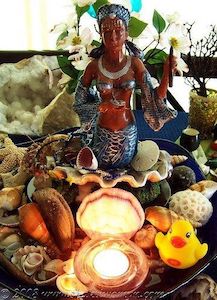
What has me most inspired is the descriptions of how to build an altar. I am looking forward to creating the time and space to do this soon. I knew I had been collecting seashells, sand dollars, and mermaid figurines for something! And thanks to the wisdom Morgaine has imparted in Yemaya, I also plan on creating cleansing and protecting my house as well.

Once again, I must impart how thorough Morgaine is in his details of doing these things. He even describes how it’s good to have an altar with drawers to store sacred objects, where to find affordable old furniture, and how to cleanse the furniture. At other times, Morgaine reminds the reader to use a dust mask or that a certain spell might smell weird, but that’s okay. His conversational writing style makes it feel like I am directly receiving this valuable information from a beloved teacher, mentor, and friend.

Somehow, Morgaine finds the perfect mixture of lightheartedness and seriousness to impart these lessons with care and consideration both of Yemaya and the well-being of the practitioner. He very much wants to ensure Yemaya is honored in a way that is pleasing to her, and he also wants to make sure practitioners don’t make foolish mistakes that can have detrimental impacts. Truthfully, he’s the perfect mediator between both, an ambassador if you will, in establishing this relationship.

And what’s so special about Morgaine’s perspective in Yemaya is that it’s inclusive. For him, having a relationship with Yemaya is not limited by one’s race, gender, sexual orientation, or cultural background. He draws parallels between Mother Mary and Isis with Yemaya, as well as acknowledging that many pagans choose to work with deities outside of their own culture’s pantheon. There’s a lovely section on how different aspects of Yemaya are protectors of people of all gender and sexual orientations — Yemaya is mother to us all.

Oh, I could keep raving about this book forever! All in all, Yemaya is a wonderful book to begin a relationship with the great mother ocean goddess. Morgaine teaches the reader how to cultivate a spiritual practice dedicated to Yemaya through telling her stories with the Orishas, sharing her many aspects of self through reincarnation, what offerings she loves and what things she dislikes, and how to establish a relationship nearby or far from the ocean. The anecdotes, recipes, magical associations, and practical wisdom from Morgaine are enough to get someone started on this path for at least a few years!

The Divine Feminine Tao Te Ching, by Rosemarie Anderson

The Divine Feminine Tao Te Ching: A New Translation and Commentary, by Rosemarie Anderson, Ph.D.
Inner Traditions, 1644112469, 160 pages, April 2021

Rosemarie Anderson, Ph.D., has many accomplishments – she is professor emerita of psychology at Sofia University, an Episcopal priest, an author of several books, and the recipient of the Abraham Maslow Heritage Award. She has traveled widely through Asia, and she has decades of experience with the Chinese language and the Tao Te Ching – all of which more than qualify her to author The Divine Feminine Tao Te Ching.

However, the qualification that touched me the most was declared in the very first sentence written in the book, in the acknowledgments section: “Translating the Tao Te Ching has been a work of love.”3 The love that this author has for the Tao Te Ching, and for the language in which it was written, informs her entire translation.

Anderson begins with a few short pages explaining her personal story of moving to Asia as a young woman and how she very quickly learned, and fell in love with, the Chinese language. She explains her love for the elegance of the calligraphic form and the etymology of the characters, along with the reverence the Chinese people seemed to have for them. 

In exploring and observing the Chinese way of life during her time in Asia she recognized that she was beginning to learn a concept the Chinese call “wei wu wei, which means to ‘act without acting’ or ‘know without knowing’.”4

This concept of wei wu wei, she explains, is essential to understanding the Tao Te Ching, requiring one to slow down, to read with patience, to allow the poems to enter one’s knowing almost of their own accord.

Anderson originally decided to translate the Tao for her own benefit and delight, using her basic knowledge of Chinese supplemented by scholarly books that would teach her any characters she did not recognize. She began this process expecting that she might discover something new in the Tao Te Ching along with some new discoveries about herself. The thing she did not expect was to discover that the Tao was profoundly feminine – full of self-descriptive words such as “mother”, “virgin”, and “womb of creation” – all intrinsically feminine ideas! 

In fact, the descriptor of Anderson’s translation in the title as “divine feminine” is what drew me as a reader to this version. And it seems so obvious upon reading these ideas that the Tao would be referred to as “She” in most if not all places where pronouns are used, but historically that has not been the case. “Only in a rare poem do a few translators refer to the Tao as “She” when the reference to “mother” or “womb” is blatant.”5

Something I found profoundly interesting was that the author’s experience of the wei wu wei method of translation is that it was “rarely mental but typically took the form of bodily impressions.”6

This idea of allowing input (in this case the poems of the Tao Te Ching) to reverberate in the body instead of automatically depending on the mind to figure everything out seems to be something worth exploring in earnest. 

The next idea to help us ingest the poems (and to enter into wei wu wei) is to read the poems aloud, or to sing them – even perhaps to a favorite tune, along with a suggestion to read one poem per day and to truly commit to listening and hearing what the Tao has to offer. 

I particularly liked this specific instruction:

“Sing out loud and sing long. This is hermeneutics in action. The term hermeneutics comes from the Greek god Hermes, the great communicator who brought the gods’ messages down to humans. In singing the Tao Te Ching, communicating with the Heavens and back to planet Earth is precisely what you are doing. Do it. Improvise on the text as an ancient storyteller might. Begin your own legend – your own pathway to the Heavens and back again.”7

This instruction seems like the perfect way to begin or expand one’s exploration of the Tao Te Ching, especially The Divine Feminine Tao Te Ching – unhurried, embodied, and without any specific expectation other than “communicating with the Heavens and back to planet Earth.” For me, as a beginner, this encouraged me to not overthink or overdo, but to just sing.

So far, one of my favorite poems in Anderson’s translation is poem 34, which I place here for your enjoyment:

-34-
The Tao flows everywhere!
She stretches to the left and to the right
All things rely on Her for life
She never turns away
She accomplishes Her work
And makes no claims
She is free of desires
We call Her small
All things return to Her
Yet she never controls
We call Her great
In not striving to be great
The wise accomplish great things

This selection seems to align well with the author’s instructions and contemplations of wei wu wei, and this particular passages encourage me in the idea of “accomplishing great things by not striving to be great”8 and to “grasp the Great Mirror”9 of the Divine Feminine Tao Te Ching.

The poems are presented in a beautiful, flowing form, the typography spacious. And the book wraps up nicely with Notes on the translation and calligraphy, as well as an annotated bibliography. 

I recommend this little gem of a book to anyone wanting to study the Tao Te Ching – especially to consider it in the context of a gentle, non-striving practice.

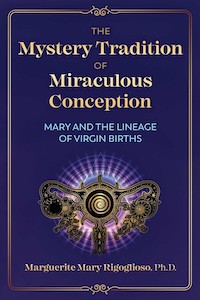
The Mystery Tradition of Miraculous Conception, by Marguerite Mary Rigoglioso

The Mystery Tradition of Miraculous Conception: Mary and the Lineage of Virgin Births, by M​​arguerite Mary Rigoglioso
Bear & Company, 1591434130, 192 pages, April 2021

Every year on Christmas Eve, it always strikes me as odd that there is not more focus on Mary in the story of Jesus’s birth: a devout virgin, pregnant with the child of God, relying on faith alone amid adversity and uncertainty, in labor delivering Christ to the physical realm. Clearly, Mary had to be a pretty incredible woman to be picked for this divine conception, yet her story always seems glossed over in religious text. While scholars debate even the most minimal nuisance of Biblical text, many remain mysteriously mute on the subject of a virgin birth.

The more I learned about the divine feminine, ancient priestesses, and sacred sexuality, the more I became convinced there had to be something about Mary which made her able to fulfill such an extraordinary task, but I never could find any validation for this intuition. Finally, many of my questions have been answered by Marguerite Mary Rigoglioso in The Mystery Tradition of Miraculous Conception: Mary and the Lineage of Virgin Births, which hands-down has been one of the most life-changing books I’ve ever read.

The premise of The Mystery Tradition of Miraculous Conception is based on the Infancy Gospel of James (Protoevangelium of James) that dates back to the 2nd-century. It was never canonized, and in fact it was condemned by Pope Innocent I in 405. Rigoglioso chose to use the version of the gospel, which she refers to as the Birth of Mary, as translated by Ronald Hock. And let me tell you, this is one juicy gospel!

The author of the text claims to be James, Joseph’s son from his first (and only) wife. Described in the Infancy Gospel of James are Mary’s upbringing, her publicly acknowledged spiritual authority, her relationship to Joseph, her experience of pregnancy, her journey to Bethlehem, and finally the birth of Jesus and the events immediately following.

Piece by piece, Rigoglioso deciphers the text for the reader with the belief that certain parts of the text needed to be cryptic in order to keep the truth concealed. Based on her research, lineages of divine priestesses had been trained to conceive partheogentically, which is asexual reproduction where the egg turns into an embryo without the fertilization of sperm. According to Rigoglioso, Mary was impregnated by Logos, or “through some kind of unification with the divine creative sound, the divine order, the wisdom essence of the universe.”6

Mary’s unusual childhood prepared her to serve as a divine birth priestess, and she showed advanced spiritual mastery at an early age. She was prepared for this sacred duty from the time of her own parthenogenetic birth by her mother Anne, who was also a skilled divine birth priestess. Some of the things done to ready Mary for divine birth were imbibing consciousness-altering substances, eating a specific diet, and learning special songs and dances.

At the appropriate age, Mary is taken to the temple to be raised. She remains there until it is time for her to undertake her duty as divine birth priestess and is given to Joseph, who was chosen to protect her. Contrary to popular belief, Joseph and Mary never married, and from the text, he was rather resistant to caring for her at first. It is clear the conception, energetically initiated by Mary, was not at all aided by Joseph, who in fact didn’t believe at first she had conceived and remained a virgin.

Despite the miraculous nature of Mary’s feat, the Infancy Gospel of James also documents the trials she was put through by her own religious community to ensure she was telling the truth. This text reveals the distrust and suspicion surrounding the miraculous feat of a virgin birth and demonstrates the need for Mary to be concealed from the public as her pregnancy progresses.

Ultimately, Mary does give birth to Jesus, once again on her own in solitude. Joseph and the midwife he found return to find the baby has been born. The birth did not require the assistance of a midwife, which is considered another miraculous feat. The divine avatar, Jesus Christ, has been brought into existence.

After this brief synopsis of the Infancy Gospel of James, you might be doubting the veracity or questioning all that you’ve been taught. For this reason, I think it’s important to acknowledge Rigoglioso’s impressive career to highlight the background for this book. First and foremost, Rigoglioso is a distinguished expert on the subject of virgin births, previously authoring Virgin Mother Goddesses of Antiquity and The Cult of Divine Birth in Ancient Greece. She holds a Ph.D. in humanities and a M.A. in philosophy and religion from California Institute of Integral Studies, along with an B.A. in psychology from Vassar College.

Her scholarship is focused on ancient Mediterranean mystery traditions, bringing to light suppressed histories of holy women. Rigoglioso also teaches workshops, courses, and mentors people to assist them reclaiming the priestess path through offerings such as Priestess of the Dove Oracle Training and the Holy Womb Chakra teachings. She has many free spiritual resources on her website SevenSistersMysterySchool.com, which was very fun to peruse.

Needless to say, the content in the book is well-sourced and filled with references to ancient texts. Yes, Rigoglioso does interpret the Gospel of the Stars in her own way, but given her academic training and spiritual knowledge, I find the information credible. It takes someone with insight into ancient culture, Biblical history, and soulful wisdom to interpret the text as Rigoglioso has done.

Just reading the Infancy Gospel of James was an eye-opening experience, as I’ve done much studying of the suppression of Mary Magdalene in the Church’s history, but had never thought much about the Virgin Mary. I’m actually curious to learn more about their relationship, as it seems that Mary Magdalene is always portrayed as a sacred sexual priestess, which Rigoglioso very thoroughly distinguishes from the divine birth priestesses, who remained virgins their whole lives.

This especially piques my interest because Rigoglioso describes Mary’s parthenogenetic conception as this lineage was actively being dismantled by patriarchal forces. It makes me wonder, given the potency of the divine birth priestess, if Jesus would have been in a physical relationship with Mary Magdalene.

Another thing that really struck me as fascinating was Rigoglioso’s suggestion that the three wisemen actually came to see Mary, the most holy one who had accomplished this miraculous feat. Her interpretation of the three gifts they brought (gold, frankincense, and myrrh) makes much more sense as offerings for her as currency for financial support (gold), sacred temple herbs for her to burn in holy places and claim her spiritual authority (frankincense), and an embalming oil (myrrh) for when she needs to anoint Jesus’s body at his death.

That last bit might have you a bit confused: how would Mary have known about Jesus’s death at the time of his birth? The Infancy Gospel of James describes a prophecy Mary has right before giving birth, which Rigoglioso points out illuminates her spiritual mastery to hold the knowledge of cruelty the world will inflict on her son and remaining open to love nevertheless.

“It must be a disturbing reality for this young priestess to know that her child, no matter how holy, will be entering the world of matter and duality, and that all those associated with him will have to come to terms with that. In a sense, she is in this very moment, just before she is about to give birth, also able to foresee the circumstances of her son’s death, in which the duality around his teachings will be played out in a deeply painful way. Once again, we can really appreciate Mary as a human woman who will have to grapple with maintaining the high vibration of love amidst agony and fear as the events of her son’s life unfold.”10 

Once again, Rigoglioso demonstrates that Mary was not a naive young woman, ignorant to the spiritual mastery of her son. Rather, it was through her training and active agency that Jesus, the son of the God, also considered a divine avatar by some, was able to physically manifest in this plane of existence. Her role as a most holy divine birth priestess is what allowed for a being of elevated consciousness to be conceived to elevate all of humanity.

Simply sitting with this truth changes everything for me. The information Rigoglioso has shared is so deeply empowering for me on a personal level, and I believe on a collective level too as more people awaken to the spiritual abilities of the divine feminine. For too long, women have been stripped of their spiritual authority, oppressed by patriarchal values, and denied the right to know the full potency of their potential abilities.

More than anything, I hope the information in The Mystery Traditions of Miraculous Conception becomes more wide-spread. I’ve been actively sharing what I learned from reading it with friends and family, initiating discussions about the topic of a virgin birth and Mary’s spiritual lineage. This is a must-read for anyone interested in the divine feminine, especially within Christianity. Rigoglioso has packed so much information into this text that I know I’ll be reading it again and again. I love that it’s filled with references and sources to assist the reader in doing their own investigation. All in all, this book is the major missing piece to the history of Christianity that is sure to spark meaningful revelation in all readers.