✨ A Gathering Place for Magical Readers and Writers ✨

Tag Archives: dreaming

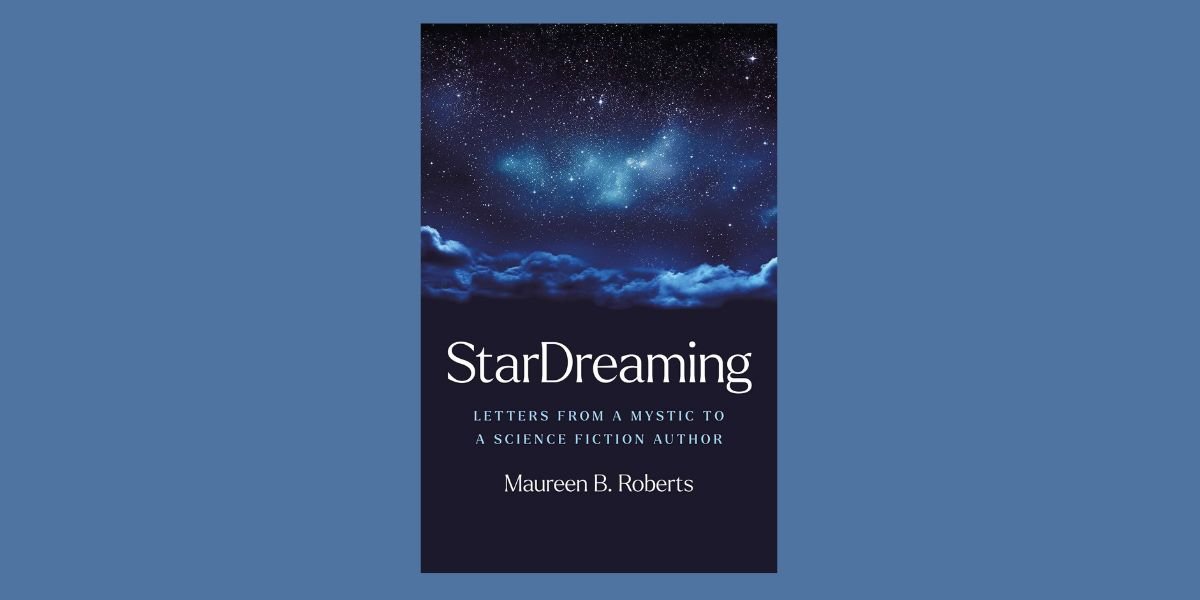
StarDreaming, by Maureen B. Roberts

StarDreaming: Letters From a Mystic to a Science Fiction Author, by Maureen B. Roberts
6th Books, 1917704623, 200 pages, August 2026

What happens when two people meet at the intersection of intellect and intuition, skepticism and mysticism, outer space and inner worlds? In StarDreaming: Letters from a Mystic to a Science Fiction Author, Maureen B. Roberts offers an intimate record of a relationship that seems to exist within all of these tensions at once.

StarDreaming centers on Roberts’s correspondence with Australian science fiction author Damien Broderick during the mid-1990s. Roberts, whose background encompasses depth psychology, Jungian thought, shamanic psychotherapy, mythology, and spirituality, approached their connection through an intensely symbolic lens. Though we don’t read Broderick’s side of the correspondence, these letters become the story of two people attempting to understand one another, meeting between two different ways of interpreting reality.

Between 1994 to 1997, Roberts experienced a series of powerful dreams, including one with Broderick himself that piqued her interest in him; she came to understand the dream as foreshadowing the emotional pattern and eventual trajectory of their relationship. Even knowing things probably wouldn’t end great, Roberts dove into the relationship with an open mind and open heart.

What followed was years of thoughtful correspondences that range from day to day things going on in Roberts’ life at the time to metaphysical discussions to romantic conversation. Here’s an example of the range:

“At the heart of myth is the archetypal essence of human nature, the transcendental centre and circumferential whole of the Jungian “self”, which is coextensive with the cosmic and experientially indistinguishable from God. If myth is inclusive by virtue of its holism, so then is its unifying core self, which transcends the polarities of matter and psyche, inner and outer, Nature and technology.”1

To vulnerable confessions like this:

“All the men I was involved with before you were conventionally good-looking as well, personality-wise, idealised versions of my idolised father, and as I’ve mentioned before, part of my breaking free from this complex has come through finally learning to love aman who’s not in the least like my dad, so perhaps I’ve made some progress.”2

It’s so fascinating to see things from Roberts’ perspective, navigating her inner world during the evolution of her relationship with Broderick.

Readers familiar with Jung will recognize many of the ideas woven throughout the letters: projection, archetypes, synchronicity, individuation, the unconscious, and the meaningful symbolic life. Yet the book moves beyond Jungian psychology into questions of precognition, spirituality, reincarnation, shamanism, paranormal experience, literature, and philosophy.

Science fiction becomes another realm where these mysteries are explored, as Broderick was a science fiction writer, while Roberts was an enthusiastic reader. Robert introduces readers to the idea that rather than being completely separate from mystical experience, speculative fiction becomes a place where humanity has long experimented with ideas about consciousness, identity, alternate realities, transcendence, and the unknown. While I rarely knew the science fiction book she was discussing, I loved how she interwove themes, for instance:

“All of this is of course the essence of synchronistic phenomena as eruptions of archetypes into the phenomenal realm. Predictably, then, Strieber’s aliens reflect the evolution of consciousness, that is, Jung’s proposal that ruling dominant age, thereby bringing about what he called a ‘metamorphosis of the gods’, such that (in Strieber’s words) ‘we know that their appearance depends more on the understanding of reality through which a given culture perceives them than on any objective insight into their true nature.”3

I mean, we got aliens, consciousness, and Jungian psychology. How cool, right?!

It’s fascinating to read her letters because Roberts can move from intellectual discussion into emotional vulnerability, from literary analysis to spiritual speculation, from psychological interpretation to the complicated realities of loving another person. She has a wide range of interests but her thoughts are absolutely fascinating.

The book’s range is broad, occasionally moving quickly between personal experience, psychology, philosophy, literature, science fiction, and mystical speculation. Those comfortable following connections between seemingly different territories are likely to find this quality part of its charm in reading Roberts’ letters.

I really enjoy epistolary structure of the book, which makes the experience of reading it particularly intimate. Since these were Robert’s personal letters during the time, decades later they still retain something of that immediacy that comes from passion–the amorous and vexing feelings all in one shimmering within the subtext. You get this glimpse into Roberts’ heart and soul, which feels a bit voyeuristic at times but completely enthralling.

And while readers never get to read Broderick’s responses, I do not feel this diminishes the book in the slightest. Ultimately, the style reinforces what StarDreaming truly is: one person’s attempt to understand what that relationship awakened within her. As someone who has long kept diaries of lovers and saved especially meaningful conversations, I just think there’s such beauty in this publication. The thought that a meaningful catalyzing relationship could yield such insight is inspiring, and it’s very entertaining to witness this small glimpse into a formative time in Roberts’ life.

While most readers will never experience Roberts’s precise circumstances, many will recognize the experience of meeting someone whose presence rearranges the internal landscape. Some relationships arrive not because they are destined to remain forever, but because they expose something previously hidden. They reveal projections. They activate wounds. They challenge assumptions. They introduce new ideas. They force an encounter with parts of the psyche that might otherwise remain comfortably unconscious. Within these letters, we see how Roberts moved through these activations, finding meaning in the process.

Love, in StarDreaming, does not guarantee compatibility. Spiritual significance does not guarantee permanence. A relationship can matter profoundly and still become conflicted. Meaning does not necessarily require a conventional happy ending. I think this is a beautiful lesson that is imparted, amid the many intellectual, emotional, and spiritual conversations taking place.

Those who are interested in exploring the idea of destiny, soul connections, synchronicity, and signs will enjoy reflecting on what might have brought Broderick and Roberts together, as StarDreaming presents a romance that is psychologically complex. This is a meaningful example of how connection may feel fated while still demanding discernment and how a dream may reveal significance without providing simple instructions. Sometimes, the goal is not a unified relationship; transformation itself may be the purpose.

Ultimately, Roberts invites us into the liminal territory where dreams intersect with waking life, intellectual understanding meets intuitive knowing, and another person can become both companion and catalyst. Some relationships change the course of our lives because they last. Others change us because they awaken something. StarDreaming is an exploration of the latter and of the mysterious inner universe that opens when we are willing to take our dreams seriously.

I highly recommend this book for those interested in Jungian psychology, dreamwork, synchronicity, paranormal experience, science fiction, shamanic perspectives, and spiritually transformative relationships. Roberts has given those with mystical inclinations a real gift by sharing her letters. There are so many avenues one can explore within the content–discovering new sci-fi books, understanding Jung better, contemplating the role of dreams in our lives–that I am sure each reader will take away something special from this book.

Your Dream Handbook, by Marc J. Gian

Your Dream Handbook: Unlock the Meaning of Your Dreams to Change Your Life, by Marc J. Gian
CICO Books, 9781800653399, 144 pages, June 2024

Author Marc. J. Gian shares his “dream toolbox” with readers in his book entitled Your Dream Handbook: Unlock the Meaning of Your Dreams to Change Your Life. I love that he is offering to support us as we “prepare for dreaming, remember dreams more easily, use a dream journal, and unlock your dream images to change your waking hours for the better.”4 What draws me to this book is the opportunity to learn about my recurring dreams and transform this information into guidance for my life. 

Gian is a massage therapist, licensed acupuncturist and teacher, who has been in practice for more than 25 years. He works with clients in Manhattan and Brooklyn, utilizing massage, acupuncture, essential oils, Chinese medicine, and hypnosis. He also teaches classes on dreams and aromatherapy at the New York Open Center and other venues. For more information about Gian, check out his website.

Gian breaks the book into five chapters:

  1. “Foundations for working with night dreams”
  2. “Your dream toolbox: Getting ready to dream”
  3. “Waking from the dream and mining the diamond”
  4. “Challenging dreams”
  5. “Waking life as a dream”

On the first page of each chapter, he also shares section titles and the respective page numbers for the information he will cover. At the bottom of the left-hand page Gian features the chapter title and on the right-hand page he lists the section title. This is so helpful!!!

In his brief introduction, Gian shares:

“This book is about using your dreams to achieve self-mastery and walk the path of truth. It outlines the integrated mental tools in specific mind body principles that are needed to immerse yourself in the pictorial language of dreams.”5

Gian provides lots of exercises for the dreamer, including many meditations for dreamwork. Gian covers common themes, as well as therapeutic steps you can take to read a dream or change a dream. For example, he shares how to write down your dream, ask three basic questions and then follow up with more questions regarding the elements in the dream. He also shares how important it is to work with just a “blip”6 of a dream and not discount its importance.

It is important to note that Gian cautions against analyzing dreams:

“Throughout this book I have been careful not to use the word “analyze.” Dreams are real and happen of their own accord. When we dream, we are not analyzing waking life. When we wake and read the dream receptively, we are not analyzing the dream, we are seeing analogies in waking life.”7

My favorite section is the one on nightmares. Gian provides a thorough explanation of nightmares and explains that these usually come “in order to alert you.”8 He also talks about night terrors and the difference between the two. Did you know that it is totally possible to transform our nightmares? I particularly love Gian’s wisdom on this:

“In order to disown something, first you need to own it, instead of stuffing it down…. Once you have discovered the meaning of the dream, corrected it, and created a new blueprint, it is likely the feelings associated with the dream will no longer be present.”9

I really enjoyed the list of numbers and potential meanings. For example, twelve may mean “wisdom or discernment”10, while nineteen may represent “grace”11. I also enjoyed the list of colors and their meanings, such as pale blue representing “detachment”, or “shiny black” referencing “rebirth, life, transcendence.”12

In addition to dreams and dreaming, Gian also shares exercise or meditations that can help in our waking life, such as one that can help you to reframe your day. With his six-step process, you can “examine your entire day in reverse” and prevent stuffing emotions and allow yourself to release “feelings of frustration, anger and resentment.”13 I’ve recorded this meditation to use later this week to let go of a busy or problematic day.

The book is accented by beautiful, four-color art that captures dream images, as well as aspects of daily life. Gain also peppers the prose with quotes from mentors and spiritual masters. At the end of the book, he includes four pages on the different types of dreams, an eight-page dream journal, a three-page index and a short list for additional reading on dreams and spirituality. Although I don’t like to write in my books, I can see myself copying the colorful journal pages and using them for my own dream work.

The book features a heavy, card-stock cover with fold-over pieces, so that you can mark your reading progress in the book. Gian’s prose is easy to read, easy to navigate and easy to retrace for information you want to review. I can tell that Gian carefully planned out the structure and layout of this book with the reader in mind.

Your Dream Handbook will be great for anyone who is interested in learning more about their dreams and how the information can add meaning to their waking life.  It will make a nice gift for anyone from a high school or college graduate to an adult who is searching for answers to the dreams that sometimes keep us up at night. I plan to recommend this book to clients and friends alike.

Shamanic Dreaming, by Carol Day

Shamanic Dreaming: Connecting with Your Inner Visionary, by Carol Day
Findhorn Press, 1644117037, 192 pages, February 2023

Discovering Carol Day has been an experience. She is a remarkable woman, who lends herself to many walks of life. As an author, counsellor, nature educator, and constellation therapist, Carol is used to “working with imaginary realms. Holding space within nature, and multi-realm environments”11

I enjoyed the circular, cyclical elements within Shamanic Dreaming: Connecting with Your Inner Visionary. All of life is cyclical–all of the universe in fact. This concept is something that speaks to me and something I often ponder about, as we see several different cycles regularly. The changing seasons, menstrual cycles, and the circle of life. Planetary spheres. They’re all connected in similar patterns. 

Also, the actor within me thoroughly enjoyed that the book is cleverly laid out in “Acts”, much like life itself. You can split your own play into as many acts as you like, but the point is that we’re all only on this earth for a snippet of time and Carol wants us to deepen our connection to the “calling of the land”14 to make your time here a fulfilling experience.

In Act One you are invited to ask yourself, “Why am I here?” and “What is going on?”.

Day has developed a practice, which she shares with you in the book, to aid people in being open to their visions. She talks about knowing yourself, knowing the visions that you see, and trusting in this process.

The book allows you a hands-on approach and asks you to attune yourself to everything all around you. There are tasks for you to complete throughout, all of which can bring a deeper understanding of your mindset and learning to be present.

I recommend quickly browsing the book before you begin, as some tasks require items you might not just have lain around, such as a shamanic drum. If you’ve already got one, great. But just check beforehand, because getting all ready for one of the tasks only to find you’re missing the key ingredient can be a huge disappointment. 

Day explains to us how we can connect with the vibration of the universe and how this can be beneficial for seeking out your “knowing”. This isn’t a book just to read, it is for you to make a connection, it’s a companion for a specific time in your life. To tune in and be peaceful. To lean into where you need to be in life and in the universe. 

Act Two allows you to travel through the past, present, and future. Kind of like a modern-day Christmas Carol for those who want to reconnect with the universe. No need for any Scrooges, just an openness to all things.

You’ll be guided throughout to connect with the nature of the universe, to find your own spirit guides, to be creative, and learn how to be quiet and be still. How can you be enlightened? What do you find when you open your mind? You shall set intentions across several realms. And learn how to respond to callings, how to interpret the messages, and what to do with those that you receive.

This book literally has everything, from the vibrational settings that we receive when partaking in Shamanic Drumming to the connections we can make with the Fav. 

We eventually lead into the practice and process of dreaming and how to call the ancestors into your dreams. All the while keeping yourself grounded and safe. 

Life’s grand plan for us all, for you individually, is waiting within these pages, ready to be unleashed and your first step on this path is right here in Day’s Shamanic Dreaming.

The very lovely illustrations that accompany the text are hand drawn and have a slight Quentin Blake style to them. They’re a beautiful accompaniment to this very real, open, and organic guiding system that Day has kindly shared with us. 

If you’re trying to find your place in the universe and you know there’s something else waiting, but it’s just out of reach, maybe Shamanic Dreaming has your answer, waiting patiently just on the horizon.