✨ A Gathering Place for Magical Readers and Writers ✨

Tag Archives: weiser books

Ancestral Tarot, by Nancy Hendrickson

Ancestral Tarot: Uncover Your Past and Chart Your Future, by Nancy Hendrickson
Weiser Books, 1578637416, 202 pages, March 2021

Ancestral Tarot: Uncover Your Past and Chart Your Future by Nancy Hendrickson immediately drew my attention because it combined two interests of mine: tarot and ancestry. I have been working with the tarot for almost 30 years and have used it countless times for advice, guidance, and clarification. Ancestry has been a newer passion for about the past 10 years. I have an insatiable interest in learning about the different ancestors that live in my family tree, all of them coming from Southern Italy. It’s the stories of these blood ancestors that intrigue me – why they did the things they did and how they lived. I truly feel the blood of these ancestors coursing through my veins.

Hendrickson does an amazing job of illuminating how one can use the tarot as a tool for ancestral communication to: “identify and access ancestral gifts, message, powers, protectors, and healers… and use the tarot to discover ancestors you may not have known you had.”1 As one who has decades of experience in genealogy and tarot, she is well-poised to write on this topic.

In this book, Hendrickson writes that there is really no order recommended in which to read the book. While she understands that one might want to delve into issues around one’s family of origin for example, and start with that chapter, she does suggest doing the tarot spreads and journal prompts introduced at the beginning of the book to form a foundation for working with one’s ancestors

I automatically connect the term ancestor to my family of birth origin, or as she calls them, Ancestors of Blood – grandparents, great-grandparents, great-great-grandparents – on down the line. Yet I was immensely intrigued to read about how she broadened the term “ancestor” to include two other types: Ancestors of Place and Ancestors of Time. Ancestors of Place are those ancestors with whom one has a genetic connection and who lived in the one’s ancestral homeland a long time ago, but those whose names are not known. Ancestors of Time are ancestors from past incarnations.2 I have this inexplicable draw to Ireland and was hoping to have a “conversation” with those Ancestors of Time to see if there may be a connection.

The book is divided into eleven chapters. Chapters one through three contain an introduction to the three afore-mentioned types of ancestors. Hendrickson also writes about how those who are adopted can work with their ancestors. She provides tarot spreads to help one find an ancestral spirit guide for the journey as well as using the tarot to ask questions about the purpose of one’s walk with the ancestors. As she writes, “Chapter 3 will load you up with a variety of tools for the journey. I hope your backpack is super-sized – because you’ll be given a lot to work with!”3

I did the spread to help me determine what type of ancestors I wanted to work with initially – those of Blood, Place, or Time. While my head was pulling me to one column of cards – that of the Ancestors of Time because it was comprised entirely of Major Arcana cards, my intuition pulled me to work with the Ancestors of Place. 

The majority of my ancestors that I can trace come from the same province in Benevento, Italy. Ironically, Benevento was through to be the gathering place for witches, a place where they would not be prosecuted. I remember hearing about the “Evil Eye” growing up and was given an amulet to wear to ward it off. In fact, when my daughters were born my grandmother gifted each of them with their own amulet. I also remember hearing about great-grandmothers who knew how to do the “overlooks” that could remove the curse of the Evil Eye.

Looking back, maybe it was from my Ancestors of Place that I have inherited some of my interests in Italian folklore such as the Evil Eye and witchcraft. When asked how I could expect to benefit in my work with my Ancestors of Place I drew the High Priestess card – inner knowing seems to be spot on. Finally, when asked what message my Ancestors of Place had as I begin this journey, I drew the Page of Pentacles – learning how to manifest, being a voracious learner – and ironically, the astrological correspondence of the card is Capricorn – which is my birth sign. So much insight just from one spread, which as you can see really helped me to reflect on the unknown ancestors from this spirit of place and make connections to present day in my life.

Moving along, chapter four, “Meet the Family,” held information on using the tarot to work with one’s present family to reveal familial patterns. Then chapters five, six, and seven deepened the work with the three ancestral types. Chapter eight covers the importance of keeping a tarot journal for this journey of discovery. The final chapters nine, ten, and eleven offer ways to create “ancestral altars, sacred space, and crystal grids.”4

While I have provided an overview of the focus of each of the chapters, one should realize that there is a tremendous amount of information offered in each one — too much to digest in one reading. I came to understand that working with one’s ancestors is not a quick walk in the park, but rather a dedication to spending time with the ancestors, more of a slow, multi-leveled revelation versus a quick answer. I realized that I had to dedicate the time to do the spreads and journal promptings, to listen for the answers that bubbled up over time, and to put the pieces together to understand the story. From understanding the story and receiving the communications I could begin to work on self-healing and to experience hidden ancestral gifts emerge.

Hendrickson’s writing style is very straightforward and comprehensible. However, I feel that having an understanding of the tarot is beneficial before diving into this book. A tarot novice might easily be overwhelmed by the spreads, especially since one needs to use one’s knowledge of the tarot for insight into the cards as a form of communication with their ancestors. 

The only downside I encountered was in chapter nine, “Pairing Up,” she writes about using an ancestor’s birth date to calculate personality and soul numbers. Unfortunately for me, the majority of my ancestors were illiterate, and their birth dates are more approximations. Many of the church records that housed information on births and christenings were destroyed. However, I immensely enjoyed the final chapter, “Ancestral Rituals,” which covers how one can honor the ancestors through rituals such as creating altars. This has always been a meaningful activity for me. I truly liked creating an ancestral altar using items that “came” to me as I was meditating on what to include on it. 

The Appendices in the book provide additional information. Appendix A provides an overview of the tarot – or “Tarot 101”5 as it’s referred to. Appendix B offers recommended reading on the tarot and Appendix  C offers genealogy resources. 


I very much enjoyed working with the exercises in Ancestral Tarot as a new way to connect with my ancestors. Through combining tarot and ancestry, Hendrickson has opened a whole new realm of possibility when it comes to communing with our family and spiritual lineage from beyond the veil. I highly recommend this book for those who want to use the tarot to work with one’s ancestors and discover a connection to their ancestors beyond those of their bloodline. I nod in agreement with Nancy’s observation that “the search for ancestors is really about a search for self. Work with the ancestors and the person you find is you.”6

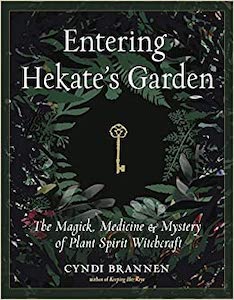
Entering Hekate’s Garden, by Cyndi Brannen

Entering Hekate’s Garden: The Magick, Medicine & Mystery of Plant Spirit Witchcraft, by Cyndi Brannen, PhD
Weiser Books, 1578637228, 288 pages, November 2020

The Garden of Hekate, the great Mother Goddess from whom all the world flows, is the spiritual home for the practice of pharmakeia, the ancient art, craft, and science of plant spirit witchcraft.  This practice uses botanicals for corporeal purposes, the crafting of magical formulations, and the art of transcending. It is a holistic art transmitted by Hekate and her witches for our use today. 4

Entering Hekate’s Garden: The Magick, Medicine & Mystery of Plant Spirit Witchcraft by Cyndi Brannen is a book about plant spirit witchcraft, a craft which incorporates magick, medicine, and the mystery of botanicals through the use of both their physical properties and their spiritual essence.  This book is for anyone passionate about plants and magically inclined, ready to take a deep dive into the mysteries of the spiritual essences and consciousness of plants.  While more and more witches are carving out a career niche in the practice of clinical herbalism, Entering Hekate’s Garden takes it a step further and elevates the practice of working with plants into the spiritual realm by creating relationship to the soul of the plants and understanding their magical properties as well as there medicinal. 

Entering Hekate’s Garden reads like a sacred text. It begins with a poetic portrait of how the dark Goddess of Nature surrendered her guard to her lover, civilization, and was betrayed. This prologue is called “Medea’s Truth.”  It sets a tone that this text is a reclaiming of a lost art. That lost art is the tending of Hekate’s Garden. Medea is the darker of the two daughters of Hekate, an underworld Goddess and Queen of Witches known also as Regina Maleficarum. The other daughter is Circe. As Brannen write, “Medea’s energy and archetype speak to our shadow selves. Circe summons us to speak to embrace the transformation found by speaking our truth boldly.”7

In “Medea’s Truth,” the author channels the words of her Goddess’s despairing truth.

“Jason came to me, not out of affection, but out of greed.  He had heard of my powers…Jason’s gods preyed upon his ambitions.  They instructed him on how to seduce me.  Not only did I welcome him into Hekate’s garden, but I put a spell on…the Tree of Knowledge…. Now the time has come for you to remember the magick, the medicine, and the mystery. Return to Mother’s Garden.”8

 The book’s narrative spirals open like an actual initiation. The chapters following, each named in Latin, lay out a sacred system of working with 39 specific plant species which Brannen has selected to present – 39 being 3 x 13. Three for Mercury, God of gathering information, and 13 for the 13 moons in a Witch’s Year.  Though all plants have sacred properties, according to Brennan, for the purposes of this book, which is meant to be an introduction to the way of Hekate’s Garden, 39 was a sufficient number to work with. Throughout the book, Brennan offers detailed recipes for medicines and spellwork (and for her, medicine and spellwork are one) that the reader can replicate at home for their own journey.

The book unfolds as follows:

·      Origio: Meeting the three Goddesses through purification ritual instructions

·      PraeparatioA brief introduction to holistic healing and the practicing of true medicine.

·      Ratio: Understanding the language of archetypes, specifically the four elements, the seven planetary correspondences, the three worlds (lower, middle, and upper), and Seven Sacred Forces (passion, strength, sovereignty, power, discipline, awareness and integrity)Plus, there is a powerful initiation ritual called the Sacred Seven Ritual.

·      Practica: Physical formulations of plant medicine, such as how to tincture and make syrups and oxymels.

·      Gnosis: The 39 monographs of plants used in sacred plant magic.

For each of the 39 plant monographs, from basil to foxglove to saffron to walnut, Brennan offers a bit of lore about the plant. For example, “Thyme has been associated with the bumble since Greek warriors used them both to decorate their battle gear”.9 She includes a thorough list of properties and correspondences, such as zodiac sign, stones, and animal.  She also includes indications, formulations (for example, “Cats are often fond of thyme and it is safe for them”10) and a yummy recipe for goat cheese crescents.

The book concludes with Magikeia, and here reads very much like a classic grimoire with specific instructions on using plants in particular spellwork. She includes a long list of common types of spells and how to make basic formulations for them, which can be further customized as a practitioner gets more comfortable using the monographs.  The list includes popular spellwork topics like abundance, binding, attraction, and protection.

In sum, this book is absolutely beautiful!  It is easy the glean that Brennan is a true devotee to her path and her spirit possesses aeons of experience with her subject. The book has heart and what it offers is no less than an actual tangible portal into a magical realm, if you are willing to follow her steps and do the initiations she outlines. For a more casual fan of plants and gardens Entering Hekate’s Garden is full of fascinating and rare information about common plants – like that yarrow is one of the most powerful plants for honoring Venus! I strongly recommend this book.  It will remain a treasured piece in my own book collection for years to come and I hope to see a future hardcover addition with glossy photographs of all these wonderful, magical plants!

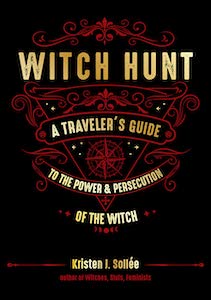
Witch Hunt, by Kristen J. Sollee

Witch Hunt: A Traveler’s Guide to the Power and Persecution of the Witch, by Kristen J. Sollee
Weiser Books, 1578636990, 256 pages, October 2020

Kristen Sollee has written several books on the legacy of the witch, a subject that is hugely interesting to me. Yet I have to say, the thing that excited me most about Witch Hunt: A Traveler’s Guide to the Power and Persecution of the Witch is that not only was it a book about witches and history, but it was also about travel. After this past year of pandemic lockdown, a virtual tour of the world and of witchcraft was just the thing I needed to bring a little adventure and magic to my cabin feverish soul.

Sollee records her travels throughout Europe and North America as she visits significant sites connected to witches, witch hunts, and the persecution of witches. Somehow, she manages to write about episodes in this history that are terrifying, violent – and at times harrowing to the degree of being unimaginable – with grace, thoughtfulness, and insight, as well as second sight.

The author deftly weaves her own imaginings of witchy characters, their voices, thoughts, actions, and motivations into her telling of historical periods, beginning with Giovanna, a sultry fifteenth century sex witch proficient in glamour magic that takes a seat next to the author on a park bench in Florence, Italy.

As we move through Italian cities and witchscapes, we arrive at Vatican City in a chapter chock full of the most delightful descriptions of surprisingly witchy art pieces and artifacts, including a fresco of the Greek goddess of love, Aphrodite, a statue of the Egyptian lioness goddess of war, Sekhmet, and a ceramic kylix depicting the Greek goddess of wisdom, Athena. Also spotted: “…another beautiful Roman mosaic from the third century AD where Medusa makes an appearance with her glorious snaky mane unfurled.”11 I have never desired to visit Vatican City until now.

We continue our trek moving through France, meeting Joan of Arc in a wonderful telling of not only how she affected her current time, but also how The Maid’s legacy is still influencing diverse groups of people today, being not only the most famous “witch” figure to have ever lived, but the most famous saint as well.

Our visit to Paris is bedecked with not only the history of The Affair of the Poisons but descriptions of alleged Satanic rituals that were reported in confessionals and resulted in executions. The confessed sins, as well as the execution methods, are truly horrifying (and for me fell into the unimaginable category).

Sollee’s journey then takes us up onto German mountaintops (where witches were accused of arriving via flying broomstick), where we visit a witch themed amusement park complete with museums filled with torture devices, before traveling on to Ireland, England, and Scotland.

In the last five chapters we meet the witches of America with visits to Virginia, Delaware, Connecticut, Massachusetts, and New York.

Sollee does a wonderful job connecting history with the present, and this was probably my favorite aspect of the book. Her way of presenting how past events influence us today and her vivid characterizations of place, which not only include visual descriptions but energetic ones as well, I found captivating.

The author recounts that as she was settling into bed while in Virginia, she turned on the TV to see the 700 Club with Protestant preacher Pat Robertson. She watched until she could stomach no more; she turned the TV off and found herself pondering how much and how little the American religious landscape has changed since the days of King James. I found myself having similar thoughts through the entire reading of this book. How much and how little, indeed.

I also found myself ready to hop on a plane, and much of the time the desire I had was to revisit places in Europe that I have already been, but was previously never aware of these specific places or history. For me, reading this book was like seeing all these places anew. My travel wish list has now doubled in size.

The book concludes with nearly two dozen pages of travel resources and a lengthy bibliography for those inclined to book a witch trip or do further research.

I enjoyed Witch Hunt and highly recommend it to anyone who is interested in witch lore, witch history, and travel. It fits the bill and ties all three of these interests together into one enchanting tome.