✨ A Gathering Place for Magical Readers and Writers ✨

Tag Archives: herbalism

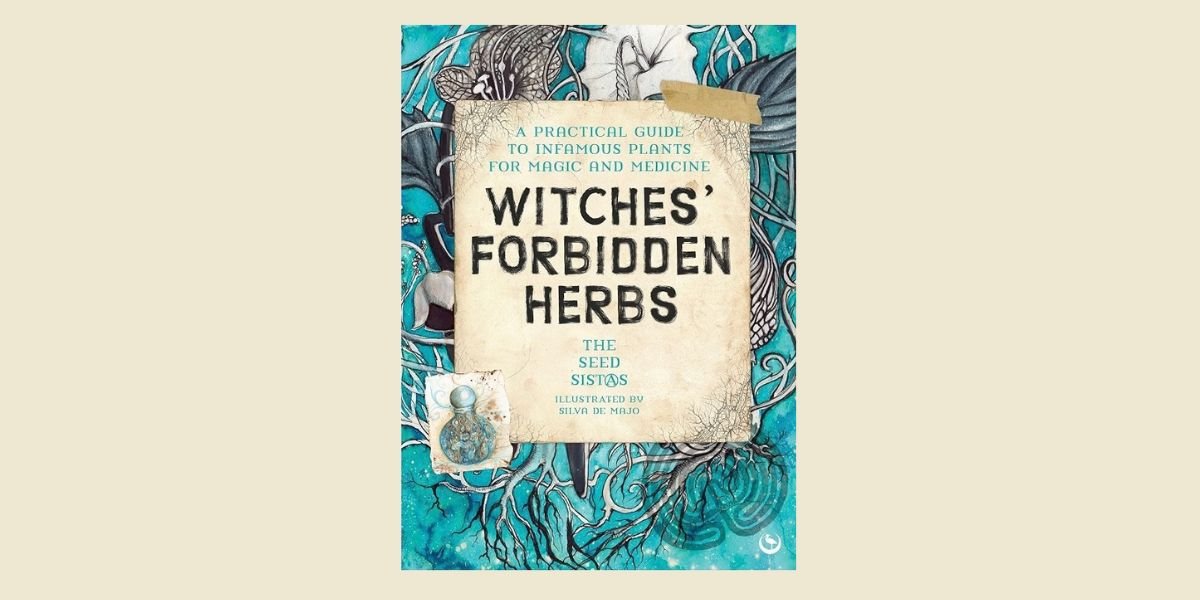
Witches’ Forbidden Herbs, by The Seed Sistas and Silva De Majo

Witches’ Forbidden Herbs: A Practical Guide to Infamous Plants for Magic and Medicine, by The Seed Sistas (Fiona Heckles and Kaz Goodweather) with illustrations by Silva De Majo
Watkins Publishing, 978-1836810544, 304 pages, June 2026

I read a lot of books where cunning women use herbs for a variety of things: protection, healing, love, and more. I’ve picked up the basics such as Belladonna’s sweet flavor and that flying ointment has long been associated with witchcraft. But this is where my knowledge came to a heed. In the spirit of expanding my magical repertoire, I dove into Witches’ Forbidden Herbs: A Practical Guide to Infamous Plants for Magic and Medicine by The Seeds Sistas (Fiona Heckles and Kaz Goodweather) with illustrations by Silva De Majo, and I have been steeping (perfect herbal reference, right?!) in all that I’ve learned! My heart lit up when I read the words “re-wilding of the psyche”1, as the authors write in the introduction, and from here on I knew this book would be illuminating.

The first thing I want to say is that I love the format of this book. It’s chunky yet easy to hold in one’s hand. The flexible binding allows me to push down the pages to make note of things I want to remember quickly for reference. And, most of all, the illustrations keep me engaged! This isn’t the first time I’ve delved into herbalism, but too often books have an overload of text without any meaningful real-life imagery to connect with. How am I going to bond with a plant if I can’t even visualize it? And yes, I can Google, but that distracts from my reading immersion because then I’m on a rabbit hole for something else!

This book is more akin to a field guide, which is exactly what I would want when I’m studying nature. It’s even illustrated to look like pictures are taped in! It makes me feel like I’m reading someone’s beloved scrapbook filled with their plant magic and medicine. I then learned that The Seed Sistas have published another book, The Sensory Herbal Handbook, which shares techniques to understand plants without relying solely on memorized lists, and I was like “They get it!”. Especially given that so much plant wisdom has been passed down orally, it’s so refreshing to engage with the material beyond just charts, associated properties, and a list of uses.

But I digress! The book begins with an introduction from The Seed Sistas, sharing their magical intent and mission along with the ins and outs of what readers can expect.  They write:

“This book is written for anyone who feels a calling to the feral and who is interested in the revival of forgotten knowledge. It is for those of us who want to restore the wild traditions – to be touched by the sacred power plants and fungi of our lands. It is for those who sense the existence of other realms and who wish to learn to trust their intuition and be guided by the plants. And it is for those of us who want practical tools for working with the forgotten gifts of the otherworld and who wish to explore a new paradigm around altered states of consciousness and health.”2

Check. Check. Check. Hi, It’s me. 😀 Needless to say, I dove right in. Divided into three parts, the pacing of the book is quite nice. First, The Seed Sistas give an overview of plant medicine, specifically poisons and altered states. There’s also coverage of witchcraft and how working with plants can become a practice of reclamation. I found The Seed Sisters’ backstory very interesting as well as their take on malevolent magic and hex removal. There’s also information about how astrological influences plant medicine as well, covering harvesting times to plant correspondences. I appreciate this bridge between Earth and the cosmos.

“Part II: Connecting to the Witching Herbs” begins with inspiration for connecting with plants, including smoking them, doing spellwork with them, drawing them, and simply yet profoundly tending to them. After this, the book turns to the heart of the topic: the Solanaceae plant family. More commonly known as nightshades, The Seed Sistas provide an overview of tropane alkaloids contained in the nightshade family, detail the alkaloids affect the central nervous system, discuss doses, and the potential of overdose, all while masterfully weaving together science, history, and mythology.

This all leads readers into chapters on “the magical three”3: henbane, datura, and belladonna. One by one, The Seed Sistas do a deep-dive on these three plants. There is just the right amount of information, and as mentioned previously, it’s all arranged in an engaging way thanks to illustrations and formatting that make the information easy to digest. From the removal of henbane as an herbal gruit used to flavor beer due to the Beer Purity Act to the way datura can be drawn on for sex magic, there was so much fascinating material into not only these plants but a wider collective experience that is possible or missing because of the exclusion or inclusion of these plants in our lives.

The Seed Sistas really offer a well-rounded approach to getting to know these plants. Yes, there’s the practical harvesting advice but there’s also insight into the plants’ divas. Readers learn the history, mythology, and magic of these plants. And while I initially avoided ever connecting with these plants because of their poisonous nature, I see now how misaligned this sentiment was, primarily based on fear and misinformation. It’s lovely how The Seed Sistas don’t shy away from the dangerous aspect–they give plenty of warnings and cautions about how these plants can be misused–but yet still make them so inviting and accessible for readers.

The final section, “Part III: The Flying Ointment”, really had me wishing I could somehow buy the compound The Seed Sisters so kindly with great detail share how to create yourself. However, it does require a 13-moon harvest cycle, along with herbalism skills that are way out of my reach right now. Made with 13 ingredients, The Seed Sistas have crafted this recipe over years of trial until it finally felt right. This section details the history of flying ointment followed by a nice overview of all 13 ingredients. There is guidance for preparing for flying along with different ways to use the ointment, such as meditation, divination, connecting with ancestors, and sacred sexuality to name a few.

While I am not in a position to physically tend to these plants right now with two very little children dominating my household and no outdoor area to grow plants, I have been inspired by this book to get to know these plants. I think my next step will be journeying to meet the plant divas and form my own relationship. I am so grateful for all the wisdom The Seed Sistas have included in these pages. I mean, a full-on tried and tested recipe for flying ointment, in addition to decades of wisdom of herbalism? It’s truly priceless! And something I am glad to have in times where ancient history is being replaced by AI-generated content. Ugh! Did I mention there’s a hex for rapid materialism in the book too? Once again, The Seed Sistas just get it!

I highly recommend checking out their website too. I felt super connected to their personalized attire and way of writing that is honest, open, and relatable. They also have prerecorded workshops on their site too for those who want to learn more!

Overall, I really connected with Witches’ Forbidden Herbs. The Seed Sistas brought to life these plants for me in a way that grounded their potential use in reality rather than just superstition, fear, and secrecy. One day I might have the privilege of tending to these plants, but for now, this book serves as a guide for expanding my relationship with them energetically, which in itself feels exciting! Herbalists, witches, and magic makers will all have something to gain from this wonderful content. This will definitely be a book I continue to recommend when the topic of the nightshade family arises!

Kate Forsyth’s Hedgewitch Oracle, by Kate Forsyth

Kate Forsyth’s Hedgewitch Oracle, by Kate Forsyth
Rockpool Publishing, 1923208136, 144 pages, 44 cards, May 2026

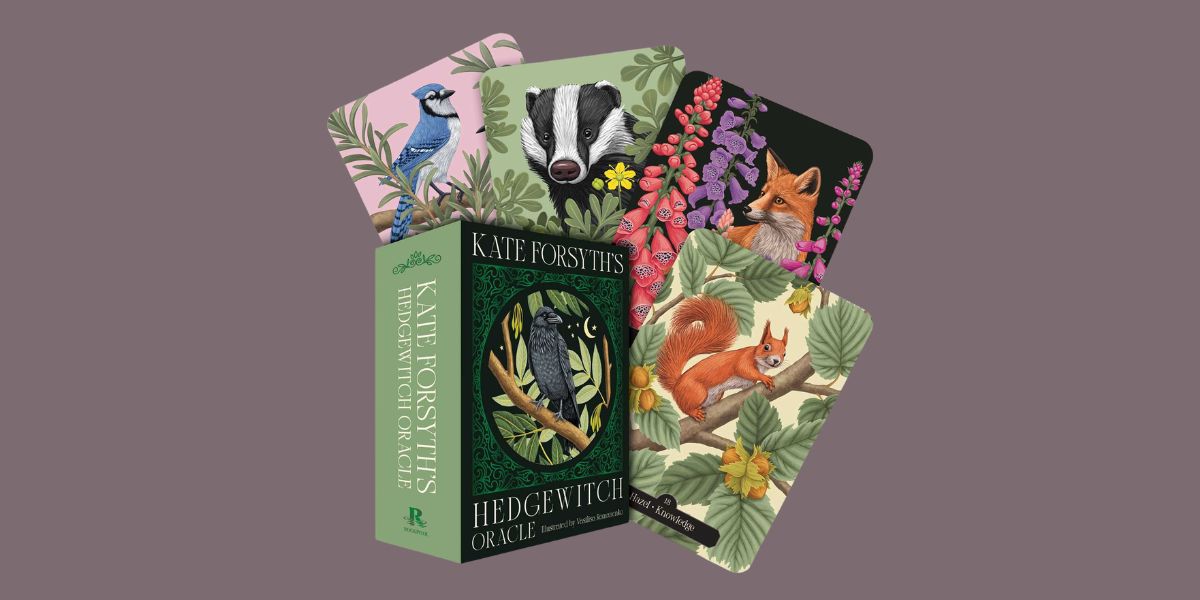
Hedgewitchery is a nature-based magical practice centered on cultivating a deep relationship with the land, the seasons, and the liminal spaces between the ordinary and the mystical. Rooted in folk traditions, it encourages practitioners to develop intuition, mindfulness, and a strong connection to the natural world through observation, herbal wisdom, divination, and everyday acts of magic. Kath Forsyth’s Hedgewitch Oracle celebrates this craft, sharing wisdom and beauty in the cards.

Kath Forsyth’s Hedgewitch Oracle is a 44-card oracle deck centered on magical herbs, folklore, and the hedgewitch tradition. Raised close to the Earth, Forsyth shares her knowledge about herbal magic, plant spirits, and folk witchcraft. Her skills as a storyteller ground the herbs in a wider context, inviting readers to truly develop an allyship with them.

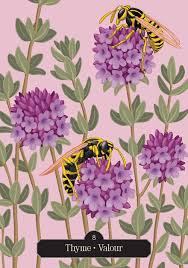
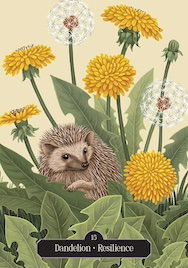
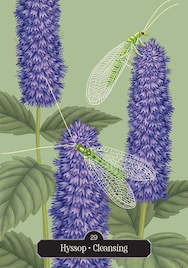
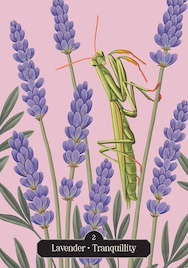
The deck itself is absolutely gorgeous. The cards have a feeling of naturalist botanical art, where the plants are depicted with the accuracy and detail of a vintage field guide or herbal compendium. Every leaf, flower, and stem appears carefully observed rather than stylized, showcasing its natural vitality and essence.

There’s a beautiful simplicity to the cards, as they’re all natural with no ornate symbols or extravagant patterns. The magic in the cards comes from the wildlife featured, giving the deck an animistic feeling. Meanwhile, the gentle energy of the cards still lends a bit of whimsy while remaining educational, contemplative, and rooted in traditional plant lore. The vivid colors and engaging detail make for an attractive addition to an altar space.

The depiction of animals or insects in nearly all the cards evoke the old belief that plants, animals, and spirits exist in relationship with one another. Plus, the animals are symbolic, adding to the layers of meaning for each card, such as an owl on the card Apple representing wisdom and the lady bug in the card Verbena for blessings. This is definitely a great deck for bird lovers, as there’s many cards with them!

As for the guidebook, Forsyth shares guidance on how to use the cards and provides a few spread options. The cards are grouped into four categories, which is indicated by the background color of the card’s image. They are as follows:

❁ Pink – Herbs for love, tenderness, strength and tranquility

❁ Yellow – Herbs for friendship, happiness, optimism and vitality

❁ Green – Herbs for fresh beginnings, healing, intuition and transformation

❁ Black – Herbs for banishing, guarding boundaries, mystery and shadow

This mixture of categories makes for a varied deck, offering meaningful insight into different facets of life. Each entry has the name of the herb, its scientific name, and the key word at top. Forsyth provides a one sentence meaning for the card and then a section about the wisdom of the card, which tells the historical use and folklore. The final section is “Spell of the Day” where Forsyth shares a magical way to use the plant, often including an incantation.

Most of the spells are easy to do with things on hand, though some might require a bit of material gathering. For instance, the spell for the card Comfrey suggests taking a bath with comfrey-infused oil and mineral salts, while the dandelion card calls for a yellow candle. What’s nice about the spells though is how Forsyth encourages collecting herbs from the wild. This isn’t something I usually do, but it has spurred me on to take more interest in where these herbs might be found locally, which will obviously differ by region.

And while Forsyth does offer a message for each card, in the style of a traditional oracle deck, I’ve found this deck to be more useful for the spellwork aspect than divination. I also think readers could definitely use the guidebook to enhance their herbalism knowledge without even needing to work directly with the cards. Though, it is so fun to do spreads and see if any themes emerge in regard to the different card categories. Sometimes, I even divide the cards into categories and specifically draw a card from one based on the type of magical support I am seeking.

So far all my readings have felt very aligned. A few days ago, I felt a bit of negative energy in my energy field, so I decided to pull a card. I got Sage, which Forsyth has given the keyword “Purification”4 The meaning for the card reads:

“Every now and again you need to stop and take a moment to reflect on your life and yourself, take stock of what is beneficial to you and let go of anything that may be doing you harm.”5

I resonated with this, and it encouraged me to be proactive in assessing where the negativity was coming from and creating a boundary. The spell Forsyth shares is creating a smudge stick and using it while repeating an incantation. I plan on doing this soon!

Overall, Kate Forsyth’s Hedgewitch Oracle is great for readers who enjoy herbal magic, nature-based witchcraft, and working with plant allies. Forsyth’s approach to plants as both a folklorist and hedgewitch brings a unique combination: readers get the practical knowledge along with magical lore. By weaving spiritual practice into daily life, this deck fosters a sense of grounding and belonging, reminding us that magic is not separate from the world around us but woven into the rhythms of the living earth. I love the reverence she holds for the natural world as well as the enchanted well she invites readers to perceive these herbs.

Enchanted Plants, by Varla A. Ventura

Enchanted Plants: A Treasury of Botanical Folklore and Magic, by Varla A. Ventura
Weiser Books, 1578638607, 288 pages, April 2025

Varla A. Ventura’s book Enchanted Plants: A Treasury of Botanical Folklore & Magic incorporates stories/legends, scientific/botanical information, folk information, magickal uses, and medicinal purposes for each selected plant.

First, let me start by commenting on the sheer beauty of this book:

1. The colors are rich and vibrant – from the spot gloss front and back cover to all the pages in between.

2. The art-nouveau-inspired illustrations are stunning. (The first thing I did was to flip through all the pictures, then go back through and really STUDY the artwork.) Each illustration magnificently enhances the experience.

3. The organization and layout is easy to follow and wonderfully presents the information in a visually appealing manner.

4. The gold gilded page edges are of collector’s quality which is additionally enhanced by the gold foiling on the front and back cover.

It is absolutely beautiful.

As a budding herbalist, my first stop was Chapter 4 “Among the Fields and Valleys: Wildflowers, Meadowlands, and Other Things to Gather – Dandelion.” After noting the botanical name, native locale, common names, medicinal properties, and magical properties, the Ventura provides general conceptions and/or personal insights for the plant, noting that it is and has always been considered a weed. She then recalls the story of Hans Christian Andersen’s “The Conceited Apple Branch” which plays with the theme of vanity and gratitude.

“Just then, the young countess who had placed the bough in the vase and her ladies came into the room. Cradled delicately in her hand was a flower of some kind. Carefully, the countess removed the leaves and then the apple branch saw it. [T]here appeared the feathery seed crown of the despised yellow dandelion… ’Isn’t it beautiful?’ the young lady exclaimed.”5

In organizing the information in such a way, Ventura creates a template for organic learning and teaching. Rather than simply providing factual information, the information is embedded and enhanced with modern traditions and folklore that can help with retention of information and practical applications.

Each chapter feels like a warm and inviting visit with my grandmother – full of wisdom, insight, stories, lessons, and love/respect for the natural/botanical world that is all around. My only regret is that there are not more chapters; however, it leaves room to hope for a second book!

I plan to use Enchanted Plants as a starting point and reference to teach, guide, and grow my children. With its mixture of stories, botany, general medicinal information (if applicable), and life lessons the possibilities are extensive! When teaching the chapter on the dandelion, I envision teaching my kids how to make daisy chains, the folklore of blowing seeds to the wind, how to make dandelion honey, and the benefits of dandelion tea.

And lastly, while this book does not provide specific recipes or spells, it pairs wonderfully with home apothecary guides (like Nicole Apelian’s, Forgotten Home Apothecary), herbalism books for magical purposes (like Scott Cunningham’s Encyclopedia of Magical Herbs), and tarot cards (like Michael Tierra and Candis Cantin’s The Herbal Tarot).

Enchanted Plants would be a valuable addition to both beginning and advanced herbalists looking to add additional insight to repertoire, magic users, plant enthusiasts, folk-lore lovers, and collectors of beautiful books. This book would also make a thoughtful gift for plant-loving bibliophiles.

What a gem of a book!

Herbal Intelligence, by David Hoffmann

Herbal Intelligence: Plant Teachers and the Return of Viriditas, by David Hoffmann
Healing Arts Press, 1620556146, 256 pages, March 2024

David Hoffmann’s Herbal Intelligence: Plant Teachers and the Return of Viriditas is more than just a book on herbal medicine; it is a philosophical and practical exploration of the deep intelligence of plants, human relationships with nature, and the evolving role of herbalism in contemporary times. Hoffmann, a seasoned herbalist and a fellow of Britain’s National Institute of Medical Herbalists, brings decades of experience and scholarship to this work, integrating traditional wisdom with modern scientific insights.

The title immediately intrigued me, particularly the emphasis on “viriditas,” a concept popularized by Hildegard von Bingen, referring to the life-giving green force of nature. In a time when herbalism is increasingly commercialized and detached from its roots, Hoffmann’s book serves as both a wake-up call and a guide for reconnecting with the true essence of plant medicine.

One of the book’s strengths is its ability to weave together history, science, and spiritual philosophy. Hoffmann presents a compelling argument for the intelligence of nature, illustrating how plants have coevolved with humans and other species in ways that suggest a deep, symbiotic relationship. His discussion of biodiversity, chemodiversity, and ecological interactions is both enlightening and accessible, making complex topics digestible for a broad audience.

The book is structured in a way that allows readers to approach herbalism from multiple angles. Hoffmann begins by exploring the ancient roots of herbal medicine, examining how early humans observed and utilized plants for healing. He then moves into modern herbalism, discussing the exponential growth of peer-reviewed research on phytotherapy and the role of herbs in contemporary healthcare.

Perhaps most intriguing is his critique of the commodification of herbalism. He warns against the dangers of separating herbal medicine from its cultural and ecological roots, emphasizing that herbs should remain integrated with holistic health practices rather than becoming mere pharmaceutical substitutes. Hoffmann’s call for a return to traditional, community-based herbalism is particularly compelling in today’s wellness industry, where herbal supplements are often marketed with little regard for their origins or intended uses.

A highlight of Herbal Intelligence is Hoffmann’s practical approach to herbalism. While he provides a scholarly foundation, he also offers personal insights, case studies, and techniques for deepening one’s relationship with plants. He encourages readers to engage with herbal medicine not just intellectually but experientially—through direct interaction with plants, mindful harvesting, and preparation of remedies.

One of the most striking aspects of the book is Hoffmann’s ability to bring scientific evidence into alignment with intuitive plant wisdom. He presents studies on medicinal plant use in animals, which reinforce the idea that humans are not the only species that rely on herbal medicine for survival. This exploration of interspecies herbalism was something I hadn’t encountered in many other herbal texts, and it added a fresh perspective to the discussion.

I also appreciated his examination of the social and political dimensions of herbal medicine. Hoffmann does not shy away from discussing how herbalism intersects with issues of social justice, sustainability, and healthcare accessibility. His argument that herbal knowledge should remain freely available to communities rather than monopolized by corporations resonates deeply with the ethos of grassroots herbalism.

Hoffmann’s writing is engaging and well-researched, striking a balance between being academic and approachable. While some sections are dense with scientific terminology, he does an excellent job of breaking down complex ideas into digestible explanations. His passion for the subject is evident throughout the book, making it an inspiring read for both beginners and seasoned herbalists.

The book is well-organized, with clear chapter divisions that allow readers to navigate topics easily. Hoffmann’s use of historical anecdotes, personal reflections, and case studies makes the content relatable and engaging.

For those new to herbalism, some sections may feel a bit advanced, especially when he delves into biochemistry and the ecological roles of plant compounds. However, even readers without a background in science will find valuable insights, as Hoffmann consistently brings the discussion back to practical applications.

Overall, Herbal Intelligence is an essential read for anyone interested in herbal medicine, ecology, and holistic health. Hoffmann presents a compelling vision of herbalism as a living tradition that must be preserved and adapted responsibly for the modern world.

I highly recommend this book to herbalists, naturopaths, botanists, and anyone interested in deepening their connection with plants. It is especially relevant to those concerned with sustainability and the ethics of herbal medicine, as it thoughtfully critiques commercialization while offering solutions for maintaining herbalism’s integrity.

For me, this book was both an educational and spiritual journey, reinforcing my belief in the interconnectedness of all living beings. It has inspired me to approach herbalism with greater mindfulness and to advocate for the preservation of traditional plant knowledge. If you’re looking for a book that goes beyond the standard herbal guide and delves into the philosophy, science, and ethics of plant medicine, Herbal Intelligence is a must-read.

The Poison Path Grimoire, by Coby Michael

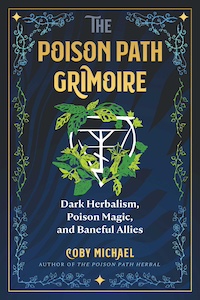
The Poison Path Grimoire: Dark Herbalism, Poison Magic, and Baneful Allies, by Coby Michael
Destiny Books, 978-1644119952, 240 pages, November 2024

One of the most time-worn conversations in magic is the debate between light and dark magic. Which is stronger? Which extracts the higher price for knowledge or skill, and how might one get started on either path? While this book doesn’t answer any of those questions, it does provide unique insight into the idea of intentional knowledge gathering, which might prove to be helpful in determining which is the right path to follow.

As an occult herbalist and magical practitioner who teaches about the ritual use of poisonous and psychoactive plants, Coby Michael is well positioned to opine about the topic in his book The Poison Path Grimoire: Dark Herbalism, Poison Magic, and Baneful Allies. While one could certainly dive into this book and gain knowledge of the darker side of herbalism, my recommendation would be to pick up and read his first book, The Poison Path Herbal, prior to doing any work with this one. Trust me on this. Having said that, it isn’t a requirement to have read anything prior to delving into this tome; I personally feel that the reader would benefit from having both books.

The book is sectioned into various topics that deal with areas such as the context of poison, the variety of paths in this practice, and much more. It’s hard to choose one area to explore as it’s all fascinating; however, the section I was drawn to dealt with botanical allies. Here we are introduced to numerous herbs that “offers a compilation of some of my favorite baneful plant allies to work with”6, Michael explains. He goes on to provide some context for the plants, stating that “not all of them are harmful or adversarial or thorny”7 and that each exhibit some quality of ‘otherness’ which is not limited to plants that are poisonous, but also apply to most of the natural world.

Great care is taken to showcase details regarding each herb and plant listed in this section. Michael is careful to provide thorough information regarding uses and associations. For example, in the section for aconite, Michael goes into detail about how it was associated with the Goddess Hecate, and how to safely work with it today. He also describes other uses for the herb, both medicinal and spiritual in the context of spell craft or warding. It’s fascinating to read about how this specific plant was cultivated by monks and used for their everyday remedies as well as recognizing the connection through Hecate. 

Like all plant and herbology books, this one also comes with a stern warning. If you’ve ever partaken of plant medicine or related ceremonies outside of the common usages, you most likely have been given a variation of this warning. I personally have not ever participated in plant ceremonial magic, and the caution Michael gives is a sobering one meant to dissuade those who would use the information in this book for anything other than what it was intended for: personal enlightenment.

Michael cautions the reader, saying:

“Poisonous and psychoactive plants can open us up to very primal and sometimes ambivalent forces. This is why it’s important to work with these plants in a ritual setting with a clear intention and clear boundaries. Disrespecting this boundary and working with these plants recreationally once you have entered into spiritual relationships with them can spell trouble.”8

This makes sense on many levels, as one thing people are told prior to taking plant medicine is that they need to have clear intentions as to why they are partaking. Having a clear ‘why’ provides a much more balanced experience. Michael says, “our experiences with these plant allies are often very powerful, sometime traumatic, and in the end cathartic if properly processed. If left in an unprocessed state, however, these experiences can lead to mental and spiritual disturbances.”9

Interestingly, there is also another caution in this section, this one against using the book too frequently. It is recommended that practitioners of the poison path should observe cleansing rituals and work with healing herbs to balance their work with the other. Michael includes a selection of herbs he uses to counteract the aftereffects of the herbs used in his own practice. He recommends brewing a nourishing tea after working with baneful allies, as it’s a wonderful way to reconnect after doing the work.

The information in The Poison Path Grimoire is beyond useful and a must for anyone interested in baneful herbs and how to incorporate their uses into personal practice. It’s a magical book filled with dark herbalism, left-hand-path philosophy, shadow work, and spellcraft. While tempting to describe the work as dark, it’s also healing, empowering, and uplifting as the information presented enriches one’s personal practice.

The Tameless Path, by Kamden Cornell

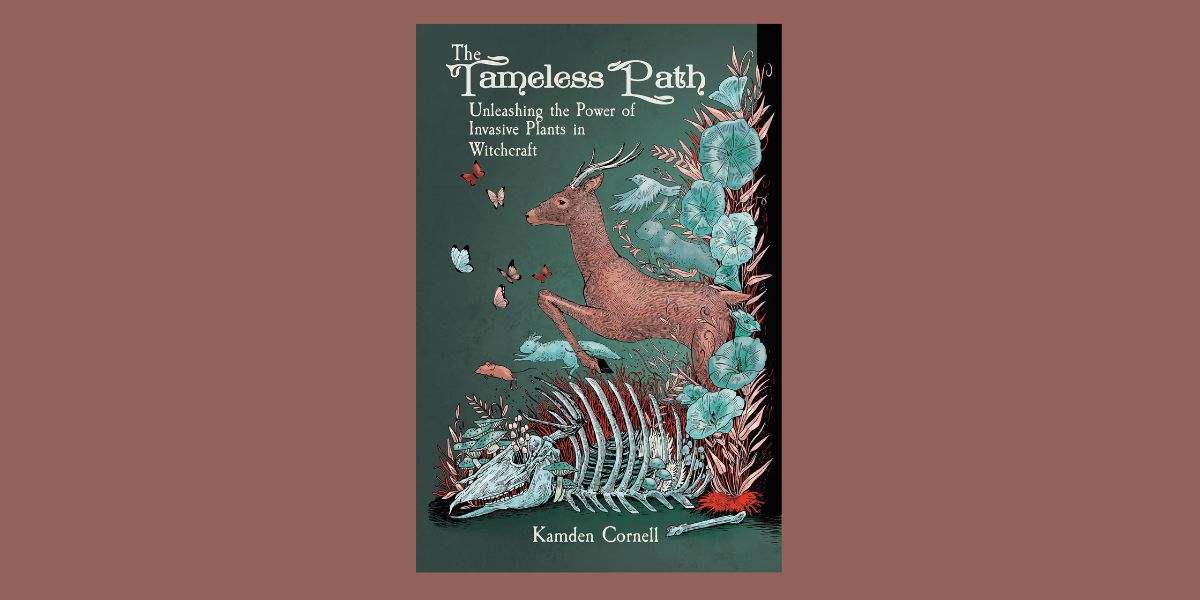
The Tameless Path: Unleashing the Power of Invasive Plants in Witchcraft, by Kamden Cornell
Crossed Crow Books, 1959883631, 306 pages, August 2024

In recent years, there’s been a shift in how plants are used in magical practices. There have always been ways to obtain ingredients for spells or other workings, but the events during the last few years have seen many people foraging for their own elements. Without overly generalizing, it seems as though anyone with access to an outdoor space has taken advantage of that and started to grow their own herbs and such. But how many people actually forage, as in go into the woods and search endlessly for plants that grow wild only in certain spots? And how do you make sure that what you are gathering is safe and not harmful to children or pets?

Enter The Tameless Path: Unleashing the Power of Invasive Plants in Witchcraft, by Kamden Cornell. If Rachel Pollacks’ 78 Degrees of Wisdom is looked upon as the definitive book on tarot, then Cornell’s book will certainly be a top contender with respect to plants. Cornell is no stranger to plants: they currently teach classes on witchcraft, occultism, herbalism, wortcunning, foraging, and invasive species wildcrafting in their region. They also work as an apothecarist and own a small, witchcraft-oriented business that focuses on herbal remedies, ritual goods, and education. To say they are qualified is an understatement.

“What we call “weeds” have been used as remedies and food for thousands of years in the regions they were native to before being transplanted to our own soils.”7

One of the first things I questioned when I picked up this book was relevance to me personally; after all, I don’t live anywhere near the author. Looking at the table of contents quickly relieved me of that fear as I saw many familiar plants that grow in my area listed. The chapters on alchemy, planetary magic, and various methods of plant preparation are well written and provide information that will lead the reader to a deeper understanding of the connection between plants and the universe.

There are two table of contents pages: one showcases chapters divided thoughtfully into a pattern that makes sense in terms of content, and the other is a full listing of spells and recipes by weed. Both are comprehensive and well laid out, but it’s the spells and recipes that drew me in. While some of the spells seem whimsical in terms of their ingredients, knowing what can be substituted for the more arcane and less available tasks is vital. Knowing a bit of herbology and spellcraft would be useful here but isn’t necessary as long as the internet exists!

Chapter 4 is my favorite as it deals specifically with choosing the method of preparation and provides clear instruction on how to do so. The preamble for the directions is very informative and provides a ton of guidance around the processes. There is also a disclaimer regarding using words such as medicine or medicinal, as Cornell is very clear to reiterate that “nothing in this book is intended to be a substitute for medical treatment.”9 The author is very clear about personal safety and recommends being in the care of an allopathic physician should one choose to utilize herbal protocols in any way. 

Cornell goes into great detail in each section of this chapter, explaining common terms that relate to each section such as tisane and strewing blends. Most people who pick up this book will probably have some knowledge around these terms, yet Cornell goes deep into each area and ensures there are no stones left unturned. I appreciate that immensely as there is no need for cross referencing: everything you need to know is contained in one book. How convenient!

Perhaps the most interesting part of the section is the alchemical one. Not being familiar with this specific method myself, I devoured the section and made notes. I was under the impression that processes like distillation were complicated and involved so many containers and apparatus, and I was right. Probably not something I could do in my tiny apartment, but a girl can dream. I love the idea of distilling my own supplies, but the reality is I cannot. Not the first time I’ve been disappointed but at least it’s not with the book.

The Tameless Path is perfect for those who are interested in the path of herbology and want to deepen the practice. Chock full of information that isn’t readily available elsewhere unless you dig deep, this book provides clear and concise information as well as a variety of accompanying methods and recipes for a well-rounded literary journey through the land of herbology. Practical and magical, I will be gifting copies of this book to a few of my green-thumbed friends, who might be persuaded to share the fruits of their labour with me.

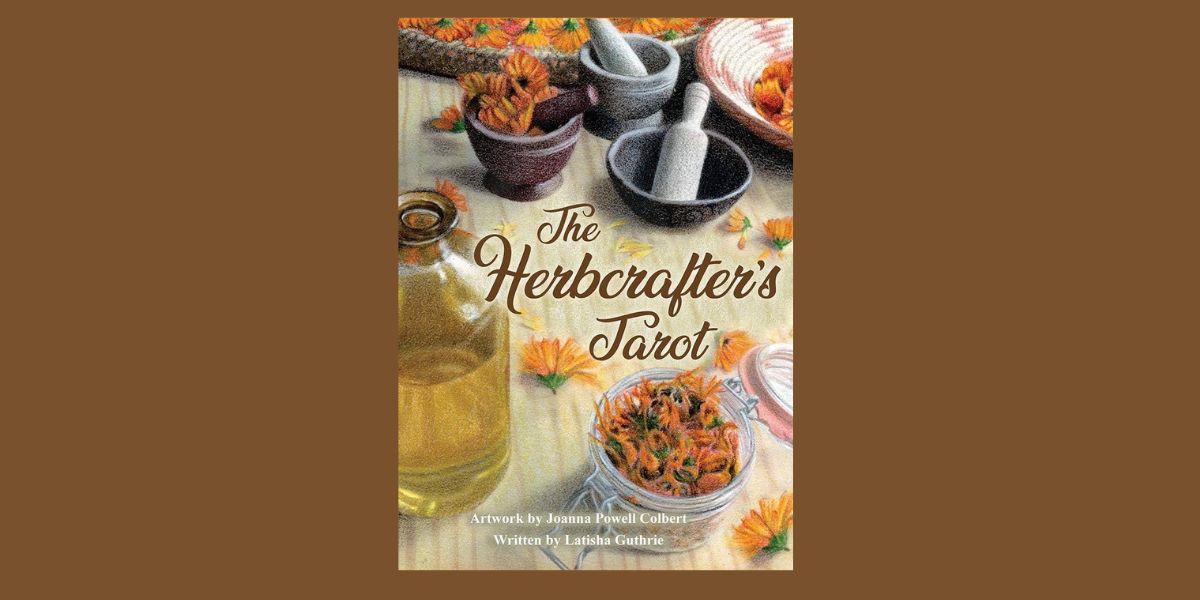
The Herbcrafter’s Tarot, by Latisha Guthrie

The Herbcrafter’s Tarot, by Latisha Guthrie with artwork by Joanna Powell Colbert
U.S. Games System Inc., 1572819723, 124 pages, 78 cards, May 2019

The traditional tarot images often grow stale for me. In delving into why this happens, I reached the conclusion it was because they aren’t always relatable. Symbolic? Sure. But sometimes I just want to see images from daily life; I want to see scenes of my day to day. It was my quest for this domestic, homey feeling I was seeking in my readings that led me to The Herbcrafter’s Tarot by Latisha Guthrie.

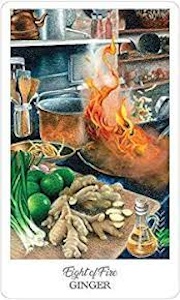
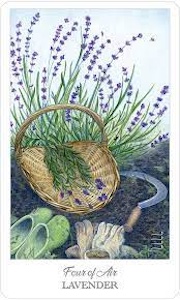
The Herbcrafter’s Tarot by Latisha Guthrie is a beautifully crafted deck that intertwines the wisdom of the natural world with the mystical art of tarot reading. This 78-card deck, created in collaboration with illustrator Joanna Powell Colbert, is a celebration of the healing power of herbs and plants. Each card is thoughtfully designed to depict a specific plant, along with its symbolic meanings and practical applications, making it a unique blend of botanical knowledge and spiritual insight. And the imagery was spot-on for what I was seeking!

The cards are from the point of view of the reader. The Major Arcana cards depict a natural altar to the herb and its corresponding energy. They represent the gratitude the herbcrafter feels “for the gifts and insights the plants give her.”10 Some of the altars looked planned out, such as the ones in the shape of the mandala, while others are simply the altars that arise during herbcrafting as one is actively engaged in their process.

The Court Cards, which in this deck are called People Cards, all feature hands of the herbcrafter. They show hands doing all sorts of mundane tasks: picking plants, drawing a bath, pouring a tea kettle. She writes:

“Our intention is to highlight the plant as well as to celebrate the slow intentional ritual of handcrafting. With every berry gathered and tincture mixed we enflesh the sacred, making prayer visible.”11

In this deck, the Court Cards are Hijas (Daughters, traditionally Pages), Adelitas (Warriors, Traditionally Knights), Madres (Mothers, traditionally Queens), and Curanderas (Healers, traditionally Kings). Characterizing the Court Cards in this way made me feel extra connected to this deck too because these are the types of people that show up in my life; it’s easier for me to identify a motherly figure than it is a queen.

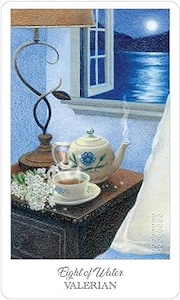
Other cards in the deck depict momentary scenes of what it looks like in the midst of gardening, having a cup of tea in bed with the moon shining above, or simply gazing at nature scenes of gardens, rivers, and trees exuding their beauty. As I browse the cards, I instantly feel at peace, grounded, and connected to the natural world. Yet the imagery takes on a whole additional layer of meaning after reading the guidebook.

Guthrie explains how instead of traditional tarot suits (swords, wands, cups, and pentacles), their corresponding elements are used for the Minor Arcana (air, fire, water, and earth). And the cards for each element have a theme: air shows the observation of nature, fire the transformation of the herbs, water focuses on baths and teas, and earth showcases “baskets and fiber arts”, which are considered “legacy tools.”12

Furthermore, the herbs were chosen for each number within the elemental Minor Arcana based on “how they contribute to an ecosystem”.13 Guthrie provides a list for numbers 1-10 to explain the roles of one. The guidebook also groups the cards by number, so rather than looking through a section on a specific element, one looks to section on that number and then finds their element within.

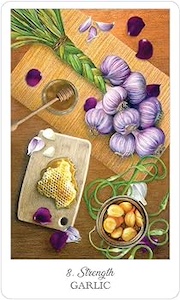
One of my favorite cards in the deck visually is Strength, which is the Garlic card. This is a Major Arcana card, so I knew it was depicting an altar of sorts, but it is certainly one of those altars that arises naturally from being in the moment. While I could describe it for you myself, a real bonus of the guidebook for this deck is that each entry features a description of the card. This is what the guidebook says about this card:

“A braided cluster of purple garlic rests on a cloth made of natural fibers. Roses from a nearby vase begin to dry, and petals have fallen on the table. Golden liquid seeps from a heart-shaped honeycomb onto a wooden board. Green scrapes fold into their lemniscate shape surrounding a pot of garlic cloves submerged in honey.”14

Guthrie perfectly captures the scene in each card with her vivid descriptions of the imagery. Even though I’m gazing at the card, her words bring the setting to life; I can feel it with my senses, further opening my intuitive understanding of the card.

The guidebook also features the Latin name, three imperative sentences for insight, a paragraph of wise words that speak to the spiritual meaning of the card, and three ways to craft with the energy of the card using the plant. For instance, the Strength card offers wearing a garlic amulet over the heart as a reminder to be bold, cook with garlic to fortify the body, and make “immune-boosting garlic honey”15 to soften intensity or conflict.

One of the standout features of this deck is its ability to connect the reader with the herbs, forming relationships “for medicine, creativity, ritual, and spiritual guidance.”16 The cards are not just tools for divination; they serve as a bridge to deepen one’s understanding and relationship with plants too. Guthrie’s guidebook provides detailed descriptions of each herb, including its traditional uses, folklore, and ways to integrate it into daily life. This makes the deck an educational resource as well as a spiritual tool, ideal for those who have an interest in herbalism or wish to incorporate nature into their spiritual practice.

In terms of usability, this deck is accessible for both beginners and experienced tarot readers. The imagery is rich and cozy, allowing for intuitive readings based on the set scene, while the guidebook is comprehensive yet easy to follow. The deck encourages a hands-on approach, inviting users to engage with the herbs mentioned, whether through gardening, cooking, or crafting.

Overall, The Herbcrafter’s Tarot is a harmonious blend of art, nature, and spirituality, offering a unique and enriching experience for anyone interested in tarot and herbal wisdom. It has become my go-to tarot deck recently. I absolutely love getting to learn more about the plants themselves, from the practical uses to the spiritual messages they have to share. Guthrie and Colbert have done a wonderful job distilling the essence of each plant into the cards both in the imagery and guidebook for readers to truly connect with their natural powers.

Apothecary Flashcards, by Nicola McIntosh

Apothecary Flashcards: A Pocket Reference Explaining Herbs and Their Medicinal Uses, by Nicola McIntosh
Rockpool Publishing, 1922785776, 42 pages, December 2023

I love learning about herbs, but I am the first to admit I struggle to keep track of all their medicinal properties! Apothecary Flashcards: A Pocket Reference Explaining Herbs and Their Medicinal Uses by Nicole McIntosh is absolutely perfect for staying organized, studying herbs, and looking up quick information. Even better, these cards have images that aid with identifying plants in the natural world.

These cards are 2.5 inches squares that fit easily inside your palm. They come with a ring that you can link through them to make it a flip deck. The rounded corners make it comfortable to hold – no sharp edges here! They are a great size for carrying on-the-go. And the font is a good reading size, whether you hold the cards near or far away from yourself.

McIntosh is an artist, herbalist, and Celtic Shamanism practitioner. She focuses on establishing a deep connection with nature in her work with the aim of spreading peace and love. For those who are interested in learning more about preparing botanicals at home, her book Plant Spirit Medicine is a great resource. Other decks she has published include Mushroom Spirit Oracle, Celtic Spirit Oracle, and Crystal Grid Oracle.

In introduction Apothecary Flashcards, McIntosh writes:

“The world of herbal medicine awaits you, and there you will find a whole apothecary at your fingertips.”13

There are forty herbs in this deck. The front of each card is an image of the herb, while the back of the card has all the pertinent information about it. McIntosh shares the botanical name, part of the herb used for the remedy (root, leaves, stem, etc.), actions of the herb, medicinal uses, and methods it can be prepared for a home remedy. The last piece of information is a caution, sharing advisement about when the herb should not be used.

The action section contains words that might be unfamiliar to some, such as “adaptogen” or “renal tonic”, but luckily, McIntosh had the foresight to include four deck slides, Points to know, defining what the actions do. For instance, adaptogens “help the body deal with stress”, while renal tonic “builds and tones the kidneys.”14 The list of actions is a great way to become familiar with the terms as one studies the impact of herbs on the body.

There is also one card following the Points to know, which is Terms used. These range from aerial parts, “the parts of the plant that grow above the ground”, to UTI, “urinary tract infection”.15 With all of these clarifications, it becomes exceedingly apparent that McIntosh cares about details and want to ensure the information she is convey is accurately understood.

The way the deck is on a ring makes it easy to flip back and forth between the herb card and the action card to look it up. Everything is organized alphabetically: Points to Know, Terms used, and the herbs in the deck.

Recently, I’ve been reading a book about the Melissae, the bee priestesses who oversaw the Eleusinian Mysteries. The author of the book was inspired to learn more about them after becoming curious about the botanical name of Lemon Balm, Melissa officialis, and researching to discover these long-forgotten yet high-ranking priestesses of Ancient Greece. This made me curious to see what McIntosh wrote about medicinal properties of Lemon Balm, so it was the first cared I flipped to in the deck.

From McIntosh, I learned Lemon Balm is antiviral, sedative, diaphoretic, and carminative (you bet your bottom dollar that I was flipping to Points to know for those last two words!). The medicinal uses of Lemon Balm including treating herpes (topically), depression, and IBS (another term defined on the Terms used card). For a home remedies, McIntosh writes it can be infused to make a tea or tincture to take internally or used in a poultice to put direct on skin.

Lemon Balm is surprisingly one of the only herbs that does not have a caution. And for me personally, the cautions are the most important part since herbal remedies can be a hurtful as they are healing if not used properly. For instance, Sage is toxic in large amounts, while Schisandra and quite a few other herbs in the deck are not to be used during pregnancy. Once again, McIntosh is specific, writing “should not be used during the acute phase of an infection/cold”17 for the herb Astragalus.

Overall, Apothecary Flashcards is a wonderful reference when making herbal remedies. The organization and detail make them true time-savers, and their nice size makes them easy to keep on hand or nicely stored in one’s own apothecary. Whether you use them for brushing up on your own knowledge or to identify herbs outside, this deck is a wonderful resource for guidance.

The Treadwell’s Book of Plant Magic, by Christina Oakley Harrington

The Treadwell’s Book of Plant Magic, by Christina Oakley Harrington
Weiser Books, 1578638011, 176 pages, April 2023

There are a lot of books on the market that will tell you about plants in various terms: how to identify, where they originate from, and what their uses are. The Treadwell’s Book of Plant Magic by Christina Oakley Harrington goes one step further. This book is pure magic and should be on everyone’s shelf regardless of their personal or spiritual beliefs. Harrington, the founder and guiding light of the renowned occult bookshop Treadwell’s Books located in London, UK has brought the same level of care to this book that she has to the shop. I am in awe of this book.

Harrington has made it incredibly easy to find specific plants by sorting the book into three glorious sections. Titled “Problems and Solutions”, the first section is what would be expected from such a thorough compilation: an alphabetical listing of various maladies ranging from anxiety, money, protection, and so on with the corresponding herb(s) that will assist. This is meant to be a quick reference guide for those who are familiar with herbs and just need a refresher. The book assumes a working knowledge of plants and how to deal with them, as little to no instruction is provided on the basics such as growing, harvesting, and the like. It feels like this is a deliberate choice to ensure that those who use the book already have a healthy respect for the plants that they choose to work with and aren’t just looking for a speedy way out of a mess.

The middle section has no title and jumps right to providing in-depth information about herbs and plants. The book is worth the price just for the section on uses of Bay alone. Almost three whole pages are devoted to the herb and for good reason. Bay is the lavender of the herb family in that there are many ways to use it in both cooking and spiritual work. Included in each distinct method of usage is a ton of information on the herb itself that just isn’t present in other books. Like I said, worth the price right there. I have plenty of books on plants and their uses and this one book replaces all of them.

The last section is why we are all here: “Spells and Potions Using Multiple Herbs”. Where do I even start? This section is an absolute tribute to anyone working with plants and herbs in their practice in that the assumption of having basic knowledge is apparent. There is no how-to on how to make Marygolde water; it’s assumed the reader knows. Personally, I love this way of presenting information as I find some books on this specific subject spend far too many pages giving information that can be easily looked up on the internet. Many books claim to be resource books but end up masquerading as something far more basic than what the tag line says. This book is the opposite.

The spells contained in this section are not carved in stone; there is an understanding that the reader will take what they need and leave the rest. Using herbs and plants in personal spell work is not like using herbs and plants in cooking: there is no recipe to follow here, only guidelines. The book incorporates the generally accepted uses of all the plants and herbs mentioned, making it universal so there’s no need to undertake additional research on what rue can be used for. 

To be clear, there are no “recipes” for potions, only a general suggestion as to how one might go about crafting it for their own use. While there are instances of direction being provided in some cases, for the most part it’s assumed that the reader is familiar with basic applications such as making herbal blends and diffusing them. 

Should you pick up The Treadwell’s Book of Plant Magic if you’ve never held an herb in your life? YES. We all need to start somewhere and this book, while not providing introductory information on how to work in this realm of magic, will give you an abundance of information about the tools used to craft within this sphere. 

Hermetic Herbalism, by Jean Maveric

Hermetic Herbalism: The Art of Extracting Spagyric Essences, by Jean Mavéric, edited and translated by R. Bailey
Inner Traditions, 1620559857, 234 pages, May 2020

I was first drawn to Hermetic Herbalism: The Art of Extracting Spagyric Essences by Jean Mavéric (in a new translation by R. Bailey) because of my fascination with the very subject described by the title: the influence of hermetic thought on the history of the use of plants for maintaining health. I thought it would be a practical guide to a little-known form of herbalism that has recently gained in popularity, and that I would learn how to make spagyric essences. I had no idea that, in addition to a hermetic guide to plant preparations, I would be getting a fascinating compendium of herbal lore, with lists of properties, correspondences, and suggested remedies, from the theory of the humors to the plants and the planets.

Clearly a product of the 19th century’s renewed interest in all things magical, and the desire of scholars of that time to be as complete and scientific as possible, the book, originally published in French in 1911, feels at first like an arcane encyclopedia. A concise foreword by the translator paves the way for understanding just where the author, in all his own mystery, was coming from. As we start to read, we can picture the mysterious Jean Mavéric in his garret, surrounded by old books. Yet the author explains that the book is not a “mere compilation,” but there for the reader to extract its “quintessence.”15

Reading it is its own alchemical process, and the author guides the reader well from the beginning of this voyage. Hermetic Herbalism thus does more than supply a summary of its subject matter; it offers a glimpse of the magical revival of the 19th century and how writers of the time sought to preserve and share esoteric knowledge, transmitted in premodern times by Paracelsus and his followers.

A basic knowledge of hermeticism and astrology comes in handy for a reader starting to travel with Mavéric, yet like any good French scholar, he begins with a discussion of the terms he will be using, so newer scholars of the hermetic arts are not left too far behind. As he separates the subject matter into short, digestible chapters, the reader can also perceive how the elements, the planets, the humors and the plants interconnect, leading up to an understanding of astrological herbalism and how to read a natal chart.

Mavéric details how to map the planets onto the body according to hermetic correspondences, offering some questions for the student of astrology to ponder. I really appreciated the detail to be found here, including the relationships between the planets, the elements, the humors and the body’s functions. I better understand, for example, why my capacity to act can sometimes feel blocked since Mars lives in the sixth house in my natal chart, one of the houses that Mavéric says most influences our vitality. I feel that I know the planets better and can thus better assess how I am feeling their influence at any given time.

 His discussion of the houses also clarified the relationships of each one to the others and also the whole. Not all of his explanations on how to analyze a natal chart were clear to me, and I found myself thinking that I would want to follow up with a teacher on how, for example, to locate the astrological sign that represents the head in someone’s natal chart. Beware, it isn’t always Aries! Finding someone’s “astral temperament”18 also requires a more complex set of calculations than I could figure out, but I know I can return to these finer points after further study.

Part two deals with the more practical matters of premodern herbalism: the fires, vessels, and processes required to extract the “juices” and salts of plants according to class. Reading it, I wondered if I would ever be able to try any of these preparations. My conclusion was that I would definitely need a mentor — too bad I can’t visit Mavéric in his laboratory. Plus, all of the preparations take time — thirty or forty days, the “philosophical month.”19

I wish I had gotten the book a little earlier, during lockdown, when I really would have had the time to digest it, and that I knew where to order an alembic. But whether you are reading the book for practical application or theoretical investigation, Marvéric supplies you with the raw material to engage in the beginnings of your own mental fermentation on the topic. In the meantime, I’m dreaming of distilling rainwater and dissolving salts, wondering how this all may be a metaphor for my own evolution. 

In conclusion, I think Hermetic Herbalism will be a useful companion during my study of both herbs and astrology, allowing me to deepen how I understand the interaction between the two. The astrological calculations described are quite complex, but give me something to look forward to as I continue my reading of the stars and the planets in relation to the Earth. All I need is some more “practice, patience and perspicacity”!20 I look forward to further translations of esoteric French works from this period by R. Bailey, who combines careful and clear translations with in-depth notes and references on the author’s sources that the original work lacks. The indexes (of common plant names, scientific plant names, authors, and subjects) and bibliography will make this book an important volume in my herbal library.