✨ A Gathering Place for Magical Readers and Writers ✨

Tag Archives: moon books

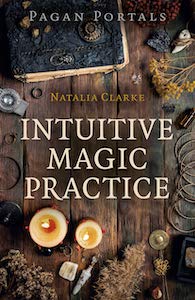
Intuitive Magic Practice, by Natalia Clarke

Pagan Portals – Intuitive Magic Practice, by Natalia Clarke
Moon Books, 1789046157, 120 pages, May 2021

Intuitive Magic Practice, part of the Pagan Portals series, by Natalia Clarke makes me want to breathe a long, deep sigh of relief. Things have been a bit hectic in my world recently, and I’ve felt the disconnection that stems from being out of touch with my inner voice. Reading this book has shifted me back into my more natural, receptive state of being in the most delightful way.

Clarke has combined her experience as a transpersonal psychotherapist with wisdom as a spiritual guide to offer readers insight on how to create an intuitive magic practice. Throughout the book, her gentle, calming tone invites a sense of fluidity, harmony, and personal energetic resonance to emerge.

In no way is this book one in which the author holds the knowledge, prompting a hierarchy between author and reader. Rather, Clarke develops a relationship with the reader that’s guided by feelings of goodwill and trust. Much of the imparted content to the reader stems from her own personal experience, and she writes this book as though she might be telling a friend about her experiences with magic and developing intuition in her own life. I enjoyed her anecdotes and the lens it provided me into seeing how she developed her own spiritual perspective.

I really liked reading about the importance of nature in Clarke’s spirituality and connection to her intuition. There is so much beauty in the natural world, along with lessons of tending, growing, and slowing down to enjoy the moment. Since her writing does not stem from any one belief system or practice, I noticed how nature seemed to be the greatest influence that gave shape to Clarke’s experiences.

However, there’s so much that Intuitive Magic Practice covers. Each chapter highlights a method of connecting to one’s intuition and offers ways to become receptive to the guidance of one’s inner knowing. Receptivity is key here, as Clarke’s writing calls the reader to settle in, move at their own pace, and gently open to the promptings that want to be acknowledged.

Some topics covered in the book are dreamwork, journaling, breathing exercises, creating sacred space, creative imagination, moon cycles, and more. Clarke also shares spells, information on candle magic, and guidance on how to select ritual tools. Through it all, she emphasizes that there is no one size fits all model for one’s magical practice; there is also no need to force something when the energy is not there.

“This way there is a natural flow, no force, no attachment to an outcome, no artificial influences of any kind and it always works. One might say I flow with intuitive energy if and when it comes in. If I am not called or specific energies are not present, I do not do anything.”1

Clarke also includes information on the Triple Goddess aspects, working with the elements, and tips for intuitively crafting one’s own magical practice such as writing spells, casting a circle, and creating rituals. Again though, this all arises from a place of moving with the flow, rather than planning, specifying, and dictating how the process should look. She even contrasts intuitive magic to ritual magic to help readers get a better sense of this method in relation to others.

My favorite chapter of Intuitive Magical Practice was “Intuition, Divine Feminine and Sacred Self-care.” While this book has valuable information for all readers, Clarke does note in the introduction it is more geared towards a female audience. All I can say is this chapter was all I needed to be reminded of and more right now.

As I move through a phase of transition, stemming from immense burn-out in my last job that lead me to severely disconnect from my own internal guidance, I desperately needed the reminder that listening to my intuition, caring for my body, and moving in alignment with the energy is a practice of sacred self-care.

“What do I mean by sacred self care? This links in with self-awareness, which can grow through listening to yourself with complete trust and seeing powerful results in your way of being with yourself and the world. It means giving yourself what your inner voice asks of you or points you towards; giving yourself what you need in the moment by listening to your intuition; treating yourself with compassion, love and respect, as you would any divine energy.”2

It’s interesting too how Clarke reminded me of the importance of moving according to where the energy is and how things are flowing. To be honest, this book has been sitting on my shelf for about two weeks now, and I had procrastinated delving into my new book. I tried to read it a week ago, but after a few pages it was sidetracked. Then, suddenly, this morning, all my energy was focused on reading this book and sinking in to receive it’s message. I am so glad that I trusted the timing of my feelings and didn’t read it in a mindset that wasn’t ready to embrace all the wisdom in this book.

For the past few months, I’ve forgotten that it’s okay to live according to your intuition and trust the timing of when things unfold, but reading Clarke’s words reassured me that it’s okay to move in rhythm that feels right for you. It was particularly inspiring to read how she doesn’t do spellwork unless she feels called. Living a magical lifestyle doesn’t have to be doing spells with each moon cycle, or constantly keeping up with a specific practice “just because you’re supposed to.” It can be just as powerful when your practice is fluid and guided by intuition. This is such a deeply refreshing approach to magic.

I’ll admit I moved quite quickly through the book, soaking it all in as I sat outside in the sunshine, feeling the fresh air gently flow around me. However, this is also a book that can be savored and referred back to over time. While I did finish it quickly, I now am ready to go back through it and practice some of the exercises, which Clarke offers plenty of through the book.

There is one method of connecting to intuition Clarke writes about that I had never heard of before, which I am particularly excited to try out: intuitive drawing. This approach can help to facilitate a dialogue with the subconscious and allow feelings, sensations, and thoughts to arise from deep within. Sometimes I feel like I get trapped in my words, and I am eager to see what comes out when I choose drawing as a form of communication with my inner guidance.

All in all, Clarke’s gentle and uplifting approach to an intuitive magic practice is something of great value to those who are seeking a more natural approach to working with energy. I highly recommend Intuitive Magic Practice to those who are seeking to tune back into their inner voice in a way that feels authentic and true to who they are. This book is a wonderful reminder that there is no right or wrong way, and that healing comes from remembering the sacred connection to our inner guidance. As you read Clarke’s wisdom, I’m sure you’ll feel right at home within yourself, comforted by the words that it’s okay to embrace your intuition and let your energy flow in a way that feels harmonious.

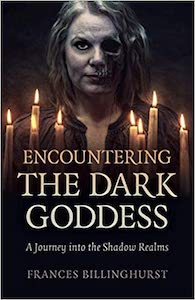
Encountering the Dark Goddess, by Frances Billinghurst

Encountering the Dark Goddess: A Journey Into Shadow Realms, by Frances Billinghurst
Moon Books, 1789045994, 248 pages, March 2021

One of the most fascinating elements of human psychology is the penchant we have for self-reflection. In some form or another, we often delve deep within ourselves to try and find answers that we know lie deep within us. In her book Encountering the Dark Goddess: A Journey Into Shadow Realms, Frances Billinghurst has carved a path for us to tread in our personal search for the answers we need in order to evolve and become better versions of ourselves.

An experienced writer on this topic, Billinghurst is an initiated witch, ritualist and healer, and runs workshops on metaphysics, mythology, and the occult. Billinghurst thoughtfully divides the book into three parts which make perfect sense if you are new to the idea of Shadow Work and the Dark Goddess Herself. Bundling information together in this way is extremely helpful if you are familiar with the work and want to jump past the background information.

Personally, no matter the topic, I almost always read the intro sections provided because I feel they form the basis or foundation of what the writer is actually trying to get across. Knowing where Billinghurst sits in terms of who she feels the Dark Goddess is and how she perceives Her is valuable information to me and helps me to expand my own knowledge. No matter your knowledge level, I highly recommend reading the introduction section to ensure you gain the same insight.

Billinghurst provides substantial background on the origin of the Dark Goddess and challenges our collective fear of the darkness by stating that:

 “Darkness holds the peace which is reflected by the mother’s womb from which we all are born, and the earth’s tomb into which we eventually return. From darkness we are born and, in effect, into darkness we will all return.”3

By making such comparisons, she is effectively building the case for why we should embrace the darkness and perceive it as a helper rather than something to be feared. She also makes a valid point about balance that I happen to agree with: the need to have both light and dark in one’s life is essential for forward movement and growth, whereas too much of either is potentially limiting.

The section titled “Meeting the Dark Goddess” caught my eye straightaway, with Billinghurst delving into thirteen different representations of the Dark Goddess. She weaves together aspects of the Dark Goddess from across a variety of practices and belief systems, something that is often attempted but poorly executed.

Here, Billinghurst respectfully offers her views on 13 different representations of the Dark Goddess and offers ways in which to work with them. There is a sense of reverence that is felt through her writing about the various aspects and she alludes to deeper works that might be of interest to those wishing to go even further down the rabbit hole of history, myth, and folklore in connection with the Dark Goddess. 

The final section is about working with the Dark Goddess and there is no shortage of caution expressed by Billinghurst. She doesn’t shrink back from exploring the enormity of working within the Shadows of ourselves nor does she try and pretty up the process to make it more palatable. Shadow Work is intense, uncomfortable, and life-changing and just because you’ve dipped your toe into this work one or twice does not mean you are free from the gaze of the Dark Goddess. If anything, doing this work puts you on the radar, so to speak. Billinghurst feels the same, saying

“Just because you have worked with the Dark Goddess once or in one format, or even under the guidance of one particular teacher does not mean you have completely embraced all of your shadow qualities and therefore no longer need to undergo such work.”4

What really impressed me with this book is the appreciation for, and acknowledgement of, the fact that just because you are immersed in an excavation of the soul through shadow work, it doesn’t mean you neglect the lighter aspects of the Goddess. These labels we give to the goddess helps us to navigate through the various lessons that are provided through the interaction we have with her, but we need to understand that when you work with an iteration of the Goddess, you end up getting all of Her and not just the parts you think you need. Billinghurst expands on this this by saying, “Working with the Dark Goddess does not necessarily mean you are not working with a lighter aspect of the goddess, the divine feminine, either.”5

This means to me that while we have lots of fancy descriptors for whichever iteration of the Dark Goddess we happen to be working with that correspond to the qualities we feel we need to access at this time, we also have access to the rest of Her too. Doing Shadow Work with a Dark Goddess is not like feasting at a buffet: you have to acknowledge and accept that you will see all sides of the Goddess and adjust accordingly. Personally, working with a Dark Goddess always brings me closer to the part of me that needs softening. Working with a Goddess such a Morrigan brings about a lot of fire and intensity, but after that dies down there is a sense of peace and stability that follows that my soul craves while I am doing this work.

Whether you are familiar with Shadow Work or just contemplating starting, Encountering the Dark Goddess is an excellent guide on how to dovetail an iteration of the Dark Goddess into that work. Full of useful information on a selection of Dark Goddesses, as well as personal stories and poems, this book is going to remain on my shelf to be pulled down often for both reference and for the deeper work that the second half of the year brings.