✨ A Gathering Place for Magical Readers and Writers ✨

Tag Archives: book review

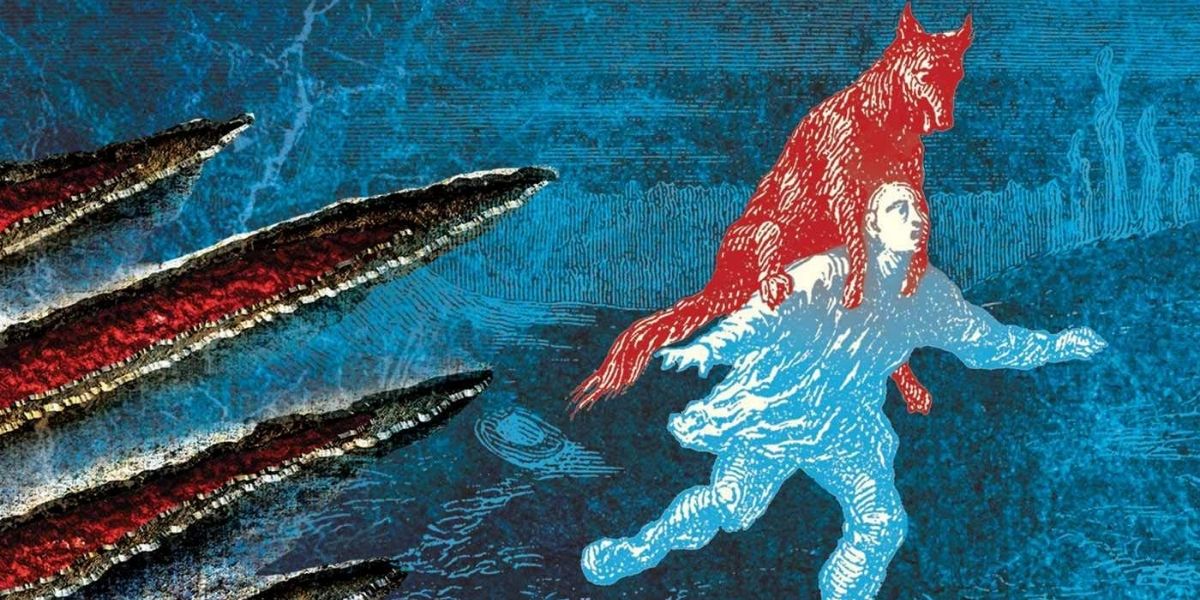
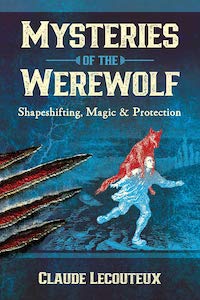
Mysteries of the Werewolf, by Claude Lecouteux

Mysteries of the Werewolf: Shapeshifting, Magic, and Protection, by Claude Lecouteux
Inner Traditions, 1644110784, 224 pages, August 2021

Ahhh-ohhhh, werewolves! Legends of werewolves are as popular as ever, but did you ever wonder about the origins of these stories? In Mysteries of the Werewolf: Shapeshifting Magic & Protection, Claude Lecouteux delves into folklore, legends, and historical accounts from all over the world, showcasing how the tale of the werewolf evolved through time.

Lecouteux’s impressive background certainly influences the way he wrote this book. As a professor emeritus of medieval literature and civilization at the Sorbonne, it’s evident that he is dedicated to the scholarship of his work. Mysteries of the Werewolf is incredibly well sourced, and many of the translations in the book were done by Lecouteux himself. He has applied the same thoroughness to detail in his previously published works The Book of Grimoires, Dictionary of Ancient Magic Words and Spells, and The Tradition of Household Spirits.

What is very unique about this book is the way Lecouteux creates a cohesive cultural understanding of the werewolf through comparing texts side by side. While some books on werewolves try to play up werewolves as a form of cryptid, Lecouteux uses historical records to piece together a whole picture of this possible mythological, possibly real being. He states:

“The texts I’ve collected for this anthology are intended to document the history of the werewolf through the ages and include some excursions far from the European domain when there was a good reason to do so.”1

Hence, we have documentation from around the globe dating back to the 10th century of different aspects of lycanthropy. Topics include stories on becoming a werewolf, pacts with the devil and evil spells as cause, werewolves’ clothing and accessories, healing and free werewolves, testimonials and more!

A sixteenth century French story Lecouteux called “How the Werewolf Lost an Eye”:

“A young noblewoman of the land of Livonia was arguing with one of her servants about whether it was possible for a man to change into the shape of a wolf, and as she made it seem dubious, this servant, so that he could provide her more ample proof, asked her permission to turn himself into a wolf. She granted him such permission, and he retreated to a secret room in the house, which he left shortly afterward in the form of a wolf. After this a pack of dogs caught his scent and set off in pursuit of him, chasing him into a nearby wood where they ripped out one of his eyes. The next day when he regained his human shape he returned to the house missing an eye.”2

This is just one example of the many, many tales in the book (I would estimate at least one hundred!). It was certainly enjoyable and entertaining reading the stories; some are heartbreaking, others vicious, while some are infused with a bit of comedy. Some feature witches and wizards, while others are just common people who are plagued with the curse of the werewolf.

It’s a thrill to feel connected to people of centuries past through the common thread of werewolves. I couldn’t help but wonder what it might have been like to tell some of these tales prior to electricity, when animals and humans were in much closer contact.

To see the range of the stories, from all over the world, I can’t help but start to think about the commonality of this man turn beast archetype. And at some point, I did start wondering if there was any merit to these stories, given they have persisted for such a long span of time cross-culturally!

“Elsewhere, we see a warrior who changed into a bear lending his support to men battling an enemy. In Africa, people believe in jackal-men, hyena-men, and leopard-men; the Inuits believe in caribou-men, and the people of the Far East believe in tiger-men. Every land and every civilization has had its own distinctive view of lycanthropy.”3

I wonder what it is about the human turn beast that leaves such a lasting impression on our psyche. Perhaps approaching the book with this question in mind will yield some answers, as I read it mostly for the enjoyment of the stories the first time. Though, I will note that Lecouteux’s introduction is filled with background information and history of the werewolf, so this book is much more than just a fun-filled, entertaining read.

Any werewolf lover is sure to enjoy Mysteries of the Werewolf, but even those with a general interest in folklore would find it worth the read. These stories help weave a picture of how the tales of the werewolf have evolved over time, expanding the reader’s knowledge of lycanthropy folklore. Lecouteux has done a phenomenal job gathering all the stories in one collection for readers to compare and contrast how tales of the werewolf, and perhaps one day, may even add their own!

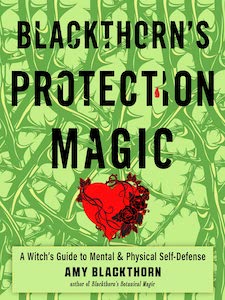
Blackthorn’s Protection Magic, by Amy Blackthorn

Blackthorn’s Protection Magic: A Witch’s Guide to Mental & Physical Self-Defense, by Amy Blackthorn
Weiser Books, 1578637619, 208 pages, March 2022

My spirit journey took an unexpected twist recently. After spending a year delving into the realm of mermaids, I suddenly felt very called to explore the world of superheroes, self-defense, and protection magic. For the first time ever, I watched all the Marvel movies, and I became inspired to increase my physical strength and psychic defenses. This is what led me to reading Blackthorn’s Protection Magic: A Witch’s Guide to Mental & Physical Self-Defense by Amy Blackthorn. It has been a game-changer, awakening so many new ideas with practical tips I can immediately incorporate into my practice.

I had heard of Blackthorn because of her best-selling books Botanical Magic, Sacred Smoke, and Blackthorn’s Botanical Brews. But I was very surprised to discover Blackthorn also has a background in security. She holds a bachelor’s degree in Criminal Justice, is a blackbelt martial artist, and shoots pistols competitively in addition to teaching women self-defense. How freaking badass can only possibly be? I would have never guessed! Her experience in both magic and security makes for one all encompassing, hell-of-a read.

The book is divided into four parts and covers mind, body, and spiritual protection. Then the last part is the additional information section that shares information about timing work according to the day of the week/moon phase, color correspondences, and plants to use for different types of spellwork. Plus, Blackthorn provides a fantastic introduction into the topic of protection magic, writing about ethics, boundaries, and her own magical point of view. Her very straightforward approach made me more comfortable with the idea of using protective magic, and I especially liked how she clearly defined magic, curses, hexes, and jinxes for readers. There’s even a curse assessment for readers – how cool is that?

This book is the perfect blend of practical advice for self-defense and instruction on how to perform protection magic. What really stands out about Blackthorn’s writing is her conversational tone. She uses anecdotes to illuminate the content, such as bravely sharing her story of dealing with a stalker, and also ensures readers are taking the utmost precaution with their supplies. For instance, she continually reminds readers essential oils should never be used on infants and notes when certain herbs or essential oils are not appropriate to use. It feels like Blackthorn has your back as you read, which is such a reassuring feeling.

Blackthorn even wants to protect us from getting scammed! I really enjoyed the section of the book where Blackthorn shares how to determine the quality of essential oils and crystals. She goes into depth about how one can determine if they have a diluted essential oil or if it’s using low-quality ingredients. Then she discusses how to know if a crystal is legit, which I’ve always struggled to figure out. I will absolutely now be testing the quality of my essential oils and more discerning in my crystal selection.

I also now want a tactical pen to carry around with me. And I convinced my husband we should practice Blackthorn’s advice on how to get out of being tied up. I also looked into going to a shooting range because for the first time ever I saw the value in being able to defend myself. And all of this is so out of my typical lifestyle in so many ways, but it’s exactly what my hippie-heart needed to read to remember we can be loving and badass at the same time.

Another great thing about the book is that Blackthorn offers so many suggestions of how to incorporate protection magic into your practice that every reader is bound to find something that works for them. From energy practices (breathing, grounding, shielding) to outdoor gardening, the options offered seem limitless. And Blackthorn is thorough! The section on crystals did a great job of explaining their properties and it came in handy later when she talked about creating a crystal grid for protection. Her information on gardening, both indoor and outdoor, for home protection was wisdom I’ve never read elsewhere. There’s incense recipes, tarot spells, mirror boxes, and so much more.

The energy practice that I’ve been using most (and with great success) is one where she discusses visualizing oneself in an eggshell. Visualization practices usually never stick for me, but the way Blackthorn teaches it, including customizations one can make to their eggshell, has really stuck for me. I feel so much less anxious being around a lot of people now and haven’t felt “pulls” on my energy since I’ve started practicing this energy technique.

The only thing missing that I wish was included in the book is information about protecting oneself online, such as insights on tech-defense and thoughts on how to protect one’s energy in the digital world. Society is becoming more reliant on technology, most people use the internet daily, but with the amount of animosity, hate, and confusion that spreads like rapid fire nowadays, it can be tough to know how to protect one’s energy online.

I have developed my own practices, and based on the wealth of information given by Blackthorn, readers could definitely piece together a spell for online protection. But I just value Blackthorn’s insights so much that I wish I could learn her thoughts on digital safety and protection too. However, this in NO WAY detracts from the immense amount of information provided in the book for day to day protection.

All in all, Blackthorn’s Protection Magic is the best book I’ve ever read on the topic. Blackthorn gives her readers the low-down we all need to stay safe, strengthened, and shielded from harm. Her unique blend of practical and magical wisdom make for a comprehensive how-to guide when it comes to protecting oneself on all levels: mind, body, and spirit. I feel strong after reading this book – and more street smart. I highly recommend this one for your collection!

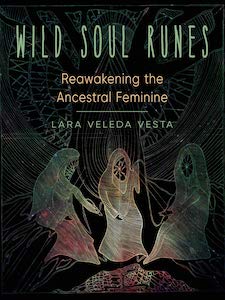
Wild Soul Runes, by Lara Veleda Vesta

Wild Soul Runes: Reawakening the Ancestral Feminine, by Lara Veleda Vesta
Weiser Books, 9781578637393, 208 pages, May 2021

Lara Veleda Vesta’s book Wild Soul Runes: Reawakening the Feminine is not just another book that lists the various runes and provides meanings for them. Well, it does, but don’t let that fool you into thinking that this is “just another book” about runes, because it isn’t. This, my friends, is a 33-week course disguised as a book and is almost impossible to put down.

Vesta is an artist, author, storyteller and educator transforming chronic illness into a path of healing and reclaiming. The author and illustrator of The Moon Divas Guidebook and The Moon Divas Oracle, Vesta is currently working toward her PhD in Philosophy and Religion while exploring ancestral connection and disability as initiation. Wild Soul Runes is a journey towards a deeper understanding of runes and their magic, as well as an opportunity to reconnect with ancestral energy while exploring personal sovereignty within the framework of spirituality.

Personally, runes have always both fascinated and bewildered me. I want very much to connect with them but have found it difficult, as there are so many books and courses that provide conflicting information on how to interpret, when to read, and even how to choose a set. Vesta’s book doesn’t provide a set series of steps to follow; instead, she offers “a scaffold, information, recommendations, and a theory based in my own ritual relationship with the runes.”4 How refreshing!

What I love about this book is the sense of inclusion: Vesta believes that all people should have access to runes and their teachings:

“The basis for this practice is the belief that we can all receive direct, divine information. It is not just for a few special people – it is the birthright of all humans. We are so inured to the idea that information must come through specific authorities, we have forgotten how to cultivate our own inner knowing, activate our ancestral magic, and believe in this direct communication.”5

The first section of the book is simply titled “Beginning the Work” and sets out the framework for the teachings. Set over the course of 33 weeks, Vesta recommends working with one rune per week and describes the practice as something that “consists of building a rune altar each week, examining the ancient rune poems, investigating personal translation, employing meditation and sacred art practice, and toning the runes in a rhythm.”6

Vesta also speaks to the importance of a daily ritual and recommends starting with ten minutes a day. She says that this amount of time can expand as needed but starting with a non-negotiable time frame of ten minutes is necessary for consistency. She also acknowledges that working with the runes requires a certain amount of personal alignment and clarifies:

“If you have things in your life that are out of integrity, places where you are not being honest; are resisting change; or are not letting go based on fear, guilt, shame, or another patterned emotion, the runes will seek to clarify your path before deepening into relationship.”7

That gave me pause. When I looked back at the times I tried working with runes, I realized that those were the times in my life where I was struggling to bring an aspect of my life back into balance. In one case, I was working a job that paid well but didn’t fulfill me. I felt heavy each day going into work, and while I was good at my job, I felt empty. Looking back now, it makes sense that the runes would want a safe foundation upon which to build, something I didn’t have at that time.

In writing this book, Vesta felt called to look up certain words to get a sense of what the runes were trying to say. This is partly where some of the confusion comes from across multiple sources of information, as there is no dictionary and the language most of the reference materials are written in does not exist anymore. Vesta explains:

“There is no definitive source that spells it out clearly. We are missing the historical context of the runes, the culture and society from which they came. Our source materials have been mostly rewritten and translated. Those translators – even those with a deep understanding of ancient grammar and culture – still rely on inference and, like so much in translation, judgment. In translation a word may have many meanings, so a translator makes a judgment based sometimes on deep knowledge but other times for poetic purpose or personal interpretation. When we read a translation, especially of an ancient primary source in a language no longer spoken – like Old Anglo-Saxon – we are reading such an interpretation.”8

This book has done a lot to dispel some of the confusion I’ve had around runes and why I’ve felt that they don’t like me. While I haven’t had a chance as yet to go through the 33-week course, I do plan on doing that, as I feel a pull to access some of my deeper ancestral knowledge and recognize this path might be a good way to establish a connection. 

Written in a comfortable, easy to read voice, Vesta has done a great job in making the sometimes confusing and temperamental divination system known as runes more accessible. For me, Wild Soul Runes has opened my eyes to a gentler way to access my personal gnosis and to not take it personally when the runes decide that today isn’t the day to solve every single one of my problems. This book is perfect for someone who seeks to connect to the runes and wants to explore that possibility using a slow-paced, buildable process that empowers as well as educates. 

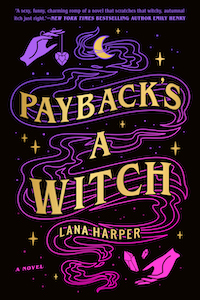
Payback’s a Witch, by Lana Harper

Payback’s a Witch (The Witches of Thistle Grove), by Lana Harper
Berkley, 0593336062, 352 pages, October 2021

New year, same me reading witch lit 🙂 And my latest book, which I discovered when cleaning out my garage – a perk of the effort, is Payback’s a Witch by Lana Harper. As someone who’s read a lot of books, particularly in this genre, I can say with confidence Harper is one of the best writers I’ve ever come across. Payback’s a Witch takes the quality of this genre to a whole ‘nother level!

The premise of the story is that Emmaline Harlow (otherwise known as Emmy or Harlow) has come back to her hometown of Thistle Grove. As a scion of the one of the four magical founders of the town, obligation compels her to return to town in order to fulfill her role as arbitrator in the Gauntlet tournament, which is held every 50 years between the founder’s families to determine who will safeguard the magical wreath and benefit from its power.

But Emmy isn’t super pumped to be back home. Her first night back, she runs into her ex-beau, Gareth Blackmoore, who descends from the family of the most powerful witches in town. He’s a textbook narcissist who never really seems to get what he deserves. The same night though, Emmy also has a reconnect with Talia Avramov, another scion of the founding family most practiced in the dark arts. After quite a few drinks Emmy feels a bit better about running into Gareth and definitely notices a few sensual feelings budding towards Talia.

At breakfast the next morning with her longtime BFF, Linden Thorn, the fourth founder family’s descendent, Emmy is surprised to have Talia join them. Turns out, Emmy isn’t the only one who received the short-end of the stick of Gareth’s arrogance and schemes. He also two-timed Linden with Talia – or vice versa – point is, he was seeing them at the same time when both thought they were exclusive. Now, Liden and Talia want revenge, specifically at the Gauntlet tournament, and they are looking for Harlow to help out.

Harlow is well-aware of her duties to arbitrate without bias, and at first she’s a bit reluctant. She fled the town wanting to forget Gareth, and suddenly the whole time home seemed to be becoming all about him. However, when Talia and Linden point out this goes beyond petty revenge; the balance between the families has become skewed by the Blackmoores repeatedly winning, gaining magical advantage, winning again, and so on in a repetitive cycle.

This has led to them building a giant castle structure of Camelot akin to a Ren Faire that has drawn all the tourists away from more local shops, such as the Thorn’s farm and Aramov’s emporium. If balance is not restored, the unequal distribution of power could see foreclosure in the future for the Aramovs and Thorns. Understanding the greater balance of power among the founding families at risk, Emmy decides she’ll assist, and obviously, foresees some personal enjoyment in bringing down Gareth as well.

What takes Emmy by surprise is how happy she feels to be home. As her magic returns after her long departure from Thistle Grove, she starts to recall all the small joys of the town. Adding to her inner confusion is the romantic sparks between her and Talia. Talia can’t imagine a life away from their hometown, while Emmy is very proud of the life she’s built for herself.

As the Gauntlet plays out, in very twisted and unexpected ways, Emmy discovers there is more to her family’s lineage than she previously realized. Ultimately, she must reckon with the consequences of leaving her family and close friends behind, forgoing her claim to magic, and newly discovered feelings towards Talia to decide what her next step will be.

Luckily, the story doesn’t end here – there is a sequel coming in March! I am very pleased about this because I absolutely adored all the characters. I think there’s so much room for the story to grow. Plus, Harper really knows her stuff when it comes to magic. There’s plenty of diversity among the different types of magic practiced, and reading how they blend together or repel one another is an intriguing part of the story.

This was a fun read with surprising depth. There is the perfect amount of banter, tension, and love between the characters, with plenty of emotion balanced by humor and quirk. I loved reading it as a leisure book to relieve the stress of the day and tap into some magic.

The pace of the book is perfect with one chapter effortlessly flowing into the next, often on a cliff-hanger that compels you to keep reading. There’s also a great blend of fantasy with modernity, which gives the story very relevant magical realism. I love when this happens because I enjoy believing somewhere in Illinois a town like this might just really exist.

My favorite character was Talia since she practices the dark arts, particularly necromancy. Throughout the book, she chats with ghosts and summons her ancestor for guidance. The magical families that lean more towards “life-magic”, specifically the Thorns, are put off by the spookiness of the Avramov family, as Emmy is eager to see their magic, which is usually kept hidden.

Plus, Talia has a deeply caring and compassionate side, wanting to cook for and tend to the needs of those she loves. The relationship between Talia and Emmy is just beautiful to watch unfold. I absolutely love having some lesbian protagonists in a witch lit book! What’s better than two witches falling madly in love? THE ULTIMATE ENDING of the Gauntlet challenge, which is all I will say for now! 🙂

All in all, Payback’s a Witch is a 10/10 from me. Harper is one of the best writers I’ve read in a long time. The story has the perfect flow; the characters are very relatable; and the plot is enticing. I am very excited for the book in The Witches of Thistle Grove series!

A Guide of Spirits, by Chris Allaun

A Guide of Spirits: A Psychopomp’s Manual For Transitioning The Dead To The Afterlife, by Chris Allaun
Moon Books, 9781789046601, 224 pages, October 2021

“Death is a final rite of passage of our physical life. As we know, death is not the end. There is a spiritual journey ahead for each person. Each of us must walk our own path of death and into the realm of the afterlife. Walking our spiritual path of death can be difficult and we may need the help of a guide. The psychopomp has the sacred duty of guiding the spirits of the dead back home to be with their beloved ancestors.”5 

It seemed fitting to begin this review of A Guide of Spirits: A Psychopomp’s Manual For Transitioning The Dead To The Afterlife by Chris Allaun with a quote from the first paragraph of the conclusion, as the quote beautifully states what appears to be an ending is actually a beginning in a new fashion and form. Allaun has done a marvelous job of honoring and explaining the role of those individuals who selflessly give of themselves to serve as guides for those transitioning beyond the veils of death: the psychopomp.

A Guide of Spirits is separated into nine chapters that provide the reader with an inside perspective of what being a psychopomp entails, the journeys of the spirits they guide, and practical recommendation for self-care and psychic defense. The bibliography is extensive in its diversity of source, ranging from Carl Jung to Bullfinch’s Mythology to Virgil and the work of occultist Israel Regardie to name just a few. These also included religious and spiritual texts such as The Tibetan Book of the Dead and Greek and Roman Necromancy, which are often referenced when speaking of cultural attitudes and customs regarding death. 

Allaun gives a beautiful introduction in chapter one, “The Psychopomp”, about what a psychopomp is and the service that one who takes up this calling provides:

“A psychopomp is a special type of healer. Not only do they escort the spirit of the dead to the realm of their ancestors, they also send the spirit healing energy to aid in letting go of earthly attachments that may keep them bound to the physical world. The word itself comes from the Greek language which roughly translates to “conductor” or “guide of the soul.”6

The reader is given the perspective of the psychopomp as a healer, not dissimilar to what the usual definitions of a healer may be, but in this case, one who assists the healing of release of corporeal existence so the real journey can begin.  We learn that the work of a psychopomp is not readily taken up because of its close association with death, something that many still fear. 

A Guide of Spirits is nicely balanced with theory, practical application, and exercises to develop both the reader’s psychic abilities and pathways towards communing with Spirits and the ancestors. I found these to be very useful in a variety of ways beyond whether one chooses to take up the work of becoming a psychopomp. There is a lot of general information that could serve to deepen the readers connection to their own ancestors and departed beloveds that would offer comfort and healing as death approaches or has occurred. 

Allaun provides the reader with many opportunities of encouragement in trusting and believing in the inherent skills he believes everyone possesses…

“As I said, I believe we all have the ability to see the spirits. Yes, some magical people are natural seers and do not have to try hard to see the spirits, while the rest of us have to practice daily in order to get just a little hint that the spirits are there. I want to make something very clear; just because it may be difficult for you to see spirits now, does not mean you will not grow into a powerful seer.”9

I truly found this running theme within the book to be truly empowering. Confidence builds as the reader moves through each of the chapters, practices the exercises, and deepens their awareness of perception “outside of the box”.

Chapter five, “Helping the Dying to Transition” takes the reader through the steps of death’s process and what may occur for both the individual preparing for transition and any who are assisting or witnessing that crossing. The importance of surrounding the individual with compassion and love is stressed throughout the book as a requisite for those acting as psychopomp. Through the tools of “Death Midwifery”, a term used to describe the work of the psychopomp, an energetic space of love is created for the dying to draw upon as manifest life recedes.

“The art of death midwifery is a profound and intuitive way of communing with the dying, of lending support and guidance to those making the greatest of transitions. Committing to deep spiritual work. The death midwife becomes a strong, clear conduit who directs the flow of divine love to the dying.”10

Overall, A Guide of Spirits provides a clear and thorough text of how we may become better supports for those who are in all stages of the process of death. Whether reading out of curiosity or for the purpose of serious consideration of how to assist those souls embarking on the next grand journey, the reader will come away from this reading with tools that may be applied to any spiritual pursuits. This title is rich with ritual, moments for reflection, exercises to strengthen greater self-awareness and much more. This is a book I am excited to continue working with and exploring the profound nature of death and those who support a loving transition. Perhaps it will provide you with a new perspective of death, as well.

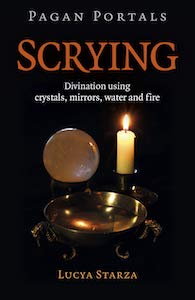
Pagan Portals – Scrying, by Lucya Starza

Pagan Portals – Scrying: Divination Using Crystals, Mirrors, Water and Fire, by Lucya Starza
Moon Books, 9781789047158, 104 pages, February 2022

Writing about subjective topics such as scrying is not an easy task. There needs to be an innate understanding of the topic as well as a personal link in order for the reader to feel connected to the author. Thankfully, Lucya Starza is no stranger to writing about things that are hard to pin down and define. As the author of quite a few books on such subjects as poppets, candle magic, and others, Starza is well positioned to offer her perspective on scrying in Pagan Portals – Scrying: Divination Using Crystals, Mirrors, Water and Fire.

Scrying has been difficult for me personally, as I just can’t seem to sit still long enough to allow images to form in the crystal ball, to visualize signs within flickering flames, or to see things come forth from the inner depths of a scrying mirror or pool of water. Picking up this book made me a bit nervous; I wondered how I would be able to use the content effectively. Starza says that’s completely normal, as “Scrying requires us to use our psychic senses and intuition to the full. But don’t worry if that seems a tough task, this book will teach you how to do that. It’s also okay to feel nervous at your first attempts.”11

Starza’s writing reminds you of a loving aunt who has tons of advice that actually is helpful. When scrying, she stresses the importance of not reacting immediately to whatever information is picked up and adds that there are things to do before you even think of starting to scry. Foundational advice is always welcome, and Starza offers a few pearls of wisdom in the context of scrying to help the reader understand that what they might see is completely subjective and open to interpretation. She says:

“Often what we see offers insights about ourselves that may help us with the problems we face or what is yet to come. Do not act hastily after scrying. Make notes and think about what you’ve experienced; let the meaning of any visions become clearer with time. But we’re getting ahead of ourselves; thinking about what to do after scrying. Before we even begin there’s some background to understand and preparations to do…”12

This is an important quote because not all books that discuss topics such as this actually delve into the beforehand preparations. They detail a number of pre-done how-to scenarios that aren’t based in the reality of how people might use the information being presented and wash their hands of it. This book does not do that: Starza goes out of her way to ensure that the reader is fully versed in the foundations of scrying before even getting into the art itself. There’s even a gentle suggestion of speaking with a counselor or GP prior to beginning any sort of magical work if there is a concern regarding mental health. Wonderful to read that, as some books don’t mention it at all, and I personally feel it’s vital to offer that caveat when offering esoteric information.

The introduction of the book is full of useful background information that delves into the history of scrying and where it was used. Starza gives full descriptions of various cultures using scrying for their purposes which not only builds credibility in the art but also gives an anchor in terms of who used it and why. Personally, I find that information valuable, and I love introductions, so this was a pleasure to read.

Starza writes with a practiced hand and her prose is easy to understand and approachable. For me, I would rather have a book written in a clear way without extraneous text getting in the way of the information. I have read books where I have felt that the author has fluffed up their sentences and paragraphs in an effort to pad their word count and I can say that I don’t see this here. Starza writes from the heart and it shows in the words chosen and the way the book is laid out.

My favorite chapter is the last one titled “Problem Solving and Frequently Asked Questions” because it clearly telegraphs that Starza knows her audience. She understands that not everything readers want to know will be in the book, (how could it all fit in this slim volume? Impossible.) so she cleverly has a section devoted to everything she couldn’t fit into the rest of the chapters. Brilliant.

The questions in this section include topics such as seeing scary images, how to scry for others, and what to do if you can’t scry no matter how hard you are trying. (I might have flipped to that last one first.) What I love about this chapter is that Starza repeatedly reinforces ethics, mental health, being gentle with yourself, and writing everything down to reflect back on.

These are also basic witchcraft principles that she has woven into this book, and, personally, I love seeing the overlap. Not all who scry identify as witches and not all witches scry, so seeing these cornerstones repeated throughout was refreshing. Starza’s answers to the FAQ’s are thorough and crafted to make the reader feel good about having the question to begin with, something I’ve not seen for some time in books such as these.

Scrying is difficult under the best circumstances, and if you don’t have the right mindset or the right information you can end up being very confused and feeling like you’ve failed. If you are interested at all in scrying or tea leaf readings or any other type of interpretive art this book would be an asset. Not only is it full of useful information on the actual types of readings themselves, there’s also an extensive listing of symbols and colors that relate not only to scrying but also to Tarot and other divination types. I found myself jotting down notes in my personal book on various symbols as Starza’s interpretations seemed more fulsome than some other resource material I have. 

Pick up Pagan Portals – Scrying if you are even remotely interested in scrying. Even if you never see anything in whatever medium you choose to explore in your scrying, you will have a remarkable resource book that can be used across a variety of disciplines.

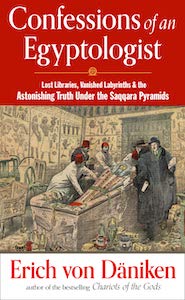
Confessions of an Egyptologist, by Erich von Daniken

Confessions of an Egyptologist: Lost Libraries, Vanished Labyrinths & the Astonishing Truth Under the Saqqara Pyramids, by Erich von Daniken
New Page Books, 1632651912, 208 pages, September 2021

Doesn’t it sometimes seem like Egypt holds all the secrets to the Universe? It’s easy to get lost in the ancient history of such a vast, expansive empire. I had previously read Erich von Daniken’s book Chariots of the Gods, and was curious what other hidden history might be revealed in Confessions of an Egyptologist: Lost Libraries, Vanished Labyrinths, & the Astonishing Truth Under the Saqqara Pyramids.

The book starts off with a very violent act of terrorism, but this sets the stage for the story of Adel H. to unfold, who was tragically murdered in the rampage. When the company Adel was working for needed a guide for von Daniken’s group, Adel volunteered, despite von Daniken’s notoriety for asserting his own information. Adel had read von Daniken’s work and was eager to have the opportunity to speak with him, sparking a decade-long friendship.

Throughout their relationship, Adel shares tons of insider information, having come from a family of grave robbers, with von Daniken. Confession of an Egyptologist‘s  primary focus is on one particular experience that Adel had in the Saqqara Pyramids, which changed his life forever and reveals fascinating information about what might still be hidden beneath the pyramids.

Adel had claimed that his family knew of underground structures that dated back even further than we could comprehend – tens of thousands of years at least. This sparked von Daniken’s interest, as he had written about books written longer than 2,000 years ago hidden in underground labyrinths. His own knowledge, plus what Adel shared sparked von Daniken’s curiosity.

“And I could help but wonder under which deserts, settlements, or sanctuaries these labyrinths must be hidden. Where were these lost, underground worlds from distant times? Had they been excavated and then covered up again? If so, by whom? Had these long-forgotten structures become inaccessible due to natural disasters?

And where are the millions of books that were written in the distant past? Were they burned? Damaged? Deliberately destroyed? And if so, again, why? Is the little that we see today all that there is? Or do secret libraries exist, accessible only to hooded guards or members of obscured orders? Who actually had an interest in writing, hoarding, and then hiding books for millenia? Who wanted to make these books disappear again?”12

Suddenly, I became curious about these questions, right along with von Daniken, and this made me eager to continue reading. It is of von Daniken’s opinion that the Egyptians hid these books because they feared a flood. However, humanity has also proven to be just as destructive of knowledge, from Caesar trying to burn down the Great Library of Alexandria to Pope Gregory IX burning Jewish books in the Talmud burning. (For more on the topic of book burning, I highly recommend Burning the Books: A History of the Deliberate Destruction of Knowledge by Richard Ovenden, which I’ve been reading this week too.)

As the different theories of why books would be hidden and where they might be, different theories come up between Adel and von Daniken based on their cumulative knowledge. One that was especially interesting was the concept of books being inscribed in precious stones hidden in the artwork on the underground walls. Von Daniken brought up the ancient text The Life of Adam and Eve, which describes how Adam learned how to communicate with a sapphire stone and learned all about astronomy and the earthly calendar.13 Adel had his own experience related to this:

“I saw a sculpture of the goddess Hathor carved into the wall in addition to the strange, tubular objects I described before. Between her eyes, in the middle of her forehead, was something like a precious stone. I clearly remember the indescribable awe I felt that prevented me from prying out the stone.”14

Is it possible that precious stones can communicate knowledge spanning millennia? If so, this would point to an advanced technology of the Egyptians, which might be hard to explain for some, but not for von Daniken. He asserts time is relative, and in both the past and present Earth has had visitors from the skies. Citing multiple witnesses of UFOs, von Dankien ultimately concludes the extraterrestrial intelligence that has come before is now present again on earth. 

To be honest, this felt like a stretch to me, but it was an intriguing concept nevertheless. I just wish it had been substantiated a little better than the assortment of testimonies von Daniken put together, leading to a kind of smorgasbord of ideas trying to pass as a credible theory. So while I wasn’t sold on the ultimately conclusion about alien life present on Earth, I did enjoy another focus of the book: the search for historical labyrinths and the experience Adel confided in von Daniken.

Before proceeding to discuss my thoughts on that content, it’s worth noting that the greatest flaw in the book is the lack of organization and skipping from one subject to the next without any clarity about how they are related. It feels like there could be some loose, easily broken thread connecting the different topics covered, but the book lacked a strong thesis, which made it hard for me to follow along with how one part of the book led to another. It felt like a mis-mash of information, which is often what makes me dubious of the veracity of the content.

As mentioned, the highlight of the book was Adel’s personal story of being stuck in the underground labyrinth of the Saqqara pyramids. While accompanying his father and uncle in a grave robbing expedition, he ended up getting stuck in the pyramid when a rock blocked his path back out.

Noticing a stairway that led downward led to mystical experience for him, filled with intimate relationships with a beautiful young woman and discovery of a mechanical throne, possibly linked to King Solomon’s. He was able to survive and escape with the help of a falcon that guided him to an exit. This is a quick summary, and his experience is recounted in much more detail by von Daniken, but it sounds incredible. It makes one wonder about what’s hidden in the unexplored tunnels underneath the pyramids.

Overall, I got some entertainment from reading Confessions of an Egyptologist. It was interesting to imagine the scenery and experiences of Adel, and I did learn some new information about Egypt from von Daniken. Just like many “conspiracy theory”-esque or outlandish ideas, the book has enough factual information to make it seem plausible, but it is simultaneously riddled with loopholes of confusion and inconsistency. So while I am not full subscribing to the tenets of the book, I am at least glad that I read it for consideration.

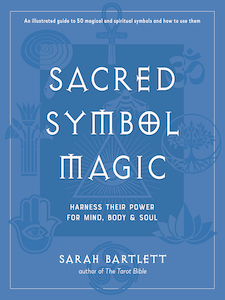
Sacred Symbol Magic, by Sarah Bartlett

Sacred Symbol Magic: Harness Their Power for Mind, Body, and Soul, by Sarah Bartlett
Weiser Books, 9781578637386, 128 pages, April 2021

Working with any form of magic requires not only belief in what you are doing and why, but also harnessing the power of the corresponding energies to amplify and set out the pathway to the ultimate goal or intention. After all, if you just stick a photograph of a yin-yang symbol on the wall, it will not have any true meaning in the context of your need…unless you actually engage in the process of the magic itself.15

Sacred Symbol Magic: Harness Their Power for Mind, Body, and Soul, by Sarah Bartlett is a compact hardcover title that is dense with information and visual inspiration. As humans, a large aspect of our interaction with anything relies on the visual components provided: their artistry, color, line, shape, etc. This organically arises even before we begin to analyze their origins and meanings. And, no less so in magickal pursuits, we deepen our connections to our work and practice through the symbology that serves to create and decode the mysteries. 

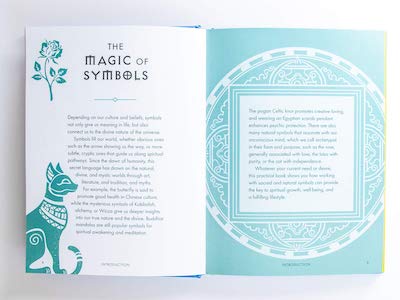
Depending on our culture and beliefs, symbols not only give us meaning in life, but also connect us to the divine nature of the universe.16

Bartlett gives due diligence to the inclusion of a variety of fifty symbols that span diverse spiritual practices and cultures. This holds in keeping with the understanding that no one culture claims the “one” symbol that is the key to the universe. Instead, it presupposes that all symbols are inherently divine and connected in a universal way that may be tapped into regardless of religion or spiritual persuasion. I believe this is an important realization in cultivating a more unified approach to our magical and spiritual workings — inclusion, power, and strength in your beliefs that have been formed by many beliefs. 

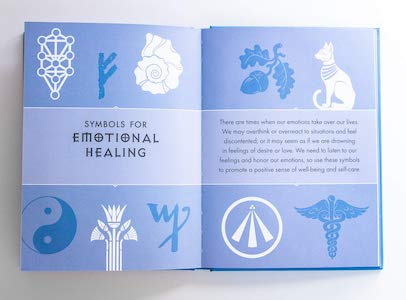
Sacred Symbol Magic is separated into six sections, including the Introduction, with each section containing those symbols relating to a specific type of energy the practitioner wishes to work with. These include: Blessing the Home, Self-Empowerment, Spiritual Growth, Joyful Relating and Emotional Healing. The topics themselves leave an open-ended feel making them all the more flexible in the specificity of their use beyond the obvious suggestions. This makes the book very user-friendly from the get-go without having to wade through various symbols and then back track to find exactly what you are looking for. 

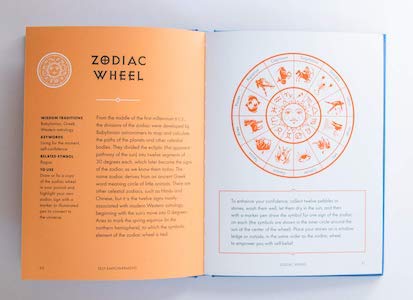
Each symbol is presented with information relevant to its cultural/spiritual origins, keywords, related symbols and a simple how to use. The image of the symbol is beautifully and carefully illustrated in a size that could easily be photocopied and pasted onto a flashcard or altar object and used as a contemplative focus or sigil. A suggestion for magical use/ritual is included with each symbol as well, giving the reader immediate application and trial.

Although the intention of Sacred Symbol Magic was not one of guiding the reader in the creation of sigils, there is enough inspiration contained between its covers to pique the interest in those who are so inclined. One of the basic premises of sigil creation is that of being familiar with the components of the sigil desired that its construction allows for energy to flow through it and the visual product stimulates within the practitioner growth. Incorporating and overlaying some of these symbols in a specific way, and having the benefits of the information provided by Bartlettt would definitely serve the purpose of creation of personal symbols, sigils or talisman. 

I was particularly interested in the section containing symbols for spiritual growth…

…. In times of uncertainty, loss, or a change in lifestyle, we all need a belief system or some form of spiritual guidance to know that we are not alone. To access the spiritual power deep within yourself, or to connect to the universe, use these symbols to set you on a positive pathway for your quest.17

Perhaps I was drawn to this chapter given the challenges we have all been facing these past years and months. Regardless, we could all use self-empowerment and a bolster to our goals of spiritual merit. Many of the symbols included in this section would be easily recognizable to most: the all-seeing eye, the pentagram, bee, labyrinth, lotus, om, and more. These affirm the power of symbols in mainstream society and the meanings that are derived in their use, mundane and magical alike. 

Sacred Symbol Magic concludes with its last symbol, that of a cat. Perhaps happenstance or intention, I thought it a wonderful symbol of selection as the closure for a journey through the myriad of visual magic. 

Cats have long been the harbingers of mystery, power, mischief and those of nine lives who could overcome untimely death. They are walkers between the worlds and familiars who guard, ward and teach. They have been worshipped, maligned, treasured, and feared. Much like the many interpretations for the symbols contained in this title. Each has had its fair share of glory and grief throughout history and all are subject to personal and collective interpretation. 

KEYWORDS: Self-esteem, independence, confidence…18

Sacred Symbol Magic brings to light and life the power of symbols and their application to a sustainable and growth-filled magical and spiritual practice. The subtle reminder is that magic is all around us in what we see and what we allow ourselves to explore more deeply in its hidden meanings. The overt intention of one of cultivating and integrating the many paths and the power held in their imagery to connect and unite us at a deeper level. I will be enjoying this book for years to come. 

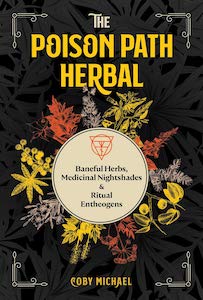
The Poison Path Herbal, by Cody Michael

The Poison Path Herbal: Baneful Herbs, Medicinal Nightshades, & Ritual Enthogens, by Coby Michael
Park Street Press, 978-1644113349, 256 pages, 2021

Any book that has a large warning at the start of it gets my attention. The Poison Path Herbal: Baneful Herbs, Medicinal Nightshades, & Ritual Enthogens by Coby Michael is not here to play. It’s here to teach you reverence and respect for this particular path, and above all, it’s here to transmute your life.

A practitioner of the Poison Path of occult herbalism and cultivator of entheogenic herbs, Michael is perfectly positioned to take the reader on this journey through the misunderstood baneful herbs. As well as practicing, he also contributes to the Pagan Archives at Valdost University, writes regularly for The House of Twigs, and maintains his own blog on Patheos Pagan called Poisoner’s Apothecary. Somehow in the midst of all that, he teaches classes and online workshops on plant magic, baneful herbs, and traditional witchcraft. 

Michael dives right into the subject, explaining that this book is “focused on the magical and spiritual uses of baneful herbs, entheogens, and plant spirit allies as well as their history and mythology.”19 He goes on to explain a few terms that are used generously throughout the book such as baneful which “refers to the ability of a thing to cause harm, and because of this threat, the baneful thing becomes taboo and gains a sinister reputation.”20

Baneful things, especial when talking about plants, can cause bodily harm and in some cases death if the practitioner isn’t clear on what they are doing. The book is separated into three parts, with part 1 covering off the basics of the poison path, Part 2 discussing the three ways of the poison path, and the last section which deals with bringing that knowledge together in practice. It’s very well laid out and a thoughtful path to follow if you are just starting your journey on this particular path.

Be warned though: this isn’t a gardening book, nor is it a how-to for using plants to hex your ex or find a job. Some of the information presented might be bit overwhelming if you don’t have a regular spiritual practice; as with any undertaking similar to this, you can expect to be changed by the process. Michael cautions against simply jumping in and instead recommends learning about the herbs’ chemistry and how the various plants affect human physiology. 

I had the notion of reading this book and then being able to find alternative solutions for my anxiety. Anxiety is not fun and presents different symptoms in many forms in those who experience it, and for me personally, it can be debilitating at times. I don’t like taking prescription medication because it makes me feel dull, so looking for another way to help myself is what prompted me to read this book. After going through it however, I realize that there’s much more to this than simply making a cup of herbal tea and wrapping myself up in a cozy blanket while I wait for the mind-goblins to quieten down. This is an actual path to follow and it is directly linked with Shadow Work. There is no spiritual bypassing here.

Fortunately, Michael seems to have understood this, as he writes clearly about the various families of plants and lists what they are used for. He also addresses the notion of using poisonous plants as spirit allies in magical practice despite the danger they present. He stresses the importance of personal exploration, as there is no substitute for your own counsel in such personal things. Such learnings do have a price though, as Michael clarifies, “…we learn to work with our own shadow as well as the darker forces of the natural world.”21

Having laid out the various plant families and their uses, Michael moves on to discuss the crossroads on the path of poison. This is where it gets a bit advanced; if you aren’t familiar with planetary influences you might find yourself scratching your head and wondering what the hell you’re reading. On the assumption that the reader has a working knowledge of planets and their influences, Michael writes brilliantly about Mercury, Venus and Saturn: the three paths of poison. He arranges them visually in a triangle, a shape that represents the traditional threefold worldview that many pagan cultures subscribe to. 

This collection of planetary influences is the basis for the Poison Path, and a profound one. Michael says, “The archetypal forces of Saturn, Venus, and Mercury are aligned with the currents of magic, witchcraft, and plant lore, providing powerful allies to one’s craft… their association with boundaries and liminal spaces in addition to their correlation with the other world and witchcraft mythos are the powerful themes expressed in this book.”22

Those themes run through the book, making the reader either cringe at the thought of having to learn more information on planets and such, or is an absolute delight to those who have working knowledge and wish to add to it. Planetary magic is not easy, and when baneful herbs are included as an accompaniment it becomes challenging for those not accustomed to specific terms and phrases. 

There is a lot of information in The Poison Path Herbal that might not be appropriate for those who live in the ‘good vibes only’ section of the chorus, as much of this book is dedicated to personal gnosis and the responsibility inherent in achieving that gnosis. I will be adding this book to my collection simply because it doesn’t coddle or coerce: this book demands your undivided attention and promises great rewards for doing so. Alternatively, if you aren’t prepared to go all in, you might want to pick up a different book. Out of respect for the writer, if you aren’t prepared to shovel your personal shit, don’t try to use this book as a way to cover it up.

Conform or Be Cast Out, by Logan Albright

Conform or Be Cast Out: The (Literal) Demonization of Nonconformists, by Logan Albright
Moon Books, 1789048427, 176 pages, December 2021

Conform or Be Cat Out: The (Literal) Demonization of Nonconformists by Logan Albright was the dose of reality that I didn’t even realize I needed. In a time with conspiracy-theories abound and a ravenous cancel-culture, this book takes a unique approach of examining the phenomena of attributing individualism, nonconformity, and differences from spiritual to physical as rooted in demonic evil. Albright’s critical-thinking approach to the subject, along with his candidness takes the reader on a journey from biblical times through modernity to highlight how nonconformists have borne the brunt of society’s misinterpretation of them as devils and demons to uncover a  pattern in play.

Some might be surprised to hear it’s not only in religion that this demonization occurs. Albright’s has a wide lens when analyzing this phenomena. Initial chapters include Biblical origins, but they progress to demonization showing up in bright children who excel, saints and martyrs, witches and wizards, medicine and science, notions of individualism, art, movies, and eventually modern Satanic panic of recent times. While this might seem like a smorgasbord of information, in reality, it simply shows how prevalent this recurring pattern is within human culture.

And Albright’s approach is so well-researched that despite the many directions the book goes on, the central theme is easy to follow. There’s a ton of anecdotes from throughout history that keep the reader interested and engaged. I would say that Albright leaves no stone unturned in this quest to shine light on the demonization of nonconformists. He packs a ton of historical information to weave together a very clear picture of how time and time again those who choose to walk their own path, stand by their beliefs, or advocate for something outside the traditional norms often pay a steep price.

One of the most intriguing aspects of the book is how Albright explains how different notions of the devil, from the imagery of horns, hooves, wings to the concept of selling one’s soul, have been perpetuated by myth, folklore, stories, and songs. As Albright points out, a very small portion of people actually worship demons or the devil. Even Satanists do not have a theology centered upon demonic worship. Nevertheless, this imagery has persisted into modern day. Reading Albright’s research helps to break the grip of this collective archetype to start exploring what the energy is that’s actually being repressed through it.

Albright even draws parallel between the Inquisition and motives of Institutional Psychology, demonstrating many of the fear-based tactics are the same thing, just different covers. While we like to believe we’ve progressed as a society, many of the same patterns repeat. From assertions that the planets don’t revolve around to the Earth to choosing to play Dungeons and Dragons, being outside social bounds doesn’t mean the intention is evil – and it’s time we start to realize this and stop inflicting literal pain and torture on those who buck the norms.

While some revel with the accusations hurled at them, far too many people have paid a high cost for their nonconformity. Since reading this book, I’ve continually reflected on all the potential snuffed out and valuable ideas lost to the tides of time due to unwarranted fear. This book feels like a tribute to them, nodding at their accomplishments, even though the praise is much too late. Nevertheless, we can continue to learn from the scientists, saints, philosophers, writers, occultists, but most of all, free-thinking individuals that pioneered their own paths.

I think we often expect books to answer something for us or provide guidance. What was unique about Conform or Be Cast Out is that Albright doesn’t really do this for the reader. Rather, he lays it all out through his examination of history, mythology, folklore, occultism, philosophy, and even the arts and simply shows examples of this demonization, sometimes discussing where they arose from or what perpetuated, but otherwise just sharing his thoughts on the subject. There is no solution proposed; if anything Albright highlights how this is still occurring now in our culture, despite advancements that make it so we no longer have to be rooted in conformity in order to survive.

I gained a lot from reading the book, even if it’s hard to put my finger on. I can best describe it as a sense of liberation. Reading through all the different examples of how this happens when people break formation, whether it be for scientific advancement or spiritual callings, made me more comfortable doing my own thing, even at the cost of judgement. And as a rather avant-garde individualist, judgement and being labeled “bad” is something I’ve come up against rather often. I think that the past few years that I’ve been trying too hard to conform to escape this demonization, but to what avail, honestly? That is at the heart of what I’ve been questioning since reading this book.

And thanks to Albright, I have so much to research further! The browser tabs I currently have open are The Manufacture of Madness by Thomas Szasz, A History of White Magic by Gareth Knight, Envy by Helmut Schoeck, and Escape from Childhood by John Holt. All of these titles and more are part of the wide-ranging sources Albright draws upon in his exploration of this topic, truly demonstrating the depth and breadth of his accumulated wisdom and level of study in regard to this phenomena of demonization.

Conform or Be Cast Out is a book that I feel is going to stick with me for a while because it woke up something within me that needed attention. Albright’s keen insight brought the topic to life through time right into my present reality. And what’s most important about the way he’s done this is that it lacks fear and judgement. The facts, plain and simple, speak for themselves, and suddenly, the reader realizes just how ridiculous these notions of demonization truly are given the life story of the individualist.