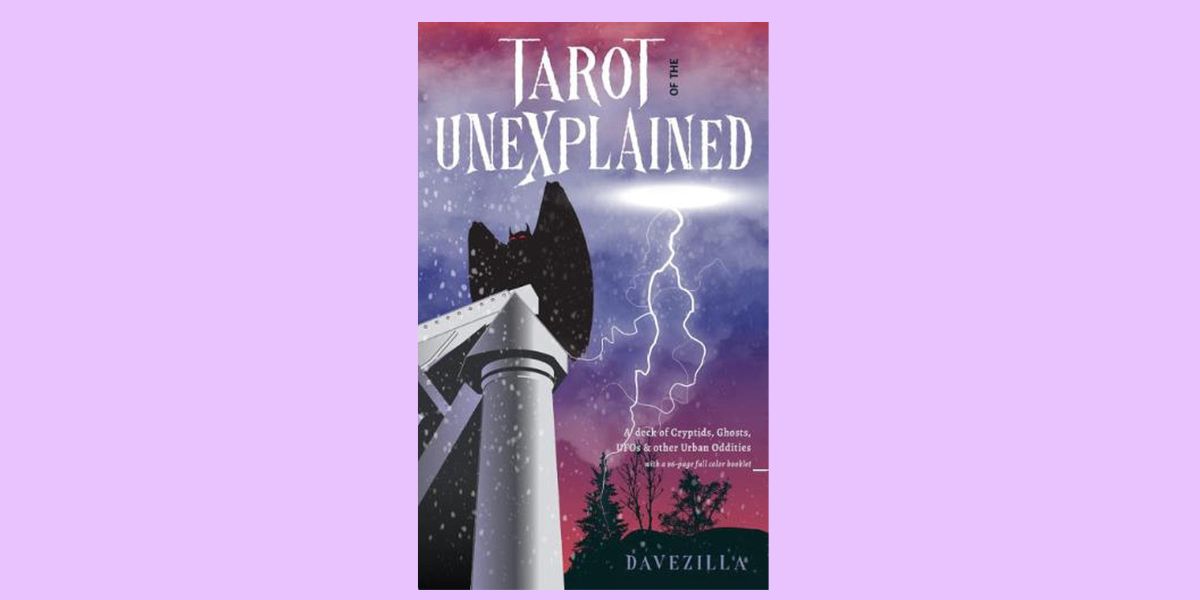
Tarot of the Unexplained: A Deck of Cryptids, Ghosts, UFOs and Other Urban Oddities by Davezilla is an intriguing blend of the high weird and the mysterious, merging the world of tarot with the enigmatic realm of urban legends and unexplained phenomena. This unique deck not only serves as a tool for divination but also as a fascinating exploration of some of the most captivating and eerie tales from around the world. And, if I’m honest, each time I pick it up cues the Twilight Zone theme song playing in my head.
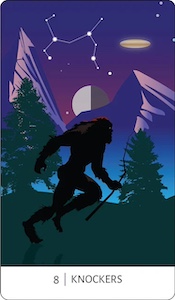
In the guidebook’s introduction, Davezilla explains how he couldn’t find the tarot deck he was seeking–one that essentially combines aliens, ghosts, UFOS, cryptids, unexplained phenomena–so he decided to create his own. Creating an other-dimensional, parallel system that mirrors the Rider-Waite system, he opens a door for readers into the bizarre world of folklore, legends, and the unknown. In this deck traditional cups, swords, wands, and pentacles respectively become portals, ghosts, knockers, and saucers, whereas the major arcana cards reflect well-known phenomena, folklore, monsters, and more.
The deck includes a comprehensive guidebook that provides detailed explanations of each card’s meaning, along with background information on the depicted legend. Every guidebook entry includes the card’s upright and reversed meaning, phenomena associated with it, an overview of the card’s meaning, and reflection for meditation. Davezilla’s writing is a direct, tell-it-straight style that tells you just what needs to be known at that moment.
So far, I’ve noticed his ascribed card meanings don’t line up exactly with the traditional Rider-Waite ones. So while I can use my own tarot knowledge to do readings, I’ve also been referencing the guidebook to tap into Davezilla’s perspective. I personally enjoy how Davezilla’s descriptions of the cards’ meanings unveil the unknown and ground the esoteric, whether through telling the story of the image featured, teaching the astrological symbolism of the card, or describing a type of person who might be represented in the reading, as with the court cards.
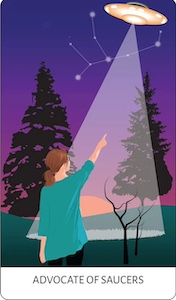
Plus, the court cards themselves are very cool since Davezilla titles them fan (page), hunter (knight), advocate (queen), and skeptic (king). Yes, he even creates space for the skeptics in the deck too! Take for example the Skeptics of Ghosts, who Davezilla describes as “a grumpy old curmudgeon. He doesn’t believe in the afterlife. No time for such tomfoolery.”2
As for the look of the cards, Davezilla’s creativity shines through in awesome illustrations in this deck. He spent nine months creating the deck himself! Whether the cards feature cryptids, monsters, ghostly apparition, portal, or UFO encounter, the detail really attunes readers to the energy. Visually, this deck is haunting and captivating, drawing the reader into a world where the boundaries between reality and myth blur. And I love how there’s always a constellation depicted in the background, bringing in the celestial symbolism too.
The cards are strangely spooky and really get you thinking about what’s lingering in the hallway, happening in the middle of the night, or even in plain sight that you’re entirely missing out on noticing. How many portals do we overlook? And where exactly did my missing lipstick get to? Is the long-dead previous tenant still roaming around the hallway? Often we remain closed off to these lines of inquiry, but this deck pushes through our psyche’s barriers to open the “what if..” train of thought that gets our inquisitiveness stirring.
And it’s this opening to the peculiarity that makes Tarot of the Unexplained unique as a deck. Its ability to evoke a sense of wonder and curiosity, especially while doing divinations, makes readers even more receptive to the strangeness that wants to come through.
When I first started working with the deck, I got so into learning more about the different stories and happenings that I spent a good deal of time going through the guidebook and following up with Google searches of things that piqued my interest. I’ve also been doing more unusual readings with the deck, such as asking which phenomena I should study for insight. I also truly feel a tingling sensation whenever I work with the deck, as though I’m opening a doorway to the weirdness of the world we’ve yet to explain.
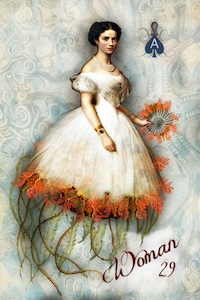
My favorite card in the deck is La Llorona, the Mexican Weeping Woman, who I first learned about when reading The Queen of the Cicadas by V. Castro. Seeing Davezilla pick her as the Empress utterly shocked and delighted me in the best way possible. For one, it showed me this guy really knew his stuff and wasn’t going with the basic, well-known mysterious entities in this deck. Second, relating her energy to the Empress was absolutely novel even though it appears to me as a more of a shadow side of the Empress.
Davezilla even writes this is a tough card, which most wouldn’t associate with the Empress. He writes:
“La Llorona is a “difficult” card. This is a card of chaotic magic, mental instability, infidelity, and deception. In extreme cases, this is a card where mommy can go a little crazy. In such cases, this is the official “Mommie Dearest” card.”3
I thought this was a very interesting take! And it speaks to how I have continually gone back to reference the guidebook to see Davezilla’s intention in creating the deck rather than relying on my own tarot knowledge to better understand the readings.
Overall, in Tarot of the Unexplained, Davezilla successfully captures the essence of these extraordinary oddities, encouraging users to delve deeper into the stories behind them. Whether used for divination, storytelling, research, or simply as a collector’s item, Tarot of the Unexplained is a must-have for anyone fascinated by the unknown and the supernatural. It’s a delightful journey into the obscure and the uncanny, offering the perfect combination of personal insight and out of the ordinary entertainment.
Alanna Kali is an astrologer, numerologist, and pioneer spirit that loves to explore life through the lens of depth psychology. She has a passion for studying the humanities and social trends. Her academic work is centered upon reuniting body, mind, and spirit through eco-psychology. She loves reading, spending time in nature, and travel.
I really enjoyed getting to know and working with The Jolanda Witch Tarot by Rosie Bjorkman and Hans Arnold. The symbolism is like the Rider-Waite-Smith deck, although the illustrations are charged with whimsy and fantasy. The guidebook is full of great wisdom, spiritual healing tips, and information on reversals, as well.
Rosie Bjorkman is a Swedish woman who originally published this deck in Swedish in 1997. Later, she began to translate the cards and text into English and worked with two different editors to perfect the language. Bjorkman is very well known in Sweden as “Jolanda the Witch” and loves to give tarot readings, workshops, and lectures. She has studied with several Native American tribes in America and a shaman in Siberia. She has also written a book on Shamanism, which is currently only available in Swedish. As a leading expert in “occultism and spirituality,” Bjorkman has also been a kundalini yoga practitioner for over 30 years. She currently lives in Solna, Sweden. You can learn more about Bjorkman on her website.
Hans Arnold (1925-2010) was a gifted artist and illustrator who is well known for his art that blends horror with fantasy and bright colors. Arnold was born in Sursee, Switzerland and moved to Sweden in the 1940’s. He illustrated fairy tales and articles, becoming a favorite in the science fiction community. I was interested to learn the source of this fantastical art that often depicts monsters and found this explanation on a website about Arnold:
“The horror illustrations are said to come from his way of conjuring his own fears. For God, the confinement and childhood in Sursee. It all started when Hans Arnold was a little schoolboy. He then met his first monsters in the form of his teachers at a very strict school. These memories were therefore carried with them later in life.”4
You may be interested to learn that Arnold also illustrated the Greatest Hits album for the Swedish Group ABBA. For more information and to see examples of his art, visit his website.
The Jolanda Witch Tarot is a standard tarot deck of 78 cards with Major Arcana and Minor Arcana cards. However, there is nothing standard about this deck. By working with Bjorkman, Arnold has created quirky, colorful illustrations of archetypal characters, animal guides, and other symbols from witchcraft and shamanic traditions.
Animal guides is a very general term that encompasses sea creatures, insects, dragons, reptiles, birds, and some mythical creatures from Arnold’s own imagination! For example, the 8 of Swords features eight hornets bearing down on a small family and it is a truly frightening image! The rest of the Swords illustrations feature real swords on each card.
The Wands appear as tree branches, carved totem poles, candles, columns, and other images. The cups are the same across all cards, while the coins feature many different images or symbols on the coin faces. Minor Arcana cards feature the standard card line-up, except that Page is replaced by Princess and Knight is replaced by Prince.
Within the guidebook, Bjorkman includes astrological signs and/or planets that correspond to each Major Arcana card, as well as a Goddess for most of these cards. Key words are shown for every card in the deck. She includes what she calls “four subsections with the following titles: Herstory, The Art of Magic, Medicine for the Soul and Imagination … In Magic Nation.”5 Bjorkman also weaves in a personal story for some of the Major Arcana cards. For the Minor Arcana, the wisdom is similar, although the sections are shorter. Most of the pip cards include a focal word printed on the card.
I took the deck to my Friday Coffee & Cards group and the ladies loved it! Several remarked about how the fun and whimsical illustrations softened the blow of the often hard-hitting guidance. One friend wrote to me during the next week and shared how the Sun and Moon Meditation for the 9 of Wands really helped her to “lie low for a while”6 and await a solution to a current situation in her life. Another friend loved the detailed guidebook and took photos of several card entries.
I utilized the deck for a three-card reading for myself and drew these cards:
9 Wands – Reversed
8 Swords
Princess Coins – Reversed
Using Bjorkman’s beautiful guidance as a framework, I created the following journal prompts and affirmations for my personal reading:
How am I NOT using my strengths nor acting on ideas for my business? How am I distracting myself?
I am relaxing into my success by changing distracting thoughts and focusing on my strengths. I am in the perfect position for this next chapter of my life!
This deck is an average size and is just a little larger than I like for shuffling with my small hands. The cards are printed on nice cardstock that will stand up to repeated use. The cards and guidebook come inside a heavy-duty box with a fold over, magnetic flap. Bjorkman includes a table of contents with page numbers for each card, an introduction to the cards, a note about her own magical practices and information on how the book is structured. She also includes a Bibliography of books and online references.
My favorite card in the deck is the 9 of Wands. It features a female archer on the back of a horse who is jumping over nine animal totems. She is poised ready to shoot one arrow, while her quiver holds an arrow of the sun and one of the moon. I love her confidence and the keyword: Strength.
Anyone with a basic knowledge of tarot and Rider-Waite-Smith symbolism will enjoy The Jolanda Witch Tarot. The guidebook is so large and comprehensive that a novice reader may be put off by the sheer amount of information. On the other hand, a new reader could easily use this as a type of “tarot bible” for studying the myth and lore of the symbols, as well as the stories of the goddesses Bjorkman includes. Anyone interested in Shamanism will also enjoy this deck. The “medicine,” tips and tools that the creator shares are so helpful to anyone wanting to establish a daily spiritual practice. Bjorkman leaves us with this affirmation at the end of the guidebook:
“I love and respect myself in all my aspects. Others love me just the way I am, and those who do not love me do not know me!”7
PJ Spur is an author, intuitive, spiritual mentor, astrologer, and hypnotist. She does tarot & oracle card readings, natal chart readings, grief coaching, and relationship healing. She also has hosted a weekly “Coffee & Cards” event with her Soul Compass Community for the past four years. Her book Navigating Grief with Grace is available on Amazon. Learn more at www.dearpj.com
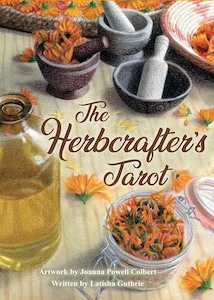
The Herbcrafter’s Tarot, by Latisha Guthrie with artwork by Joanna Powell Colbert U.S. Games System Inc., 1572819723, 124 pages, 78 cards, May 2019
The traditional tarot images often grow stale for me. In delving into why this happens, I reached the conclusion it was because they aren’t always relatable. Symbolic? Sure. But sometimes I just want to see images from daily life; I want to see scenes of my day to day. It was my quest for this domestic, homey feeling I was seeking in my readings that led me to The Herbcrafter’s Tarot by Latisha Guthrie.
The Herbcrafter’s Tarot by Latisha Guthrie is a beautifully crafted deck that intertwines the wisdom of the natural world with the mystical art of tarot reading. This 78-card deck, created in collaboration with illustrator Joanna Powell Colbert, is a celebration of the healing power of herbs and plants. Each card is thoughtfully designed to depict a specific plant, along with its symbolic meanings and practical applications, making it a unique blend of botanical knowledge and spiritual insight. And the imagery was spot-on for what I was seeking!
The cards are from the point of view of the reader. The Major Arcana cards depict a natural altar to the herb and its corresponding energy. They represent the gratitude the herbcrafter feels “for the gifts and insights the plants give her.”8 Some of the altars looked planned out, such as the ones in the shape of the mandala, while others are simply the altars that arise during herbcrafting as one is actively engaged in their process.
The Court Cards, which in this deck are called People Cards, all feature hands of the herbcrafter. They show hands doing all sorts of mundane tasks: picking plants, drawing a bath, pouring a tea kettle. She writes:
“Our intention is to highlight the plant as well as to celebrate the slow intentional ritual of handcrafting. With every berry gathered and tincture mixed we enflesh the sacred, making prayer visible.”9
In this deck, the Court Cards are Hijas (Daughters, traditionally Pages), Adelitas (Warriors, Traditionally Knights), Madres (Mothers, traditionally Queens), and Curanderas (Healers, traditionally Kings). Characterizing the Court Cards in this way made me feel extra connected to this deck too because these are the types of people that show up in my life; it’s easier for me to identify a motherly figure than it is a queen.
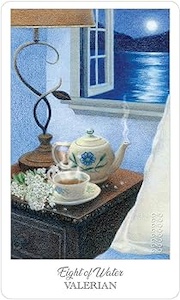
Other cards in the deck depict momentary scenes of what it looks like in the midst of gardening, having a cup of tea in bed with the moon shining above, or simply gazing at nature scenes of gardens, rivers, and trees exuding their beauty. As I browse the cards, I instantly feel at peace, grounded, and connected to the natural world. Yet the imagery takes on a whole additional layer of meaning after reading the guidebook.
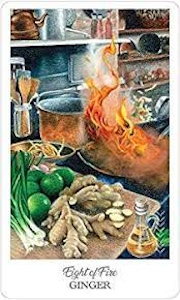
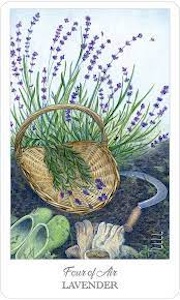
Guthrie explains how instead of traditional tarot suits (swords, wands, cups, and pentacles), their corresponding elements are used for the Minor Arcana (air, fire, water, and earth). And the cards for each element have a theme: air shows the observation of nature, fire the transformation of the herbs, water focuses on baths and teas, and earth showcases “baskets and fiber arts”, which are considered “legacy tools.”10
Furthermore, the herbs were chosen for each number within the elemental Minor Arcana based on “how they contribute to an ecosystem”.11 Guthrie provides a list for numbers 1-10 to explain the roles of one. The guidebook also groups the cards by number, so rather than looking through a section on a specific element, one looks to section on that number and then finds their element within.
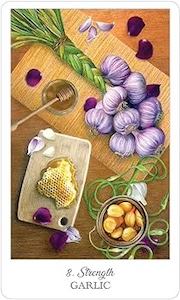
One of my favorite cards in the deck visually is Strength, which is the Garlic card. This is a Major Arcana card, so I knew it was depicting an altar of sorts, but it is certainly one of those altars that arises naturally from being in the moment. While I could describe it for you myself, a real bonus of the guidebook for this deck is that each entry features a description of the card. This is what the guidebook says about this card:
“A braided cluster of purple garlic rests on a cloth made of natural fibers. Roses from a nearby vase begin to dry, and petals have fallen on the table. Golden liquid seeps from a heart-shaped honeycomb onto a wooden board. Green scrapes fold into their lemniscate shape surrounding a pot of garlic cloves submerged in honey.”12
Guthrie perfectly captures the scene in each card with her vivid descriptions of the imagery. Even though I’m gazing at the card, her words bring the setting to life; I can feel it with my senses, further opening my intuitive understanding of the card.
The guidebook also features the Latin name, three imperative sentences for insight, a paragraph of wise words that speak to the spiritual meaning of the card, and three ways to craft with the energy of the card using the plant. For instance, the Strength card offers wearing a garlic amulet over the heart as a reminder to be bold, cook with garlic to fortify the body, and make “immune-boosting garlic honey”13 to soften intensity or conflict.
One of the standout features of this deck is its ability to connect the reader with the herbs, forming relationships “for medicine, creativity, ritual, and spiritual guidance.”14 The cards are not just tools for divination; they serve as a bridge to deepen one’s understanding and relationship with plants too. Guthrie’s guidebook provides detailed descriptions of each herb, including its traditional uses, folklore, and ways to integrate it into daily life. This makes the deck an educational resource as well as a spiritual tool, ideal for those who have an interest in herbalism or wish to incorporate nature into their spiritual practice.
In terms of usability, this deck is accessible for both beginners and experienced tarot readers. The imagery is rich and cozy, allowing for intuitive readings based on the set scene, while the guidebook is comprehensive yet easy to follow. The deck encourages a hands-on approach, inviting users to engage with the herbs mentioned, whether through gardening, cooking, or crafting.
Overall,The Herbcrafter’s Tarot is a harmonious blend of art, nature, and spirituality, offering a unique and enriching experience for anyone interested in tarot and herbal wisdom. It has become my go-to tarot deck recently. I absolutely love getting to learn more about the plants themselves, from the practical uses to the spiritual messages they have to share. Guthrie and Colbert have done a wonderful job distilling the essence of each plant into the cards both in the imagery and guidebook for readers to truly connect with their natural powers.
Alanna Kali is an astrologer, numerologist, and pioneer spirit that loves to explore life through the lens of depth psychology. She has a passion for studying the humanities and social trends. Her academic work is centered upon reuniting body, mind, and spirit through eco-psychology. She loves reading, spending time in nature, and travel.
Wild Lands Tarot, by Leah Shoman Sacred Scribe Publishing, 9798987986608, 78 cards and 96 page guidebook, 2024
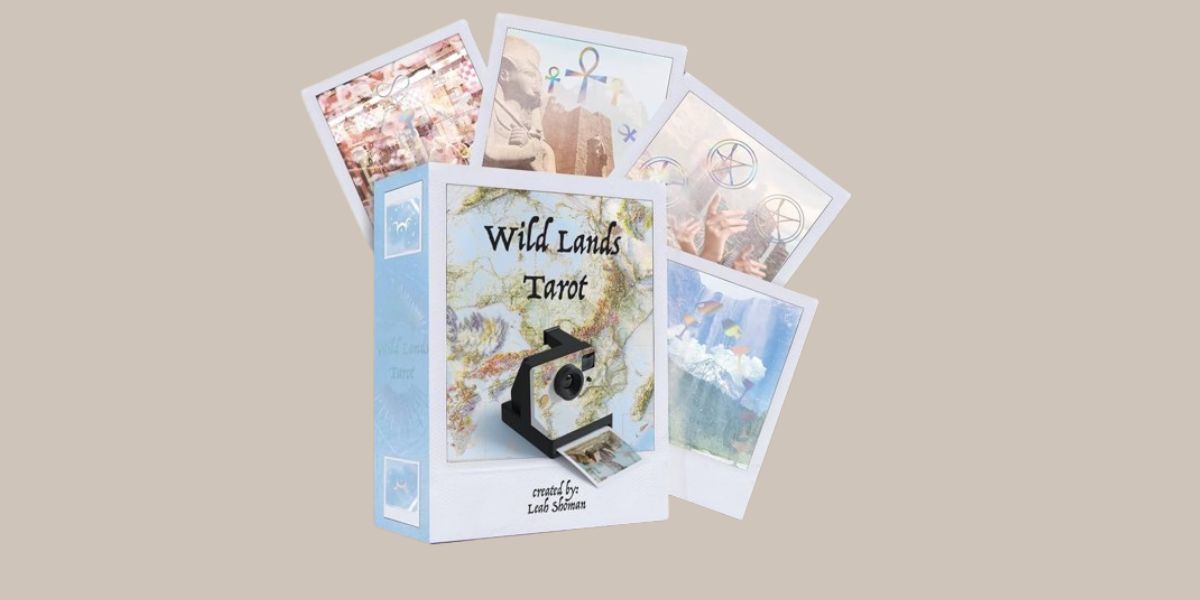
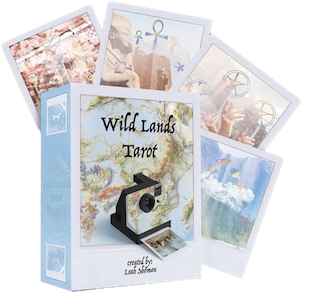
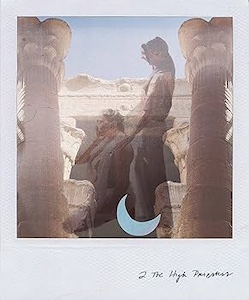
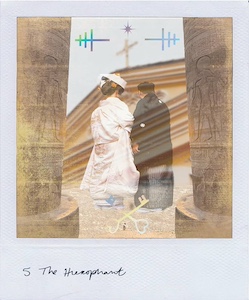
Wild Lands Tarot initially caught my attention because of the design. I’ve been fascinated by pictorial decks lately and the polaroid aesthetic of this deck especially appealed to me as a lover of all things vintage, so I knew I would have to give Leah Shoman’s creation a try.
Honestly, I wasn’t disappointed.
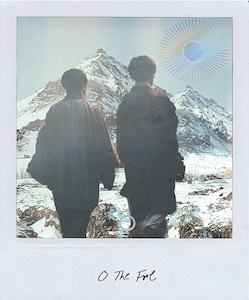
The pictorial base of the deck was beautiful, and the silver-foil embellishments were an unexpected addition that served to enhance the connections between the photographs and the specific card that they represented. However, the images selected for the deck seemed to be a little eclectic rather than revolving around a specific theme; the majority were either Japanese or Egyptian in nature, though occasionally there were some based on landscape photography as well.
I would have appreciated a section of the guidebook dedicated to the selection of the images. Why did Leah choose a particular image for one card over another? Why did she blend the images together or choose to overlay them like she did? Some explanation around those topics would have given the deck even more depth that I personally would have enjoyed.
The guidebook that came with this deck contained a dedicated page for each card, as well as two different spreads, and some information for a one-card draw. The interpretations follow what has become standard for Rider-Waite-Smith (RWS) based decks.
However, the Wild Lands Tarot did rename two of the suits. The deck has the traditional Wands and Cups, but has replaced Swords with Ankhs and has renamed Pentacles to Coins. As you can imagine, most of the Egyptian themed images belonged to the suit of Ankhs, while Coins and Cups were primarily landscape and nature-based photography, and the suit of Wands contained primarily Japanese imagery.
The Major Arcana is where all three of these themes collided; some were Egyptian coded, others Japanese, and still others landscapes. The thing that most seemed to anchor the images to the cards they represented was the silver-foil overlays, which really helped to bridge the gap between the image and the traditional RWS majors. Without the foil images, I don’t necessarily think that I would have connected a lot of the photographs to their corresponding archetype.
The cards of the Wild Lands Tarot, in keeping with the vintage polaroid aesthetic, were shaped like the film that you would have to shake until they developed. (Yes, I know you remember those!) While that shape is not at all common in the world of tarot, I feel like it added to the appeal of the deck and the sense of nostalgia and hiraeth that permeates it. It is, however, an odd shape to shuffle and the cards weren’t the most comfortable to handle. They also have pointed corners, which isn’t something particularly prevalent in tarot, which tends to favor the rounded corners for comfortability and/or ease of use.
As far as handling goes, though, I absolutely loved the thickness and feeling of the cardstock. It’s definitely on the thicker side, which is my personal preference (I feel like it will last longer); coupled with the smooth yet still tactile matte finish, I was almost in cardstock heaven. Shoman got that aspect of her deck, in my opinion, just right.
When I pulled the deck out to give some friends readings, they all agreed that they loved the back of the cards. The light blue color gives a hint of the whimsy of the deck while keeping true to a more natural color palette. The silver foil is also present on the back, where it outlines a triple moon surrounded by the signs of the zodiac.
When it came down to it, though, I had a bit of difficulty actually reading with the Wild Lands Tarot. Shoman’s photography, as I’ve mentioned throughout this review, was stunning; however, I really struggled to visually connect the cards, possibly due to the lack of cohesion among images.
Overall, I feel that Wild Lands Tarot is best suited for people who prefer to use cards with surreal and whimsical imagery in their readings. Despite its lack of a single, cohesive theme, this deck brings a sense of beauty and nostalgia for all that once was, and all that could be. I, for one, am glad to have it in my collection to fulfill my longing for far-off places that I may never truly come to know.
Being somewhat of a newbie with Lenormand cards, I jumped at the chance to work with The Sirens’ Song: Diving the Depths with Lenomand & Kipper Cards by Carrie Paris and Toni Savory with contribution from Tina Hardt. The Sirens’ Song is a combination divination kit that contains 40 Lenormand cards and 38 Kipper cards. (What I know about Kipper cards would fit in an earbud!)
Paris is one of my favorite diviners and deck creators and I had an opportunity to meet with her for coffee at a tarot event several years ago. She is a generous, incredibly creative and gifted teacher and mentor. I’ve also “met” Savory on Zoom via her World Divination events, and her knowledge and enthusiasm for various types of card divination is contagious! When I heard that the two of them collaborated on this kit, I was very excited to learn more.
Paris has created four other tarot and Lenormand decks, as well as numerous charm casting kits. Her The Relative Tarot and The Beloved Dead kits are two of my favorites for communicating with the ancestors for messages and guidance to live my life. Paris is a very talented artist, who blends art and graphic elements from across many eras to create her decks and frequent Facebook posts. She has a master’s degree in the Cultural Study of Cosmology and Divination from the University of Kent, UK. Learn more about Paris at her website.
Savory (aka The Card Geek) founded the World Divination Association and hosts virtual teaching events several times a year with a collection of teachers and mentors. She is also well-known for hosting free events with classes on tarot, Lenormand, Kipper and other types of cards. She has created five other decks and written five books on card divination. Savory has researched Kipper decks for more than ten years, including spending time with the families of readers going back several generations. See more at her website.
Contributor Hardt is an author, who has worked with Paris to create the guidebooks for The Relative Tarot, The Beloved Dead, and The Sirens’ Song. She considers herself a diviner and enjoys sitting in circles and communicating with departed souls.
Paris and Savory have beautifully created this kit with a compact box in hushed tones of gray-blue and aqua. The teal lettering and haunting image of the siren and some of her underwater friends grace the cover of the box. Printed inside the kit, this lovely invocation greets you:
“May the Sirens’ Song guide you away from rocky shores and lure you into the dazzling depths of your own truth and mystery.”11
Next, you notice the guidebook, which provides a brief history of both Lenormand and Kipper cards, as well as how this deck came to be. Paris created the original Sirens’ Song Lenormand deck in 2017. Savory asked her to create a Kipper Deck and then the two of them combined both decks “into a single treasure chest because, at their core, these two card decks are kindred divinatory tools.”13
“Both the Kipper and Lenormand cards long to tell the reader a detailed, no-barnacle- unturned story, in which the Querent is always the main character. The potential for discovery is enormous. . . . The Petite Lenormand can serve as a gateway to the Kipper.”14
The guidebook was expertly structured to introduce you to the Lenormand style of reading and descriptions of the card meanings before flowing into the Kipper cards and their unique card descriptions. The creators made it clear that the cards can be used alone or in tandem, and they showed how each deck has its own “ability to tell a story, to sing you the song that you need to hear.”15
Unlike tarot and oracle decks, which are read intuitively, Lenormand cards are read symbolically, and Kipper cards are read quite literally. Lenormand deals with the outer world while Kipper deals with the interpersonal. Read together, the story the Sirens tell reveals the hidden meaning to be found in both people’s everyday lives and in societal issues they face.
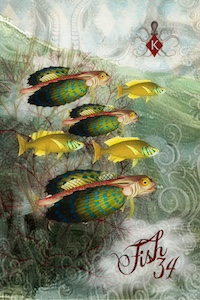
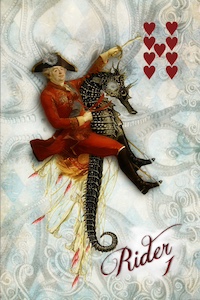
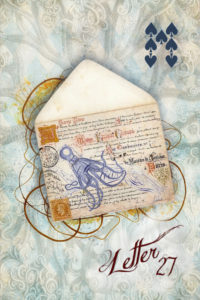
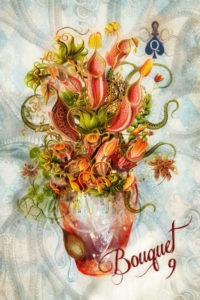
This kit is so much fun! I enjoy the graphics, with the beautiful artwork and symbolism. Each of the images has an underwater creature theme, from an octopus to fish and so on. The cards are marked on the back with either a K for Kipper or an L for Lenormand, so you can keep the decks straight.
The spreads in the back of the guidebook were so helpful! I especially loved how they showed a three-card Lenormand reading and featured the three cards in each of the three positions. Paris and Savory also share how to do the Grand Tableau style of reading, which involves using all the cards in either deck. The deck creators also shared how to combine the cards and read a Grand Tableau of 36 cards created out of both decks. However, I think I will master the four, five or nine-card spreads before I venture into the deep waters of the Grand Tableau!
Yet the coloring on the front is the same, so it is not easy to distinguish between the decks for someone like me who was relatively new to the two styles of cards. Yes, the Lenormand deck features the miniature card symbols from playing cards in the top right-hand corner. Yes, the Kipper deck has different card images. But it may take me lots of practice to be able to distinguish between the two decks.
The cardstock was a nice weight, and the cards had a matte finish. I loved the small size, which made the cards easy for my small hands to shuffle. The guidebook was also a great size to tuck into a bag or purse and was printed in four-color with thumbnails of all cards. The paper was glossy, and the font was whimsical, to complement the underwater theme.
Armed with this background information, I decided to give the Lenormand cards a spin. I created a question regarding the launch of a new program I wanted to present to my community. I decided to use Paris’s spread called “The Tell it Like it is Spread.”
Creating my own sentence from the key words and the placement of the cards as shown, I saw the following:
Sharing my knowledge is NOT going to be challenging, so I may move ahead to schedule the event and know that all will be well.
Great first reading!
For the Kipper Cards, I decided to do a simple three-card spread. I placed the Siren significator card to the right as I asked my question: How may I support my daughter at this phase of her life, after her recent break-up? I drew three cards and placed them alongside the Siren card. The cards lined up as:
Long Road
Hope
High Honors
Siren
From this, I saw that recognition, maybe a promotion was forthcoming, especially since it was next to the Siren card. Hope was the next card, meaning manifestation of love, fame and/or fortune. Finally, I saw Long Road, which could be indicative of a great distance or maybe a time of two years. The fact that the Hope card was next to it said that the time may pass quickly and the road may not be rocky. From these cards, I saw that my daughter’s job will be very rewarding, and there is hope for her future in both love and fortune, although it may take some time. Wonderful reading!
The Sirens’ Songwould be great for anyone who wants to learn or practice Lenormand or Kipper. I was a relative newbie to both styles of reading, and I enjoyed learning them very much. I could see myself keeping this deck by my desk to refer to when I had a quick question. For now, I’ll be off to check out one of Savory’s videos on Kipper cards on YouTube!
PJ Spur is an author, intuitive, spiritual mentor, astrologer, and hypnotist. She does tarot & oracle card readings, natal chart readings, grief coaching, and relationship healing. She also has hosted a weekly “Coffee & Cards” event with her Soul Compass Community for the past four years. Her book Navigating Grief with Grace is available on Amazon. Learn more at www.dearpj.com
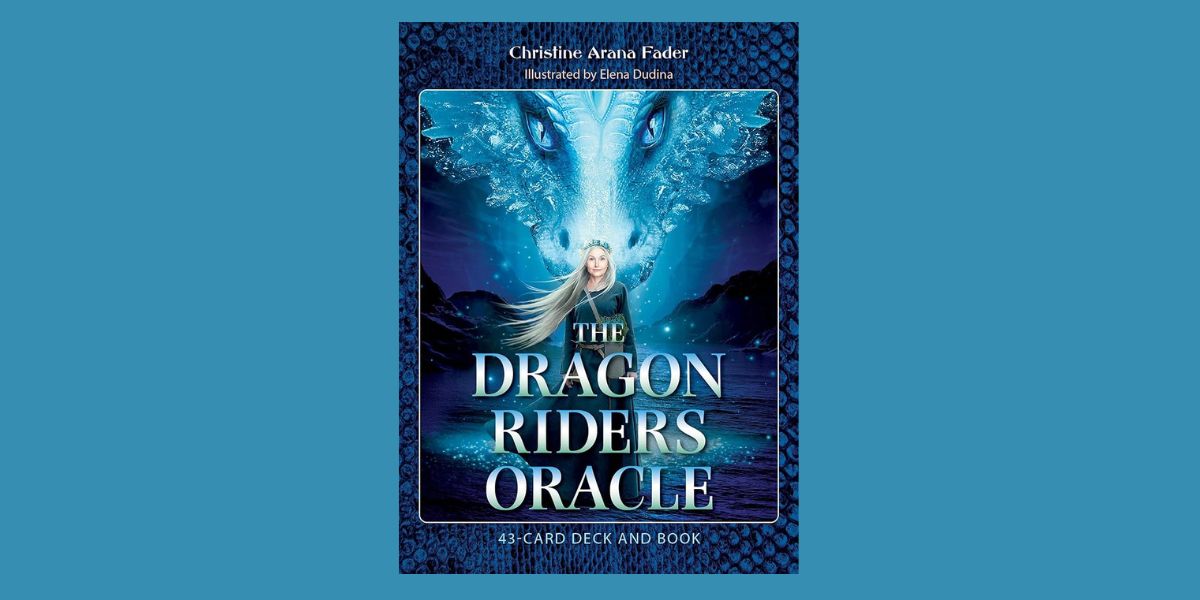
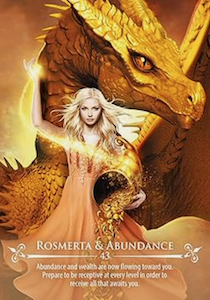
Dragons are absolutely majestic, and quite frankly, they can also be intimidating! Though I’ve desired to connect more with dragon energy, I was struggling to find a book or deck that made the grandiosity feel accessible. The Dragon Riders Oracle by Christine Arana Fader and illustrated by Elena Dudina was the “in” that I needed to discover my own dragon and better understand their true nature.
It was the way Fader provides a creation story for the origins of dragons and how they came to be companions to other energetic beings. According to what her own dragon has shared, Fader explains dragons were “the first entities in our universe”1, who were entrusted by Source to be universal protectors. I now see dragons as guardians of the galaxy, an energy that vibrates with high love for the multitude of energetic beings in the universe.
Those energetic beings are the dragon riders–gods, goddesses, elves, angels, and ascended masters–who are coupled with their dragon on the cards in this deck. The dragon riders Fader has depicted come from a range of spiritual traditions (Christianity, Celtic, Greek and Roman Pantheon, Buddhism, Confucianism, and more) giving a wide range of insights. Many of the dragon riders will be familiar names, though there were some energetic beings I was happy to discover and learn more about, while the dragons’ names will most likely be new to readers.
Fader teaches how the true name of each dragon cannot be uttered by humans, as it is a matrix of “pure power and comprises numbers, letters, sounds, symbols, and colors.”2 Reading that sentence, I conjure a mental image of what a potential matrix might appear as, but as Fader notes, it’s hardly translatable to paper! For this reason, she has chosen names that still resonate with the dragon’s energy and have meaning in regard to “the element of the dragon’s being.”3
Another thing Fader notes in the introduction, which I really appreciated, was how the energetic beings portrayed do not actually have human forms; the way they are depicted by Dudina is intended to help readers form a relationship with their energy by giving them a relatable appearance. Fader writes, “All the beings portrayed in the cards have a body, a face, eyes, and distinct colors, but it is important to remember they are not the “truth”, they are only representations to help you make contact.”16 I value this reminder, as it helped me to attune myself to the spiritual dimensions of the cards, while also providing a form I could visualize connecting with while meditating.
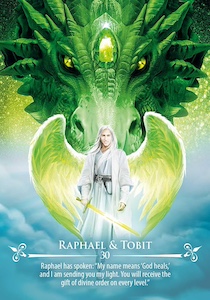
The cards themselves are very sturdy with a sleek feel that makes them easy to shuffle. Dudina has done an absolutely incredible job illustrating the multitude of dragon riders and dragons. There are so many types of dragons in all the colors of the rainbow, yet for each one, Dudina has captured their loving spirit in the way she’s drawn the eyes. I feel the regal presence of the dragons shining through, portraying a relationship of mutual love, trust, and devotion with the companion dragon rider. As for the dragon riders, they all look immaculately handsome and beautiful.
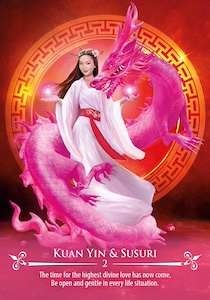
Each card is numbered and has the name of the dragon rider and companion dragon along with a short message at the bottom. The number makes it easy to look up the corresponding entry in the guidebook for further insight. In the guidebook entry, Fader provides background on the dragon rider and then a message from both the dragon rider and the dragon. The messages are in direct quotes, indicating it was spoken directly to Fader by the energetic being to be shared with readers.
Here’s an example of the messages from the card Kuan Yin & Susuri. The first quote is a snippet of the message from Kuan Yin, while the second is part of the message from Kuan Yin’s female dragon companion Susuri.
“Follow my teachings and learn to love without expecting anything in return. In doing so, you will discover unimaginable inner riches.”17
“Let me penetrate the very depths of your being; let me expand you from within and break your inner chains. To do this, hold the card over your heart and feel how with my resonance I am at work within you.”18
The insights are not divinatory–they are more like advice directly from these higher spiritual beings for us. In the introduction, Fader even encourages readers to not ask a question when shuffling and pulling a card, rather she instructs to connect to one’s heart and breath, concentrating on being in the moment without overthinking. This is the way to establish the connection with dragons, and the message that is meant for you will come through. There is a specific energetic being that wants to guide you, one whose teachings are most relevant to you at the time of drawing your card.
One fun and unexpected aspect of this deck is the addition of two Joker cards (number 7 and 13) with cats on them. These cards represent “a leap in consciousness”19 and that new opportunities for spiritual growth are on their way. In order to ensure readers are prepared for this new energy headed their direction, the Joker cards offer rituals to perform to find one’s center, becoming the bridge between the spiritual and material world. If readers don’t feel called to work with the Joker cards, they can of course just not include them in their deck.
Overall, The Dragon Riders Oracle is a wonderful way to gain the spiritual wisdom of high vibrational energetic beings of love. From gods and goddesses to angels and ascended masters, this deck opens the door to protection, guidance, and support from the realms above. Most especially, the genuine and powerful essence of the dragons shines through to ensure readers are aligned with their spiritual path. The primal, mystical powers of the dragons is sure to create a fulfilling change in readers’ lives.
Alanna Kali is an astrologer, numerologist, and pioneer spirit that loves to explore life through the lens of depth psychology. She has a passion for studying the humanities and social trends. Her academic work is centered upon reuniting body, mind, and spirit through eco-psychology. She loves reading, spending time in nature, and travel.
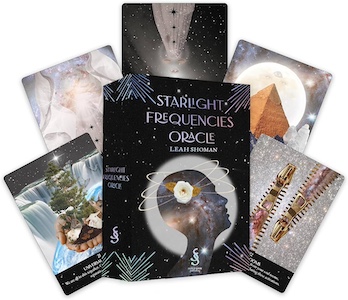
Are you feeling the shift in your life? As many begin to awaken to new frequencies and dimensions, it can be immensely helpful to lean into cosmic assistance. Starlight Frequencies Oracle: The Knowledge You Seek is Seeking You by Leah Shoman is a deck designed to bridge the current reality with the New World being formed, leading the way towards 5D consciousness with love rather than fear.
“This time is powerful. The veil between fear and the truth is thin and you are being called to be the seeker. You are the being called to cut through this veil and illuminate your light upon the shadows.”20
Creator Leah Shoman is a spiritual writer and tarot and oracle deck creator. Other works of hers include Wild Lands Tarot, Crystal Rituals by the Moon, and Divine Codes Oracle. She also recently launched Sacred Scribe Publishing which publishes items that open doors of consciousness, leading the collective to new levels of spiritual exploration and visionary prowess.
This deck is unique because readers are intended to “interpret and decipher the transmissions for yourself.”21 Shoman describes how these cards were downloaded directly from Source, containing multi-layered light codes within each one that will make themselves known when the timing is right. All the aspects of the card, from title to color to number have specific intentions embedded within, and each reader’s experience will be different, based upon what it is their soul is meant to receive at the time of the reading.
I will admit, this threw me for a loop at first. Not to say I’m a huge guidebook person–I like to follow my own intuitive guidance when it comes to readings–but the limited framework of each card made them a bit of a mystery to me at first. While there is a sentence or two written on each card, which is exactly what it says in the guidebook too, there’s no fast and easy answers with this deck. You really need to spend some time connecting with the card, taking in the imagery and reflecting on the brief message being revealed.
What stands out the most is the visual aesthetics, making it a more meditative deck for me, where one must open up to receive the messages from a higher channel. The box is nice and sturdy with a magnetic latch that keeps the cards nice and secure. The words on the box are written a glistening, silver foil that gives the deck a lot of shimmer and shine. Opening the deck, readers are greeted with the message “Now child, crack open & awaken” on the box’s inside cover, while the bottom of the box is an image of a gorgeous swirling galaxy, filled with hues of pinks, purples, and blues.
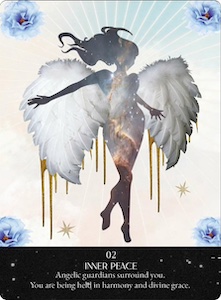
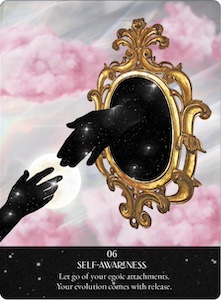
The cards are likewise edged with silver foil, as well as the foil creating shining stars on the back of the cards, giving the deck itself an iridescent feel. The imagery on the cards is an eclectic mix of collage. The imagery woven into the cards ranges from Egyptian pyramids to rose buds and doves. It’s a mixture of spiritual symbolism and nature imagery (crystals, shells, flowers, etc.), though these too have their own meanings to convey, which make each card filled with messages to decode.
There’s a real mystical feel to the deck, combining the cosmic world with the natural world. Rainbows flow through mountains while the cosmos glistens in the background; a white rose blossoms in the mind of a star-filled silhouetted figure with rings around their head, similar to an atom or halo – it’s up to decode what you see and find meaning for it yourself!
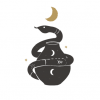
My two favorite cards are Expansive Growth (08) and Illumination (24). Expansive Growth features snakes slithering around a ceramic vessel filled with flowers with an infinity symbol on it. The background reminds me of the natural rock arches in Utah, though the scene on the card looks very other-worldly. The message “You are experiencing an infinite loop of expansion.”22 makes me think about how we are always evolving, yet there’s a cyclical nature to our growth.
The card Illumination features a huge orange slice in the sky above a glistening body of water. The orange slice has yellow flowers surrounding it, giving the appearance of a radiant sun. The pop of bright color gives me a wave of hopefulness and inspiration; I can imagine the refreshing tangy taste of the orange on the card, awakening my senses as I gaze at it. The message on the cared, “Shine your light upon those who cannot see.”23 feels empowering, invoking overflowing positive feelings.
These are just my interpretations, of course! Readers will find their own secret message within the imagery on the cards. Shoman’s artistic eye for details makes this deck an on-going exploration for seekers, as there’s always a new dimension to be discovered. The ethereal nature of this deck breaks through stagnant patterns, serving as a channel for Source to come through and make necessary alignments.
Overall, I recommend Starlight Frequencies Oracle for those who are looking to expand their intuitive connection and attune themselves to new realms of consciousness. Creativity naturally awakens from working with deck, opening doors of perception to new realms. Shoman’s work is a perfect mixture of guiding readers in seeking higher knowledge for growth while holding space for them to go deeper and see the beauty hidden within.
Alanna Kali is an astrologer, numerologist, and pioneer spirit that loves to explore life through the lens of depth psychology. She has a passion for studying the humanities and social trends. Her academic work is centered upon reuniting body, mind, and spirit through eco-psychology. She loves reading, spending time in nature, and travel.
From the shining, metallic type on the deck box to the rich colors of the floral and pop culture collage graphics, Divine Codes Oracle by Leah Shoman is truly a work of art. Within the deck, Shoman combines photos of roses with pianos and Buddhist monks with clouds. Landscapes pair with sky divers and children from the 1960’s play in the stratosphere. Her goal is simple with this deck: share love in all forms and with all people. She tells the reader on the inner lining of the deck’s box:
“I Love you, Sweet One. Pass this love on to all those you encounter, for you are the connection point. You are the point which tips the scales of balance between love and hate.”
Shoman is a crystal energy healer, author, and deck creator, who brings guidance from Spirit to her clients and readers. She has published numerous decks and books. She also has an online crystal shop where she offers crystals sourced from around the world. Learn more about her offerings on her Instagram.
For my first visit with the DivineCodes Oracle, I chose card #33 Sacred Realm. The card features a surfer and orca whales against the backdrop of a Buddhist temple and an eclipse in the sky. Unusual graphics for a message about the importance of tuning into your heart, but Shoman reminds us that we do not need a temple or church, just solitude and a connection to our inner self. In the guidebook, she marries the graphics and lines on the card with a suggestion to “feel the interconnectedness of it all.”22
I took the deck to my Friday Coffee & Cards group and asked each friend to pull a card. Everyone loved the deck! They complimented the colors and rich graphics. However, most of all, they appreciated the messages from Spirit that Shoman reveals.
My friend Paula drew a card that talks about self-acceptance. It highlights a heart that breaks open and then a Divine love that is “finding its way to fill crevices with pure golden light. Repairing, resolving, renewing.”24 Paula said, “I think I can feel that happening in my life right now!”
Another friend drew a card that suggested she start moving her body. It features two dancers and several butterflies. “Step out of your mind and into your heart. Move your body to shift your vibration and release any stagnant energy currently present,”25 the message says. She said that the message really hit home for her.
I really enjoyed working with this deck. I sent card messages to a few friends via text and each one really resonated with the message and the graphics. It seems to me that these cards are truly sourced from Divine wisdom and Shoman has a real way with words that focus on encouragement and healing. My favorite card in the deck is # 30 Bigger Picture:
“Zoom out. A shift in perspective is needed in this moment to gain clarity around a current situation you feel stuck in. You will never be free until you free yourself from the prison of your own false thoughts.”26
Shoman includes a table of contents, brief introduction, how to use the cards, and three different kinds of spreads. For the three-card spread, she presents five different ways to do a three-card spread. Her five-card spread presented a bit of a twist on what I’ve worked with in the past: “current overall energy; current concerns and complications; hidden factors; new ideas, people or things that can help you grow further; what you need to be more aware of within yourself.”27
This deck is a standard size for oracle decks and the card stock is a good weight. The cards are numbered and shuffle nicely, and I can tell they’ll hold up to frequent use. Along with the metallic imprint on the flip box that holds the set, the cards have a lavender metallic edge. The guidebook messages are clear and concise, in that Shoman keeps the guidance for most cards to a one-page limit. There are a few instances where she features a poem or other channeled guidance on the facing page.
I really like that the guidebook is printed in full color. The pages feature either a full-color thumbnail of the card and guidance or graphics that she has pulled from the cards. For the pages that feature her poems or prose, she prints on top of muted graphics. The paper stock for the guidebook is a nice weight and has a satin finish.
Divine Codes Oracle would be great for any level of oracle or tarot card reader. The guidance is simple to read and understand and you can even use the cards as a stand-alone message–the heart of the message is printed on each card. I plan to add this deck to my collection to use after an intuitive reading or natal chart reading for clients. It will make a nice way to close the session. Shoman has created a beautiful deck that focuses on love and radiates the importance of self-love and self-acceptance. She sums it up in the introduction:
“Divine Codes Oracle is a deck about LOVE. You are called to hold the frequency of love. You are called to be the embodiment of love and anchor it into the Earth Plane. This deck is bringing forth pure love consciousness, for we as a collective need it now more than ever. It will attune to your energy when you hold it and it will tell you exactly what you need to hear in that moment”28
PJ Spur is an author, intuitive, spiritual mentor, astrologer, and hypnotist. She does tarot & oracle card readings, natal chart readings, grief coaching, and relationship healing. She also has hosted a weekly “Coffee & Cards” event with her Soul Compass Community for the past four years. Her book Navigating Grief with Grace is available on Amazon. Learn more at www.dearpj.com
As a tarot enthusiast and reader for twenty years, I was excited to learn about the publication of Rachel Pollack’s revised deck The Shining Tribe Tarot. Initially published in 1992 by Aquarian Press, the deck was called The Shining Woman Tarot. In 2001 she changed some of the art on some of the cards and the deck was published by Llewellyn. The title was also changed to The Shining Tribe, which she felt better reflected the community of people drawn to tarot for divination and personal growth:
“The name was a kind of invocation, a hope that the deck would shine for others, especially in reading, and light the way for travelers on their own sacred journeys.”27
For this 2024 edition, Pollack created five new cards: one for each of the minor arcana suits and one to represent the major arcana. Although the deck was published after Pollack’s death in 2023, she was able to complete the revisions and supervise the creation of the deck before her death. It is also important to point out that Pollack created the artwork herself for all of the cards.
Rachel Pollack (1945-2023) was a giant mentor in the field of tarot. In addition to writing the bestselling book Seventy-Eight Degrees of Wisdom, she wrote the guidebooks for several tarot decks, as well as many fiction and nonfiction books. She taught at The Omega Institute for over thirty years and was a frequent panelist at tarot workshops around the world. I was blessed to meet her at a tarot workshop in Los Angeles in 2007. She was brilliant, generous, and very friendly. A group of us went to lunch during the workshop where I visited with her and Mary K. Greer!
In addition to her interest in tarot, Pollack also created the first transgender superhero in several issues of the comic book Doom Patrol. She was also known as a trailblazer within the transgender community.
“Welcome to the definitive edition of the Shining Tribe Tarot. It’s the equivalent of a director’s cut of a film. It’s the creator’s cut, Rachel Pollock’s cut. Published for the first time with all 83 color corrected cards, it also includes a full colored guidebook in which Rachel discusses the evolution of the deck, offering insights into each card and how to read them. More than merely an accompanying book, this guidebook stands as another of Rachel’s landmark Tarot guides.”28 – Judika Illes, Editor
With this Introduction, the editor opens a door into the special world of Pollack. In the next few pages, Pollack gives us a history of this deck, including the inspiration for the tribal images and artwork that she created. She talks a great deal about symbols and colors and the different cultures on which her images are based. She makes it a point to say that she wants to honor and respect the “history and living power”29 of the symbols.
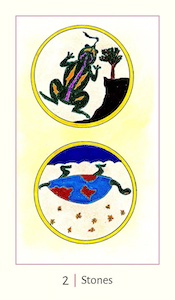
The structure for this set of cards is fairly traditional, although she has adopted her own names for the suits of the minor arcana: Trees (Fire/Wands), Rivers (Water/Cups), Birds (Air/Swords), and Stones (Earth/Pentacles). She has also renamed the court cards as “Vision” cards: Place (Page), Knowers (Knight), Gifts (Queen), Speakers (King).
Pollack also shares this:
“One difference is that the Vision cards in general do not signify actual people the way the Court cards sometimes do in traditional tarot. Nor do they represent character types in quite the same way. Instead, they take us into an experience of ourselves. They give us a chance to discover and use the power of the elements.”30
The cards are a nice size, a little larger than playing cards. The card stock is a nice weight, and the matte finish is great for the ancient symbols and bright colors of the deck. Each card has a white border, and the name of the card is shown at the bottom in black type. The set comes in a beautiful box with a cut-out portion and ribbon for the cards, as well as ample room for the hefty guidebook.
These cards are easy to shuffle, and I enjoyed using them for my week of daily readings. For the first day, I drew one card: Three of Trees, which is the Three of Wands in a traditional deck. This card is always a celebration for me and I was interested to see what Pollack shares:
“This card is a celebration, filled with the laughter of the Grandfather. He welcomes and protects us with his open arms.”31
She also includes the story of the artwork, which features “a spirit image formed from a tree by the Ojibwe people of Canada.”32 The image is based on a photograph of this type of tree, which has been carved to represent a person.
The next day, I did a three-card spread and drew these cards: Knower of Birds, Six of Trees, and The Sun. With Pollack’s guidebook and my own intuition, I created this affirmation, based on the three cards:
“I collect signs and symbols and share my knowledge with confidence and wisdom, as I emerge into the light of divine consciousness.”
Her imagery is so beautiful, and the artwork invites deep contemplation and a connection to the heart. My favorite card in the deck is one of the five “extra” cards: Portrait of Albert-Bright Through Nobility, which relates to the major arcana and Spirit. Pollack explains that this card is based on the name of her animal guardian, a red fox. “The name Albert means ‘bright through nobility.’ Getting this card means a sense of protection and the ability to ask for and receive help.”33
The guidebook is very easy to navigate, from the Table of Contents to the Glossary. She includes a large section on Readings and includes lots of ideas for spreads for various situations. She also includes an Appendix which explains the name changes for all cards, how to work with reversals and how to start your own Shining Tribe. She even has notes for groups, including ways to start conversations and create activities for developing your tarot skills. The last section is a Glossary that includes references to some of the cultures, religions, and symbology used in the deck.
I really enjoy working with The Shining Tribe Tarot. I can feel the decades of tarot history, as well as the flavors of the various indigenous cultures in the cards. I can’t wait to introduce it at my next Coffee & Cards Zoom with my friends.
PJ Spur is an author, intuitive, spiritual mentor, astrologer, and hypnotist. She does tarot & oracle card readings, natal chart readings, grief coaching, and relationship healing. She also has hosted a weekly “Coffee & Cards” event with her Soul Compass Community for the past four years. Her book Navigating Grief with Grace is available on Amazon. Learn more at www.dearpj.com
“We often look to the stars, thinking they are so far away and wondering what they have to do with us. They have everything to do with us; we are made of stardust.”29
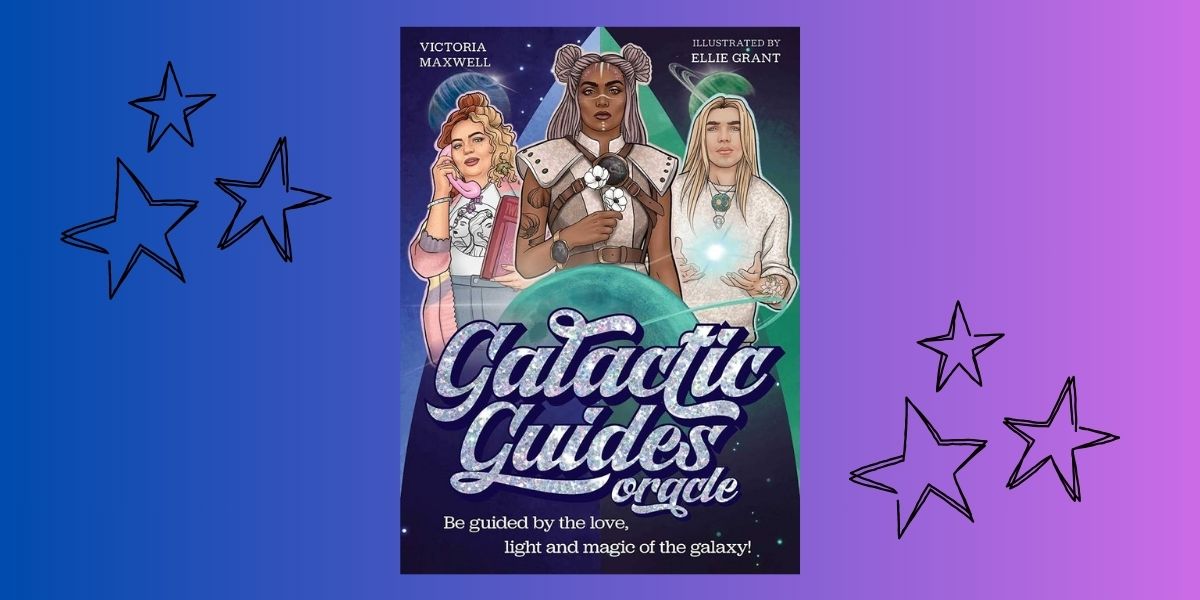
Maxwell has a talent for attuning oracle card readers to new dimensions. Her previously published decks, Angels Among Us and Goddesses Among Us, are my go-tos when I am in need of some insight. Now with this deck, Maxwell transports readers into the galaxy to connect with the energies of planets, zodiac signs, and star systems for interstellar guidance.
I love what Maxwell shares in her introduction. She describes: “When I stopped focusing on what the planets, constellations and star systems meant according to traditional definitions and simply tuned into their energy, I found I could connect with them on a deeply personal level and invite them to guide me through astrological seasons and moon cycles and help me with what’s happening here on the ground.”30 This appeals to me because as an astrologer I’m always in relationship with the cosmos, yearning to go beyond what I know about each planet from books to create my own energetic connection. This deck is perfect for this purpose.
In the “How to use the cards” section of the guidebook, Maxwell offers different card spreads and describes the difference between the planetary cards, zodiac sign cards, and star system cards. The planetary cards tend to draw attention to something happening here and now that needs your attention; the zodiac sign cards ask you to look at the bigger picture and take a broader perspective; the star system cards have to do with destiny and insight from high-level guides. Additionally, she explains how each card also has an associated element, chakra, crystal, flower, and planet ally that expands the meaning even further. This information adds another layer to readings, though one can certainly glean plenty of insight just from reading the description of each card in the guidebook.
There is just so much guidance for each card! In addition to the aforementioned correspondences, each guidebook entry has an overall message of guidance, questions to ask yourself, description of the card, insight for the five common realms people seek guidance about (love, money, purpose, service, and spirituality), and a message from a lightwork perspective and shadow work perspective. So much insight for each card!
I had an insanely cool synchronicity happen with this deck. I happened upon a list of 100 baby names related to space. My son had a “D” name, so I was looking at other “D” names on the list and came across Draco. I thought it sounded cool, and I was envisioning myself calling my child that, but then told myself to refocus back to working with my deck. I shuffled and then pulled out the card.. Draco! Can you believe it?! The guidebook describes, “Draco, which is Latin for ‘dragon’, is one of hte largest constellations in the sky.”33 To add to the timing, it was also on the Chinese New Year, ushering in the year of the dragon!
I was mostly interested in the the card related to my love life, so I focused on that message in the guidebook, which reads:
“Relationships are the ultimate opportunities for personal and spiritual growth. The people who challenge you may have the most to teach you.”34
This felt extremely resonant, as I was working through some “growing pains” in my current relationship. This card helped me to reframe my perspective and remember that challenges do not mean the relationship isn’t success, rather they present a chance to grow stronger by doing my own inner work and focusing on spiritual growth.
The imagery on the cards, illustrated by Ellie Grant, all feature a person embodying the energy of the planet, zodiac sign, or constellation. They are very accurate, and at times can seem embellished, but I enjoy this because I can study the imagery and see all the attributes and characteristics of each energy personified. The general color theme is what you’d envision for deep space–blues, blacks, purples, greens–along with bursts of colors to make the characters on the cards pop and stand out.
My favorite image in the deck is Saturn, which features a gorgeous elder with striking gray hair. I always get a crone feeling from Saturn, the wise grandmother figure, so I enjoyed seeing Grant portray the energy this way too. Other cards that I got a kick out of include Aquarius, featuring a man who looks like he’s at Burning Man, covered in tattoos, necklaces, a scarf, and reflective sunglasses that flip up to remind us of the third eye. I also love the image of a woman holding her big pregnant belly, wearing a beautiful flower crown, for the Full Moon card. It’s also worth noting this is a very inclusive deck that personifies the energies of a diverse range of people.
My final thoughts about this deck are that it can feel a little ungrounding to work with. For those looking to attune to higher frequencies, it’s perfect! But if you’re not used to working with these energies, you might want to ensure you take the time to ground back in nature after working with the deck. I personally love how the deck gives me an out of body feeling while working with it, but for some this might feel disconcerting. So make sure to take the time to create the right space for working with this deck and balancing yourself afterwards.
Overall, Galactic Guides Oracle is a really amazing way to connect with the celestial energies. Whether you’re looking for inspirational guidance, cool synchronicities, or a fun way to meditate with the energies, this deck has you covered. The imagery on the card does a wonderful job of bringing these energies into a form we can visually identify with, while the guidebook is filled with interesting facts about the stars as well as soulful messages that can help reorient you towards your higher calling. I highly recommend this deck for those who are interested in the myseries of space, the beauty of the stars, and interstellar travel consciousness.
Alanna Kali is an astrologer, numerologist, and pioneer spirit that loves to explore life through the lens of depth psychology. She has a passion for studying the humanities and social trends. Her academic work is centered upon reuniting body, mind, and spirit through eco-psychology. She loves reading, spending time in nature, and travel.