✨ A Gathering Place for Magical Readers and Writers ✨

Tag Archives: pagan portals

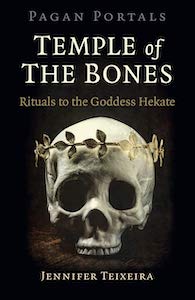
Pagan Portals – Temple of the Bones, by Jennifer Teixeira

Pagan Portals – Temple of the Bones: Rituals to the Goddess Hekate, by Jennifer Teixeira
Moon Books, 1789042828, 112 pages, June 2021

Pagan Portals – Temple of the Bones: Rituals to the Goddess Hekate author Jennifer Teixeira has been a practicing witch for over two decades, and in 2009 went forward on her priestess path with The Starflower Coven and The Amazon Blood Mothers of San Francisco Bay Area in California. Beyond being a practicing witch, the author’s specific relationship with the Goddess and experience leading ritual dedicated to Hekate more than qualifies her to educate on the specific rites and rituals presented within these pages.

At just 112 pages, the book is compact and reads as a literal handbook for developing and maintaining a relationship with Hekate, specifically as a group. The writings are in large part the actual public rituals of The Temple of Bones, a group dedicated to Hekate that meets in the San Francisco Bay Area in California.

The book begins with a Foreword written by Rowan “Briar” Rivers, one of the Temple of Bones leaders, who begins by telling the story of how they came to be a dedicants of Hekate, and how the group came to be formed. Rivers goes on to explain some of the many symbols and signs that Hekate may use to call upon and invite you to also enter into a relationship with Her.

Hekate is known for having many names (I’ve read in places that there are hundreds at least) and we are shown more than a dozen of them in this book. The Temple of Bones chooses one epithet to work with each month, and the chapter titled “Epithets of Hekate” gives us the exact format that is used to facilitate Her monthly prayer circle where each month another of Her names is called upon for community healing and protection.

The ritual format continues to be explained in the following chapters, “Casting the Circle in the Temple of Bones,” “Elements of Hekate,” “Ancestors of Blood and Affinity,” “Calling the Goddess,” and “The Ritual Working.”

These chapters are succinct and direct with instructions given for leading these portions of the ritual.

The chapter titled “The Bone Oracle” goes into great depth with the Temple of Bone’s “Bone Divination Guide.” Having next to no knowledge of reading or “throwing” bones, and also having an interest in lithomancy (fortune telling by reading crystals and stones) I was thrilled to see that the Temple’s “bones” include crystals, stones, shells, bones, herbs and other interesting, assorted items including alligator claw, coyote claws and teeth, a fossilized stingray barb, and an iron nail. The guide explains the meanings attached to each item and how to use them in divination.

The pages following are a virtual recipe book of offerings, spells, incense formulations, potion recipes, flying ointments, and rituals for the phases of the moon. There is a simple recipe for Florida Water, which I happened to be looking for and delighted to find (and thrilled to realize how simple it is to make!)

The Chapter “Hekate’s Garden” lists the herbs used by the Temple of Bones and explains a bit of history and usage for each. This chapter, as well as the “Bone Divination Guide” are worth the price of the book alone as a reference for working with Hekate.

“The Temple of Bones Ritual Pit” gives the outline for the public ritual of the Temple of Bones and is wonderfully complete in its instruction and would be useful for anyone desiring to lead a Hekatean ritual.

The book wraps up with suggestions for further reading.

I would recommend Pagan Portals – Temple of the Bones to anyone who is interested in working with or learning more about the Goddess Hekate. It is a lovely addition to my own small Hekatean library and I’m sure I’ll use it often in the future at the very least for its lists of herbs, explanations of specific “bones”, incense formulas, and of course for that wonderful Florida Water recipe.

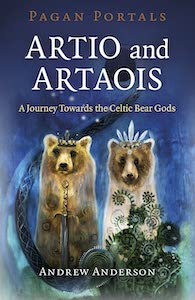
Artio and Artaois, by Andrew Anderson

Pagan Portals – Artio and Artaois: A Journey Toward the Celtic Bear Gods, by Andrew Anderson
Moon Books, 1789044626, 120 pages, July 2021

When I picked up Pagan Portals – Artio and Artaois: A Journey Toward the Celtic Bear Gods by Andrew Anderson, I really had no idea what the book would be like. This was my first time reading a book from the Pagan Portals series, so I didn’t know what I’d find inside. Mythology, spirituality, anthropology, history? It turns out this new book in this series hits all of those at once!

Anderson invites the reader to ride along on his intriguing journey to discover the identity and importance of this pair of Celtic bear deities. This pilgrimage begins as an investigation of a protective ursine spirit guarding his home and ends with the conclusion that this divine duo may be some of the eldest deities worshipped by mankind!

Anderson’s journey begins with a synchronicity: seeing Artio’s name and image in a social media post. This became significant soon after, when Anderson sent out a general plea for a higher power to help protect his home. He saw a vision of a great, spectral she-bear (later identified as Artio) standing guard above his house. Spurred by this spectacular manifestation, Anderson felt an immediate connection to this deity and decided to begin a pilgrimage of discovery to learn more about Her.

Initial research revealed precious little about the she-bear goddess, but Anderson followed the bear’s historical pawprints into mainland Europe: from Luxembourg to Germany to Switzerland. In Bern, Anderson found the most compelling piece of evidence: a sculpture dedicated to Artio amid a town with a long – and still-standing tradition of venerating bears. It was here where Anderson really begins to put the pieces together, using keen observation and insight to bring this investigation to life for the reader. His evocative description of Artio’s sculpture and meditation on the bear’s presence and energy drew me right in, as if personally introducing me to the goddess.

Anderson does brilliant work of incorporating research from other scholars into his discussion, but also uses their ideas as launching points for his own, perceptive insights about Artio. Regarding the sculpture in Bern – which includes not only the bear, but a tree and a woman holding a basket of fruit as well – he disagrees with many scholars that the tree is merely a symbol of the bear’s forest habitat. Anderson argues instead the tree has a deeper significance: there is a connection between it and the she-bear as symbols of rebirth. He writes:

“The tree is very stylized, not identifiable as any particular genus of tree and seems to have a somewhat phallic acorn pointing over the bear’s back. . . taken together, the bear, the human, the fruit and the tree present a powerful image of rebirth and plenty, a dedication to an extremely powerful protective mother. . .”1

One of the most surprising and fascinating sections of the book comes from mythological connections that Anderson investigates, particularly with regard to Artaois, Artio’s masculine counterpart. Continuing to trace the history of bear imagery into the United Kingdom, Anderson’s research suggests that past rulers associated themselves with bears in order to stylize themselves after the legendary King Arthur. Indeed, the characterization of Artaois seems to share many similarities with the great king: a protector of his people, a mighty warrior, and a craftsman. Even the linguistic connection between ‘Arthur’ and ‘artos,’ the Welsh root for “bear,” makes one think it’s quite likely that the spirit of Arthur has its root in the divine nature of the bear god.

I absolutely love this weaving of the spiritual and mythic worlds that Anderson presents. Although the question is left open as to how much the worship of Artaois influenced the tales of King Arthur – and Anderson thinks we should definitely not just conflate the two – the question itself invited me into the realm of archetypal thinking. I found myself engaged with questions of how our ancestors might have migrated over time from worshipping these ursine gods to idealizing a human figure, as both represent the positive qualities we desire from the masculine side of a great ruler.

These thoughts flowed right into the next chapter of the book, where Anderson takes what he has learned about Artio and Artaois and begins to search many other cultures of the world for the significance of bears. I was shocked to learn that bear worship – or, at the very least, sacred respect for these creatures – is among the most ancient forms of human reverence. Artio, the she-bear, may indeed be one of the most primordial representations of the Great Mother!

In the final chapters of the book, Anderson finds that even bears in popular media: such as the film, Brave, and the video game, Smite. I loved his inclusion of the contemporary media portrayal of bears, as it is very enticing for me to now go and look at these sources with fresh eyes, paying attention to how they capture the spirit of these ancient bear deities. And for those interested in taking up a spiritual practice focused on bears, Anderson provides several suggestions for creating your own rituals – including the ancient rite of the Bear Feast!

I highly recommend Artio and Artaois to anyone wishing to learn more about bears – not only the animals themselves, but also the relationship that humankind has had to these creatures throughout our history and beyond. It’s also important to note that bear populations have vastly declined in recent centuries, especially due to habitat destruction for human expansion. Throughout the book, Anderson firmly encourages the reader to consider our connection with these magnificent creatures so that we might help to restore them to a place of high honor and treat them with the reverence that our ancestors had once offered.

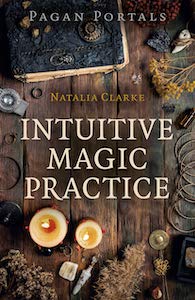
Intuitive Magic Practice, by Natalia Clarke

Pagan Portals – Intuitive Magic Practice, by Natalia Clarke
Moon Books, 1789046157, 120 pages, May 2021

Intuitive Magic Practice, part of the Pagan Portals series, by Natalia Clarke makes me want to breathe a long, deep sigh of relief. Things have been a bit hectic in my world recently, and I’ve felt the disconnection that stems from being out of touch with my inner voice. Reading this book has shifted me back into my more natural, receptive state of being in the most delightful way.

Clarke has combined her experience as a transpersonal psychotherapist with wisdom as a spiritual guide to offer readers insight on how to create an intuitive magic practice. Throughout the book, her gentle, calming tone invites a sense of fluidity, harmony, and personal energetic resonance to emerge.

In no way is this book one in which the author holds the knowledge, prompting a hierarchy between author and reader. Rather, Clarke develops a relationship with the reader that’s guided by feelings of goodwill and trust. Much of the imparted content to the reader stems from her own personal experience, and she writes this book as though she might be telling a friend about her experiences with magic and developing intuition in her own life. I enjoyed her anecdotes and the lens it provided me into seeing how she developed her own spiritual perspective.

I really liked reading about the importance of nature in Clarke’s spirituality and connection to her intuition. There is so much beauty in the natural world, along with lessons of tending, growing, and slowing down to enjoy the moment. Since her writing does not stem from any one belief system or practice, I noticed how nature seemed to be the greatest influence that gave shape to Clarke’s experiences.

However, there’s so much that Intuitive Magic Practice covers. Each chapter highlights a method of connecting to one’s intuition and offers ways to become receptive to the guidance of one’s inner knowing. Receptivity is key here, as Clarke’s writing calls the reader to settle in, move at their own pace, and gently open to the promptings that want to be acknowledged.

Some topics covered in the book are dreamwork, journaling, breathing exercises, creating sacred space, creative imagination, moon cycles, and more. Clarke also shares spells, information on candle magic, and guidance on how to select ritual tools. Through it all, she emphasizes that there is no one size fits all model for one’s magical practice; there is also no need to force something when the energy is not there.

“This way there is a natural flow, no force, no attachment to an outcome, no artificial influences of any kind and it always works. One might say I flow with intuitive energy if and when it comes in. If I am not called or specific energies are not present, I do not do anything.”2

Clarke also includes information on the Triple Goddess aspects, working with the elements, and tips for intuitively crafting one’s own magical practice such as writing spells, casting a circle, and creating rituals. Again though, this all arises from a place of moving with the flow, rather than planning, specifying, and dictating how the process should look. She even contrasts intuitive magic to ritual magic to help readers get a better sense of this method in relation to others.

My favorite chapter of Intuitive Magical Practice was “Intuition, Divine Feminine and Sacred Self-care.” While this book has valuable information for all readers, Clarke does note in the introduction it is more geared towards a female audience. All I can say is this chapter was all I needed to be reminded of and more right now.

As I move through a phase of transition, stemming from immense burn-out in my last job that lead me to severely disconnect from my own internal guidance, I desperately needed the reminder that listening to my intuition, caring for my body, and moving in alignment with the energy is a practice of sacred self-care.

“What do I mean by sacred self care? This links in with self-awareness, which can grow through listening to yourself with complete trust and seeing powerful results in your way of being with yourself and the world. It means giving yourself what your inner voice asks of you or points you towards; giving yourself what you need in the moment by listening to your intuition; treating yourself with compassion, love and respect, as you would any divine energy.”3

It’s interesting too how Clarke reminded me of the importance of moving according to where the energy is and how things are flowing. To be honest, this book has been sitting on my shelf for about two weeks now, and I had procrastinated delving into my new book. I tried to read it a week ago, but after a few pages it was sidetracked. Then, suddenly, this morning, all my energy was focused on reading this book and sinking in to receive it’s message. I am so glad that I trusted the timing of my feelings and didn’t read it in a mindset that wasn’t ready to embrace all the wisdom in this book.

For the past few months, I’ve forgotten that it’s okay to live according to your intuition and trust the timing of when things unfold, but reading Clarke’s words reassured me that it’s okay to move in rhythm that feels right for you. It was particularly inspiring to read how she doesn’t do spellwork unless she feels called. Living a magical lifestyle doesn’t have to be doing spells with each moon cycle, or constantly keeping up with a specific practice “just because you’re supposed to.” It can be just as powerful when your practice is fluid and guided by intuition. This is such a deeply refreshing approach to magic.

I’ll admit I moved quite quickly through the book, soaking it all in as I sat outside in the sunshine, feeling the fresh air gently flow around me. However, this is also a book that can be savored and referred back to over time. While I did finish it quickly, I now am ready to go back through it and practice some of the exercises, which Clarke offers plenty of through the book.

There is one method of connecting to intuition Clarke writes about that I had never heard of before, which I am particularly excited to try out: intuitive drawing. This approach can help to facilitate a dialogue with the subconscious and allow feelings, sensations, and thoughts to arise from deep within. Sometimes I feel like I get trapped in my words, and I am eager to see what comes out when I choose drawing as a form of communication with my inner guidance.

All in all, Clarke’s gentle and uplifting approach to an intuitive magic practice is something of great value to those who are seeking a more natural approach to working with energy. I highly recommend Intuitive Magic Practice to those who are seeking to tune back into their inner voice in a way that feels authentic and true to who they are. This book is a wonderful reminder that there is no right or wrong way, and that healing comes from remembering the sacred connection to our inner guidance. As you read Clarke’s wisdom, I’m sure you’ll feel right at home within yourself, comforted by the words that it’s okay to embrace your intuition and let your energy flow in a way that feels harmonious.