✨ A Gathering Place for Magical Readers and Writers ✨

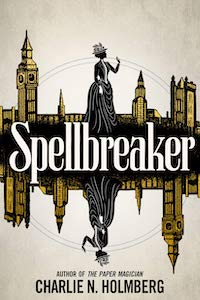
Spellbreaker, by Charlie N. Holmberg

Spellbreaker (Spellbreaker, 1), by Charlie N. Holmberg
47North, 1542020093, 303 pages, November 2020

I will admit, I love 19th-century period pieces about magic. Therefore, it was no surprise I picked up Spellbreaker by Charlie N. Holmberg to read this weekend, as it is set in England in 1885. However, England is quite a different society with magic making the world run smoothly, but also contributing to societal class divide. Therefore, Elsie Camden doesn’t feel bad about using her spellbreaking powers to knock the English nobility down a few notches to help out the common folk.

The world Holmberg writes about is filled with mystery, intrigue, and most of all spells to make the world go around. All magic users and spellbreakers must be licensed by governing bodies, and the spells are kept closely guarded, only passed down to those who prove they can be trusted with the power. The whole process of how magicians level up their magic and incorporate spells is absolutely fascinating! It involves these drops of magic which glisten and then are absorbed by the aspector’s skin, permanently making the spell a piece of them. When an aspector dies, a magnum opus of their spells is left behind.

The interesting thing about these magnum opuses is that anyone can use the spells in them once by tearing the page out. Therefore, these books are often handed down to other aspectors or guarded by the magical governing bodies. Recently though, there’s been a string of murders of master aspectors involving stolen magnum opuses. The tension is high as no one can figure out who is behind the ghastly crime of murdering magicians for their spells.

Elsie Camden finds herself smack dab in the middle of the action. Day to day, she works as an assistant to a stone mason, but she also does secret work as a rogue spellbreaker. After being orphaned as a child, Elsie was left to fend for herself in the world. As a fire burns down her workhouse, leaving her to wonder what’s next for her, she is approached by a woman who realizes what she truly is: a spellbreaker.

From this point on, Elsie spell breaks for who she calls the Cowls, though she’s truly never known exactly who these people truly are. She enjoys feeling needed by them and also views herself as a modern Robinhood, stealing from the rich to give to the poor. Since she’s not registered as a spellbreaker, she’s in both an advantageous and dangerous position for doing this discrete work.

On an assignment gone wrong, Elsie winds up getting caught by Bacchus Kelsey, a man dedicated to earning his aspector mastership. Bacchus is an aristocrat, but he’s different from the others since he’s from Barbados and not of usual English breed. Rather than turn Elsie in, Bacchus decides to capitalize on Elsie’s spellbreaking abilities, as there’s some things about the Duke of Kent’s estate, where he’s staying while in England, that he’d like to refurbished. It’s easier for Bacchus to apply new spellwork once the the spells currently there are removed, thus begins Elsie’s indentured work to pay off the asking price for his silence.

That’s all I will give away for the plot summary, but this is only the beginning of a very neat story. I more want to focus on how this is one of the best magical stories I’ve read in a while. What I liked most about it was Holmberg’s skill at world building. I felt very immersed in this version of 19th century England, which blended the historical cultural values of the time perfectly interwoven with this dimension of magic added into it.

From the different types of magic described to how the process of spellcasting worked, Holmberg really adds the details to make it extremely easy to get lost in without feeling too fanciful. I was surprised to see the book is actually classified as science-fiction rather than fantasy, but this being said, it’s a wonderful mixture of both genres in my opinion. I would perhaps label it science-fantasy, though it’s much more focused on magic than any science or technology.

I also found the character immensely relatable. Elsie is funny, honest, and has a good head on her shoulders. While she loves her readers, she avoids gossip and focuses on her work. She has a sense of identity, which I think is one of the most important things for me in a character. And the other main character, Bacchus, likewise has depth, intelligence, and general relatability. Though they come from different worlds, they are both outsiders in some sense who have their own views of how things are in the world. It’s quite exciting to see what happens when a spellmaker and spellbreaker team up together!

And I just have to say how unique the concept of a spellbreaker was to me! In fact, I couldn’t stop thinking about the application of spellbreaking in magical works and did a deep dive in reflecting about the role spellbreaking has in my own magical practice. In fact, it was quite a revelation to realize all the ways I identified with the main character Elsie. After just discussing how fictional works can inform one’s magical practice, I experienced it first hand in reading this book. I now plan on labeling myself as a spellbreaker and seeing how this evolves my perception of the type of magical practitioner that I am.

I also found it refreshing to read a magical fiction book that still had a woman lead that wasn’t focused on witchcraft. I liked Elsie’s ability to break spells, and furthermore how she didn’t rely on magic. In fact, she often broke spells that were cast upon her, preferring to have clarity without magical influence. She clearly understood how magic could be used for both benevolent and malevolent purposes, and she did her part to ensure it was used for the latter. She wasn’t enamored with it, nor seeking fame and glory for herself. She used her abilities for a greater cause with intention, and otherwise primarily kept to herself and focused on her mundane tasks without complaint. I like her very much as a role model.

Overall, Spellbreaker was captivating. It ended on such a cliff-hanger that I just requested the next book in the duology, Spellmaker, from my library. Holmberg has done a wonderful job crafting a unique plot that captures the reader’s attention and opens the imagination. Whether one is interested in a good read or to gain insight into how they might incorporate spell breaking into their own magical practice, I appreciate this different point of view. For now, I am eagerly waiting to see how the rest of the story unfolds!

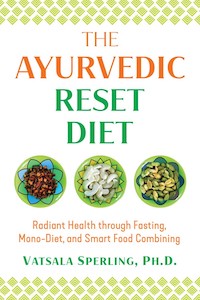
The Ayurvedic Reset Diet, by Vatsala Sperling, Ph.D.

The Ayurvedic Reset Diet: Radiant Health through Fasting, Mono-Diet, and Smart Food Combining, by Vatsala Sperling, Ph.D.
Healing Arts Press, 1644111307, 150 pages, January 2021

Ayurvedic – the word kept appearing to me in books and magazines. Curiosity finally got the best of me and I decided to delve into exactly what this thousands-of-years old system of what originated as medicine had to tell me. I decided to read The Ayurvedic Reset Diet: Radiant Healing through Fasting, Mono-Diet, and Smart Food Combining by Vatsala Spelring, Ph.D. to delve into my new diet adventure. Before beginning my journey, I wrote down what I thought an Ayurvedic diet would be like, and admittedly, though I wrote out what I thought of its benefits, my list of what it would taste like or how easy it would be to maintain came up short.

My list of positives: being mindful of food combining, talking to plants, eating unprocessed foods, giving thanks to the things I was about to consume, eating seasonally, eating raw. My list of negatives: I wouldn’t enjoy the diet, it would set me apart from how my family ate, I would be eating “weird” (aka non-familiar) food, the food wouldn’t be at all pleasurable akin to eating seasoned cardboard.

I found that this approach to food and eating had the ability to enact positive changes in my mind, body, and spirit. On a deep level I had known for years that eating seasonally, eating non-processed foods, eating raw foods, eating only when hungry, eating slowly – were all beneficial. I was glad to read that what I had been feeling for years was my body speaking to me – and leading me to a form of Ayurvedic eating without me labeling it as such. 

Sperling begins the book with an Introduction asking whether we view food as a friend or a foe. Do we view food as the enemy that allows us to put on weight? Do we view food as nourishing? Are we too busy counting calories that we neglect to give thanks? Are we eating mindlessly, or do we slow down and enjoy the food? Sperling states that Ayurveda is an “ancient system for understanding disease and health that considers food that is grown, cooked, and eating with reverence as both nutrition and medicine.”1 She then continues with the Ayurvedic concept that “we are and we become what we eat.”2

Next, Sperling introduces the reader to the five known “interconnected koshas, or sheaths, in the body, which include the annamaya kosha (physical body), the pranamaya kosha (vital life force), the manomaya kosha (mind), the vojnanamaya kosha (intellect), and the anandamaya kosha (the inner blissful self). The koshas are interrelated and affect each other. It is important to be mindful if we are eating to live or living to eat. If we are more mindful of what we are eating, why we are eating, and our relationship with the food, we can create positive effects on the five koshsas.”3 

Sperling also shares with readers three “simple steps in the time-tested Ayurvedic technique: fasting on water or water and herb teas to help flush out the system and rebalance gut bacteria, isolating food by eating only one type of food at a time to simplify digestion and allow the body to fully absorb all of the nutrients in a particular food (also known as mono-diet), and mixing foods from various food groups in a sensible way.”4

The book is divided into seven chapters, each laying out concepts in an easy to understand manner that delve into the above-referenced three steps. The challenge, at least for me, was a dedication to actually incorporating what I was reading into my daily life. The first three chapters focus on problems facing Mother Earth in how we eat and the negative impact of industry, food transportation, and food modification. Sperling brings to light soil depletion, the cruel treatment of animals to mass produce food, and the use of hormones. 

Chapter 1, “A Season for Everything”, touched on the importance of eating seasonally as did our ancestors. I’ve been trying to eat seasonally for many years, so this concept resonated with me. I try to eat what is grown locally, not shipped in from another continent. Our body needs food differently throughout the year – heavier eating in the winter (in the Northern Hemisphere), lighter in the summer. Root vegetables in winter, berries in summer. Check – I could handle this part of the Ayurvedic diet.

In Chapter 2, “The New Normal”, Loss of Seasonality and Quality in Modern Eating, Sperling writes about issues contributing to our eating outside of the season and our location including transportation of food, mass production of food, availability of non-seasonal food and even our propensity or eating out that often exposes the eater to modified food. Chapter 3, “Industrial Food Production”, focuses on how technology is being used to tame and modify nature and how what we eat affects the earth including the negative impact that the beef industry has on nature. 

The final three chapters hone in on the Ayurvedic diet beginning with the “reset” diet to reboot well-being. It’s been ingrained in us that we need to eat three square meals a day. For some of us, snacking is also a part of our eating habits. Sperling reminds the reader that this constant eating does not give our digestive system a chance to rest. Not only that, the non-stop eating usually means that we are also overloading our bodies with the “wrong” kind of food. She writes at length on the importance of eating foods that are “compatible” for digestion.

Food combining is also touched upon – eating more than one food group in a meal. In the Ayurvedic diet, one eats one particular food at a time in moderation as one’s body digests different foods differently. Chapter 5, “Preparing for the Ayurvedic Diet”, outlines practical actions to take as a prelude to beginning the diet such as clearing out the kitchen cabinets and re-stocking with recommended foods such as nuts, grains, and local, seasonal produce. Sperling includes recommendations for caffeine withdraw and the importance of proper hygiene and physical activity.

Chapter 6, “Eight-, Six-, and One-Week Protocols”, provides a step-by-step plan for the reader to begin the diet with whatever time frame seems most comfortable and doable. Finally, Chapter 7, “Daily Living”, concludes with encouragement and ways to sustain this way of living and being. 

Admittedly, I have not yet ventured into even a one-week protocol at this point, but I am taking the steps to clear my cabinets, be mindful of what I eat, when I eat, and even why I am eating. I’ve been feeling “polluted” lately and want to cleanse my body, my mind, and my spirit. The concepts of an Ayuvedic diet/lifestyle resonate with me. While I am not ready to fully embrace it, I will incorporate the concepts into my day. 

Sperling’s knowledge of the Ayurvedic diet is amazing. She was raised in this tradition as she grew up in India. She has a doctorate in microbiology and has conducted research with the World Health Organization. Impressive credentials, for sure, but what I most liked about Sperling was her writing style and her passion to impart this ancient way of being to others. I highly recommend The Ayurvedic Reset Diet, even if you’re not sure this is the right diet path. It is an eye-opener and life-changer in regard to how, why, and when we choose to eat.

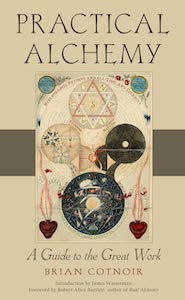
Practical Alchemy: A Guide to the Great Work, by Brian Cotnoir

Practical Alchemy: A Guide to the Great Work, by Brian Cotnoir
Weiser Books, 1578637473, 160 pages, July 2021

Alchemy has been beckoning to me for quite some time, yet it was hard to know where to get started exploring such a vast art with centuries of history. Where should I start? What essential things should I know about this work? How can I implement this into my daily life? These questions and more were all answered in Practical Alchemy: A Guide to the Great Work by Brian Cotnoir. In this extremely useful guidebook, Cotnoir does a wonderful job of contextualizing alchemy and providing a foundation one can start their journey from.

To begin, Cotnoir offers the motto of the Mutus Liber of 1677: “Ora, lege, lege, lege, release, labora et invenies. “Pray, read, read, read, reread, work, and you shall discover.””5 He reminds the reader that “alchemy is a living process and is always working with living substances.”6 It very much feels like this sentiment has been imbued into the book itself, which seems to have a potent energy to it, similar to that of a well-used grimoire.

This could be because the book is a compilation of so many different alchemist’s work along with pictures, tables, and illustrations of different cycles adding to the substance of the text. Practical Alchemy is definitely a good starting point for one’s own research for this reason. Cotnoir does a good job of showing how alchemy has evolved by looking at the different approaches to it over the centuries, and therefore, this range of various references does not feel generalized or superficial. If anything, it demonstrates an excellent weaving together of a huge body of knowledge to show it’s evolution through time.

What I most appreciate about Cotnoir’s writing is that it’s not cryptic, nor intended to conceal. As he describes, alchemy is filled with “ways[s] of concealing from fools the precious knowledge of transmutation.”7 While I certainly appreciate the lengths alchemists took to conceal this esoteric knowledge, it nevertheless makes it a daunting task to start putting together the different pieces of the puzzle. Cotnoir is such a kind mentor, describing how the information was obscured, such as in different texts or by switching the names of materials, and provides guidance on how to overcome these barriers when undertaking your own alchemical work.

Practical Alchemy is divided into two parts: “Theory” and “Practice”. The first section, “Theory,” covers topics such as the elements (and how their rotation is integral to alchemy), the Three Principles (Mercury, Sulphur, Salt), prima mater, alchemical cosmology (planetary spheres, fixed stars), alchemical timing (lunar months, planetary hours, ways to divide the year), interrelation of micro- and macrocosmic, and the inner work to achieve gnosis. The section concludes with the tabula smaragdina, or “The Emerald Tablet”, translated in both Latin and English.

I was happy to realize that being an astrologer already has prepared me for certain aspects of alchemy, such as planetary days and hours and lunar months, which I had never realized were components of an alchemical practice. I appreciated the historical information about how these aspects of alchemy blend together to be part of the greater cosmology. To be honest, it’s only recently I had the realization that I can break free from current cosmology, as in I can explore beyond the Big Bang theory.

With all the advances since medieval times, I sometimes think that former cosmologies are written off as primitive or no longer relevant, but I feel like shifting the paradigm to embrace an alchemical mindset about the world is an important part of getting started on this path. Cotnoir gently guides readers into expanding their perception by detailing how other alchemists came to understand the world in this way through time and provides a wonderful overview of alchemy’s foundation as a living body of knowledge.

The second part of the book, “Practice”, is where I started to feel simultaneously in over my head and astounded that there’s so much for me to learn. 

“Here we enter into the body of alchemy–the physical process. Nature must lead both in material and in method. Nature is your true book. Study it well.”8

In this section, Cotnoir delves into many ways to manipulate matter through rotating the elements, from calcination to dissolution and fermentation to sublimation. Up until now, I primarily have related to the spiritual dimensions of these techniques, but this section brought them to life in the material world for me. I began to notice the relationship between alchemy and chemistry and think about how I might go about doing some physical alchemical experimenting. Let’s just say, if you saw my holiday wish-list, you’d think I was setting up a small lab, which in many ways it seems like I will be in order to pursue alchemy on this level.

Cotnoir suggests starting with the basics: water, wine and vinegar, and Salt of Tartar. For each one, he provides detailed instructions about the process, including temperature needed and amount of time required for steps. From there, he describes how to distill water, wine (to make Spirit of Wine, followed by instructions on how to rectify this), and vinegar. For further work, Cotnoir describes the process of creating Archaeus of Water, Angel Water, and Spirit Wine of the Sages. He also includes directions to purify salts using calcification, crystallization, and sublimation.

One of my favorite chapters came next, “The Herbal Work”, in which Cotnoir details how the Three Principles can be obtained by plants through fermentation, distillation, and calcification. “The herbal work consists of separating the Principles, purifying them, and then recombing them.”9 The process of doing this is called spagyry. Cotnoir once again provides thorough instructions. This time he describes how to create spagyric tinctures, herbal Magistries, and spagyric Plant Stone. Furthermore, he provides background information on how to use these plant-based alchemical preparations as medicines and initiatory substances on one’s alchemical journey.

The rest of the book includes information on working alchemically with minerals, aurum potabile, the Opus Magnum, and a highly informative appendices. The appendices cover laboratory safety and equipment, more techniques (including information for making essential oils), and a long lists of plant correspondences for all seven planets. Cotnoir makes it very easy to find what one is looking for in the book, and the resources are so incredibly useful as reference. 

For those who do feel the tug to learn more about alchemy, I highly recommend following the calling to read this book. It’s a must-have for beginner alchemists, and I’m sure it would be enjoyed by someone who’s been alchemically experimenting for some too. The recipes alone make it worth adding to one’s book collection! I am eager to begin my journey into the physical side of alchemy, more assured than ever before from the information in this guidebook.

I believe Practical Alchemy will naturally draw readers ready for its information at the right time. And honestly, there’s no rush for the Great Work. It would be highly discouraged to start upon this work if one did not truly feel ready for what it may yield. Preparation is an important part of the alchemical process. Reading Practical Alchemy was a fantastic way to gain the preliminary information needed, as well as the confidence, to move forward on this path. Cotnoir has done a truly exemplary job of writing a useful, relevant guidebook packed with practical information.

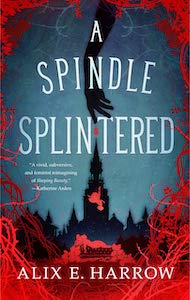
A Spindle Splintered, by Alix E. Harrow

A Spindle Splintered (Fractured Fables #0), by Alix E. Harrow
Tordotcom, 1250765358, 128 pages, October 2021

I was so enthralled with The Once and Future Witches by Alix. E Harrow that I decided to read her most recent book, A Spindle Spintered (Fractured Fables #0), over the weekend. Talk about a fairy tale for modern young women! Harrow has a knack for capturing the heart in her tales of romance, magic, and self-discovery.

Zinnia Gray expects to die shortly after her 21st birthday. She suffered the ill effect of lax corporate environmental regulations, which caused a group of children in her town to have incurable health issues. No one has made it past 21. Nevertheless, Zinnia lives by her “Dead Girl Rules”, one of which is to move fast, and pursues a study in folklore. Sleeping Beauty was alway her favorite fairy tale, ever since seeing a photograph of her emerging wide-eyed and alive after death-life trance. Despite her resignation to the reality of her situation, a part of Zinnia hoped to change her story and emerge from the curse of her illness.

On the night of Zinnia’s 21st birthday, her best friend, Charm, throws a surprise Sleeping Beauty party for her – spindle included! As per the traditional fairy tale, Charm encourages Zinnia to prick her finger just like Sleeping Beauty. What happens next is most unexpected!

Zinnia hops dimensions and is transported INTO the bedroom of Sleeping Beauty, called Primrose in this tale. Primrose has yet to prick her finger, as her father has burnt all the spindles, but the tug to fulfill the curse is still strong. Primrose is utterly miserable. From the curse that puppeteers her when she sleeps, beckoning her to succumb to a century of sleep and a life in the palace that narrows her options to marriage to a less than superb knight, there seems to be no escape. Zinnia’s unexpected arrival turns out to be her moment to help Primrose change her story – and that is just what they do!

I won’t go further than this, but the book is AMAZING. Zinnia has a really down-to-earth attitude that still seeks to believe in magic. And the portrayal of Primrose and her world was like reading a real fairy tale. Together, Zinnia and Primrose realize they are living out the same story, but they also have the power to change the narrative. I really liked this concept because I have studied the power of archetypes within the psyche, and I’ve learned the power of identifying the mythological/fairy tale story one is living out. For real change to occur, both individually and on a societal level, requires a change of narrative, and this is exactly what Harrow has given readers.

For instance, Charm is very into women and Zinnia is super open about her own sexual preferences, at one point saying she’s ¾ straight, but acknowledging there’s a piece of her that also finds women attractive. I enjoyed how the characters weren’t type-cast and it embraced the whole spectrum of personality. There’s a lot of blending, rather than fixed edges. From Charm and Zinnia’s friendship, colored with mutual attraction, to the ability for characters to merge with others living out their narrative and work together to change it.

And that’s what is cool about the tale: the bonds of women. While the typical “hero’s journey” is often an individual pursuit, this book portrays fairy tales as a teamwork effort. I think it’s more in-line with a feminine way of being; opening up, trusting, finding allies, and choosing to stick together until everyone is out of harm’s way. There’s an element of choosing to help another over helping oneself, but not in a self-sacrificing way. It is in the spirit of cooperation and seeing that one person as an individual can make a huge difference for someone else, and in doing so, overcomes their own obstacles.

A Splintered Spindle invites us to reconsider what a hero looks like and reimagine the fairy tale so that it’s not only a prince that saves us at the end. True love’s kiss, well that one is kept for the story, but in the spirit of female friendship. And ultimately, sure it’s a happy ending, but also a very heartwarming, honest ending. And I think those are the best kind in real life  because they are not fake. Sure, we can’t outrun reality, but we can always believe in the magic within ourselves.

I sincerely hope that Harrow keeps on writing these revised feminist stories of fairy tales, magic, and witchcraft. This one was short and sweet; I read it for only about 2 hours. I highly recommend it to women of all ages, but particularly young women, because I think it provides a new narrative to live out. For those of us who still hold dear to our fairy tale dreams, this book will be perfectly satisfying too. It’s a wonderful mixture of reality and magic, hope and despair, and the choices we make to forgo saving ourselves to help a friend.

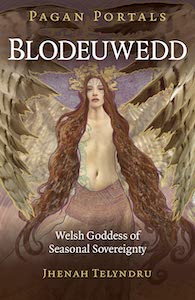
Pagan Portals – Blodeuwedd, by Jhenah Telyndru

Pagan Portals – Blodeuwedd, by Jhenah Telyndru
Moon Books, 1785352126, 134 pages, August 2021

Most faith-based belief systems have similarities ranging from deities and methods of worship and ritual to their myths and legends. In Pagan Portals – Blodeuwedd, Jhenah Telyndru takes us on a deep dive into who the Welsh goddess is, where she came from, and what she symbolizes. 

An in-depth researcher who leaves no stone unturned, Telyndru has masterfully taken an enormous amount of data and compiled it into healthy bites that present an interesting tale. Like most of the Celtic Britons, the Welsh people opted to share their stories through oral tradition, resulting in limited resources from which to pull when putting together a book such as this. Telyndru has woven a magical tale of a goddess whose origin story sounds a lot like that of Eve.

One of the reasons why I love exploring religious cultures and their deities is the thread of consistency that connects most, if not all, of the religions we see today. We are all familiar with the Christian tale of Eve: a woman created from the rib of Adam, the first man, and what she has come to represent. A similar thread appears in the Welsh goddess’ story as well.

In Blodeuwedd’s story, she is created to be the wife of Lleu, a man who is forbidden to marry a human woman due to trickery. Lleu and his father create Blodeuwedd out of oak, broom, and meadowsweet flowers and the two are married. Once married, Lleu is gifted lands by his father and the two settle down.

One day, Lleu decides to visit his father and leaves the estate under Blodeuwedd’s care. He leaves, and Blodeuwedd is informed that a lord from a neighboring kingdom is on her lands. He and his party had been hunting a stag and had followed the animal onto her lands. She extends the hospitality of her hall to him, as is the custom, and sparks fly. They spend a few nights together and they come up with a plan to spend the rest of eternity together. These things never turn out the way they are supposed to, and both Blodeuwedd and her lover are found and punished.

What’s interesting to me is the fact that Blodeuwedd was not given a choice, much like the Christian Eve. They were both created to serve a function, and once they discovered that there was more to life than their specific function, they were punished. This theme carries through into real life as well, with women bearing the brunt of man’s anger and suspicion throughout the ages. You needn’t look far back in time to see glimpses of this: it’s everywhere.

The book details the circumstances around the creation of Blodeuwedd and explains why her creation story was a bit tricky to accept. Telyndru explains:

“It is notable that we don’t see Blodeuwedd give consent to her marriage…Even if we assume she has given consent “off stage”… as a literal newborn, would Blodeuwedd have even possessed the understanding or capacity required to make such a choice?…she has no family to negotiate the terms of the marriage on her behalf. She has been created specifically for the purpose of being Lleu’s wife, since her creator is Gwydion, Lleu’s uncle, it is clear that his priority is to see his nephew wed…”6

Telyndru continues:

“…Blodeuwedd is married the same day she steps into this world… it is this very lack of consent which may have stood out to the contemporary medieval audience, leading them to consider that the marriage…may not have been proper or legal.”10

This is important because Blodeuwedd’s apparent adultery was not considered to have been that; according to their customs, her union with Gronw, the lord from the other kingdom, fulfilled very specific requirements involving three nights of consecutive sleeping together as a sort of elopement. Since her ‘marriage’ to Lleu did not have her consent, and therefore did not seem legal or proper, she couldn’t have committed adultery. What a fascinating twist! Despite all that though, it should come as no surprise that this story was meant as a cautionary tale to the medieval audience: “nothing good comes of women seeking to change their circumstances, especially when it goes against the status quo.”11

This book, while fascinating and wonderfully written, had parts that really upset me. I see echoes of this story everywhere I look, where women regularly sacrifice their own dreams in order to look after the home and support her partner. Personally, I am tired of the expectation that I should shelve my own aspirations in order to support my partner in achieving their goals. I didn’t even get into the sexual repression and how women’s sexual agency is an apparent threat as the whole thing just infuriates me. Not Telyndru’s fault or anything they have done, it’s the topics that this particular legend covers that just irks me.

Having said that, I think it’s vital that we read things such as this in order to see where these ideas come form and hopefully create new ones that are in alignment with current equality expectations. And honestly, the legend of Blodeuwedd doesn’t stop with the whole adultery thing. Becoming the Goddess of Sovereignty isn’t just about agency, it’s also about creating opportunities for those who would rule to prove themselves worthy of the task. As her legend evolved, Blodeuwedd morphs into a benevolent Goddess who was instrumental in creating an opportunity for Lleu and Gronw to achieve their destinies.

If you have even an inkling of an interest in this type of legend, you should pick Pagan Portals – Blodeuwedd. It infuriated me in parts and made me happy in others, and that’s really what I want in a book. Telyndru did a remarkable job in putting together a ton of information in an easy-to-understand way. Now if you’ll excuse me, there’s a patriarchy I have to topple.

A Visionary Guide to Lucid Dreaming, by Lee Adams

A Visionary Guide to Lucid Dreaming: Methods for Working with the Deep Dream State, by Lee Adams
Destiny Books, 1644112373, 192 pages, 2021

In his practical guidebook, A Visionary Guide to Lucid Dreaming: Methods for Working with the Deep Dream State, Lee Adams provides the reader with step-by-step information for lucid dreaming. A Visionary Guide to Lucid Dreaming is a compilation of “articles, blog posts and studies”12 Adams has done over the past two decades. He explains in the beginning of the book: “I am a dreamer and have been all my life.”13

With a bachelor’s degree in psychology, Lee Adams has practiced, researched and taught lucid dreaming for more than 20 years. He is currently pursuing a Ph.D. at Pacifica Graduate Institute. He hosts both the podcast Cosmic Echo and the dreamer community taileaters.com from his home base in Port Orchard, Washington.

My interest in this book can be traced to a six-week course that my husband took in lucid dreaming at a local yoga studio. Although he passed on his notes from the class, I was interested in more practical information. With Adams’ teachings, I began to understand more about lucid dreaming and what is possible with practice. In A Visionary Guide to Lucid Dreaming, Adams covers everything for your lucid dreaming journey from “What to Expect” to “Various States of Consciousness” to “Preparing to Dream.” It’s as if he takes you by the hand and invites you to accompany him on his private journey to lucid dream land!

Adams calls the higher areas of the unconscious “The Self” and shares his goal for the book: “to provide an “easy-to-follow path to help you build your lucid dreaming skills.”14 He promises to share not only “science and techniques” but also his own dreams and dream journal excerpts.15 He defines lucid dreaming as “the most basic definition being the act of dreaming while being aware that one is dreaming.”16 He suggests that the reader get in touch with your personal motivations for lucid dreaming. Under your “Why?” lies your reason, your intention and your focus for this practice. “Understanding your reasons for embarking on this journey will focus your path. Having a clear intention for your journey is another key to success.”17

One of the first topics Adams discusses is the importance of mindfulness and mindfulness meditation. Next, he discusses the importance of “getting quality rest” and tips on how to do this. Adams follows up with his list of “Daily Habits to Promote Sleep”, which includes being exhausted, exercise, diet, and supplements.18 A bedtime routine is discussed in the next section and Adams shares lots of tips. My favorite technique was “The Talk” and how he discusses the importance of actively engaging with your unconscious mind. He suggests that you either write down or say out loud the things bothering you. In this way, you can release those bothersome things and get to sleep. He also says audibly, “It’s time for bed” to signal to his unconscious mind that he is ready for sleep.

Adams also shares how dreams occur in both REM sleep and Non-REM sleep. He talks about dream memory and how to foster better dream recall, including information from some scientific studies and how some supplements may help. In his lucid dreaming process, Adams shares 7 steps, including “good sleep hygiene and intention setting.”19 We all dream, says Adams, and we remember parts of dreams and may forget some other parts. He has a great list of techniques from “Easy” to “Intermediate” to “Expert” to help you remember your dreams.

The information Adams shares on symbols and dream interpretation was the most interesting portion of the book to me. He talks about Carl Jung and Jung’s use of symbols and archetypes for dream interpretation. Later in the book, he shares ideas from Jung’s mentor Sigmund Freud and two other men, Medard Boss and Martin Heidegger.

If you begin to notice the symbols in your dreams and bring them into your waking life, you can learn even more about the dream symbolism and the messages from your unconscious. He gives an example of when he dreamed about a panda. He created a clay panda and placed it on his nightstand. Then, he had more dreams and came to learn about a man (who looked like a panda!) and began to ask the man about dreams and reality in his lucid dreams.

The whole idea of interacting with the symbols in your dreams is new to me. I was intrigued to try this in my dream life. I took a dream I had a few weeks ago and used an interpretation technique that Adams shared. A symbol that figured prominently was a car, in which I was a passenger and no one was driving. Using Adam’s technique, I sat with this image and recalled the dream “as if for the first time.” Then I listened to any intuitive hits I received about the dream. Finally, I considered how the dream relates to me personally.

I began to see how this dream represented how I feel like “I am not in the driver’s seat” in my career. That I am just riding along, going wherever the job takes me. I also was able to see some ideas about regaining control, asking for what I need at the office and making the most of the upcoming annual review period to request more support.

To make the book even more helpful, Adams has included a great Table of Contents, a complete index of terms and an exhaustive bibliography. Throughout the book, Adams shares various online forums and resources for the lucid dreaming student. All of these elements add to the overall promise of the book: to share the journey and documentation of his personal dream work.

Adams’ writing style is very conversational and entertaining in A Visionary Guide to Lucid Dreaming. He peppers his scientific data with personal examples and information from other authors, as well. He has definitely lived his material and it really shows in the pages of his book. I feel that this book is best for a serious lucid dreaming student. Someone who already has experience keeping a dream journal would really benefit from the techniques and tips Adams shares.

The Once and Future Witches, by Alix Harrow

The Once and Future Witches, by Alix E. Harrow
Redhook, 0316422045, 528 pages, October 2020

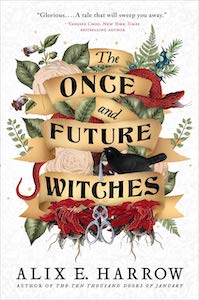
Embracing the season of the witch, my book club picked The Once and Future Witches by Alix E. Harrow for our October read, and I am in love! This is such an empowering tale of women finding their strength, courage, and magic to change the world. It’s a reminder of what happens when women from all walks of life embrace witchcraft and join together to raise hell!

At a whooping 528 pages, this book wasn’t just a rinse-and-repeat story with the typical exposition, rising action, climax, and resolution. There were so many twists and turns along the way, which made it a really lovely read to sink my teeth into. I knew this wasn’t a book I was going to tear through, and this opened me up to embracing all the characters that I’m sure will live on in my heart for quite some time.

This is a tale of the three Eastwood sisters, Agnes, Beatrice, and Juniper, who are reunited in New Salem under magical circumstances. Having all escaped the wrath of their abusive father, the girls are each making their own way in the world: Agnes as a mill girl, Beatrice as an assistant librarian, and Juniper as a good-intentioned suspected criminal on the run. As fate would have it, Beatrice chants secret hidden worlds that bring back the lost tower of Avalon, a place that was banished the last time it was called back by witches in Old Salem, leading to the great purge of witchcraft.

Suddenly, the sisters are brought back together, though not without their share of quarrels and hard-feelings between them. Juniper, who has taken up the cause of women’s suffrage, is set on using magic to further the rights of women. Bella, though hesitant to be drawn in, is obsessed with collecting witch-stories and tales. As witches know, all that is required is the will, the words, and the way. Together, the sisters use their strengths to create their own group of witches and start to wreak mayhem in the town.

Mayoral candid Gideon Hill is dead-set on capturing the witches and bringing them all to justice. There’s an oddity about him, and the shadows of the town seem to obey his will. However, this doesn’t stop these women from advocating for the ways of witchcraft to be brought back. And there’s just so many twists and turns, with a whole lot of love — both romantic and sisterly!

I won’t get too far into the plot, because as mentioned already, it’s a long book. But I will rave about it from the stance of a witch. It did a really good job of portraying witchcraft as inclusive, open to everyone regardless of their social status, ancestry, and even gender. The book is filled with spells, fables, and fairy tales – all with a witchy spin to them. It makes one proud to be a witch, and I wish more women could unite under common causes to protect one another.

The book also draws heavily upon the maiden, mother, crone archetype, as well as the united three-circle witch’s mark. There’s a mixture of academic witchcraft aka grimoires and arcane spellwork with witchcraft that is only spoken and passed down through oral traditions. I especially liked the focus on the Daughters of Tituba, which is an African-American group of witches that the Eastwood sisters become involved with.

Another aspect I liked was how magic was used for social justice. As many women in the book acknowledge, small spells are mostly for mundane things, such as whitening the laundry or keeping one’s hair in place, but as the women share their words and ways with each other, they discover that bigger change can happen through magic. I love reading about women working together, understanding each other’s plight, whether it be as a mother, abused daughter or wife, or part of the LGBTQ community .

There’s a strong acknowledgement of the desperation that often leads one to tap into magic in order to create a path where one was not before. This book isn’t about girls who “do the right thing”, it’s about the women who decide to claim their power in a world that refuses to give it to them. I felt very sovereign reading about these badass witches who didn’t back down and kept witchcraft alive even in the face of adversity. They didn’t adhere to stereotypes, but were happy to throw them in other’s face with their pointed hats and broom flying.

I highly, highly, highly recommend this book for anyone who’s into witch-fiction. Once and Future Witches one of the best books in this category I’ve ever read. There’s so much beauty, love, and magic interwoven in the pages; every reader’s heart will certainly swell, as their magic grows. This powerful read will remind you of what can happen when you choose a life of magic and decide to stand in solidarity with a community to achieve so much more than you ever could on your own. All the while, teaching the importance of healing old hurts, forgiving the past, and opening one’s heart to learn to love again. <3

The Tree Horoscope, by Daniela Christine Huber

The Tree Horoscope: Discover Your Birth-Tree and Personality Destiny, by Daniela Christine Huber
Earthdancer, 9781644113226, 144 pages, October 2021

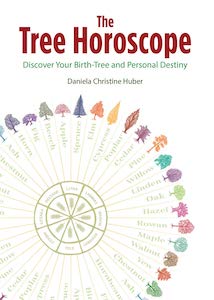
Did you know that everyone has a birth-tree based on the day they were born?  In The Tree Horoscope: Discover Your Birth-Tree and Personality Destiny, Daniela Christine Huber describes the 22 different archetypal trees that shape your personality and lifestyle. As someone who absolutely loves nature, especially trees, it has been a pleasure getting to know more about my signature tree horoscope. The best part is how Huber makes it easy to jump right in and get started!

The book starts out with an introduction to Celtic tree mythology and Daniela’s experience of working with these energies. Previously, I had learned the Celtic tree-months while reading A Spell in the Forest by Roselle Angwin, which covered the Ogham calendar and the 13-month wheel of the year in which tree-months were connected to lunar cycles. Huber has created horoscope profiles based on the archetypal Celtic tree energies. She reminds us that “Following the path of this connection with Nature with our hearts will lead us to the Source, the roots within us.”14

In Huber’s system, each Celtic tree appears twice in the cycle of the year, with the expectation of Oak, Birch, Olive, and Beech that have just one day assigned to them. Every birth-tree also is assigned an earth element (earth, water, fire, air, ether) and Huber offers a short description of the energy of each. She also discusses how connecting with the element of our birth-tree can help restore balance and fulfill emotional and psychological needs. She describes how “Our birth-tree is the guardian of our individual potential; it will always remind us of that fact and help us to become aware of our gifts and talents.”15

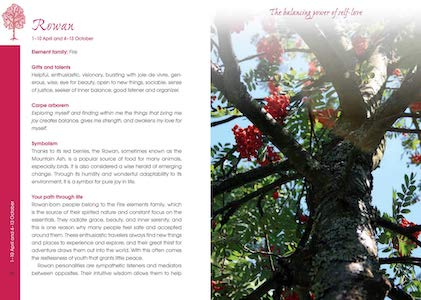
There’s an easy to follow chart in the front of the book that makes it easy to find one’s birth date and look up their birth-tree. Mine is Cedar of Lebanon, so I went right to that page first. Immediately I was struck by the beauty of the photograph featured. I think the pictures in this book are one of it’s best attributes. It’s one thing to read about the different trees, but to see photographs of them really helps with identification. I like having a visual when connecting with the energy of my birth-tree.

For every tree, there is information about the elemental family, gifts and talents of those with the tree energy, the tree’s mantra (called “Carpe arborem” by Huber), the tree’s symbolism, and the path of life for people born with this birth-tree. The path of life is the longest section of each horoscope. Then there is a general overview of the personality of people with the birth-tree, healing powers of the tree, birth-tree power, and inspiration for someone with the tree’s personality. It’s quite a bit of information packed into just a few pages!

I really resonated with my tree horoscope. It highlighted my personality pretty well. I especially liked learning more about the healing powers of my birth-tree, and I loved my carpe arborem:

“I am freedom of choice, the core from which the creative powers in my life can take effect. I free myself from the limitations of my understanding with humility and reinvent myself over and over again.”20

This was very affirming for me because I feel like I am constantly reinventing myself as I continue to learn and grow. Creativity is a big part of my life, and I felt the connection with the Cedar of Lebanon tree in this regard. To deepen this solidarity with my birth-tree, I decided to order Cedar incense that I can burn to remind myself of the special powers associated with this birth-tree: courage and self-confidence.

I have shared the tree horoscopes in this book with some friends and family. They too have all been delighted with the insight it’s given them. Another neat feature of the book is the birthday calendar in the back, where you can keep track of everyone’s birthday . It lists their birth-trees, as well as famous people also born with that particular birth-tree. I really like how easy it is to keep track of birthdays, while also learning more about the birth-trees and reflecting on how they reflect the energies of people in my life.

Earth energies, such as flower essences and herbal remedies have always been an important part of life. For years, I’ve focused on bridging heaven and earth by teaching how our energy is always reflected in both the natural world and celestial bodies. The Tree Horoscope does a beautiful job of demonstrating this idea by giving readers insight into who they are based on their corresponding birth tree. I absolutely love how the book fosters an ecocentric view of human’s relationship with trees, acknowledging how they influence our development.

All in all, this is a wonderful book for those hoping to learn more about their personality and discover how it is shaped by their birth-tree. I think The Tree Horoscope would make a great birthday gift, though it’s also useful to store birth dates of loved ones to make sure you never miss their special day. The beautiful photographs are a wonderful way to practice tree identification. While this is only a small snippet of the mythology of Celtic trees, the book is a good starting point for those who want to learn more about the different symbolisms and energies of these mighty connectors of heaven and earth. I’ve really loved reading this book and will definitely be referring back to it as the days of the year go by to see which tree energy is present.

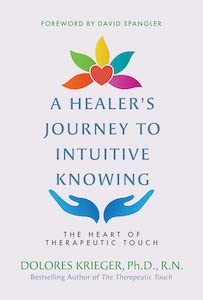
A Healer’s Journey to Intuitive Knowing, by Dolores Krieger, Ph.D.

A Healer’s Journey to Intuitive Knowing: The Heart of Therapeutic Touch, by Dolores Krieger, Ph.D., R.N.
Bear & Company Books, 1591433934, 156 pages, July 2021

In this book, which was published posthumously by Dolores Krieger’s estate, the primary goal is to explore how the healing modality of Therapeutic Touch utilizes the healer’s intuition and compassion to move energy and bring about healing. A Healer’s Journey to Intuitive Knowing: The Heart of Therapeutic Touch chronicled experiences by Krieger during her 50+ years as a nurse, instructor, and champion of hands on healing. She wrote this book before her death at the age of 97.

Krieger published several books in her lifetime and was co-founder with Dora Kunz of Therapeutic Touch. She met Kunz when she was a nurse and had just received her Ph.D. degree. (I found a number of articles about both of these women, as well as a man who began his journey by healing horses and then other animals with his hands. Later, he began to channel healing to children, and when he moved to Canada, he became part of a study with Kunz  and Krieger regarding hands on healing.)

As a Reiki Master myself, I was interested in learning more about hands on healing and the roles that intuition, intention and compassion play in the healing process. I was particularly interested in Krieger’s chronicle of the connection between the healer and the person being healed. Her philosophy shared that the person who is laying on hands is simply supporting the person to get in touch with their own ability to heal themselves. 

Including both case histories and information from scientific studies, Krieger showed how Therapeutic Touch (TT) taps into what she calls the “Inner Self” of the healer. TT has been taught in over 80 universities and over 90 countries around the world. Krieger explained the process as: 

“Ancient healing practices that are incorporated into the TT process include the laying on of hands, deep visualization, touch with and without physical contact, sustained centering of the TT therapist’s consciousness, the therapist’s knowledgeable use of certain of her chakras, and the intentional therapeutic use of breath and touch. Prime is the centering of the healer’s consciousness; throughout the TT interaction she remains in the state of ‘sustained centering.’ This becomes the background of the process, as she includes other practices that are appropriate to the condition of each individual seeking healing.”21

Next, she discussed the role of “compassion as power.”22 She saw compassion as “the catalyst or tiny chemical reaction that lights the benevolent intention to help or heal.”23 I’ve read quite a few books on hands on healing and never have I read about the role of compassion. This book gave me a greater understanding of how healing energy works and how I can fine tune my own energy and my energy centers to allow more healing energy to flow through me. 

In discussing the role of the “Inner Self,” which Krieger named “Issie”, she explained that in her view, the Inner Self is “essentially the soul-the spiritual or innermost part of an individual’s being.”24 By doing the grounding, centering and tapping into the essence of oneself, the healer grows and transforms herself along with the healing journeys of her patients. As I read the book and engaged with the steps for healing sessions that she described, I began to use what I was learning to create a different style of healing session for my loved ones and friends.

As I did a healing session for my husband one evening, I was more aware than ever before of my ability to allow the healing energy to flow through me and also became aware of “seeing” the blockage of energy near his large intestine. As I continued to allow the energy to flow, I could see him visibly relax and later he would report a lessening of the pain he had felt and some sense of relief from his diverticulitis. 

Krieger’s writing style is a great combination of scientific paper and compassionate healer notes. I love how she shared 18 in-person healing sessions, complete with her initial thoughts as she approached the person through the assessment and then the “rebalance.”25 While the notes were clear and complete, there is an underlying sense of the compassion she felt for every patient. This came shining through each case study. Later in the book, Krieger also highlighted case notes from distance healing sessions. I especially enjoyed this section, since a lot of my own healing practice happens through long-distance healing requests.

This book is a true compendium on TT and she shared not only a bibliography, but also a glossary, a list of TT resources and an index.  The index is particularly helpful in referring to key ideas in the book. Toward the end of the book, Krieger shared a poem that she wrote “On the Possible Magic of Healing.”  I’ll share a portion of it here, because it is so beautiful and captured the heart of TT:

“Healing is a window into a natural magic.
There it is,
a lump of wounded flesh,
and then touch,
Therapeutic Touch . . .

ABRACADABRAH!

Unseen clouds
Of inert biochemical molecules
Are drawn
In an uncanny manner
To the site of the wound
Quietly
Sorting themselves out en route
To match
The needs of the damaged tissues.”26

As a final note from Krieger, here is a quote on energy:  

“The prime characteristics of energy are that it flows or is continuous as it moves through space, that its flow has a coherence or rhythm, and that it has the capacity to do work.  Its flow has been described on a continuum from slow to fast, strong to weak, unimpeded to congested, tenuous to thick, or quiet to tumultuous, depending upon the situation.  Its rhythm has been characterized as steady or irregular, in harmony or unharmonious, in sync or disorganized.”27 

A Healer’s Journey to Intuitive Knowing would be great for any student of hands on healing, from the new Reiki student to the master of cranial sacral healing to the experienced massage therapist.  Anyone who would like to take their healing practice to a new level will benefit from reading this book. This book will not only improve your abilities to channel healing energies, it will also contribute to your own spiritual growth and transformation.

Sit Down to Rise Up, by Shelly Tygielski

Sit Down to Rise Up: How Radical Self-Care Can Change the World, by Shelly Tygielski
New World Library, 1608687449, 256 pages, October 2021

Self-care is all the rage right now, but how often does it extend outwardly to encompass a community? Sit Down to Rise Up: How Radical Self-Care Can Change the World by Shelly Tygielski is a beautiful reminder of what can happen when honoring the need for mutual support and community as part of our self-care practice. This isn’t a “Ms. Independent” tale of how self-care is synonymous with “me-first”; it’s a potent story of struggling to make one’s way through life amid challenge and still choosing to show up each and every day for yourself and the people who count on you.

Through this book, Tygielski candidly recalls stories of her past, even some of her family’s tales too, as she guides readers to rediscover meaning in their life, overcome limiting mindsets, and build encompassing communities that redefine the structures of society. She starts off by reminding readers of their own agency, which she likens to free will. In the section “Forget the Guru, Find the Yuru” (which I loved!) she writes:

“We all spend a lifetime climbing the proverbial mountain with an expectation that we’ll find a wise person at the top who will tell us the meaning of life. This person doesn’t exist, I promise. The ability to thrive, love, be happy, and fulfill all comes from within. Every single bit of it. It comes from the realization that we have been bestowed with the gift of agency to choose how and when to cultivate it in ourselves.”22

Once the reader has been reminded of the importance of them actively participating in their journey, Tygielski moves through a whole range of heartfelt wisdom she’s cultivated in life, channeling through her relatable stories of how she built this practice for herself. I for one always love hearing someone else’s story; it gives me motivation and affirmation that if they can do it, I can do it. Chapters include “Good is Good Enough”, “Not Broken”, “Familiarization”, “Sustainable Self-Care”, and more.

I will delve into each a bit more, but I wanted to mention how much I like Tygielski’s style. Tygielski has a way of writing about her experience without making it feel like this book is a tout of her success. It’s almost as though a close friend is having a heart to heart with you about all they’ve gone through recently, revealing their own vulnerabilities, fears, and doubts, as well as how they mustered the strength to keep going.

For instance, Tygielski writes about “deconstructing” ourselves to learn more about the narratives shaping our lives (many of which aren’t the healthiest and deserve some care from us) and then “reconstructing” ourselves in more realistic ways that allow for self-acceptance, grace with our mistakes, and affirmation that we are enough.

I tried this practice myself, after a few months of feeling woefully inadequate and caught up in a comparison-game with others, and found it to be very relieving. It helped me to see what stories I was telling myself and then actively reshape them into a more accurate and honest perspective, bolstered with a dose of “good enough” and self-love.

One of Tygielski’s defining moments in her life is finding out she has uveitis, which is an inflammatory disease of the eye, when she woke up blind one morning! I honestly can’t even imagine how scary this would be for her. She described the sensation, as well as how she had to get her toddler son ready for school without her sight, trying to remain calm until a friend could take her to the hospital.

Since it’s the leading cause of what makes people under 40 go blind and she’d require treatment the rest of her life, being diagnosed with this was a huge shift in her life. Naturally, she spun down a rabbit-hole of fear, but she made a decision to lean into her emotions, rather than try to suppress or deny them, inviting the reader to also stop masking their own pain and find happiness that isn’t based on the condition that things are all good. Tygielski writes, “I came to recognize that by changing my perception of these problems, or if I saw even the worst experience in a different light, I experienced them all differently. I felt set free.”23

It was at this point in her journey that Tygielski began examining her Jewish faith, taking up meditation, and learning more about the path of Buddhism. She describes racing thoughts and the challenges of starting this practice. However, by breaking things into small chunks, she was able to move forward with her goal of practicing self-care.

One of my favorite things Tygielski did was creating “chunks” in her to-do list (which she shares an image of!) that breaks things down into categories. I started doing this with my own to-do this and have found the organization of it to be both practical and pleasing. So, the book has not only meaningful inspiration, but also real examples that can be practiced in one’s life to cultivate this foundation.

Tygielski realized this path to change wasn’t going to happen overnight, yet her dedication to working towards getting to the root of her negative thinking, make changes in her life, and develop self-care practices never waivered. Through trial and error, she was able to find a self-care practice that works for her. And while she suggests times to include self-care, such as when transitioning from one thing to another during the day, her message encourages readers to find self-care practices and routines that fit their own lifestyle.

She also reflects on the importance of authentic self-care, as well as how it has been misconstrued in society “by corporations to create a very profitable industrial wellness complex, one that focuses on beauty, happiness, and comfort in the name of self-love and self-compassion.”25 YES! I am really glad she pointed that out, while also explaining how self-care is a key component to making the world a better place through participatory transformation.

What I like most about Sit Down to Rise Up is how Tygielski brings it outward to her community. During the pandemic, she created a grassroots mutual aid organization called Pandemic of Love. She explores the importance of mutual aid, which once was the center of community-life, but has recently disappeared in our modern culture.

Reviving this solidarity and calling upon the strength of one’s village is a self-care practice in itself, one that has a power to change the very fabric of society as people choose to offer love, kindness, generosity, and support, even to those who seem very unlike themselves. Tygielski’s organization has grown exponentially, and I’m glad because she has her priorities straight and an agenda that is truly devoted to service.

“The success and growth of Pandemic of Love proved that mutual aid goes beyond charity by mobilizing humans on behalf of humanity. It provides us with a powerful vision of the type of alternative society that is possible, one where we can be a global community connected by cooperative compassion and where we are no longer consumers in endless capitalist competition.”28

I am all on board with this call to practice self-care on behalf of not only oneself, but the entire world, so perfectly framed by Tygielski. If this message speaks to you, if you’re ready to change the world by going through the effort of changing yourself first, then Sit Down to Rise Up is definitely a must-read. It’s inspiring, empowering, and liberating to one’s spirit. As we change ourselves, the world around us changes too. By caring for ourselves, we learn how to create communities that care for others as well. I’m thrilled to see Tygielski’s community thriving — its success definitely points to what the heart of society is longing for right now.