✨ A Gathering Place for Magical Readers and Writers ✨

Tag Archives: book review

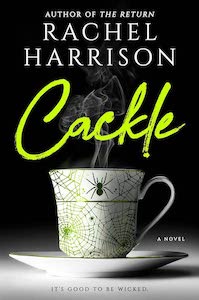
Cackle, by Rachel Harrison

Cackle, by Rachel Harrison
Berkley Publishing Group, 0593202023, 304 pages, October 2021

I was in a mood yesterday, but a quick trip to the library always changes that. Cackle by Rachel Patterson had arrived for me. As soon as I got home, I dove in. Once I started, I couldn’t put the book down, and I finished by the early evening. This book was just the reminder I needed of how empowering it can be to fully utilize my own magic and not shy away from power.

The basic premise of the book is the main character, Annie, is going through a break-up with her beau of a decade. It’s rough and she’s truly on the struggling bus trying to cope, drinking too much and feeling very despairing about her singledom. Since she can no longer afford New York City rent, she takes a job in upstate and moves to a small town named Rowan. Immediately, she loves the charm and small-town feel of Rowan.

Her impromptu meeting of Sophie, the most well-known woman in town, helps her to establish herself in Rowan. But there’s something odd about the way the townsfolk treat Sophie. Annie chalks it up to a mixture of reverence and fear, but Sophie is so doting towards her, she enjoys the company regardless. Annie is one of those people that seeks validation from others and prefers company over being alone.

When she’s not putting herself down, she’s usually crying over her ex-boyfriend Sam. Honestly, at times her depressed, self-depreciation did seem a little old at times, but I think it had its place within the overall context of the novel. And Annie is at least funny, so at times her distorted self-image is a nice comic relief. If we’re honest, many of us have gone through what Annie is experiencing, feeling lost, confused, and unsure of ourselves and the path forward.

Despite all of the emotional turmoil in her life, Annie quickly becomes best friends with the mysterious Sophie, who happens to live in a giant, haunted house in the middle of the woods. Sophie loves sweets, often baking for Annie, and Britney Spears. She’s caring, wise, and just a little intimidating with her subtle jokes of eating hearts and all-black wardrobe. But Sophie looks out for Annie, taking her under her wing, and even curses those who are unkind to her.

Sophie also has the ability to control spiders, so this book will definitely make you see arachnids in a new light. Just an FYI, in case you’re not a spider person! I for one loved all of it and just can’t stop imagining having a cute spider pet now.

As Annie’s relationship develops, she discovers new parts of herself. While she still pines over her ex, just like many modern women who had dreams of a marriage and family, she also starts to realize she has her own power. Power to indeed cause harm to those who bother her, as well as making objects float to her. As if this all isn’t enough to contend with, Annie realizes there are those in town who do not trust Sophie. She must decide for herself if her new bestie is honest and trustworthy, as some townsfolk say otherwise.

Like I said, I read this book quickly, and that’s mostly because it’s one of those chick-lit fiction books, which I have to say I love. Annie has a typical “basic” girl attitude and through surrender is able to discover a whole new power within her. The term “witchcraft” is barely used, as Sophie doesn’t like the stigma associated with it.

In reality, she’s nothing more than a woman who truly owns her desires, doesn’t settle, and is content to be fully in her own power. She’s unafraid to stand up for herself to those who seek to hurt her and finds no reason to shrink herself to please others or make them more comfortable. As Annie learns to do the same, she realizes there might be no turning back.

The revolution of women deciding they want to claim their happiness and be powerful, whether it intimidates others or not is the most potent magic. And Harrison has captured this journey perfectly in Cackle.

Another aspect of the book I really liked is that Sophie and Annie enjoy playing dress-up, dancing, baking or getting drunk together, and simply spending quality time with each other. Cackle celebrates modern-day female friendship, not through bonds of solidarity, but through simple care, nurturance, and honesty.

Sophie is a friend who knows when Annie needs psychedelic mushrooms, whiskey, or simply hot tea. She also doesn’t mince her words and is quite openly against Annie’s pining over Sam, making her new clothes and even cutting her hair. Cackle portrays all the small ways female friends support each other that make all the difference. While it might be hard to see how one is changing post-break-up, with the support of Sophie, Annie emerges a new person. At its heart, this story has a strong theme of friendship, women’s empowerment, and a sprinkle of magic!

The final thing I’ll note that I enjoyed is how magic was not portrayed as malevolent or benevolent. Sophie openly feels comfortable using her power to curse, choke, and probably even kill those who seek to do her wrong. Soon, Annie is learning how to do the same thing. I liked that Cackle wasn’t afraid to show women standing up for themselves and that the full range of supernatural powers was acknowledged without judgement. Sure, at first Annie was a bit taken aback by what she could do, but in time, she learned to wield it wisely.

I think it’s important to know how to both manifest your desires and use your energy to keep that which seeks to harm you at bay. Inevitably, there will always be something a little bit scary about a woman who is fully in control of herself and willing to own this power. It’s the classic witch motif that has caused men to shiver for centuries, but is that a reason to stay small?

Us modern-women of the 21st century think not! And for those of us who need a little self-esteem boost, or a reminder that we can choose who we give our energy to and rewrite our story at any time, Cackle is the book for us! Harrison has done a marvelous job of mixing modernity and magic to inspire us to believe the two can co-exist, even if only in fictional tales that inspire us not to seek our happily ever after, but the true witch within.

Mediumship, by Kerrie Erwin

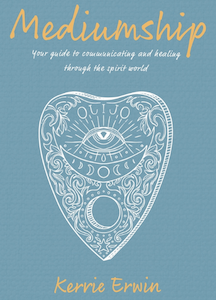
Mediumship: Your Guide to Connect, Communicate and Heal Through the Spirit World, by Kerrie Erwin
Rockpool Publishing, 978- 1925924985, 160 pages, June 2021

“Mediumship is the practice of mediating communication between living humans and the spirits of the dead. It has been documented from early human history, gaining its popularity during the nineteenth century when Ouija boards were used by the upper classes as a source of entertainment. Natural mediums are born with the gift, although they may not become aware of it until later in life. Every person who walks this path has their own individual gift to offer. Once you embrace mediumship as your life purpose it becomes an enormous responsibility, as you are helping people to cope with their grief. Despite the highs and lows it is very rewarding.”1

Author Kerrie Erwin is an Internationally recognized medium whose work includes spirit rescue and connecting loved ones to those who have passed. There is often a distinct difference in being able to impart the body of what gifts the individual may have in a live setting versus being able to translate that information and teaching into book form. In the case of this title, Mediumship: Your Guide to Connect, Communicate and Heal Through the Spirit World, I would say that Erwin has done a wonderful job of bridging that disparity.  

Although this may seem like an aside and irrelevant, I am going to comment on the visual appeal of the book. We, as humans, are very visually driven, storing memories and feelings from the catalogue of what we have seen and then experienced as a result. This book is a soft powder blue paperback with a lovely piece of cover art depicting a white outlined pseudo Ouija pointer centered between gold text for title and author.

Upon opening the book, the reader is greeted by blue line drawings of eyes in various states of gaze and opening and scattered throughout are assorted blue lined drawings representing certain aspects of the content included in a particular chapter or paragraph. The attention that went into the design of the book itself immediately engages the reader in a gentle “pulling in closer” manner to subject matter that may be frightening or fraught with skepticism.

Mediumship is separated into thirteen chapters, each providing the reader with multiple aspects of consideration when exploring the role of the medium and finding your own style of communication. The Introduction offers a look at Erwin’s life as a medium and how the work came to be. She describes being called by the spirits at a very young age and how a near-death experience in her twenties allowed her first hand experience of the spirit world. Her descriptions are comforting and are filled with hope and joy at reuniting with those within your “soul group” who have passed before you. 

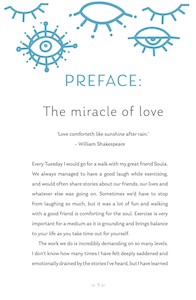
As part of the Introduction, Erwin also speaks of love and its power to act as a point of connection between the living and the departed. This is the connection achieved, as the medium becomes the conduit of that eternal connection…

“Love is the most powerful emotion in the world as its energy in its higher form, can create healing, miracles and magic in our world. When a loved one dies there is no ending but rather a new beginning, a journey back to the spirit world as spirit lives on, connected to us eternally.”2

Chapters 1-3 provide the reader with the basics of what mediumship is and how it may be defined. It was very interesting to have a definition of the types of mediumship, ranging from channeling and transfiguration. Then there is a concluding section on working with the police. 

“Chapter 4: Suicide: A Difficult Subject” was a much needed inclusion in the book for understanding another aspect of the work of mediumship, albeit one that is shied away from publicly….

To lose someone from suicide is incredibly painful, as you never understand why they took their own life and wonder if there was anything you could have done to prevent it.3

Some very thought-filled questions Erwin poses and answers are:

  • If you kill yourself are you punished and sent to hell?
  • Is it harder to make contact with a spirit who has committed suicide?
  • Do people really mean to kill themselves?

Additionally, there is a checklist of signs others can look for in individuals who may be inclined towards suicide and a listing of Australian help lines and agencies that can be called upon for help. 

“Chapter 7: Protection From Negative Energy” provides a reminder of the need to learn protection techniques and the attention that should be given to exactly what and where the spirits you may encounter are coming from:

“One of the first things I learned when I was developing as a medium was the power of protection and how to utilize it, which is mandatory in my profession. There are many different spirits and energies or different vibrations out there that are not always from the light.”4. 

As Erwin states, not all spirits have the best interest of their living connections in mind. Some can be tricksters and others downright baneful in their intentions. Psychic attack is included as a topic and the author also provides exercises in awareness and protection that are useful for those living energetic predators as well as those from the spirit realms. 

“Chapters 9: Meditation” and “Chapter 10: The Chakra System of Mediumship: Your Guide to Connect, Communicate and Heal Through the Spirit World” provide techniques for opening psychic awareness and self reflection through contemplative practice as well as the energetic anatomy that works collaboratively within the individual as the skills of mediumship are developed. Erwin makes use of nine chakra centers, beginning with the Earth Chakra and moving through the Transpersonal Chakra above the crown chakra at the top of the head. Each chakra is defined by its purpose, color and etheric location and the chapter concludes with a visualization exercise for Empowering with the Middle Pillar (another name given to the line of chakras along the etheric central column):

“The nine chakras are the energy centres in your body through which energy flows; they ground and protect you. Blocked energy in your centres can often lead to illness or dis-ease and can be projected onto your clients, so it is important to understand what each chakra represents and what you can do to keep this energy flowing.”5

“Chapter 11: Psychic Links” explores the tools of mediumship used to hone the skills of inner sight and continually build upon your abilities. Topics include flower readings, jewelry readings, pendulums, and Ouija boards to name a few.  Specific exercises to try out these tools are included, as well and provide the reader with a variety of experiences. 

I really enjoyed “Chapter 12: My Spirit Team”. Erwin talks about those guides she has for her work and I found this to enable a point of resonance between the reader and the material presented in giving a very concrete example of how these guides out-picture and what aid they offer.

“Chapter 13: Ethics for the Professional Medium” offers a lengthy and very concise list of the ethical considerations in acting as a medium for another. There is also a listing of what the client can expect from the medium. Again, very useful to ensure that if you choose to work with a medium you are placing your vulnerability and emotions in their care and keeping.  

Erwin sees life as a contract of experiences to be learned from and resolved. And, the compelling reason to seek out the expertise of a medium or to develop your own skills in connecting with those who have been part of your contract is that of healing and being able to move on to the next lifetime. She sums it up nicely in “The Afterthought”:

“I have tried many types of healing, and the most powerful would have to be simple forgiveness on every level. You don’t have to actually like the person, but once you have forgiven them you release yourself from the contract, cutting the energy connection that is no longer needed, learning the lesson and mobbing on to a life of love without fear.”6

Mediumship is a very user-friendly read that demystifies what mediumship is and the healing that can occur from those gifts being used with integrity and loving intention. I also found it a timely read given how many souls have passed over from COVID-19 and other horrific events. As I stated previously, there is definitely a message of hope and the comfort of knowing that physical death is just another state of Being.

Exploring the Divine Library, by Richard Rowe

Exploring the Divine Library, by Richard Rowe
Ozark Mountain Publishing, 9781940265803, 240 pages, March 2021

Exploring the Divine Library by Richard Rowe is a continuation of the journey outlined in his first book, Imagining the Unimaginable: A System’s Engineer’s Journey into the Afterlife, detailing his personal spiritual journey after having a near-death experience as a result of a blood clot in 2004. This experience set Rowe on a quest to deeply analyze and question death, suffering, and how people’s lives often play out in unfair ways. Finding success in a very methodical and analytical style of questioning, the questions became bigger and deeper in their intention and Exploring the Divine Library was written.

Rowe uses a unique format based on personal experience, trial, and methodical reasoning, which sets it apart from the standard fare of books focused on this subject matter. This is not surprising given that his perspective comes from a strong scientific foundation as an inventor with degrees in Avionics Systems Technology and Computer Science, along with an MBA from Florida Institute of Technology. The result is a purpose-filled fusion of spirituality, research, and science that informs the contents of Exploring the Divine Library.

This book is separated into twenty chapters, six appendices, a robust six pages of references, as well as an additional listing of references by chapter. The Introduction provides the reader with clarity of reference as to how Rowe defines the term “Divine Library” and the alternate nomenclature used:

“From ancient times to the present day, many names have been used to refer to information existing somewhere beyond our three-dimensional universe. These names include Akashic Field, Heavenly Library, the Book of Life, Hall of Two Truths, Library of Light, Cosmic Mind, the Matrix, Universal Library, Collective Subconscious, Holographic Library, and others.”7

The entirety of the book is founded upon questioning, researching, experimenting, experiencing, and finally drawing your own conclusions. Exploring the Divine Library reads much like a technical manual and may feel less mystical in its offerings. It is complete with sketches that also bring to mind lab experiment journals. The intention however is clearly one of analysis and organization that leaves room for both skepticism and belief.

“The focus of my exploration continues to be driven by questions that deeply resonate with me. I research a variety of first hand experiences and my own experiences to search for insights. This process is very similar to the approach I have used throughout my career as an inventor to invent, describe, and document systems systematically.”8

“Chapter 2: The Divine Library” lays the groundwork for deepening the readers understanding of what its purpose and nature is. Rowe uses his own findings as well as those who have used hypnotherapy and past-life regression with clients who have reported similar settings and attributes of a storage center (“a multidimensional spiritual data cloud”9) that records all human experience, words, thoughts, actions and the workings of consciousness.

Chapters 3 – 7 take the reader on a journey through the mechanics of the Divine Library. Rowe gives attention to structure, access and the effects of patterns and life cycles on the information stored not only for the personal, but on a collective webbing as well.

Chapters 8 – 13 explore the underpinnings of exploring the purpose and interconnections between the individual and the information contained within the Divine Library. Rowe takes the reader through the processes of formulating the questions, intention, problem solving, and connecting through meditation and prayer.

“Chapter 12: Life Purpose” explores the quintessential question of all humans at some point of their existence: what is my purpose? Rowe explains the importance of asking that and other “big questions” as part of the life experience. The reader learns the value of this movement through life by questioning, and its value when applying this same approach to accessing and co-creating within the Divine Library.

“A significant life event can be the perfect opportunity to ask big questions and evaluate life… Whatever the scenario, asking what is my purpose usually comes along with waves of emotion, confusion, and an off-balance feeling…”.10

Chapters 14-19 provide the reader with practical application of what has been revealed through personal research and analysis of the function of the Divine Library. How to access the records and the interconnectedness of all energetic beings is discussed, as well as ways to exercise manifesting the energy needed and expand the boundaries of individual consciousness to reach into the Divine Library’s resources.

Finally, “Chapter 20: Lessons Learned” is a summary of what Rowe (and perhaps the reader) experienced in his explorations of the Divine Library. I think this was a necessary way to conclude the book and doing so left no loose ends for the reader to try to interpret.

This book is not, by any means, an intuitive or easy read. It is user-friendly only if you have a curious and methodical mind that enjoys the minutia of dissecting whatever your focus is applied towards. That being said, I think it is a necessary and well-founded approach since the goal for the reader is one to know more about his/her/their self and the ultimate purpose of this particular lifetime. If you are willing to put in the work and pay attention to the details, you will find that the gifts of outcome are well worth the time spent in dissecting and analyzing. Exploring the Divine Library provides the access card to enter into the universal data of the Divine Library.

Spellbreaker, by Charlie N. Holmberg

Spellbreaker (Spellbreaker, 1), by Charlie N. Holmberg
47North, 1542020093, 303 pages, November 2020

I will admit, I love 19th-century period pieces about magic. Therefore, it was no surprise I picked up Spellbreaker by Charlie N. Holmberg to read this weekend, as it is set in England in 1885. However, England is quite a different society with magic making the world run smoothly, but also contributing to societal class divide. Therefore, Elsie Camden doesn’t feel bad about using her spellbreaking powers to knock the English nobility down a few notches to help out the common folk.

The world Holmberg writes about is filled with mystery, intrigue, and most of all spells to make the world go around. All magic users and spellbreakers must be licensed by governing bodies, and the spells are kept closely guarded, only passed down to those who prove they can be trusted with the power. The whole process of how magicians level up their magic and incorporate spells is absolutely fascinating! It involves these drops of magic which glisten and then are absorbed by the aspector’s skin, permanently making the spell a piece of them. When an aspector dies, a magnum opus of their spells is left behind.

The interesting thing about these magnum opuses is that anyone can use the spells in them once by tearing the page out. Therefore, these books are often handed down to other aspectors or guarded by the magical governing bodies. Recently though, there’s been a string of murders of master aspectors involving stolen magnum opuses. The tension is high as no one can figure out who is behind the ghastly crime of murdering magicians for their spells.

Elsie Camden finds herself smack dab in the middle of the action. Day to day, she works as an assistant to a stone mason, but she also does secret work as a rogue spellbreaker. After being orphaned as a child, Elsie was left to fend for herself in the world. As a fire burns down her workhouse, leaving her to wonder what’s next for her, she is approached by a woman who realizes what she truly is: a spellbreaker.

From this point on, Elsie spell breaks for who she calls the Cowls, though she’s truly never known exactly who these people truly are. She enjoys feeling needed by them and also views herself as a modern Robinhood, stealing from the rich to give to the poor. Since she’s not registered as a spellbreaker, she’s in both an advantageous and dangerous position for doing this discrete work.

On an assignment gone wrong, Elsie winds up getting caught by Bacchus Kelsey, a man dedicated to earning his aspector mastership. Bacchus is an aristocrat, but he’s different from the others since he’s from Barbados and not of usual English breed. Rather than turn Elsie in, Bacchus decides to capitalize on Elsie’s spellbreaking abilities, as there’s some things about the Duke of Kent’s estate, where he’s staying while in England, that he’d like to refurbished. It’s easier for Bacchus to apply new spellwork once the the spells currently there are removed, thus begins Elsie’s indentured work to pay off the asking price for his silence.

That’s all I will give away for the plot summary, but this is only the beginning of a very neat story. I more want to focus on how this is one of the best magical stories I’ve read in a while. What I liked most about it was Holmberg’s skill at world building. I felt very immersed in this version of 19th century England, which blended the historical cultural values of the time perfectly interwoven with this dimension of magic added into it.

From the different types of magic described to how the process of spellcasting worked, Holmberg really adds the details to make it extremely easy to get lost in without feeling too fanciful. I was surprised to see the book is actually classified as science-fiction rather than fantasy, but this being said, it’s a wonderful mixture of both genres in my opinion. I would perhaps label it science-fantasy, though it’s much more focused on magic than any science or technology.

I also found the character immensely relatable. Elsie is funny, honest, and has a good head on her shoulders. While she loves her readers, she avoids gossip and focuses on her work. She has a sense of identity, which I think is one of the most important things for me in a character. And the other main character, Bacchus, likewise has depth, intelligence, and general relatability. Though they come from different worlds, they are both outsiders in some sense who have their own views of how things are in the world. It’s quite exciting to see what happens when a spellmaker and spellbreaker team up together!

And I just have to say how unique the concept of a spellbreaker was to me! In fact, I couldn’t stop thinking about the application of spellbreaking in magical works and did a deep dive in reflecting about the role spellbreaking has in my own magical practice. In fact, it was quite a revelation to realize all the ways I identified with the main character Elsie. After just discussing how fictional works can inform one’s magical practice, I experienced it first hand in reading this book. I now plan on labeling myself as a spellbreaker and seeing how this evolves my perception of the type of magical practitioner that I am.

I also found it refreshing to read a magical fiction book that still had a woman lead that wasn’t focused on witchcraft. I liked Elsie’s ability to break spells, and furthermore how she didn’t rely on magic. In fact, she often broke spells that were cast upon her, preferring to have clarity without magical influence. She clearly understood how magic could be used for both benevolent and malevolent purposes, and she did her part to ensure it was used for the latter. She wasn’t enamored with it, nor seeking fame and glory for herself. She used her abilities for a greater cause with intention, and otherwise primarily kept to herself and focused on her mundane tasks without complaint. I like her very much as a role model.

Overall, Spellbreaker was captivating. It ended on such a cliff-hanger that I just requested the next book in the duology, Spellmaker, from my library. Holmberg has done a wonderful job crafting a unique plot that captures the reader’s attention and opens the imagination. Whether one is interested in a good read or to gain insight into how they might incorporate spell breaking into their own magical practice, I appreciate this different point of view. For now, I am eagerly waiting to see how the rest of the story unfolds!

Practical Alchemy: A Guide to the Great Work, by Brian Cotnoir

Practical Alchemy: A Guide to the Great Work, by Brian Cotnoir
Weiser Books, 1578637473, 160 pages, July 2021

Alchemy has been beckoning to me for quite some time, yet it was hard to know where to get started exploring such a vast art with centuries of history. Where should I start? What essential things should I know about this work? How can I implement this into my daily life? These questions and more were all answered in Practical Alchemy: A Guide to the Great Work by Brian Cotnoir. In this extremely useful guidebook, Cotnoir does a wonderful job of contextualizing alchemy and providing a foundation one can start their journey from.

To begin, Cotnoir offers the motto of the Mutus Liber of 1677: “Ora, lege, lege, lege, release, labora et invenies. “Pray, read, read, read, reread, work, and you shall discover.””11 He reminds the reader that “alchemy is a living process and is always working with living substances.”12 It very much feels like this sentiment has been imbued into the book itself, which seems to have a potent energy to it, similar to that of a well-used grimoire.

This could be because the book is a compilation of so many different alchemist’s work along with pictures, tables, and illustrations of different cycles adding to the substance of the text. Practical Alchemy is definitely a good starting point for one’s own research for this reason. Cotnoir does a good job of showing how alchemy has evolved by looking at the different approaches to it over the centuries, and therefore, this range of various references does not feel generalized or superficial. If anything, it demonstrates an excellent weaving together of a huge body of knowledge to show it’s evolution through time.

What I most appreciate about Cotnoir’s writing is that it’s not cryptic, nor intended to conceal. As he describes, alchemy is filled with “ways[s] of concealing from fools the precious knowledge of transmutation.”13 While I certainly appreciate the lengths alchemists took to conceal this esoteric knowledge, it nevertheless makes it a daunting task to start putting together the different pieces of the puzzle. Cotnoir is such a kind mentor, describing how the information was obscured, such as in different texts or by switching the names of materials, and provides guidance on how to overcome these barriers when undertaking your own alchemical work.

Practical Alchemy is divided into two parts: “Theory” and “Practice”. The first section, “Theory,” covers topics such as the elements (and how their rotation is integral to alchemy), the Three Principles (Mercury, Sulphur, Salt), prima mater, alchemical cosmology (planetary spheres, fixed stars), alchemical timing (lunar months, planetary hours, ways to divide the year), interrelation of micro- and macrocosmic, and the inner work to achieve gnosis. The section concludes with the tabula smaragdina, or “The Emerald Tablet”, translated in both Latin and English.

I was happy to realize that being an astrologer already has prepared me for certain aspects of alchemy, such as planetary days and hours and lunar months, which I had never realized were components of an alchemical practice. I appreciated the historical information about how these aspects of alchemy blend together to be part of the greater cosmology. To be honest, it’s only recently I had the realization that I can break free from current cosmology, as in I can explore beyond the Big Bang theory.

With all the advances since medieval times, I sometimes think that former cosmologies are written off as primitive or no longer relevant, but I feel like shifting the paradigm to embrace an alchemical mindset about the world is an important part of getting started on this path. Cotnoir gently guides readers into expanding their perception by detailing how other alchemists came to understand the world in this way through time and provides a wonderful overview of alchemy’s foundation as a living body of knowledge.

The second part of the book, “Practice”, is where I started to feel simultaneously in over my head and astounded that there’s so much for me to learn. 

“Here we enter into the body of alchemy–the physical process. Nature must lead both in material and in method. Nature is your true book. Study it well.”14

In this section, Cotnoir delves into many ways to manipulate matter through rotating the elements, from calcination to dissolution and fermentation to sublimation. Up until now, I primarily have related to the spiritual dimensions of these techniques, but this section brought them to life in the material world for me. I began to notice the relationship between alchemy and chemistry and think about how I might go about doing some physical alchemical experimenting. Let’s just say, if you saw my holiday wish-list, you’d think I was setting up a small lab, which in many ways it seems like I will be in order to pursue alchemy on this level.

Cotnoir suggests starting with the basics: water, wine and vinegar, and Salt of Tartar. For each one, he provides detailed instructions about the process, including temperature needed and amount of time required for steps. From there, he describes how to distill water, wine (to make Spirit of Wine, followed by instructions on how to rectify this), and vinegar. For further work, Cotnoir describes the process of creating Archaeus of Water, Angel Water, and Spirit Wine of the Sages. He also includes directions to purify salts using calcification, crystallization, and sublimation.

One of my favorite chapters came next, “The Herbal Work”, in which Cotnoir details how the Three Principles can be obtained by plants through fermentation, distillation, and calcification. “The herbal work consists of separating the Principles, purifying them, and then recombing them.”15 The process of doing this is called spagyry. Cotnoir once again provides thorough instructions. This time he describes how to create spagyric tinctures, herbal Magistries, and spagyric Plant Stone. Furthermore, he provides background information on how to use these plant-based alchemical preparations as medicines and initiatory substances on one’s alchemical journey.

The rest of the book includes information on working alchemically with minerals, aurum potabile, the Opus Magnum, and a highly informative appendices. The appendices cover laboratory safety and equipment, more techniques (including information for making essential oils), and a long lists of plant correspondences for all seven planets. Cotnoir makes it very easy to find what one is looking for in the book, and the resources are so incredibly useful as reference. 

For those who do feel the tug to learn more about alchemy, I highly recommend following the calling to read this book. It’s a must-have for beginner alchemists, and I’m sure it would be enjoyed by someone who’s been alchemically experimenting for some too. The recipes alone make it worth adding to one’s book collection! I am eager to begin my journey into the physical side of alchemy, more assured than ever before from the information in this guidebook.

I believe Practical Alchemy will naturally draw readers ready for its information at the right time. And honestly, there’s no rush for the Great Work. It would be highly discouraged to start upon this work if one did not truly feel ready for what it may yield. Preparation is an important part of the alchemical process. Reading Practical Alchemy was a fantastic way to gain the preliminary information needed, as well as the confidence, to move forward on this path. Cotnoir has done a truly exemplary job of writing a useful, relevant guidebook packed with practical information.

A Spindle Splintered, by Alix E. Harrow

A Spindle Splintered (Fractured Fables #0), by Alix E. Harrow
Tordotcom, 1250765358, 128 pages, October 2021

I was so enthralled with The Once and Future Witches by Alix. E Harrow that I decided to read her most recent book, A Spindle Spintered (Fractured Fables #0), over the weekend. Talk about a fairy tale for modern young women! Harrow has a knack for capturing the heart in her tales of romance, magic, and self-discovery.

Zinnia Gray expects to die shortly after her 21st birthday. She suffered the ill effect of lax corporate environmental regulations, which caused a group of children in her town to have incurable health issues. No one has made it past 21. Nevertheless, Zinnia lives by her “Dead Girl Rules”, one of which is to move fast, and pursues a study in folklore. Sleeping Beauty was alway her favorite fairy tale, ever since seeing a photograph of her emerging wide-eyed and alive after death-life trance. Despite her resignation to the reality of her situation, a part of Zinnia hoped to change her story and emerge from the curse of her illness.

On the night of Zinnia’s 21st birthday, her best friend, Charm, throws a surprise Sleeping Beauty party for her – spindle included! As per the traditional fairy tale, Charm encourages Zinnia to prick her finger just like Sleeping Beauty. What happens next is most unexpected!

Zinnia hops dimensions and is transported INTO the bedroom of Sleeping Beauty, called Primrose in this tale. Primrose has yet to prick her finger, as her father has burnt all the spindles, but the tug to fulfill the curse is still strong. Primrose is utterly miserable. From the curse that puppeteers her when she sleeps, beckoning her to succumb to a century of sleep and a life in the palace that narrows her options to marriage to a less than superb knight, there seems to be no escape. Zinnia’s unexpected arrival turns out to be her moment to help Primrose change her story – and that is just what they do!

I won’t go further than this, but the book is AMAZING. Zinnia has a really down-to-earth attitude that still seeks to believe in magic. And the portrayal of Primrose and her world was like reading a real fairy tale. Together, Zinnia and Primrose realize they are living out the same story, but they also have the power to change the narrative. I really liked this concept because I have studied the power of archetypes within the psyche, and I’ve learned the power of identifying the mythological/fairy tale story one is living out. For real change to occur, both individually and on a societal level, requires a change of narrative, and this is exactly what Harrow has given readers.

For instance, Charm is very into women and Zinnia is super open about her own sexual preferences, at one point saying she’s ¾ straight, but acknowledging there’s a piece of her that also finds women attractive. I enjoyed how the characters weren’t type-cast and it embraced the whole spectrum of personality. There’s a lot of blending, rather than fixed edges. From Charm and Zinnia’s friendship, colored with mutual attraction, to the ability for characters to merge with others living out their narrative and work together to change it.

And that’s what is cool about the tale: the bonds of women. While the typical “hero’s journey” is often an individual pursuit, this book portrays fairy tales as a teamwork effort. I think it’s more in-line with a feminine way of being; opening up, trusting, finding allies, and choosing to stick together until everyone is out of harm’s way. There’s an element of choosing to help another over helping oneself, but not in a self-sacrificing way. It is in the spirit of cooperation and seeing that one person as an individual can make a huge difference for someone else, and in doing so, overcomes their own obstacles.

A Splintered Spindle invites us to reconsider what a hero looks like and reimagine the fairy tale so that it’s not only a prince that saves us at the end. True love’s kiss, well that one is kept for the story, but in the spirit of female friendship. And ultimately, sure it’s a happy ending, but also a very heartwarming, honest ending. And I think those are the best kind in real life  because they are not fake. Sure, we can’t outrun reality, but we can always believe in the magic within ourselves.

I sincerely hope that Harrow keeps on writing these revised feminist stories of fairy tales, magic, and witchcraft. This one was short and sweet; I read it for only about 2 hours. I highly recommend it to women of all ages, but particularly young women, because I think it provides a new narrative to live out. For those of us who still hold dear to our fairy tale dreams, this book will be perfectly satisfying too. It’s a wonderful mixture of reality and magic, hope and despair, and the choices we make to forgo saving ourselves to help a friend.

The Once and Future Witches, by Alix Harrow

The Once and Future Witches, by Alix E. Harrow
Redhook, 0316422045, 528 pages, October 2020

Embracing the season of the witch, my book club picked The Once and Future Witches by Alix E. Harrow for our October read, and I am in love! This is such an empowering tale of women finding their strength, courage, and magic to change the world. It’s a reminder of what happens when women from all walks of life embrace witchcraft and join together to raise hell!

At a whooping 528 pages, this book wasn’t just a rinse-and-repeat story with the typical exposition, rising action, climax, and resolution. There were so many twists and turns along the way, which made it a really lovely read to sink my teeth into. I knew this wasn’t a book I was going to tear through, and this opened me up to embracing all the characters that I’m sure will live on in my heart for quite some time.

This is a tale of the three Eastwood sisters, Agnes, Beatrice, and Juniper, who are reunited in New Salem under magical circumstances. Having all escaped the wrath of their abusive father, the girls are each making their own way in the world: Agnes as a mill girl, Beatrice as an assistant librarian, and Juniper as a good-intentioned suspected criminal on the run. As fate would have it, Beatrice chants secret hidden worlds that bring back the lost tower of Avalon, a place that was banished the last time it was called back by witches in Old Salem, leading to the great purge of witchcraft.

Suddenly, the sisters are brought back together, though not without their share of quarrels and hard-feelings between them. Juniper, who has taken up the cause of women’s suffrage, is set on using magic to further the rights of women. Bella, though hesitant to be drawn in, is obsessed with collecting witch-stories and tales. As witches know, all that is required is the will, the words, and the way. Together, the sisters use their strengths to create their own group of witches and start to wreak mayhem in the town.

Mayoral candid Gideon Hill is dead-set on capturing the witches and bringing them all to justice. There’s an oddity about him, and the shadows of the town seem to obey his will. However, this doesn’t stop these women from advocating for the ways of witchcraft to be brought back. And there’s just so many twists and turns, with a whole lot of love — both romantic and sisterly!

I won’t get too far into the plot, because as mentioned already, it’s a long book. But I will rave about it from the stance of a witch. It did a really good job of portraying witchcraft as inclusive, open to everyone regardless of their social status, ancestry, and even gender. The book is filled with spells, fables, and fairy tales – all with a witchy spin to them. It makes one proud to be a witch, and I wish more women could unite under common causes to protect one another.

The book also draws heavily upon the maiden, mother, crone archetype, as well as the united three-circle witch’s mark. There’s a mixture of academic witchcraft aka grimoires and arcane spellwork with witchcraft that is only spoken and passed down through oral traditions. I especially liked the focus on the Daughters of Tituba, which is an African-American group of witches that the Eastwood sisters become involved with.

Another aspect I liked was how magic was used for social justice. As many women in the book acknowledge, small spells are mostly for mundane things, such as whitening the laundry or keeping one’s hair in place, but as the women share their words and ways with each other, they discover that bigger change can happen through magic. I love reading about women working together, understanding each other’s plight, whether it be as a mother, abused daughter or wife, or part of the LGBTQ community .

There’s a strong acknowledgement of the desperation that often leads one to tap into magic in order to create a path where one was not before. This book isn’t about girls who “do the right thing”, it’s about the women who decide to claim their power in a world that refuses to give it to them. I felt very sovereign reading about these badass witches who didn’t back down and kept witchcraft alive even in the face of adversity. They didn’t adhere to stereotypes, but were happy to throw them in other’s face with their pointed hats and broom flying.

I highly, highly, highly recommend this book for anyone who’s into witch-fiction. Once and Future Witches one of the best books in this category I’ve ever read. There’s so much beauty, love, and magic interwoven in the pages; every reader’s heart will certainly swell, as their magic grows. This powerful read will remind you of what can happen when you choose a life of magic and decide to stand in solidarity with a community to achieve so much more than you ever could on your own. All the while, teaching the importance of healing old hurts, forgiving the past, and opening one’s heart to learn to love again. <3

Revelations from the Source, by Barbara Hand Clow

Revelations from the Source, by Barbara Hand Clow
Bear & Company, 1591434319, 352 pages, October 2021

It started with Revelations of the Ruby Crystal (2015), then came Revelations of the Aquarius Age (2018). Now, at long last, Barbara Hand Clow has completed the trilogy with the most recent book Revelations from the Source (2021). I have eagerly been anticipating this latest release after having grown quite fond of the tight-knit community of characters in this series. All my hopes and expectations were exceeded in this dynamic final book, which expertly weaves together multi-dimensional layers of information, inspiring revelations, and reconsideration of how things truly are in the world.

Before diving into things, while this book can be read as a stand-alone, I highly recommend reading the first two books before this one. Clow doesn’t spend too much time introducing the characters in this final book, and the few sentences to summarize the characters’ relationships for those who aren’t familiar hardly does justice to the complexity of their bonds. Plus, the characters have naturally evolved, and therefore their current circumstances in this book are directly related to the previous ones.

This being said, Revelations from the Source was a thrilling read because it has an up-to-date timeline of current events. While not every event in the book happened in real life, the story intends to parallel current events. From the election of Pope Francis, the first Jesuit to hold the position, to political tensions in Iran and the presidency of Donald Trump, all the way up to the COVID-19 pandemic, the book focuses on the characters’ experiences of events.

As I read, I was reflecting on having lived through these experiences, many not too long ago, with a new sense of perspective, as well as room to integrate what I was feeling as I moved through them. This is because all of the characters in the story are very tapped into the zeitgeist, all from their own point of view, such as a psychotherapist working with clients’ processing to an artist capturing energetic transmissions of sound in painting to awaken the masses. Another character is a reporter, who previously covered events in the Middle East but is now a correspondent for a newspaper reporting on the happenings in the Vatican.

My favorite character point of view is Claudia, esteemed fashion-designer and astrologer. Since I am an astrologer myself, I could remember all the full moons and conjunctions described, during which characters perform initiations or simply muse about the world. I especially recall the conjunction of Saturn and Pluto in 2020, which was a significant moment in the book as well, as the characters work together to perform a ritual uniting the nine dimensions. I think those prone to reflecting on the placement of the stars, as well as the tumultuous events of the past few years would have a lot to gain from reading the insights of the characters in Revelations from the Source.

Clow’s astrological background is effortlessly integrated into the fictional narrative of this story. For instance, there is a lot of discussion about the nine different dimensions, with certain characters having more of a connection to each one. Clow previously authored the book The Alchemy of the Nine Dimensions, which I’m sure this story’s plot is based on. I’m always a fan of reading fictional stories where I can relate to a character’s feelings, thoughts, and experience, rather than just a non-fictional explanation of some phenomena. And it’s for this reason that I enjoyed this book so thoroughly. Other topics that Clow has woven in from her previous books include Mayan Codes (The Mayan Code), energetic influence of Chiron (Chiron), connections to other star systems (The Pleiadian Agenda), and lots of raising sexual energy as a form of altering consciousness (Astrology and the Rising of Kundalini)!

However, Clow doesn’t hesitate to venture into some of the deepest, darkest shadows in our culture as well. At times, it was hard to stomach parts of the story, especially the sexual abuse of priests on young children, which is a prominent theme in the entire series. This book really covers a lot of the energetic forces of the Catholic Church, as well as how the energy of youths has been inappropriately harvested for power, money, and prestige. Once again, while the story is fiction, it mentions events that really happened such as the Boston Globe story which revealed the extent of abuse and cover-up in the Catholic Church.

Quite a few characters leave the Church, and by the end of it, I felt more confident in my resolve to do so as well. I was born and raised in the Catholic faith, even attending a Catholic university for my undergraduate studies. However I am increasingly finding it hard to find faith in a religion that does not value the spiritual authority of women and is rife with abuse and misconduct. The characters’ journeys were really empowering in my own spiritual path, making me see that I could follow their lead, rather than continue to go along with the corruption that has taken hold in the Catholic religious community. There’s so much history packed in the story, as another character is a scholar of early-Christianity, that I was constantly Googling new topic ideas, such as “Marconi” and “Mithraism.”

Other controversial topics include climate change, vaccinations, 5G towers, and the public-safety response to the pandemic. I will admit, sometimes the beliefs did feel a bit “conspiracy theory-esqe,” but I kept an open mind without discrediting anything. I was especially intrigued by the explanation for the coronavirus springing to life when it did, which had to do with telluric interference. Now that is a thought that has never crossed my mind!

At its heart, Revelations from the Source is a tale of the characters’ awakening into the Age of Aquarius. Due to their reputable, affluent, and influential families, the characters in the story are keepers of secret history, serving as a bridge between past and present. In this way, they serve as foils to modern society, clearly showing where humanity has veered off course, thus resulting in evil forces being unleashed through social strife, political controversy, intimate violence, and looming threats of war.

Clow clearly shows through the plot that the transition isn’t an easy one, and there are many forces at work during this tumultuous time. However, with the right perspective, and tools (art, past-life regressions, astrology, writing), humanity will be able to pull through. What’s most important is that we remember the importance of connection, building trust, and working together to overcome the destructive forces both within ourselves and the world at large.

The story’s theme of friendship and community is a prompt for the reader to find their own community to assist during this changing of ages. And most of all, for readers to continue to do their own investigations and express their revelations with a broader community. In this age where the people have the power and the power is the people, increasing our ability to transmit thoughts, energies, and feelings effectively will be a key to survival.

Overall, I am immensely satisfied with the culmination of this trilogy. Revelations from the Source is a treasure-trove of alternative ideas woven perfectly into the seemingly-static fabric of our 3-D reality. Filled with history, ancient and secret knowledge, as well as esoteric understandings of humanity’s place within the greater star systems, this book will bring you into new realms of realization. By delving into the defilement and debasement of some of society’s most corrupt institutions, the truth is exposed. Something we will be seeing more of as the Age of Aquarius dawns.

I highly recommend not only this book, but this entire series, for those looking for a fascinating read that delves into many dimensions, facets of history, and opens a doorway to a future unlike what we’ve known thus far. The writing is engaging, and the characters will soon feel like an extended friend group (I certainly wish I could call on them for advice!). More and more, those awakening to the shifts will be looking for answers, and while it’s fictional, this book is sure to be the key that unlocks readers’ perception.

The Vine Witch, by Luanna G. Smith

The Vine Witch (The Vine Witch #1), by Luanna G. Smith
47North, 1542008387, 268 pages, October 2019

One of my favorite books that I read this summer was The Vine Witch by Luanna G. Smith. You can only imagine my delight in discovering that it was the first of three books in a series! For two marvelous weeks, I was wrapped up in the drama, intrigue, romance, and excitement of these novels. I considered writing a review of each separately, but then decided to write about them side by side. I can hardly imagine one would enjoy The Vine Witch and not want to continue on with the rest of the series.

As much as I enjoy a brand-new book, I also am thrilled when I discover a fully published series that lets me jump right from one book to the next with no wait time! While the latest book in the series, The Conjurer, was released in 2021, The Glamourist was published in 2020 and The Vine Witch in 2019. I highly recommend reading them in order of publication date, which is easy to do now that they’re all released.

They stories definitely build upon one another, and it’s adds a lot to the newer books already knowing the full backstory. All the characters are introduced in The Vine Witch, and the following two novels expand on the past of two characters, continuing to reveal how the three magical women’s fate is intertwined. Their unique friendship evolves as the women overcome enemies, personal challenges, and twists of fate that captivate the imagination, perfectly blending in magic, mystery, and mayhem.

Now.. onto the good stuff!

Set in the charming Chanceaux Valley, The Vine Witch delves into the story of Elena Boureanu, who has just returned to her human form after spending seven years as a toad due to a curse put on her. It was only her skilled knowledge of poisons that helped her break the curse, gruesomely by eating her shedding toad skin, which contained a specific chemical that was able to alter the effects of the spell. Still haunted by her amphibious time, Elena is eager to get revenge on the person she knows must have put this spell on her: Bastien Du Monde, her former fiance.

Elena returns to her home, Château Renard, and happily reunites with her dear Grandmere, Unfortunately during Elena’s time as a toad, her grandmother was not able to maintain the vineyard or its finances, leading her to sell it to Jean-Paul Martel, a budding vigneron. So far, Jean-Paul hasn’t had much luck with his crop, but he is intent on applying his scientific knowledge to bring the fields back to life.

Despite the rocky start they get off to upon meeting, Jean-Paul allows Elena to stay at Château Renard for the time being. Elena, who feels deeply intertwined with the vineyard is glad to be back, but also is keenly away from a spell lingering over the fields, which is contributing to the bad harvests. She’s eager to use her magic to lift the curses, but knows she must hide her magic from Jean-Paul, who denounces the superstitions of vine witches in the valley.

Meanwhile, Bastien and his new wife are on a mission to buy up the land in the area to expand their own wine-making business, which has become exceedingly popular during the time Elena was gone. For a while Elena hides her presence, not wanting Bastien to know she’s back for revenge, but eventually her identity is revealed, shocking even Elena as she uncovered the truth about her past.

As Elena comes to terms with her powers and grapples with her sparking romance with Jean-Paul, who is opening up to her supernatural world, she also must contend with the evil force that wants to do her in. When a surprising death lands Elena in magical jail, she becomes acquainted with Yvette, a rough and tumble young woman, and Sidra, a jinni. All three women have been accused of murder, but there is also their side of the story that is not give a voice. Their break-out links them together, leading to a bond that will continue to be called upon for the rest of the series.

I won’t go further, as to not give spoilers, but from a magical perspective here are some of the things that I loved about the book. First of all, Smith really makes this magic feel real. While some of the magic is extraordinary, it’s grounded in magical theory and practice. For instance, Elena must take time to reunite with her magical tools and slowly regain her strength after coming back from the curse. There are limits to her powers and this prevents a sense of all-consuming, omnipotent magic dominating the story; it’s realistic.

Additionally, the magic she does is deeply tied to the land, the vines, the animals, and her home, which I believe many witches can relate to in their own lives. Gardens, hillsides, rivers, and streams all become sacred places of power; nature and the elements are the foundation of witchcraft. You get a sense of this as you read, and it inspires one to reconnect with their landscape.

Plus, I found the concept of a vine witch to be fascinating, and it did leave me to wonder if this was ever a real thing. There was a sensuality about her connection to the wine, and the magic felt palpable, as though I could taste it as I read.

Another aspect that I really enjoyed was a local baking witch, whose pastries pointed the way to one’s true love based on their flavors. I enjoyed that there was an exploration of other types of witches, beyond the vine witches, all mixed into the story. It made the story feel imbued with sorcery, as the mundane world thrived without even realizing all the small charms and magical world around it.

I highly recommend The Vine Witch to anyone who enjoys supernatural fiction. As far as books about witches go, this is definitely one of my top five favorites. Smith has done a wonderful job of bringing to life the magic in the mundane. From cooking to gardening, this book will inspire you to include a few spells of your own in the daily routine.

Sex Magicians, by Michael William West

Sex Magicians: The Lives and Spiritual Practices of Paschal Beverly Randolph, Aleister Crowley, Jack Parsons, Marjorie Cameron, Anton LaVey, and Others, by Michael William West
Destiny Books, 1644111632,  256 pages, March 2021

Riveting and yet delightfully easy to devour, Michael William West’s book Sex Magicians: The Lives and Spiritual Practices of Paschal Beverly Randolph, Aleister Crowley, Jack Parsons, Marjorie Cameron, Anton LaVey, and Others is a spirited collection of biographies of history’s most renowned sex magicians. Vice, voice, and breakthrough come together for the quite young yet practice of sex magic in the West, with the usual suspects of Aleister Crowley and Marjorie Cameron dancing side by side with the lesser known names such as the tragic leviathan Ida Craddock. West captures the personality and quirks of each magician with a finesse and sense of fun that perhaps only a fellow practicing sex magician could bring to the table. 

West drops us squarely into the lives of renowned practitioners with such a unique immediacy—it’s a joy to gallop along with him as he recounts the meandering and often mad loves and appetites of the spirited way showers and metaphysicians of the Western tradition. 

As a female-identifying practitioner, I’m fascinated by female identity and sex magic / eros in relationship to magic and gender, specifically female eroticism and occultism. I’m a student of my body in this way. Ecstatic personal rites and experiences are fascinating to me, as is the sovereign tantric path of sexual tantra and sacred sexuality. What struck me most in reading this book was the singular path each magician discovered, having developed their own lexicon, practice, and walked their own oft misunderstood path to illumination. Sex magic is a living tradition, as is magic, one that requires a certain diablesse and courage. 

I loved Sex Magicians for it’s deep and windy dives into the lives of actual practitioners, and there’s something beautiful about a book that’s about sacred sexuality and not interested in virtue signaling or defining the ‘sacred’, but rather moving in the realms of exploration of the profane. It was a refreshing lens, a colorful one that adds dimension to the conversation on sacred sexuality. I have a soft spot in my heart for the colorful characters whose faustian will is so consuming that they use everything they can (sex included) to illuminate, inspire, and instigate their own awakenings, trials, tribulations, tragedy and all.

West’s obvious enjoyment of the topic shines through in his recounting. Beyond the sensationalism, sex magic’s major gift to us (or as West calls it, “The Open Path,”) in the here-present is a different way to the rancid landscape and psychic poverty inherent in modernity’s modus operandi of hook up culture. As West shares in the introduction, “Utilizing (sex) magic to know thyself and change your reality is a personal journey that requires imagination, creativity, and doing things your own way.”12

Anyone who is interested in — or practicing — at any level— will enjoy this benchmark book. West gives context, but the text also instigates in its own way an inner journey for the reader to contemplate what to take from the past, what to leave behind, and perhaps where their own sovereign journey will bring them.